
See your price
Application

Fitting a dormer window? Choose the right scaffold.

Fitting a dormer window really starts once the box is already sitting on the roof. From then on it is all about fixing down and closing up: screws into the rafters, lead soakers under the tiles, zinc along the sides and a tidy finish where the cheeks land. You do that from outside, with your hands on the seam between dormer and roof slope. So you put a wide 135 cm tower underneath, in a build matched to your roof. This page covers the model, the number of days and the pitch.

  • Order before 3 pm, delivered tomorrow
  • Professional Altrex scaffolds
  • Up to 14.2 metres working height
  • Easy to assemble yourself
4,2 tot 14,2 mWorking heights available
12Provinces served
7Days a week
200 kg/m²Load class 3
In short
  • For fitting a dormer window we recommend the Wide mobile scaffold.
  • For fitting a dormer window you work off a wide 135 cm tower, built to 8 or 10 metres of working height.
  • The lead, the zinc and the fascia boards travel up with you, so you want space to lay things on the deck.
  • Count on two to three rental days, since sealing and checking the seams take longer than the fixing itself.
  • First 24 hours from €175 incl. VAT and delivery; every day after that 95% off.
Key facts for this job
FeatureValue
Recommended scaffoldWide mobile scaffold (Altrex RS TOWER 52)
Working height for this job8 to 12 metres
Available working heights4.2 to 14.2 metres
StandardEN 1004, load class 3 (200 kg per m²)
DeliveryOrdered before 3 pm, delivered next working day
Each extra day95% off, from €8.75 a day
Why a mobile scaffold for fitting a dormer window?

Safe, stable and professional work at height

On this job the scaffold is not there to bridge a height but to let you work your way along the box. Your hands are on the seam between dormer and roof slope, and that seam runs round three corners. From a ladder you only reach it by shifting again and again, and with a roll of lead in your hands you want both feet on a deck. Add to that the fact that the work is only finished when water can no longer get in anywhere, so you want to walk the whole line back calmly. Hiring a tower buys you that floor, that check and somewhere to put your material.

  • A solid floor along the whole dormer seam
  • Lead, zinc and sealant within arm's reach
  • Working height between 8 and 12 metres
  • Wide 135 cm deck for fitting work
Read more about working safely →

Which mobile scaffold to hire for fitting a dormer window

The wide Altrex RS52, 135 cm across the uprights, is the obvious pick here. On this work you are forever taking material up that will not go in a pocket: a roll of lead, strips of zinc, a two metre fascia board, a box of screws and a sealant gun. All of it has to lie somewhere without being in the way and without rolling off the edge. A broad working surface is then the difference between getting on with it and climbing up and down all day.

If you are working in a back garden reachable only through a narrow gate, the 75 cm RS51 may be the only option. Reckon on going down more often in that case, because you can set almost nothing beside you. For a short fixing job on a small box that can work out perfectly well; on a wide dormer with a lot of zinc you would rather have the room. Both widths appear where you hire a mobile scaffold for outdoor work.
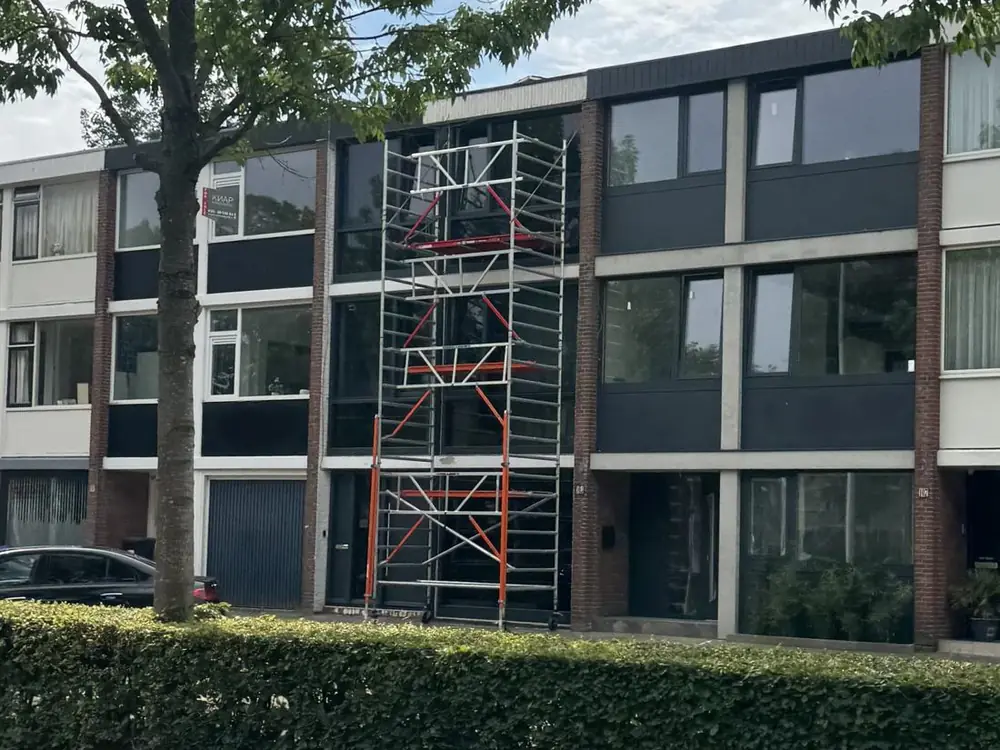
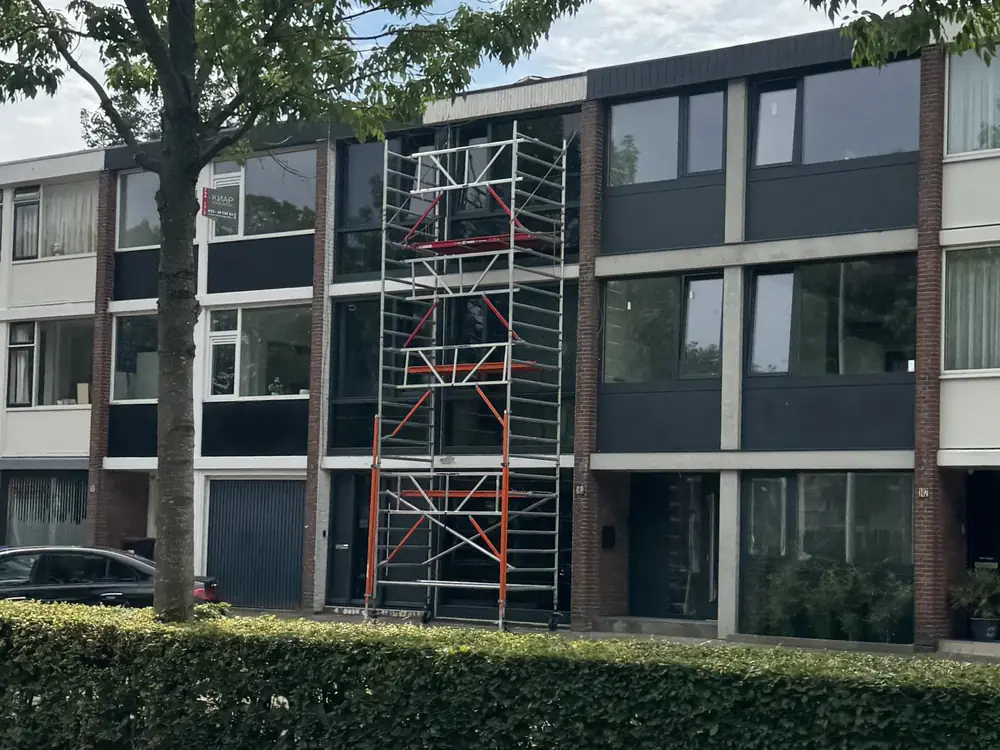
Tower standing along the front of a house, the wide model used for fitting work on a dormer window

Think about who is going up with you as well. Laying lead is a two person job more often than not: one holds the soaker in place while the other dresses it and fixes it. Two people shoulder to shoulder on a 75 cm floor is unpleasant once tools are lying there too. The exact figures per model are set out in the size comparison of the towers, so you know beforehand what will fit.
Working height for the junction between dormer and roof slope

The highest point you have to reach is not the ridge of the box but the top of the fascia board and the corners where the cheeks meet the roof slope. Over two storeys that point sits somewhere near 7 to 9 metres above ground level, and on a property with a floor more it is nearer 11. That is exactly why you pick inside a band of 8 to 12 metres for this job and tune the build to your own tape measure rather than to a rule of thumb.

Remember when you book that the working height quoted is where your hands come, not the level of the floor you stand on. Between the two sits about 2 metres of reach. If you want to drive the top screw into the fascia at 9 metres, the deck that belongs with it is around seven. Where the box sits in the roof of a second floor, that sum lands you in the upper half of the range on its own.

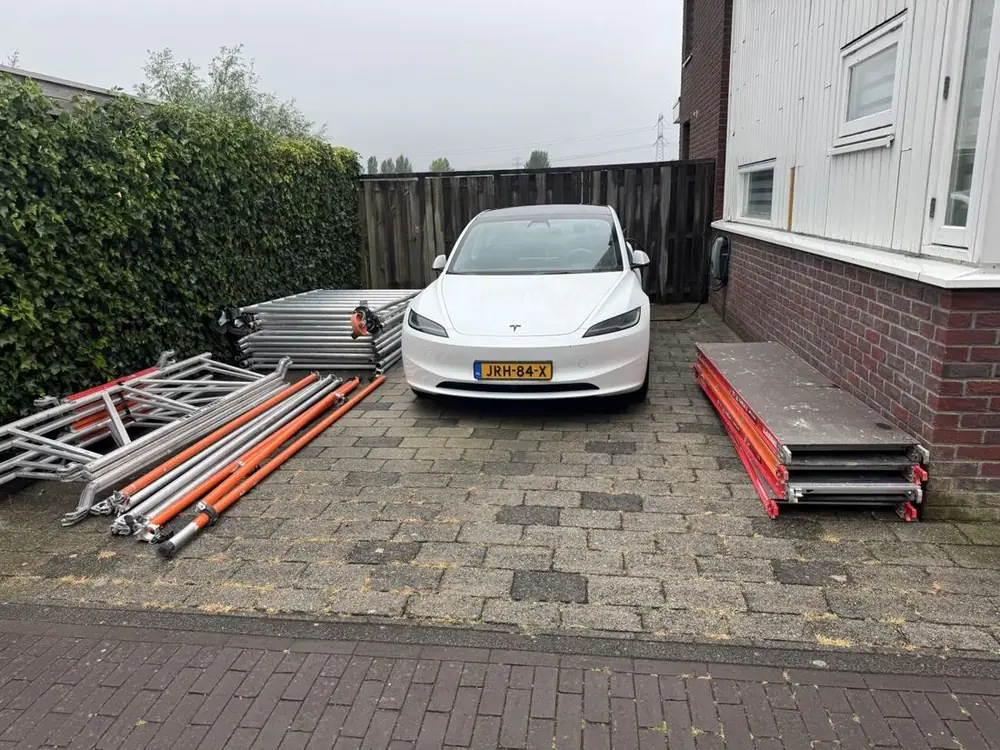
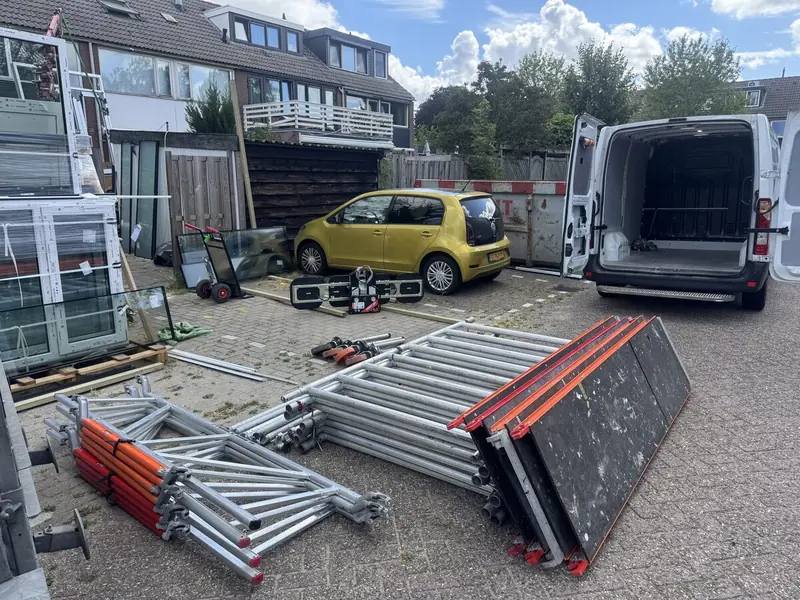
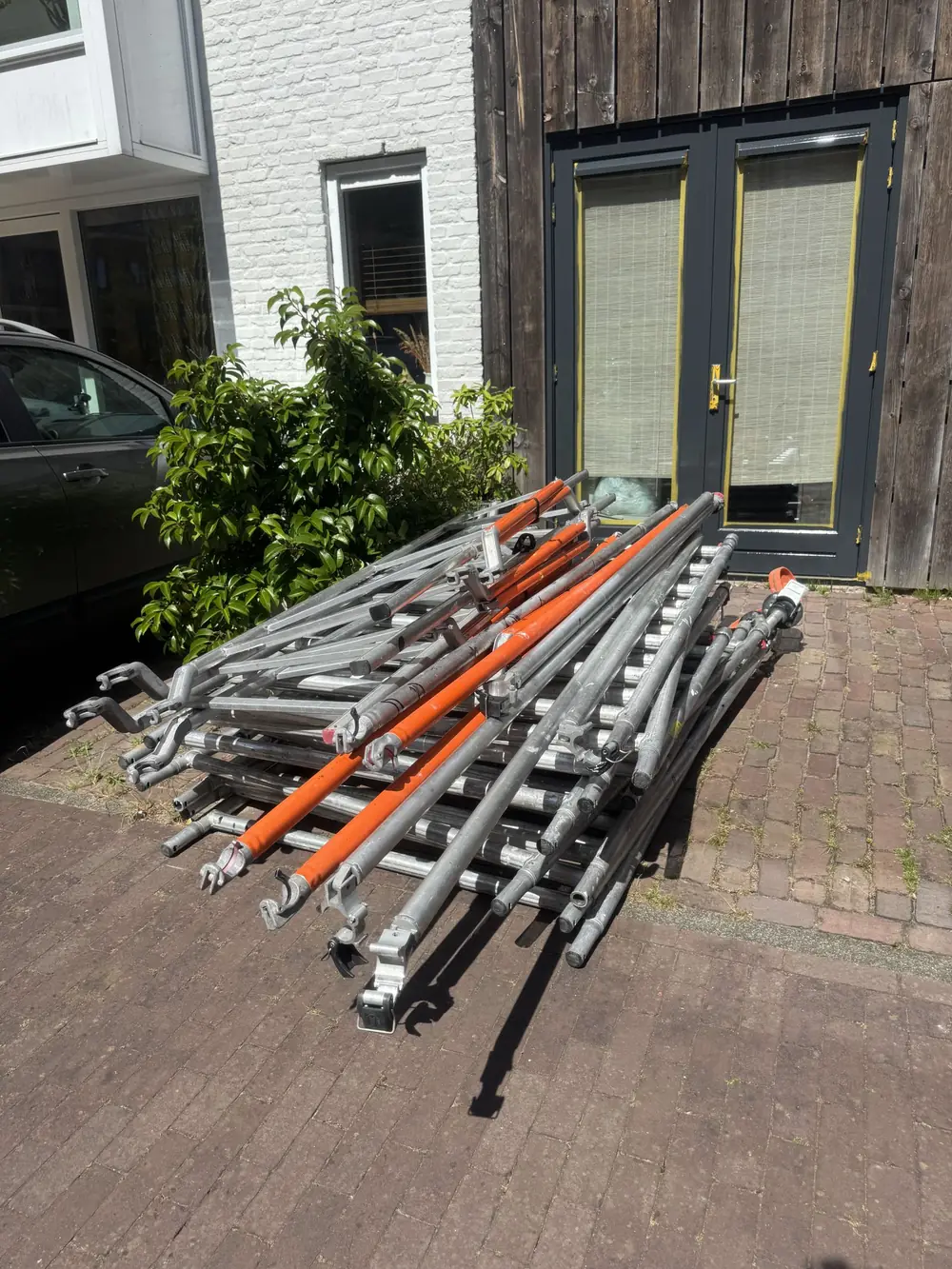
Frames and braces stacked on a drive, the delivered set from which a build of eight to twelve metres comes

Choose too low and you finish the seam with your arms stretched above your head, which is the worst thing you can do with lead and sealant: you cannot see what you are doing and your strength has gone. Stand too high and you spend the day bent over work at your feet. The deck sits best just under the bottom rail of the box, so the junction lies at hand height and you can also judge what you have made.

Renting a tower and setting it beside the dormer cheeks

A dormer has three sides that want attention, and you notice that in where the tower ends up. Most people start square in front of the box, do the face and the bottom junction there, then move left or right for a cheek. So choose your pitch such that at least two of those positions are reachable without a fuss. A garden with a terrace across the full width is ideal; a garden with a pond exactly under the right hand cheek is not.

Under the wheels you want something flat and load bearing: patio slabs, block paving or a concrete path. Fresh grass, bark chippings and loose gravel settle unevenly the moment the weight of the build comes on to them. Allow as well for the spread of the stabilisers, which you set out at all four corners and which reach a little further than you judge by eye. How you make that firm in an awkward spot is covered in the guidance on stabilising and anchoring.

Stabiliser set out beside the foot of a scaffold on paving, the pitch used for fitting work at a wall

The obstacles on this job are usually low ones. A downpipe along the wall, an outside tap, a shed on the boundary or a kitchen extension holds the tower half a metre off the brickwork, and up top you feel that half metre straight away in your reach. So walk the route and the pitch once before you rent, with a tape in your hand and your head up. Round the back of a house there is more in the way than you remember from last year.

How long to hire a scaffold for the finishing work

Bolting the box down is usually a matter of hours. The days go into what follows: dressing the lead soakers in, bringing the tiles back up to it, setting the zinc, mounting the fascia boards and trimming and sealing the joints. For an ordinary dormer on a pitched roof, reckon on two to three days with the scaffold standing. Work alone, or add a gutter or a rebuilt cheek to the list, and that soon becomes one more.

Inside that period sits time you cannot speed up. Sealant and adhesive keep their own pace, and while a joint is still wet you put nothing over it. The work is weather sensitive on top of that: you would rather not dress lead in pouring rain, and a roof slope shining with wet is not one to lean on anyway. So build a day of slack in and watch the forecast before you fix your final dates.

Erected tower left in place beside a home through the days when lead and zinc are being finished

That slack costs very little. Only the first 24 hours go at the full rate; every day you book behind it carries a discount of 95 per cent. Two extra days therefore cost you some space on the drive and almost no money, while they buy the certainty that you need not stop halfway through the zinc because the van is on its way. How that works out over a longer stretch is set out in the comparison of hiring by day or by week.

Which mobile scaffold suits fitting a dormer window?

Kamersteiger RS44
  • Working height up to 4 metres
  • Compact and narrow
  • Great for indoor and small jobs
View and calculate →
Smalle rolsteiger RS51
  • Working height up to 14.2 metres
  • Narrow (75 cm)
  • Ideal for narrow passages
View and calculate →
Most chosen
Brede rolsteiger RS52
  • Working height up to 14.2 metres
  • Wide platform (135 cm)
  • Extra stability and workspace
View and calculate →
1-persoons steiger MiTower
  • Working height up to 6.2 metres
  • Very compact
  • Quick and easy to assemble
View and calculate →

Fitting lead and zinc from a 245 cm deck

A deck measures 245 cm along its length, which puts you in front of the whole face of a standard box of two and a half metres. If the dormer is wider, you do it in two pitches: the left half with its cheek first, then the right. Mark that second spot out beforehand with a slab or a line of chalk, so you are not shuffling about after you roll. That keeps the number of moves down to what is genuinely necessary.

What you take up per trip matters more here than on most jobs, because lead is heavy and zinc is awkwardly long. Do not carry a roll of lead up the ladder in your hand; haul it up the outside on a rope and lay it flat on the floor. Three metre strips of zinc get passed up rather than wrestled vertically past the rails. Work out beforehand what fits in one round and lay it ready at the foot.

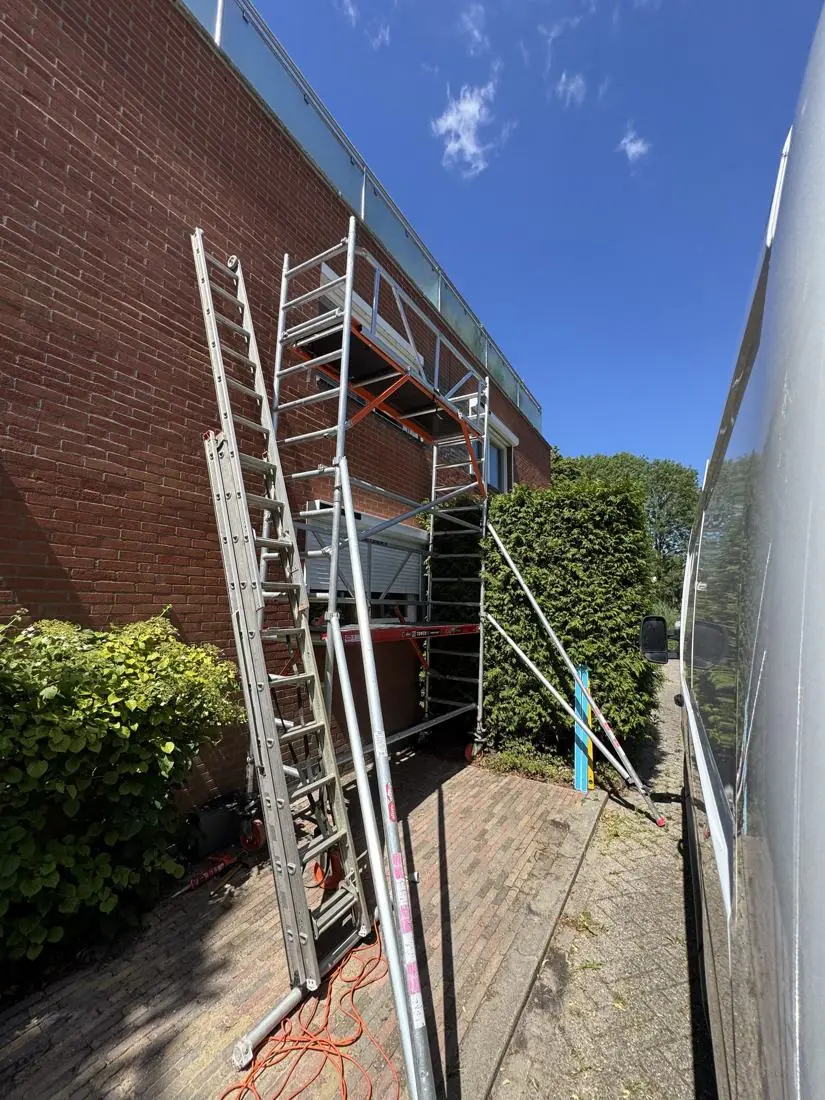
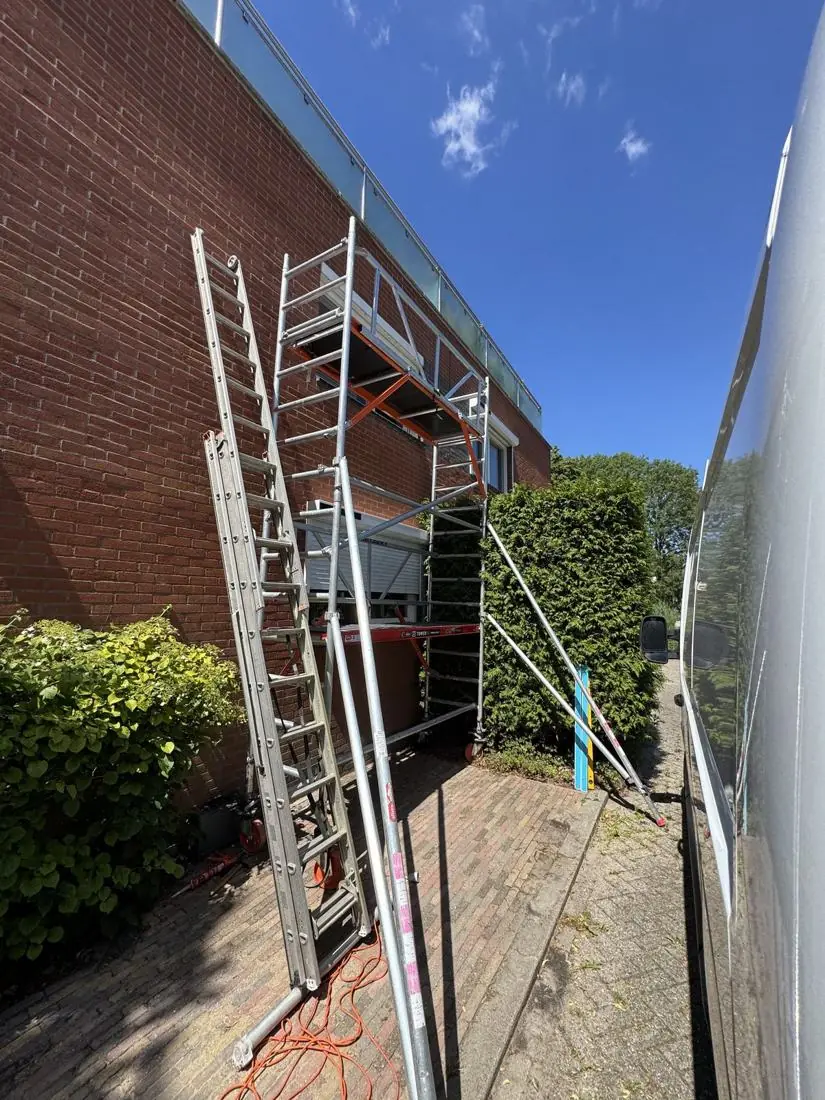
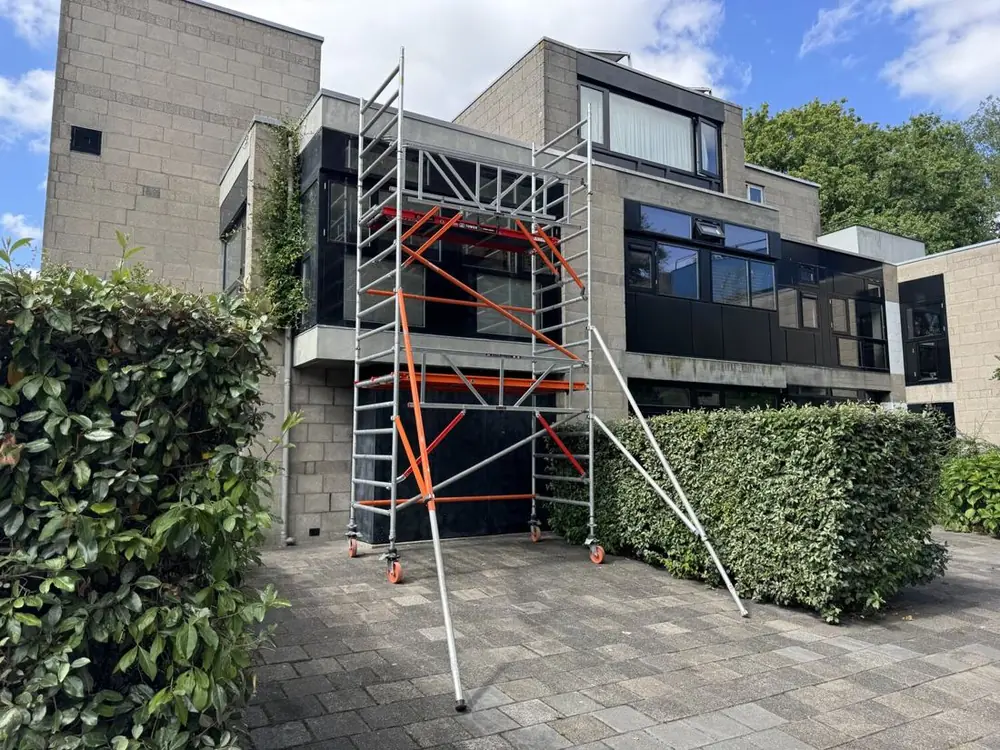
Scaffold built along the side wall of a house, the second pitch needed for the cheek of a dormer

Repositioning is done with nothing left on the floor. Anything loose goes down first or is clamped, because a roll of lead that starts rolling while you push changes the balance of the whole build. After the move, walk the brakes and the stabilisers again. A tidy floor works better anyway, since you are not tripping over offcuts of zinc. If you go straight on to painting the dormer, you can use these same positions a second time.

Scaffold hire with delivery the day before the leadwork

What turns up at your door is a complete set of parts, counted and checked: uprights, decks with a hatch, braces, guard rails, toe boards and stabilisers. Book before three in the afternoon on a working day and that set can be with you the next working day. Find a spot beforehand where the parts can lie dry and out of the walking route, because while a dormer is being fitted more people cross that path than you would think.

When the set comes and when it leaves again you fill in yourself while booking. On this job you have it delivered on the day before the box goes up or just after, so you can start on the junction the moment the crane has gone. If the installation slips a day, simply move the delivery with it: a finished tower waiting for a box that is not there yet earns you nothing and stands in the way.

Complete set of scaffold parts dropped on site, ready to build beside the house with the new dormer

When you have done, our van comes back for the gear. You make sure the build is apart and that the parts lie somewhere the driver can reach. Do that only once the lead is dressed, the sealant has cured and you have checked the joints, because putting it all back up for one small touch up is a waste of your time. The practical points around that are gathered under the common questions about hiring.

Safe working on a rented tower while fitting a dormer

Think about the weight of your material on this job. The floor you stand on takes 200 kilos to the square metre, which is what load class 3 under EN 1004 means, and with two people plus a roll of lead and a toolbox you come closer to it than on most work. Spread the weight over the deck instead of stacking everything in one corner, and leave material you no longer need today standing at the bottom.

Beyond that the ordinary agreements hold, and they weigh a little heavier here because you often hang over the rail with your upper body to reach the seam. Put the wheels on the brake before the first person goes up, never roll the build with anyone on it, and step off when the wind really picks up. A sheet of zinc or a length of fascia acts like a sail at height, and you feel that up there long before they do on the grass.

Tower with twin rails and an inside climb, as used while a dormer window is closed up and sealed

The risks that belong specifically to closing a dormer up are sharp material and falling objects. Zinc strips have edges that cut, and a hammer that bounces off the floor lands seven metres below. Work with tools on a lanyard, keep the zone underneath empty and rope the path off where the tower stands on a route that people walk along. The full set of agreements is in the overview of rules for work at height.

In 5 steps

How hiring a mobile scaffold works

1
Choose working height

Pick the height that suits your job.

2
Book online

Sorted in 60 seconds, price shown instantly.

3
We deliver

At the agreed spot the next working day.

4
Assemble safely

Assembled by you, with a manual.

5
We collect

One call and we collect the scaffold.

Good to know

Practical tips for fitting a dormer window

1

Pull a roll of lead up on a rope along the outside of the build, so both hands stay free for the ladder. Carrying it under your arm goes wrong the moment you have to correct yourself.

2

Lay a piece of felt or an old towel on the deck under your zinc. That saves scratches on the material and stops a strip sliding away at the smallest breath of wind.

3

Put a strip of tape on the guard rail level with the bottom rail of the box. After a move you can then see at a glance whether the floor sits right, without measuring again.

4

Finish the junction completely on the side the wind comes from before you switch ends. If the weather turns sooner than the forecast said, the important half of your dormer is already shut.

5

Take an extra day when you book, even if the work fits into two on paper. Sealant that will not cure or a missing zinc corner turns a tight plan over in no time.

6

Photograph the finished junction close up before you strike the tower. If you later want to check a spot, you know exactly where it is and need not go up on the off chance.

Frequently asked questions

Frequently asked questions about fitting a dormer window

Which mobile scaffold should you hire for fixing and sealing a dormer?+

Go for the wide 135 cm version. Closing a dormer up means dragging rolls of lead, strips of zinc and fascia sections about, and they have to lie beside you while you work. On a slim 75 cm floor you get in your own way, especially with two of you at it. You only rent the narrow tower when the gate or the garden path allows nothing broader. Measure that path first, because swapping once the parts are delivered costs you half a day.

How does hiring a scaffold work if the dormer is already on the roof?+

Then the order is simple: you fix your dates, the parts arrive on the agreed day, and you set the build up so you can reach the seam between box and roof slope. After that you work upwards from the bottom junction to the cheeks and the fascia. If a detail is left over, you just leave the tower standing an extra day. Hiring is the flexible part of the plan; your joiner's diary is not, so book the delivery around the day the box goes on.

How many days do you want to rent the tower for the finishing?+

Two to three days is realistic for most boxes. Bolting down takes hours, but the lead, the zinc, the tiles and the trim along the cheeks take days. Working alone, or in midwinter, adds one. Build that margin in when you rent rather than later: the following days barely register in the total, and extending afterwards always takes more arranging than booking wide in the first place. That way you need not stop midway through the leadwork.

What does hiring a mobile scaffold cost and why is day three so cheap?+

The amount follows from the model and the build height, plus bringing and fetching to your address. Every figure includes VAT and stands on the prices page. A third day adds little because of the way the rental price is put together: the first period carries the bulk and after that the meter runs very slowly. On a job with curing times and weather risk that works in your favour.

What working height do I need to reach the junction of the dormer?+

Measure from where the tower will stand up to the top of the fascia board on the box. Over two storeys you usually land around 8 or 9 metres, over three nearer 11 or 12. Count on your hands reaching a good way above the floor you stand on. There is more on that measurement on the page about the working height of a mobile scaffold. Caught between two builds, take the roomier one.

Can the scaffold be delivered before the dormer is placed?+

It can, and sometimes that helps: you build in advance and stand ready the moment the box is on the roof. Just watch that a finished tower is not in the way during the placing itself, certainly where a crane is involved. So talk the installation day through with whoever supplies the box and set your delivery date against it. That way the scaffold is ready when the closing up begins, not a day too early.

Does erecting come with the hire, or do I do that myself?+

Building is your job. The tower comes to you as loose parts and you assemble it, with the supplied manual and the instruction video as your guide. With two people it goes quickly, and it is sensible to do it a day before the fitting work itself. So we do not build; what we do is bring, fetch and make sure the set is complete and inspected. Allow half a day for a build towards ten metres.

What if the junction is not finished and I have to hire the scaffold longer?+

You sort that with a phone call or a message. As long as the tower is not immediately due with another customer, we move the collection day to a date that suits you. On a dormer that is a real scenario, because a seam that will not close or a missing piece of zinc can hold you up a day. So extending is arranged as you go, ideally a day ahead, and returning early is fine too.

How much room has to be free beside the dormer for the scaffold?+

Start from the tower itself plus the stabilisers that stick out on four sides, then add the space where your material lies. In an average back garden that comes to a clear area of roughly three by three metres per pitch. If there are planters, a trampoline or bikes about, move them before the parts are dropped off. Think about the route you carry the sections round by as well, since clearing on the day itself wastes time.

Do I have to rent the mobile scaffold longer if the rain keeps on?+

Often yes, and on this work that is no disaster. The tower stands quite happily in the wet, but you would rather lay lead and finish sealant joints dry. Use a wet day to press on indoors or to sort your material, and go out as soon as it clears. Because you choose your own collection date, you usually absorb that shift without rewriting the whole plan. A day more is cheaper than half work on a seam that has to keep water out.

How does the deposit work when you hire this tower?+

You put a deposit down at the booking and it is back with you within one working day, as soon as the returned set has been checked over. So make sure every coupling, brace and toe board goes back; on fitting work something does occasionally vanish under a stack of tiles. Walk the pitch with the list from the manual before you tell us the tower is ready. The money is usually back before you start the indoor finishing.

Can I keep hiring the same scaffold for painting the dormer?+

Yes, and that is normally the handiest order. Once the junction is closed and the timber is dry, you carry on from the same position with the primer and the topcoat. Extend your rental period for it straight away at the booking, because the box is easiest to reach exactly when the leadwork is done. Anyone who has the tower collected in between pays for delivery twice and builds twice.

Hire a mobile scaffold for fitting a dormer window today?

Calculate your rental price now or ask for free advice.

Rolsteiger van SteigerTaxi geleverd op locatie
Book it online

Your scaffold sorted in 2 minutes.

Choose your scaffold and working height, see the price instantly and book online.