
See your price
Application

Removing old paint? Choose the right scaffold.

Removing old paint is the stage that comes before everything anyone will ever admire. You burn it off, you sand it back or you lay stripper paste on, carrying on until sound timber shows again. That produces heaps of flakes and a cloud of dust, and it swallows more days than the coats that follow it. On two storeys of exterior joinery you want a narrow 75 cm mobile scaffold under your feet, ordered in a build that gives you 6 to 8 metres of working height.

  • Order before 3 pm, delivered tomorrow
  • Professional Altrex scaffolds
  • Up to 14.2 metres working height
  • Easy to assemble yourself
4,2 tot 14,2 mWorking heights available
12Provinces served
7Days a week
200 kg/m²Load class 3
In short
  • For removing old paint we recommend the Narrow mobile scaffold.
  • For removing old paint from facade and joinery up to eight metres you hire the narrow RS51, 75 cm across.
  • Under the tower a waste zone forms, full of flakes and sanding dust, so sheeting goes down before the first bay comes bare.
  • Allow three to five hire days, because laying timber bare takes longer than every coat that will later go over it.
  • First 24 hours from €150 incl. VAT and delivery; every day after that 95% off.
Key facts for this job
FeatureValue
Recommended scaffoldNarrow mobile scaffold (Altrex RS TOWER 51)
Working height for this job6 to 8 metres
Available working heights4.2 to 14.2 metres
StandardEN 1004, load class 3 (200 kg per m²)
DeliveryOrdered before 3 pm, delivered next working day
Each extra day95% off, from €7.50 a day
Why a mobile scaffold for removing old paint?

Safe, stable and professional work at height

Taking paint off is pulling, pushing and scraping, and all of it runs on your body weight. A ladder cannot give you that, because there is no solid deck to brace against and nowhere to park a tub of flakes beside you. A hired mobile scaffold supplies that deck, with room next to your boots for a heat gun on a lead, a sander on a hose and the debris coming off the wall. Then there is the duration. Bare timber appears more slowly per square metre than fresh paint covers it, so you hire a mobile scaffold mainly for the preparation and the brush only joins in at the tail of your hire period.

  • Scraping and sanding demand a solid deck
  • Heat gun, sander and waste tub travel up
  • Six to eight metres to the topmost frame
  • Removing old paint eats more hire days than painting
Read more about working safely →

Which mobile scaffold to hire for removing old paint

For laying two storeys of joinery bare you take the Altrex RS TOWER 51, a tower measuring 75 centimetres across the base. That figure earns its keep twice over. It slips through a garden gate or along a side path where nothing broader would follow, and it puts you near enough to the face to scrape hard without stretching. As a model the RS51 is built from 4.2 up to 14.2 metres of working height, so what this job asks of it sits in the bottom third of that range.

On a deck of 245 centimetres you set down more kit here than a painter ever does. A hot air gun with an extension lead, a sander with a hose running to the vacuum below, scrapers in three widths, filling knives and a tub for the lumps to land in. All of that fits on a narrow deck as long as it stays along the wall side and your walking strip stays open. Length helps you more than width, since you take a run of timber bare across, not in depth.
Slim mobile scaffold pitched against the wall of a house, the hire build an elevation of joinery is worked from

Where two of you scrape side by side, or a large extractor and a sack of paint waste have to go up the tower, the RS52 at 135 centimetres becomes worth a look. You pay for that extra deck in tubes to carry and in a chassis that no longer fits down every gap. For a garden with an eighty centimetre gate the decision makes itself. What stands ready in each size is set out under every mobile scaffold available to hire.
What working height to hire to reach every old layer

The top of this job almost always sits at the edge of the timber just under the roof: an upper window, the fascia board or the bargeboard. That is where the weather has had its way longest and where the thickest crust of perished paint waits for you. Measure to that edge and not up to the tiles. If the tape lands between 6 and 8 metres, your platform hangs somewhere between four and six; add roughly two metres of reach above the platform and you have the working height you book.

Rest the end of the tape on the slabs the wheels will sit on, never on the threshold of your front door. Where the path down the side lies lower than the terrace at the back, the whole build drops with it and that elevation wants an extra section. Factor in as well that this work drives force downward as often as upward, and that the head of a frame has to come within reach without you rising onto your toes for the last inch.

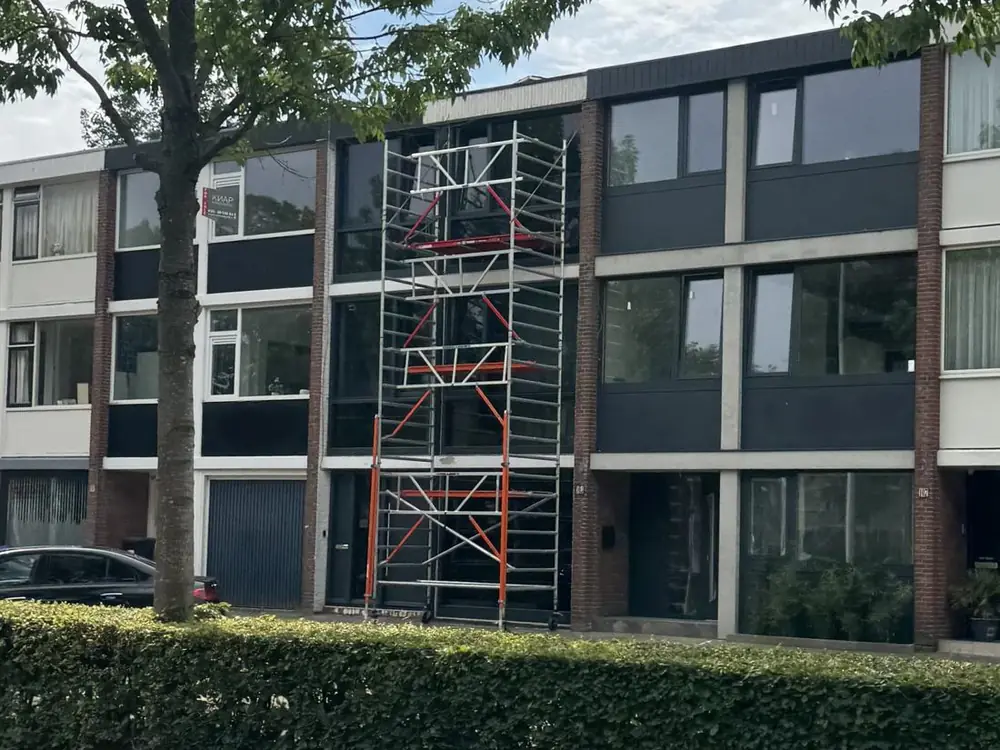
Tower standing at full height against a front elevation, built up to the fascia line at the top of the wall

Building too low punishes you longer here than it would on paintwork. Leave a ribbon of old paint up there because you could not quite get at it and the fresh coat finds nothing to grip, so the first flake reappears along that exact line. Standing low also puts you under the gun rather than beside it, with hot scrapings dropping your way. Which build suits a reach of eight metres is listed per model.

Where the hired mobile scaffold stands while the flakes fall

The strip of ground beneath your tower turns into a waste zone on this job. Everything that leaves the face lands there: flakes, sanding dust, crumbs of filler and, if you go the chemical route, paste sliding down the wall. Roll sheeting or heavy polythene over it, but keep the wheels and all four stabilisers on the hard surface underneath. A stabiliser foot resting on slippery film has stopped doing its job, and you find that out only once you are up there levering at something.

Then walk the pitch itself. Block paving, a drive or a well trodden shell path holds wheels where they belong; loose soil in a border or turf that softens after a shower will not. Expect the usual company along a house wall: the water butt under the downpipe, an outside tap, the bike rack, tubs of plants that needed covering anyway. Shift that lot before the van pulls up, because once the tower is standing nothing comes out from under it.

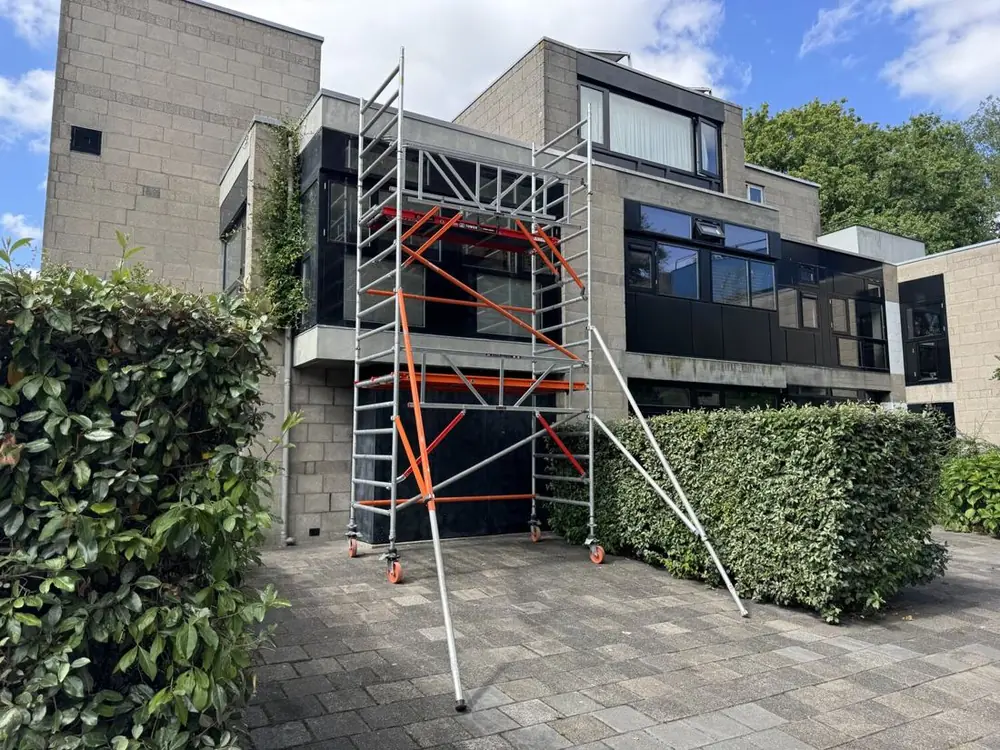
Stabilisers at the foot of a hired mobile scaffold, the base you keep on hard paving while removing old paint

Finally, work out which way the dust will drift. Sanding grit and paint flakes travel well past the edge of your sheeting, so warn the neighbours before you light the gun and make sure no car is parked alongside. Where the footprint runs over the pavement, leave a walking route clear and ask your council what it expects. One phone call settles it. For a path that falls away, the piece on uneven ground gives the method.

How many hire days removing old paint really takes

Laying timber bare is the slowest stage of any repaint. Burning off advances per running metre of frame and not per panel of wall: warm it, scrape it, go back over the places that would not let go. A machine sander does cover ground, yet mouldings, rebates and corners still ask for a cork block and a hand afterwards. On the joinery of an ordinary two-storey terrace that adds up to three to five days, with no primer laid and no brush washed out.

Inside such a period sit waits you cannot squeeze. Stripper paste has to bite down through the coats before a knife goes anywhere near it, and any face you wetted must be dry again before abrasive touches it. Weather bears down harder on this than on painting: soaked timber will not sand and a gun behaves unpredictably in gusts. So book through to the day the substrate is genuinely ready for paint, rather than to the day you hope to be done.

Mobile scaffold erected along the side wall of a house, standing put through a long stripping job

Booking generously costs you very little, because the rental price loads onto the front of the period. Only that opening twenty-four hours carries the full amount; each hire day behind it drops by ninety-five per cent, which means two days of slack barely register in your budget. Standing at a half stripped frame watching the van arrive for the tower works out far worse. A longer job is easier to estimate alongside this explanation of hire periods.

Which mobile scaffold suits removing old paint?

Kamersteiger RS44
  • Working height up to 4 metres
  • Compact and narrow
  • Great for indoor and small jobs
View and calculate →
Most chosen
Smalle rolsteiger RS51
  • Working height up to 14.2 metres
  • Narrow (75 cm)
  • Ideal for narrow passages
View and calculate →
Brede rolsteiger RS52
  • Working height up to 14.2 metres
  • Wide platform (135 cm)
  • Extra stability and workspace
View and calculate →
1-persoons steiger MiTower
  • Working height up to 6.2 metres
  • Very compact
  • Quick and easy to assemble
View and calculate →

Removing old paint from a 245 cm platform

Each set-up gives you 245 centimetres of deck, which on this work amounts to roughly one window bay with a piece of wall beside it. Finish that bay outright before you move: heat or paste first, then the scraper, then abrasive, then sweep it dust free. Save the last of those steps for later and you will be putting the very same position up a second time. You reposition less often than a painter does, simply because each bay holds you in one place far longer.

What has to travel up the ladder mounts up quickly. A gun or blowtorch, an extension lead, scrapers in three widths, sheet abrasive or a machine, gloves, a dust mask and something to catch the debris. Drape the lead in a generous loop over the guardrail so no tension pulls on it and no wheel runs across it. Clear the deck to bare boards before you roll the tower, because a scraper dropped from five metres buries itself in the lawn.

Mobile scaffold positioned along a house facade, covering the 245 cm bay you strip out completely per set-up

The thing people misjudge is the sheer volume of waste. A wall of perished coats yields buckets of flakes, and those do not belong in the household bin. Have a lidded container ready below and never leave full sacks waiting up top until you happen to climb down. Take on repairing rotten timber in the same pass and each bay gains a round of filling and curing, which stretches your hire by a good two days.

Scaffold hire with delivery for a dusty stripping job

Your tower turns up as a stack of loose parts, counted and complete, and never as a finished structure. Settle in advance which patch of ground that stack goes on, and keep clear the ground that will vanish under sheeting within a day. A drive, a run of pavement or the grass out front beats the path beside the wall, since that is where you will be walking with a tub and a scraper. A reservation logged before 15:00 on a working day puts the bundle at your door the next working day.

Which day the parts arrive and which day they leave is entirely your call. When you are removing old paint, have them brought the day before you start, so there is time to build and to unroll the sheeting straight away. Putting the tower together falls to you: the manual sits on top of the bundle and the assembly film plays on your phone. Live nearby with a van and you may take the stack away at no charge, by appointment, from Zeeburgerpad 89 in Amsterdam.

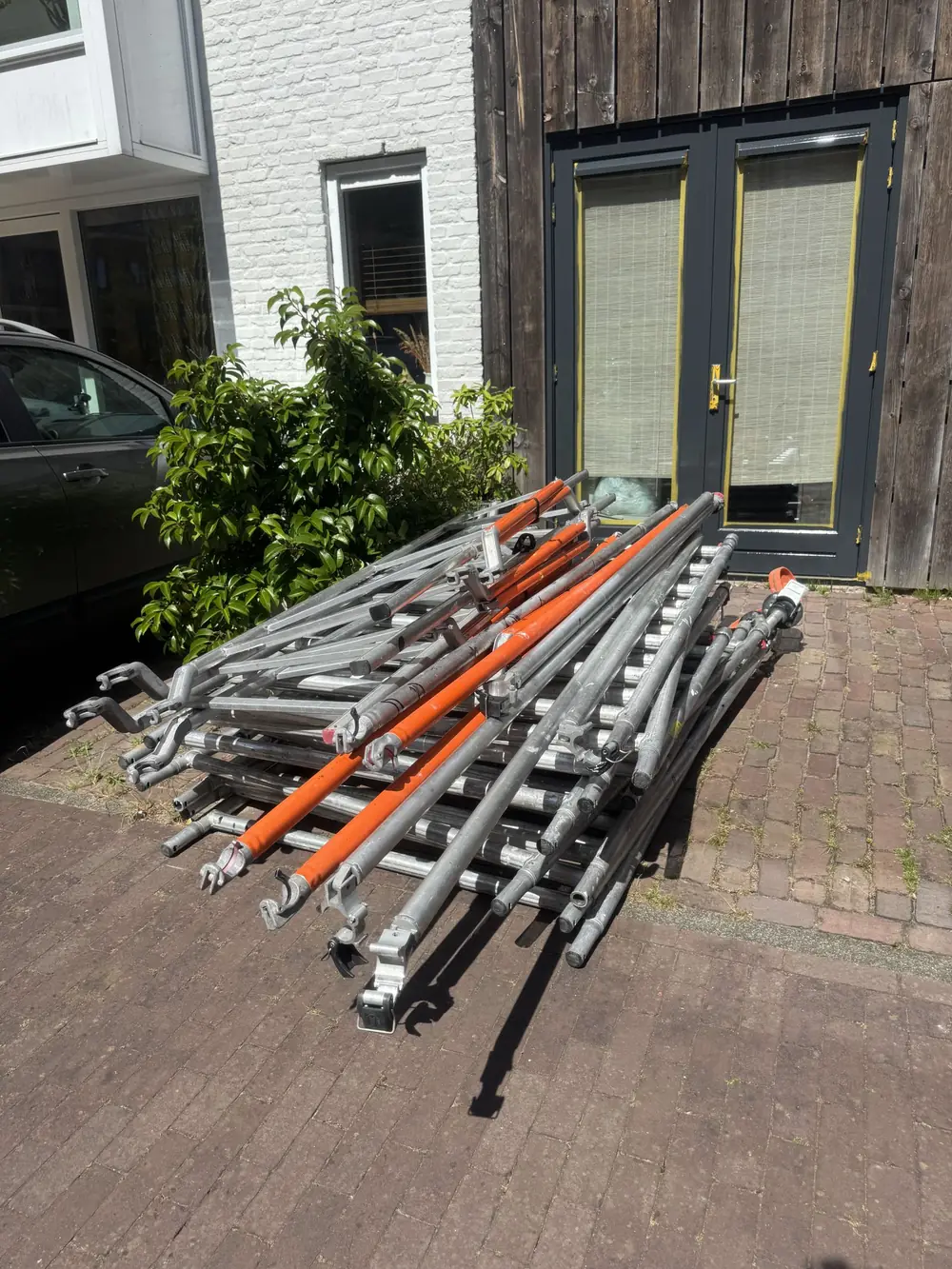
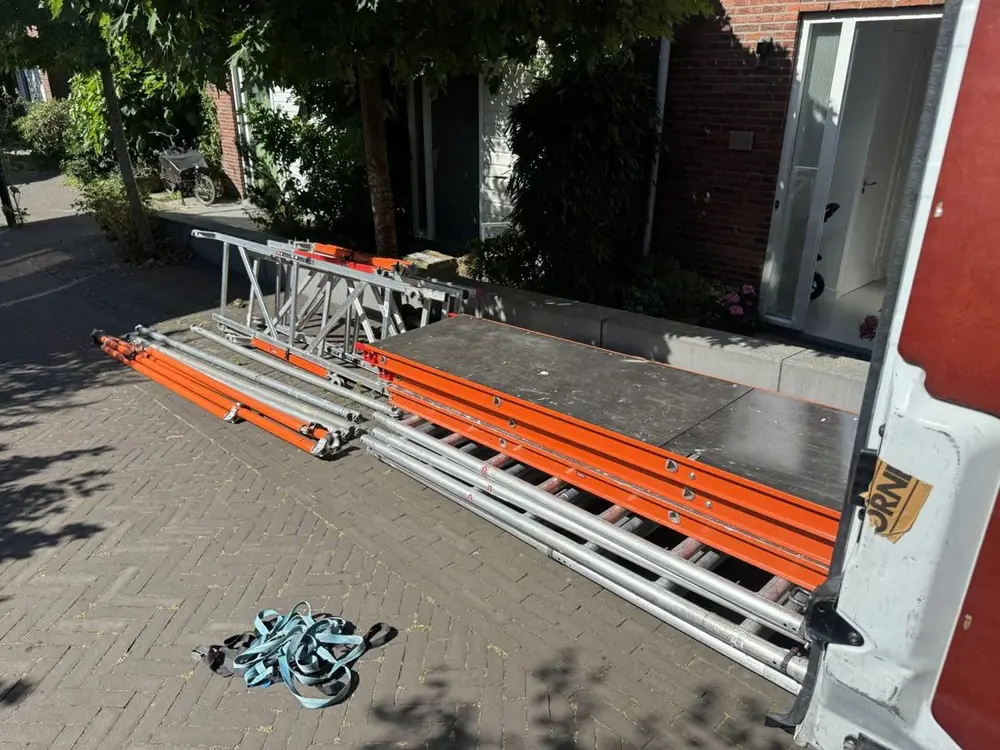
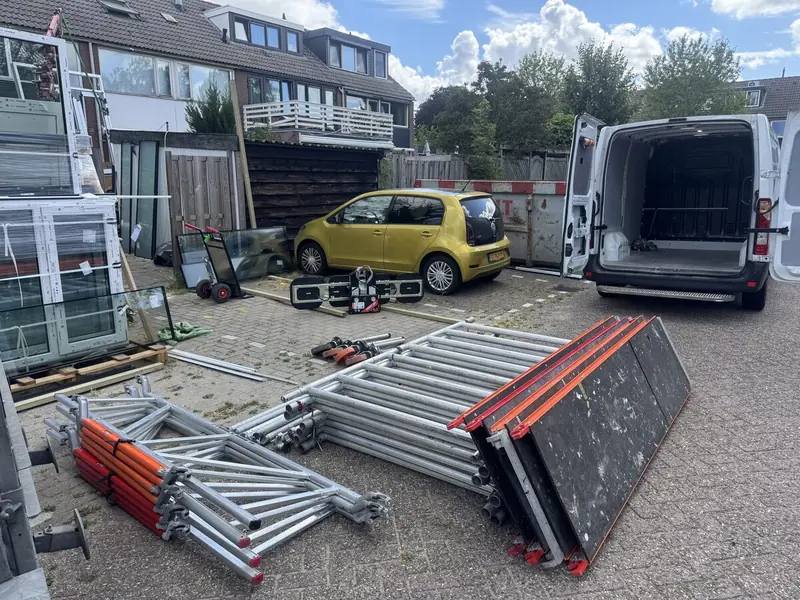
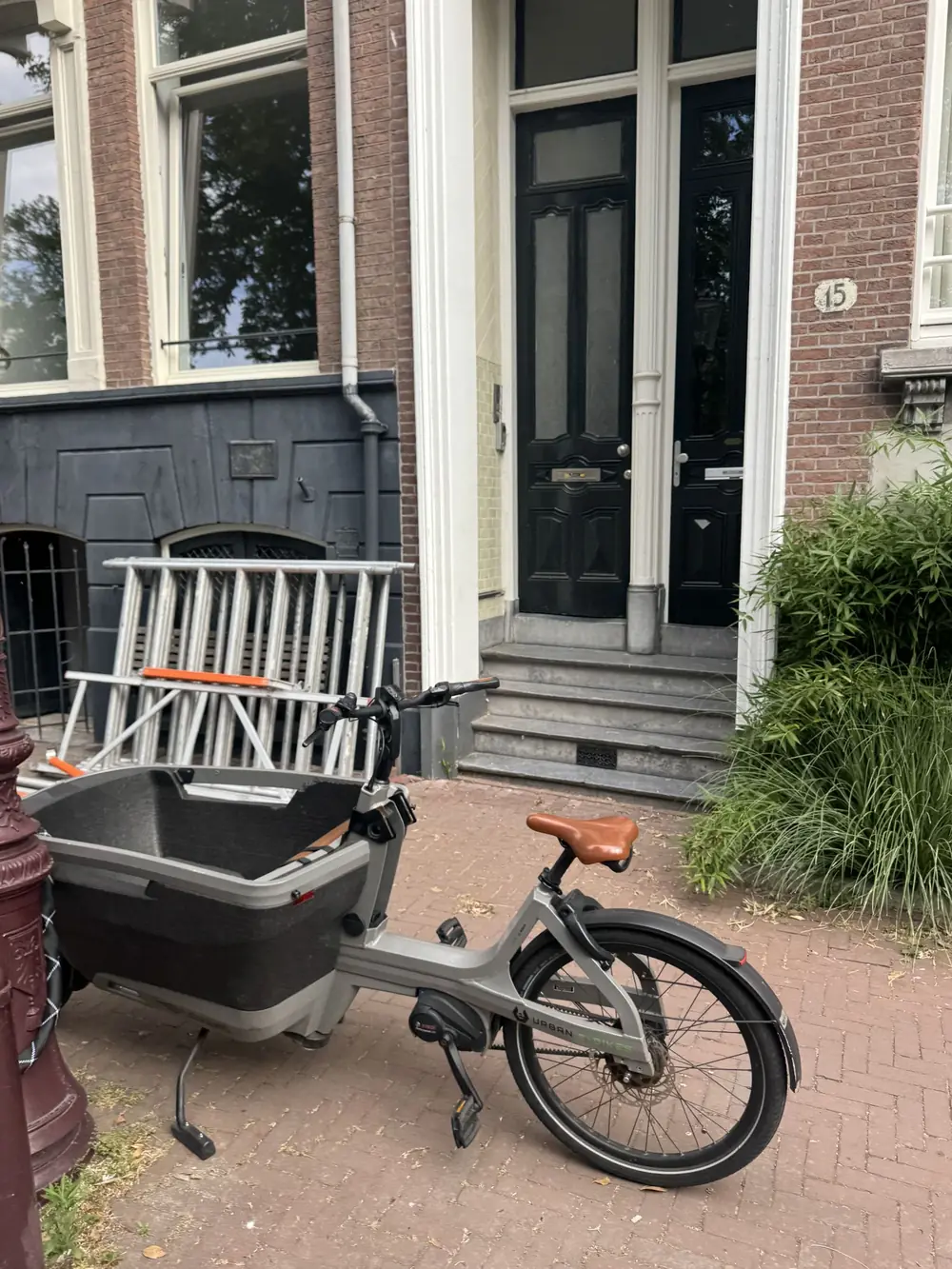
Scaffold parts laid out on the street ready for assembly, the stack you keep off your dust sheeting

Once the final flake is off, you break the tower down and we drive round to pick the parts up. Hold off on that dismantling until the sheeting and all it holds has been rolled away, or you will shake a load of grit over the tubes. Check the forecast against your delivery date, because a dry run of days counts for more here than it does on paintwork. What the round trip costs in your province is set out at the fixed delivery rates.

Working safely on a hired tower while removing old paint

The deck under your boots is proved to 200 kilos per square metre, which EN 1004 files as load class 3. Removing old paint brings you nearer that figure than you would guess: two workers, a machine, an extension lead and a tub of wet paint residue together outweigh the tin and brush a decorator carries. Spread all of it across the full surface rather than gathering man and material into one corner beside a guardrail. That is the point at which boards begin to feel springy underfoot.

A handful of standing agreements run alongside. Brakes go on before a foot touches the ladder, nothing and nobody stays on the deck while the tower is rolled, and strong wind puts a stop to the day. Wind is doubly unhelpful on this job, since it carries the dust across the whole garden and you would rather not have gusts playing round a lit nozzle. Reset all four stabilisers after each move and wind them firmly down again.

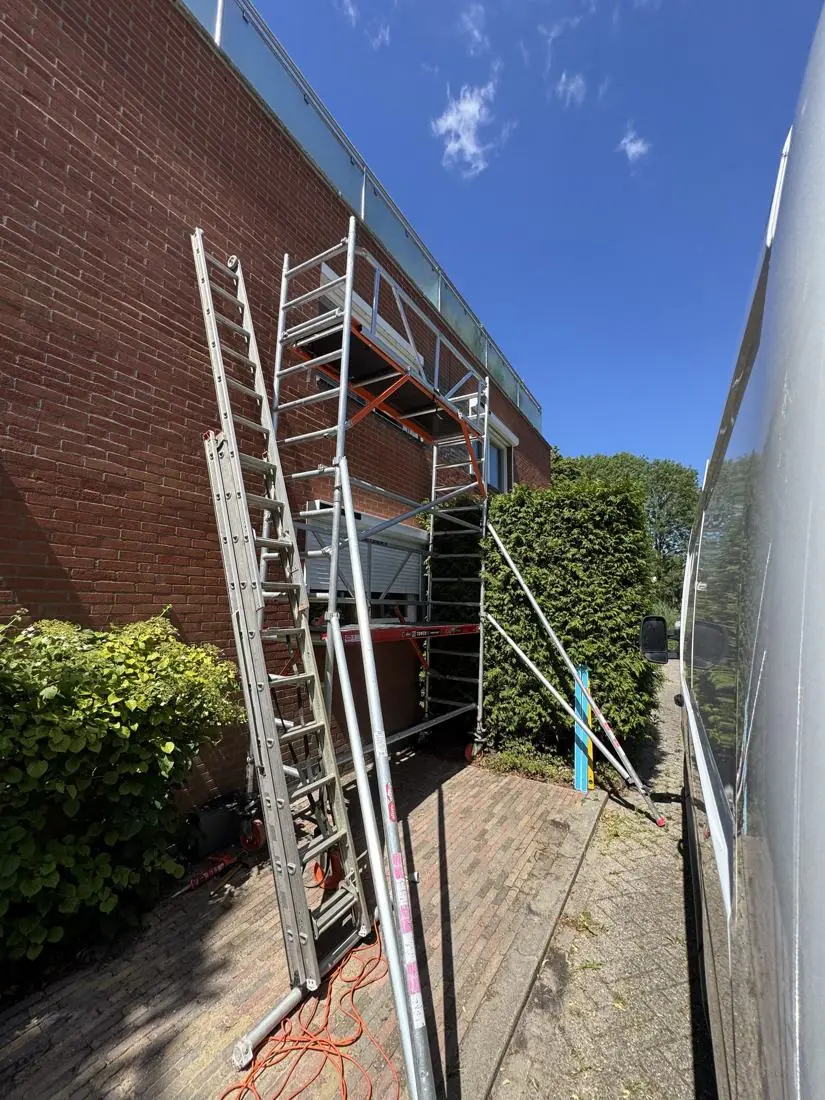
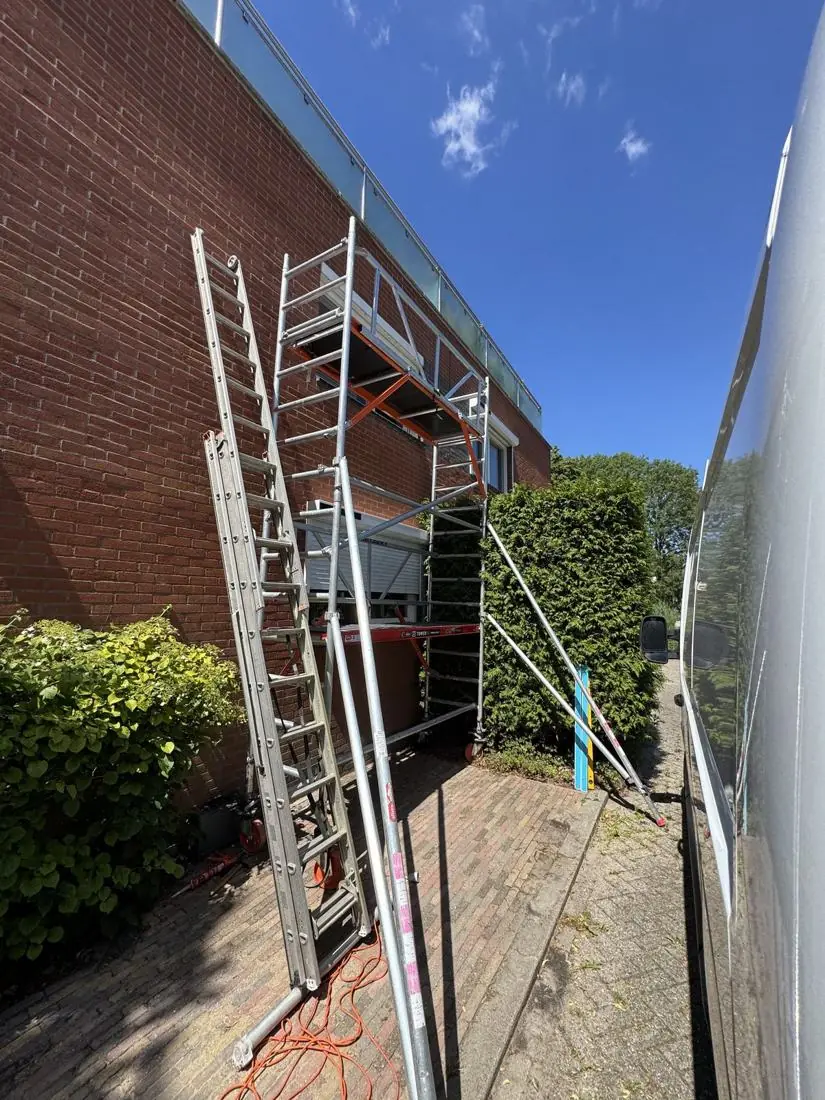
Erected tower against a brick side wall in a passage, a ladder leaning separately on the bricks a step away.

The hazards that genuinely belong to old paint are heat and dust. Never set a still glowing gun down on the boards, and after burning off go back along every joint and the reverse of a fascia board looking for something smouldering. Sanding grit turns a deck slippery, so brush it at the end of each round. Keep the zone below you empty, since onlookers gather exactly there, and read through the rules for working at height once more if it has been a while.

In 5 steps

How hiring a mobile scaffold works

1
Choose working height

Pick the height that suits your job.

2
Book online

Sorted in 60 seconds, price shown instantly.

3
We deliver

At the agreed spot the next working day.

4
Assemble safely

Assembled by you, with a manual.

5
We collect

One call and we collect the scaffold.

Good to know

Practical tips for removing old paint

1

Unroll the sheeting only once the tower stands and all four stabilisers are out. The feet then rest on the paving, and you avoid prising polythene out from under a wheel later on.

2

Carry two tubs up with you, one for the flakes and one for your scrapers. Anything loose on the deck ends up below sooner or later, and steel falls a good deal harder than paint.

3

Work every bay from the top down. What you loosen high up drops onto the part still waiting its turn, so the same strip only needs sweeping clear once instead of twice.

4

Run a line of tape across the point where you stopped laying timber bare. After a shower you can no longer tell which section is genuinely stripped and which is merely wet and shining.

5

Ask for your delivery at the start of a dry spell. Soaked timber refuses to sand, and paying out for days on which all you can do is cover things up is money going nowhere.

6

Stand a bucket of water with an old rag in it next to the gun on the deck. A remnant that starts to smoulder gets dabbed out on the spot, instead of sending you down a ladder.

Frequently asked questions

Frequently asked questions about removing old paint

Which mobile scaffold do you hire for removing old paint?+

On the joinery of two storeys this runs off the RS51, the narrow tower of 75 centimetres. It threads through a gateway and along a side path where a broad chassis jams solid, and on the deck you barely miss those centimetres because scraping keeps you tight against the work anyway. If two of you go up together, or a large extractor has to come with you, the wider RS52 at 135 centimetres makes more sense to hire for this particular job.

How does the hire run on a stripping job, from booking to the day the tower leaves?+

Online you pick a model, a build height, the day the bundle lands on your pavement and the day it disappears again; the rate is settled beforehand and includes VAT. Our van drops the bundle outside your door, you assemble the mobile scaffold and get on with removing old paint, and on the closing day you hand everything over dismantled and complete. The van then runs it back to the depot. All you still have to schedule is when the covering up begins.

How many hire days should I book for removing old paint?+

For the woodwork of an average family house you are looking at three to five hire days, and more the moment areas of walling join in. Burning off and rubbing down mouldings afterwards eat the hours, and stripper paste wants time to work before a knife goes in. Planning to prime and finish inside the same period adds at least two days on top. Renting on is wiser than sending the tower away and ordering and building it again a week later.

What is the rental price for a stripping job and what happens to it from day two?+

Your figure follows from the model chosen and the build height of the mobile scaffold, plus the run out to your province and back. Amounts inclusive of VAT are set out on the current tariff page. On this sort of work the shape of the rate is the pleasant part: day one carries almost all the weight and each day you add behind it counts for a small fraction. Booking one long stretch therefore lands better than two separate reservations.

What working height should I hire to reach the topmost coats of old paint?+

On two storeys the tape stops between 6 and 8 metres, which leaves your platform sitting at four to six. The tape runs from the paving under the wheels up to the highest edge that has to come bare, usually the top frame or the fascia. Where a hefty overhang projects above that, allow for it when you settle on the build you hire. Which build positions each tower offers appears in the working height overview.

Can the mobile scaffold I hire be delivered on the day my sander arrives?+

That is yours to arrange, since you pin the date the hired tower pulls up. It pays to have the scaffold come a day ahead of your machine or your promised help, so everything is standing when the real work starts. Prefer to fetch it, and you collect the parts by appointment provided your van takes the length. On a dusty job most choose delivery, if only to keep their load space clean. Either way the tower must be standing before the machine is any use.

Do I have to put up the scaffold I hire myself?+

Yes, assembly sits on your side of the arrangement. We drive the complete set out and take it away again afterwards, while building, rolling and dismantling belong to you. Between two of you allow half a day and follow the supplied film for the correct order of parts. Plan those hours in, because on assembly day you rarely get round to any scraping. Neither facade scaffolding nor cherry pickers feature in what we hire out, so a mobile tower is the sensible tool for stripping.

What if stripping overruns and the mobile scaffold has to stay on hire?+

Let us know the moment you can feel it coming, and the collection date gets pushed back for you, unless somebody else is waiting on that particular tower straight afterwards. Removing old paint catches nearly everyone out, because only halfway along do you discover how many coats are on there and how stubbornly they cling. Anyone wanting to stay ahead of that books an extra day at the outset. Returning ahead of schedule is allowed as well, so erring on the long side seldom backfires.

How much clear space does the hired scaffold ask for around its feet?+

Take the width of the chassis, add the spread of the stabilisers all round, then count in the band of sheeting where you catch the flakes. Together the tower wants a flat, unobstructed strip several metres wide along your wall. The patch where the parts get stacked on the delivery run belongs in that sum as well. If a shed or a bike rack sits precisely in the way, move it before the day the set arrives.

Can I keep the tower on hire when the weather makes sanding impossible?+

The scaffold is perfectly happy standing there while you wait for dry conditions. Sanding wet timber achieves very little and a gun is no friend in gusting wind. Spend such a day degreasing indoors, taping polythene up or filling ahead of time, then pick the outside work back up next morning. Since the closing date of your own hire is yours to set, a delay like that normally shows up as one further day and nothing more.

What does all that dust mean for the deposit when you hire a scaffold?+

You lodge a deposit at the booking. Once the return is in and every part counted, that sum comes back to you inside one working day. Two things matter: nothing goes missing, and no dried paint or tacky stripper paste stays behind on the tubes and the deck. A quick wipe round each evening saves you an hour of scrubbing on the final morning. A missing brace weighs as heavily at the close of your hire as a scaffold deck covered in hardened spatter.

Can you hire a scaffold if there is lead in the old paint?+

You can, though it changes how you work. The lower coats in older houses sometimes contain lead, and then you want no dry dust drifting across the garden. Work wet or with proper extraction, catch the residue in a sealed container and keep the sheeting under the mobile scaffold whole across its full width. For the hire itself nothing alters, since the tower stands exactly the same, but clearing up costs extra time, so set your period a day wider from the start.

Hire a mobile scaffold for removing old paint today?

Calculate your rental price now or ask for free advice.

Rolsteiger van SteigerTaxi geleverd op locatie
Book it online

Your scaffold sorted in 2 minutes.

Choose your scaffold and working height, see the price instantly and book online.