
See your price
Application

Repairing wood rot? Choose the right scaffold.

Repairing wood rot is spot work. You do not walk a face; you jump from place to place, a window sill here, the corner of a fascia board there, the bottom rail of a frame round the back. Every one of those points asks for its own set-up, and together they decide how long the tower stands with you. For repairs on the first and second floors you hire an RS51: a narrow scaffold 75 cm wide, built to 6 or 8 metres. Below is how such a job turns into hire days.

  • Order before 3 pm, delivered tomorrow
  • Professional Altrex scaffolds
  • Up to 14.2 metres working height
  • Easy to assemble yourself
4,2 tot 14,2 mWorking heights available
12Provinces served
7Days a week
200 kg/m²Load class 3
In short
  • For repairing wood rot we recommend the Narrow mobile scaffold.
  • For wood rot across two storeys you take the narrow RS51 of 75 cm, in a build reaching 6 or 8 metres.
  • The number of decayed points sets your hire period, not the length of the wall those points happen to sit in.
  • You stand still a long time at each point, since routing, filling, curing and sanding all happen from one set-up.
  • First 24 hours from €150 incl. VAT and delivery; every day after that 95% off.
Key facts for this job
FeatureValue
Recommended scaffoldNarrow mobile scaffold (Altrex RS TOWER 51)
Working height for this job6 to 8 metres
Available working heights4.2 to 14.2 metres
StandardEN 1004, load class 3 (200 kg per m²)
DeliveryOrdered before 3 pm, delivered next working day
Each extra day95% off, from €7.50 a day
Why a mobile scaffold for repairing wood rot?

Safe, stable and professional work at height

With wood rot you only learn the size of the job once you are standing next to it. From the ground you see a dark patch in a sill; only with a screwdriver in your hand do you find out whether it is an edge or half a rail that has to come out. That is why standing still and standing firm matters more here than covering ground quickly. You need both hands for a cutter, a chisel or an insert that has to fit exactly, and you are constantly putting a tool down. None of that works from a ladder. Hiring a scaffold to repair wood rot means counting in points and in curing time, not in square metres of wall.

  • Every decayed point wants its own set-up
  • Both hands free for cutter and chisel
  • Curing happens while the tower stays put
  • Narrow enough for the path round the back
Read more about working safely →

Which mobile scaffold to hire for repairing wood rot

Decayed timber rarely sits in a convenient row. One spot is in a window sill on the street side, the next in a fascia board above the garden doors, the third in a frame post behind the shed. Because the tower has to visit all of them, the RS51 at 75 cm is the sensible pick: narrow enough to clear a side gate, light enough to push on your own and short enough to steer round a corner. The mobile scaffolds you can hire are listed there with their dimensions.

On the 245 cm platform you lay out considerably more for this work than for painting. A multi tool or router bit, a chisel, a screwdriver to probe with, wood hardener, two part filler, a couple of filling knives, a sanding block and sometimes a small saw with a clamp for an insert. You set that out lengthways beside you instead of around your feet, and a deck of 75 cm is ample for it. Wider becomes awkward here rather than useful, since it still has to pass the gate.

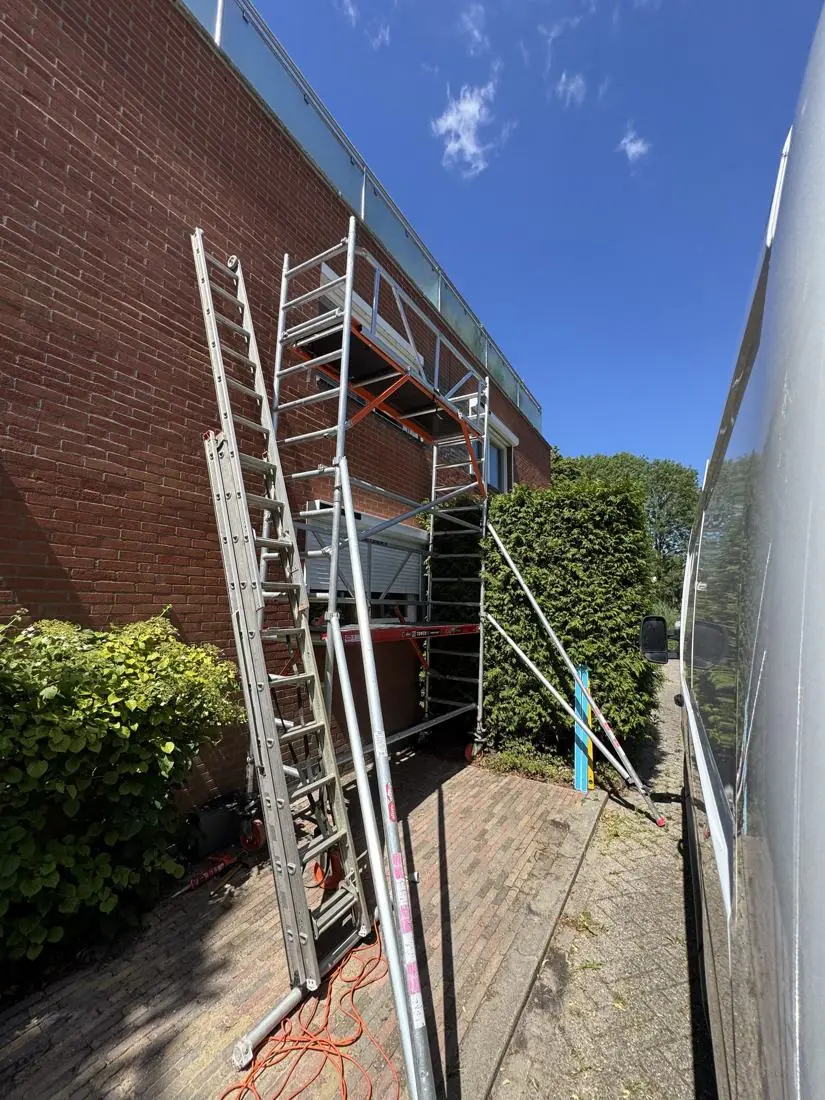
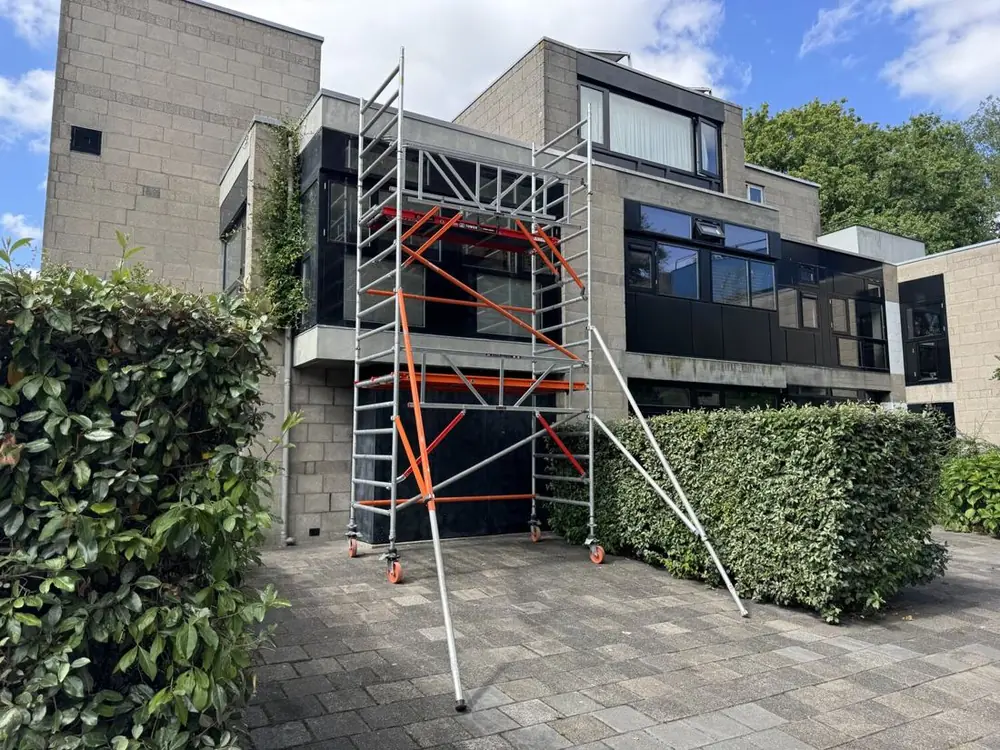
Narrow mobile scaffold standing at a house, the set-up you shift from one decayed point in the timber to the next

If you are replacing a complete section of frame, or somebody is fitting long inserts alongside you, the wider RS52 at 135 cm comes into view for the extra elbow room. Where the rot is indoors instead, say in a window board on the stairwell, the room scaffold is the logical answer: it passes an interior doorway from roughly 70 cm and gets you three to four metres up. The difference between those two routes is set out in the comparison of both types.
Working height to hire up to the highest rotten point

Find the highest damage point first, because that fixes your build and not the point you would rather start on. Usually it is a fascia board along the roof edge or a window corner in a dormer, and seldom the ground floor frame you noticed first. On a house with two storeys that brings you out at 6 to 8 metres. The sum behind it is short: to the height at which your deck comes to hang, add roughly two metres for the reach of your arms.

Start your tape at the wheels and not at your doorstep, because on this job you are by no means always standing on the pavement. Often the tower goes in a border, on a garden path or on a terrace lower than the front of the house. Allow a little margin as well, for a reason peculiar to rot: the decay seldom stops exactly where the discolouration does. What looks from below like a patch in a sill regularly turns out at close quarters to run on into the post above.

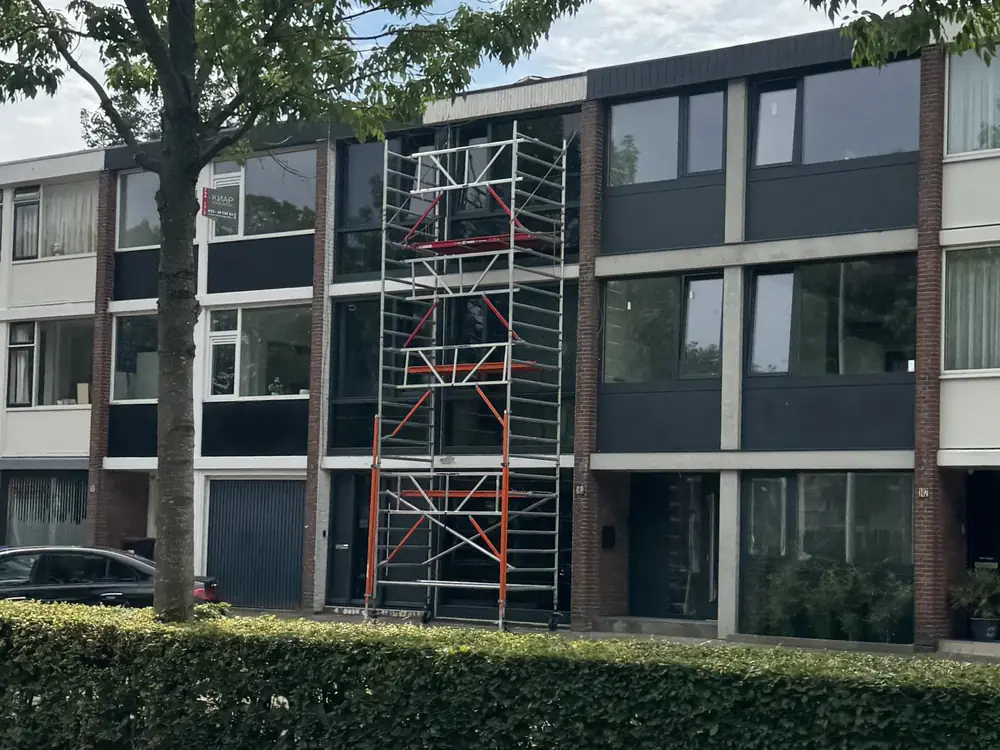
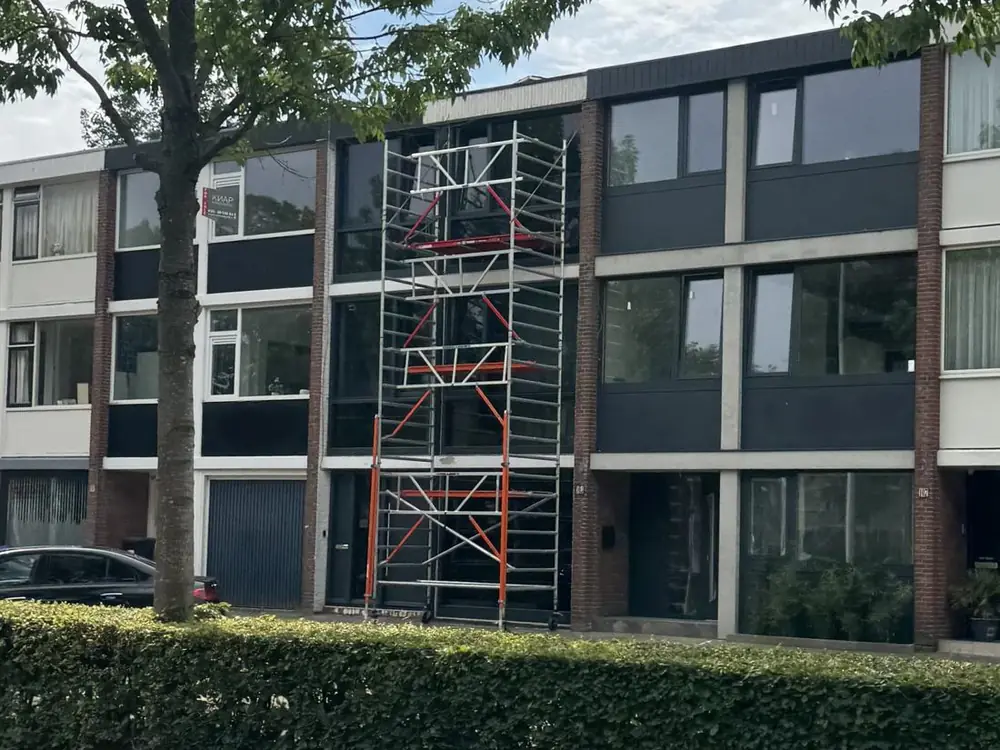
Narrow tower raised against a front wall as far as the eaves, the height decayed fascia timber makes you hire

Choose too tight and you stand with the cutter just under the edge where the timber goes soft, unable to finish the repair properly. You do not leave half routed timber open for a week with rain in prospect, so a second build or a fresh booking follows anyway, and both cost you days. One section more is by far the cheapest answer. What a build to 8 metres of working height actually reaches is set out there.

Hiring a mobile scaffold to stand at each damage point

Walk right round the house before you reserve and put every decayed point on a sketch. The tower has to be able to stand under each of them, and on repair work that is the awkward condition. A sill above an extension or a conservatory cannot be reached from ground level, nor can a fascia board above a shed roof. Meet points like that and your whole approach changes, sometimes the model too, so you want to know before the delivery slot is booked and the van is loaded.

Under every point you need flat ground plus the triangle the four stabilisers take up around it. At a repair in a back garden that often means a border or a planter moving aside, because you stay in the same place for hours rather than shuffling on. Where the ground falls away, or the grass gives after a shower, put boards or paving slabs under the wheels. How to solve that tidily is covered in the article on uneven ground.

Stabilisers folded out beneath a mobile scaffold, the fixed footprint you clear under every rotten spot in turn

Reckon as well on staying in one place far longer than you would when painting. Stand a point above the drive and the car cannot leave that day. Sit a point above the path to the back door and the whole household walks round it. Think too of the downpipe on the corner and a low hedge right under a frame: those are exactly the places where the foot of the tower will not come close enough.

How many hire days does repairing wood rot take

Count your damage points and your planning is nearly done. For four to six spots across two storeys, three to five hire days is normal. A small patch in a sill takes an hour, but a rotten bottom rail needing an insert soon costs half a day, cutting out, fitting, gluing and clamping included. So do not spread the points evenly over your days: there are always one or two that swallow more time on their own than all the rest together.

The waiting sits in the curing. Wood hardener has to soak in before you fill, filler has to go off before you can sand it, and only then can the primer follow. On a cold or damp day that takes noticeably longer than the tin suggests, and on wet timber you do not start at all, however keen you are to push on. Those hours tick by while the tower simply stays under the point, and that is what stretches a hire period beyond the working hours in it.

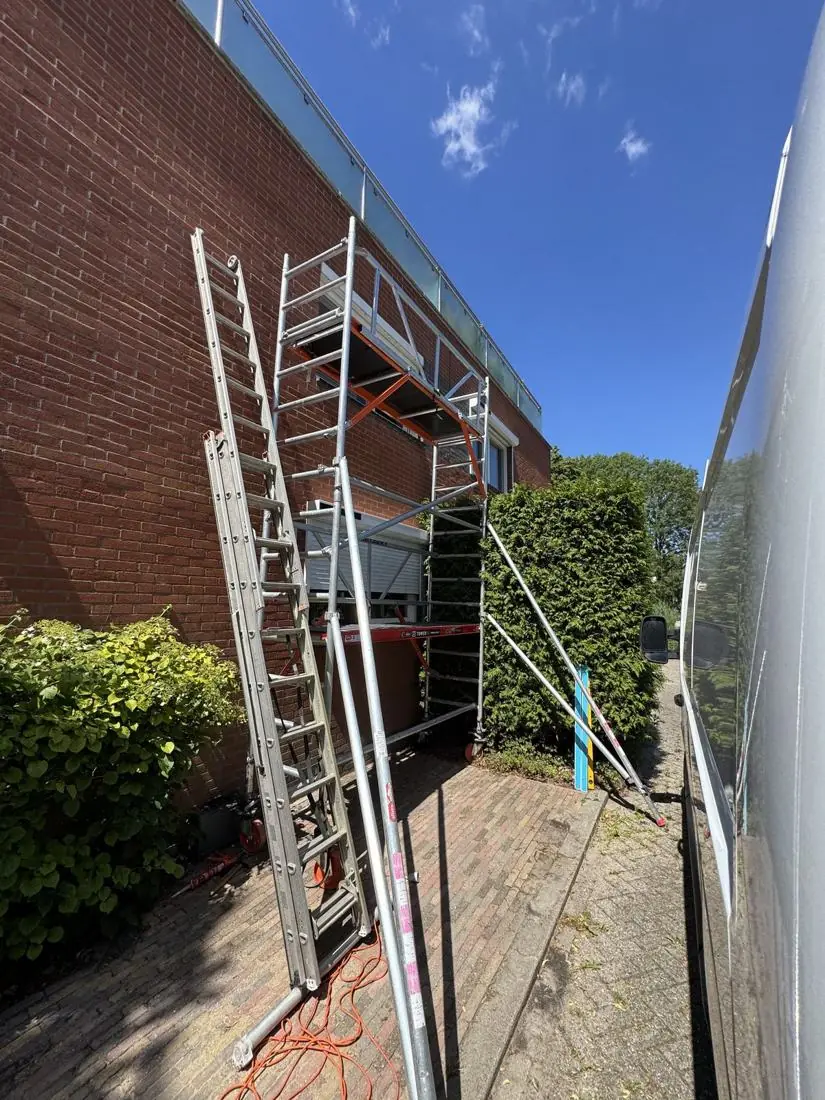
Mobile scaffold left standing at a side wall, as it does while a timber repair is curing over several days

Happily a day of overrun barely shows in what you pay, which is good news on this job. The full amount covers the first twenty four hours only; and from the second day onward 95 per cent is taken off that rate. A day of margin for a spot that opens up bigger than expected costs almost nothing, while hiring too tight leaves you with a half finished repair in the rain and a second transport. How other customers gauge such a stretch is set out in this piece on your hire period.

Which mobile scaffold suits repairing wood rot?

Kamersteiger RS44
  • Working height up to 4 metres
  • Compact and narrow
  • Great for indoor and small jobs
View and calculate →
Most chosen
Smalle rolsteiger RS51
  • Working height up to 14.2 metres
  • Narrow (75 cm)
  • Ideal for narrow passages
View and calculate →
Brede rolsteiger RS52
  • Working height up to 14.2 metres
  • Wide platform (135 cm)
  • Extra stability and workspace
View and calculate →
1-persoons steiger MiTower
  • Working height up to 6.2 metres
  • Very compact
  • Quick and easy to assemble
View and calculate →

Routing out and filling wood rot from a 245 cm platform

With a deck of 245 cm you stand wide enough at an average frame to reach the whole bottom sill plus both corners without rolling on. Where two damage points sit close together, in two windows side by side for instance, you often take them in one set-up. That tells straight away in your hire period, because every move means stabilisers in, wheels released, tower shifted, levelled again and everything locked off before you can carry on.

Take up everything you think you will need in one go. Forgetting something matters more here than in painting: once your filler is mixed you have a limited number of minutes, and that is no moment to go down for a knife or a sanding block. Lay your things out in the order you use them, with the mixed filler on a piece of card rather than sitting loose on the deck of the tower.

Erected mobile scaffold beside a house, the 245 cm deck from which a whole window frame can be put right

What people misjudge is the size of each point taken on its own. As soon as you begin cutting, soft timber almost always runs further than the discolouration outside suggested. Count on finding one or two extra points from the tower that you never saw from below, at the top of a sill perhaps, or behind a layer of paint that is lifting. Allow for that in your number of set-ups and in your hire days.

Scaffold hire with delivery the day before your repairs start

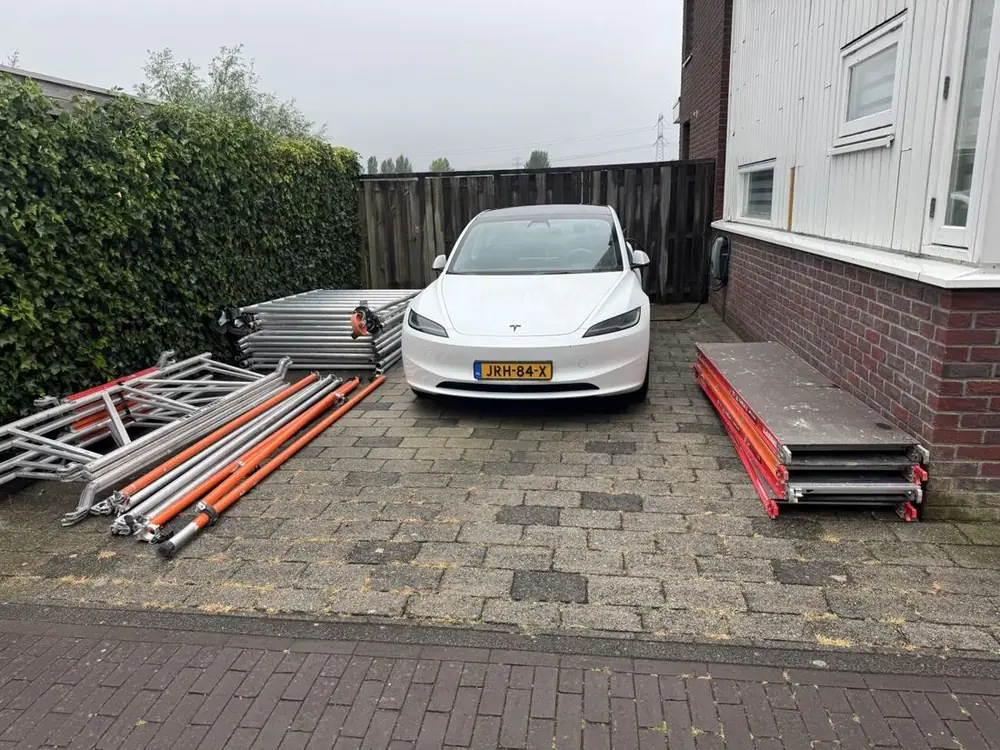
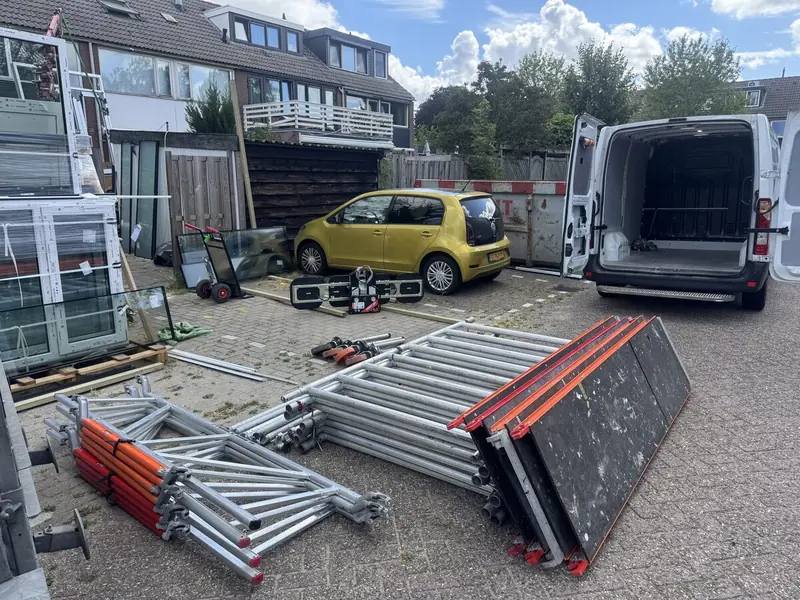
We drop the mobile scaffold with you as a complete, countable set of loose parts. Pick somewhere the stack can sit undisturbed for several days, because on this job you do not rebuild each time: you roll the same tower from point to point. A corner of the drive will do, or a strip along the fence. Orders placed on a working day and settled before 15:00 are on your street the following working day.

When the set turns up and when we take it away again you state at the time of booking. Let it come the day before you start, so you can build without haste and get straight on to probing for timber that feels soft. Putting it up is your own job, manual and instruction film propped where you can see them; an RS51 to eight metres stands within about two hours if there are two of you. A dry day helps, because filling a damp frame is pointless.

Scaffold components delivered beside a house, the set you roll from one repair point to another during the week

At the end we come back for the parts. You take the tower down and lay the components ready complete, somewhere the driver can reach them. Do that only once your last repair has cured and been sanded, or a day later you will be back at that same frame with a bucket on a ladder. What the transport costs depends on the province you live in; those amounts are listed with VAT at the charges for delivery, so you can budget for them beforehand.

Working safely on a hired tower when you repair wood rot

Two hundred kilos per square metre may rest on the deck of your tower, which is the load class 3 figure laid down in EN 1004. On repair work the weight usually sits not in the things themselves but in how they are spread: tools, tins and a set of clamps all like to end up on the same square metre beside your feet. Spread them along the length of the platform and put the heavier items towards the hatch rather than piled at one end.

The basic rules apply here in full, and none of them bends for a small job. Lock the wheels the moment anybody goes up, never shift the tower with tools or a person aboard, and stop working when it starts to blow properly. That last happens more often than you would think, because many people only start in autumn, when the damage has become visible after a wet spell. Fold all four stabilisers out again after every move and check them.

Mobile scaffold with rails and an inside ladder, the way up when you carry a cutter and filler aloft

What really counts with rot is everything that comes down. Routed out lumps, old paint flakes, nails and sometimes a whole length of sill drop straight under your working spot. Keep that zone clear, certainly where children play or a path runs beneath. Wear safety glasses against dust and splinters too, because a spinning cutter at eye level behaves quite differently from a sanding block in your hand. The rest of the rules are in this overview of requirements for work at height.

In 5 steps

How hiring a mobile scaffold works

1
Choose working height

Pick the height that suits your job.

2
Book online

Sorted in 60 seconds, price shown instantly.

3
We deliver

At the agreed spot the next working day.

4
Assemble safely

Assembled by you, with a manual.

5
We collect

One call and we collect the scaffold.

Good to know

Practical tips for repairing wood rot

1

Probe with a screwdriver along every frame corner and sill before you order the tower. Only once you know how many points there really are can you pick a hire period that does not run out mid job.

2

Mix filler in small batches on the platform rather than in a big tub down below. What you mix up there gets used within its time, and you avoid carrying a curing tub up a ladder.

3

Take a second filling knife up and store it separately. One always drops at the exact moment you are standing there with mixed filler on the first and cannot climb down.

4

Set the tower so the sun does not fall straight on your repair. Filler that goes off too fast in full sun models badly and pulls fine cracks while it is curing.

5

Photograph every routed out hole before you close it. If that spot comes back in later years you will know exactly how deep the decay went and how much sound timber you took away.

6

Leave the points on the north side of the house until last. The timber stays damp longest there, and one extra day in your hire period cuts the chance of sanding into wet wood.

Frequently asked questions

Frequently asked questions about repairing wood rot

Which mobile scaffold should I hire for repairing wood rot?+

For damage points on the first and second floors, hire a mobile scaffold in the narrow RS51 version with its 75 cm deck. You move that mobile scaffold from point to point around the house, so you want a tower that clears a gate and that you can roll on your own. On the deck you lay your tools out lengthways, and that width is plenty for it. Only where somebody works with you, or long inserts go in, do you take the wider RS52.

How does the hire of a mobile scaffold work with several rotten spots?+

You reserve online a model with the build that suits your highest damage point, say when we may come and when we collect the tower again, and pay a fixed amount with the VAT in it. We bring the complete set, you assemble it and roll it from point to point during your hire period. On the final day you put everything out dismantled and we take it back. Little else needs arranging beyond where the tower can stand under each spot.

For five damage points, how many days should I rent the scaffold?+

With four to six spots across two storeys you usually land on three to five hire days. Reckon per point not only on the cutting and filling, but on waiting for the hardener to soak in and the filler to go off completely. Where an insert is involved, half a day disappears into it easily. Anyone who counts the points beforehand and picks out the two worst ones books a mobile scaffold for exactly the right stretch.

What does it cost to hire for a job like this, and what changes after day one?+

What you pay follows the model chosen and the build height, with transport to your province on top. All amounts are shown with VAT included at the tariffs per mobile scaffold. For repair work the shape of the rental price is kind: the opening twenty four hours weigh in fully, and after that each day is charged at a fraction. Curing time and setbacks are absorbed without your bill climbing noticeably.

What working height do I hire when the rot is in the fascia boards?+

Fascia boards sit along the roof edge, so you measure to the top of the affected part and not to the gutter hanging below it. Across two storeys that puts your reach in the band of 6 to 8 metres. Take a section extra on the tower if the decay carries on towards the bargeboard or the eaves overhang, because that timber sits a good deal higher again. The page about working heights shows what each build reaches.

Can the tower be delivered or do I collect it myself?+

That choice is yours. Delivery means the set stands at the door on your chosen day and that we take it away again after your last repair, for a fixed amount per province. Fetching it yourself works as well: at Zeeburgerpad in Amsterdam you may collect free by appointment, provided your van or trailer takes a complete set. With a narrow scaffold up to eight metres that number of parts is quite manageable.

Do you assemble the tower, or is that my own task when I hire?+

The latter. We handle the bringing and the fetching, but the assembly, the rolling and the dismantling of the tower fall to you. With two people a build to eight metres stands in an hour or two, with the film as your guide. Do count that time in your first hire day. We hire out mobile towers only, so for facade scaffolding, system scaffolding or a cherry picker you are at the wrong address.

What if more decay appears and I want to hire for longer?+

That happens regularly, because soft timber often runs further than you can see from below. A phone call is enough: we push your collection day back, unless this mobile scaffold is due somewhere else that same week. Since you set the end date anyway, you may as well choose it generously and simply hand back sooner when things go well. You then never sit with a half routed frame while the van waits at the kerb.

How much room do I need under a damage point?+

Under every point you want level ground with the space around it that the stabilisers occupy, so reckon on considerably more than the footprint of the tower. Think of a border, a planter, a water butt or a bike rack that has to move first. Where the damage sits above an extension or a conservatory, a mobile scaffold from ground level simply will not reach it. Check all those points before you reserve and choose a date.

Can I carry on with the hire when it is too wet to fill?+

Yes, and with rot that is often exactly why a job overruns. Filler and hardener want dry timber, so in steady rain you simply wait. The mobile scaffold meanwhile stays under the damage point, braked and with the stabilisers out. Use a day like that for probing, cutting out and stripping loose paint, because those you can do. An extra day weighs lighter than having the set delivered a second time.

What is arranged about the deposit when you hire here?+

A deposit is paid when you book. Once the complete set from your tower is back and counted, we return that amount to your account within 1 working day. Repairing timber means watching two things in particular: leave no cured filler on the decks or the tubes, and hand over every component. Filler on aluminium is next to impossible to shift later. You will find the details in the explanation of your deposit.

Will this build also get me to wood rot in a dormer?+

Usually yes, since a dormer on the second floor falls inside the same 6 to 8 metre band. Watch above all where the foot of the mobile scaffold ends up: under a dormer there is often an extension, a bay or a flat roof, and then you cannot get at that point from the ground. Check that before you hire. If you are also going to paint the dormer, plan it inside the same period.

Hire a mobile scaffold for repairing wood rot today?

Calculate your rental price now or ask for free advice.

Rolsteiger van SteigerTaxi geleverd op locatie
Book it online

Your scaffold sorted in 2 minutes.

Choose your scaffold and working height, see the price instantly and book online.