
See your price
Application

Installing sun shading? Choose the right scaffold.

Installing sun shading is a job for a whole elevation, not a single action at one window. You decide per orientation what goes up, you check at every opening what your fixings will bite into, and you work the side of the house in two rounds: measuring and drilling first, then hanging and adjusting. That means shifting the tower several times over. For windows up to and including the first floor the RS51 at 75 cm is the obvious one to hire, built out to 6 to 8 metres of working height.

  • Order before 3 pm, delivered tomorrow
  • Professional Altrex scaffolds
  • Up to 14.2 metres working height
  • Easy to assemble yourself
4,2 tot 14,2 mWorking heights available
12Provinces served
7Days a week
200 kg/m²Load class 3
In short
  • For installing sun shading we recommend the Narrow mobile scaffold.
  • For shading along a facade the narrow RS51, 75 cm across, is the hire, built up to 6 to 8 metres.
  • You work the elevation in two rounds: a measuring and drilling round per window, then a hanging round with two people.
  • Reckon on three hire days, since every opening takes roughly an hour of drilling and another full hour of hanging afterwards.
  • First 24 hours from €150 incl. VAT and delivery; every day after that 95% off.
Key facts for this job
FeatureValue
Recommended scaffoldNarrow mobile scaffold (Altrex RS TOWER 51)
Working height for this job6 to 8 metres
Available working heights4.2 to 14.2 metres
StandardEN 1004, load class 3 (200 kg per m²)
DeliveryOrdered before 3 pm, delivered next working day
Each extra day95% off, from €7.50 a day
Why a mobile scaffold for installing sun shading?

Safe, stable and professional work at height

Shading asks for a set-up you can move easily, because you are almost never finished at one window. Every face of the house has its own sun and therefore its own type of unit, and every opening has its own substrate for the fixings to grip. That means measuring, drilling, checking and only then hanging. Those two rounds cannot be made from a ladder: you need both hands free and somewhere beside you to put the hardware down. Anyone who hires a mobile scaffold for installing sun shading looks at the height of the topmost window, at the room beside each opening and at the number of hire days spent working along the wall in the end.

  • A different type of shading per elevation orientation
  • The substrate differs per wall type and window
  • A measuring and drilling round before any hanging
  • The set-up moves from opening to opening
Read more about working safely →

Hiring a narrow tower for sun shading along a facade

Installing sun shading is rarely one small job at one window. Usually several openings are involved on different faces of the house, and then you work the wall in rounds. For that you take the RS51, the narrow Altrex version at 75 centimetres, because a pair of you rolls it on to the next window inside a few minutes. Which versions are standing ready, and which build stages go with them, is shown among the mobile scaffolds you can hire. Count your openings before you choose a stage.

Anyone wanting shade above a single window is better served by the page on a folding arm unit above one opening. That is about one cassette and one position, with the projection and the first run of the fabric as the main event. This page covers the broader job: choosing by orientation, allowing for the sort of wall you drill into, and finishing a complete side of the house in two rounds. That difference also decides how many days you hire and how often the tower is moved.
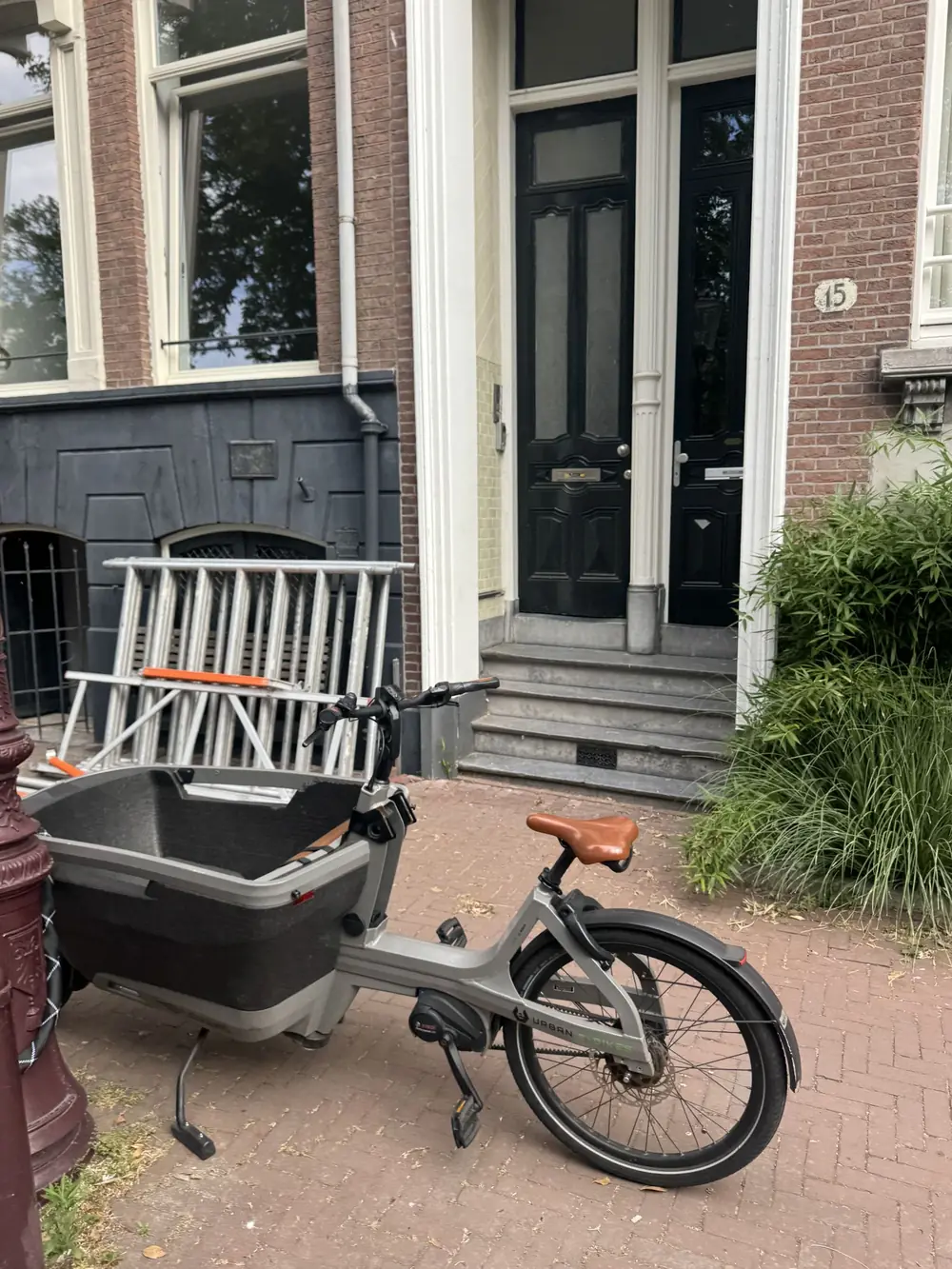
Slim scaffold frames waiting on the pavement behind a parked cargo bike, outside a house with a stepped entrance

On the deck itself you need very little room. A drill, a tub of plugs, a level and the hardware sit comfortably beside you on a floor 245 centimetres long. The units only go up in the second round, and then a second person is up there with you for a while. What does count is the narrow way through to the back of the house, because a wide deck will not thread through there without the gate coming off its hinges first. Measure that gap early.
Hiring working height for shading on ground floor and upstairs

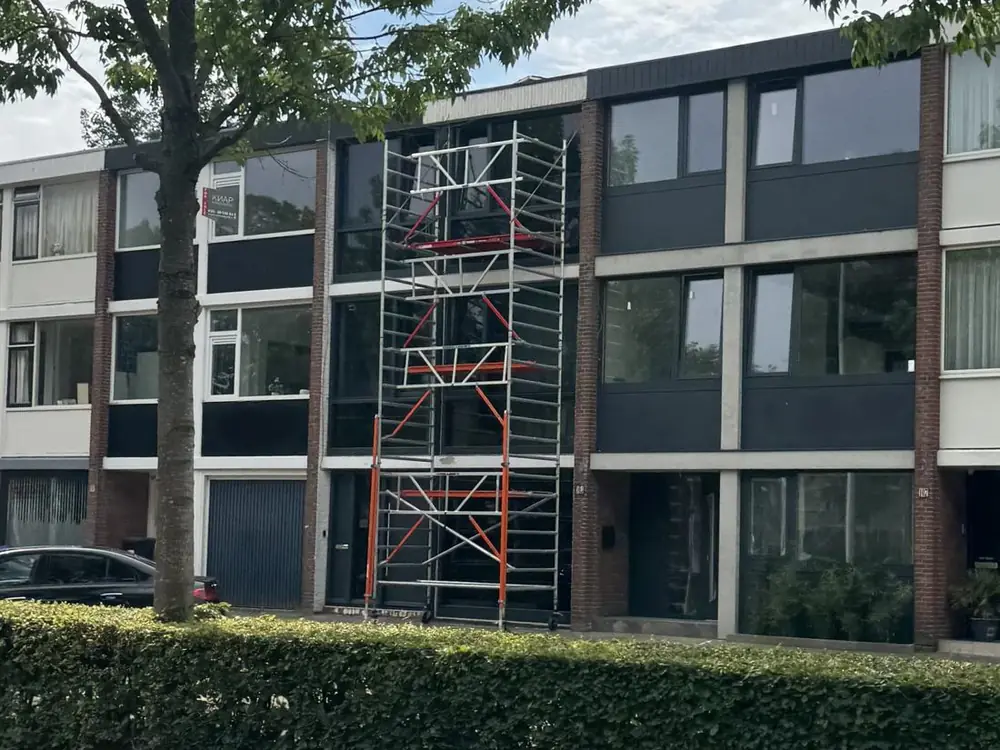
With shading the highest point sits above the topmost opening in the run. For windows on the ground floor and the first floor that works out at 6 to 8 metres of working height. That figure is the deck height you stand on with some 2 metres of reach added above it. Above the head of each frame there also has to be room for the hardware, and that belongs in your measurement. A roof with a dormer in it pushes the topmost fixing higher again, so installing sun shading there wants a taller build.

Measure each face separately. The back of a house often has an extension that starts the upper window lower, while the front carries an extra row of openings up in the roof. Take the highest point of the whole side as your figure, because you hire one build of the tower for all the rounds together. At the overview of working heights you can see how those figures relate to the number of stages. Measure at a quiet moment, not on delivery day with the parts already on the ground.

Tall mobile scaffold assembled against the front of a three storey block with rows of windows on either side

If in doubt, reserve the taller build. A set-up can always be left lower with some decks unused, but building higher than you hired is not possible. On this job that bites quickly, since the top bracket always sits above the head of the glass you are judging it by from the ground. For an elevation with openings at second floor level you reckon on considerably more, and the height you state is what your rental price is based on when you book the tower.

Moving the hired tower along the elevation from window to window

Because you are doing several openings, the standing place is not one spot but a series of them. Walk the wall before the tower arrives and check at each window whether the four stabilisers can actually be set out there. A raised terrace, a shed against the brickwork or a sunken light well under the kitchen window can make a spot unusable. Then you shift the set-up half a metre and work that window from the side. Note per opening whether the ground will do, because installing sun shading means standing at each one.

The surface changes along one elevation more often than you expect. In front of the door there is paving, beside it a border starts, and round the corner sits grass that will not carry after a wet week. Lay a thick board under the feet on soft patches and check at every position afresh that the deck is level. How to handle differences in height is covered at working on ground that will not lie flat, spindles included. A tower out of plumb works against you at the next window too.

Four stabiliser legs set out from a tower onto paving, reset from scratch at every fresh standing position

Think ahead about the order you take the wall in. Start at the opening furthest from the gate and work back towards the pile of parts, and you avoid carrying tools the length of the garden at the end of the day. Keep the route clear of furniture and bikes, since you push the tower through in one piece to the next position rather than breaking it down each time. Over six windows that habit saves a quarter of an hour apiece in build time alone.

How many hire days the measuring and hanging rounds take

Hiring a tower for shading along a whole elevation comes to three days in practice. That is because you work in two rounds: first a measuring and drilling round in which you mark the positions per window, check the substrate and fix the brackets, then a hanging round in which the units go in and are adjusted. In between there is often a day of waiting on materials or on a second pair of hands. Count that day into the period you book, because an idle tower still counts as a day of hire.

Splitting the work is not a detour but a saving. In the first round you discover which faces disappoint and which plugs you have to go out and buy, and you want to know that before a unit is hanging on the hooks. Allow roughly an hour per window for drilling and another hour for hanging. Six openings therefore fill two full working days, plus the morning in which the tower goes up. Eight of them add half a day again, and that is before any wiring is done.

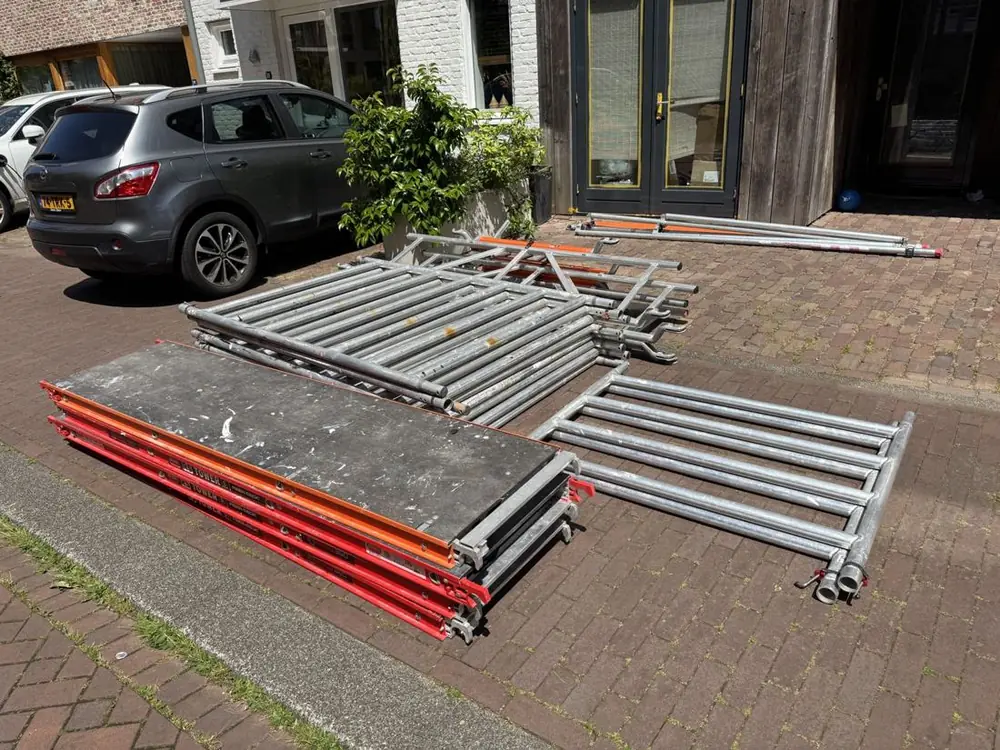
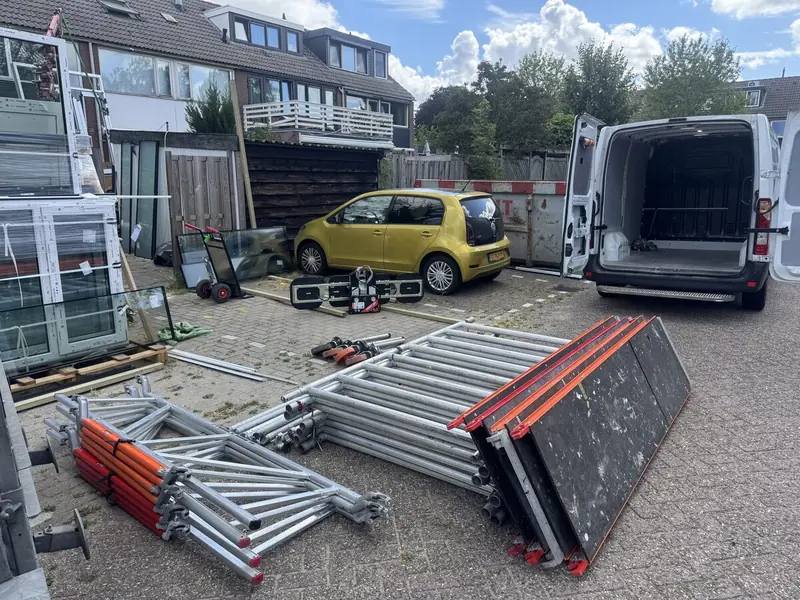
Complete set of frames, decks and guard rail tubes stacked on block paving beside a house, car parked alongside

The tariff keeps that extra day small. You pay the first day at the whole rate and from then on every day of hire carries 95 per cent off, so a third or fourth day disappears next to the first. Installing sun shading is exactly the kind of work where that helps, because one difficult window can swallow an afternoon. Put your end date well past the last hanging round rather than tight against it, and keep the margin for the difficult wall.

Which mobile scaffold suits installing sun shading?

Kamersteiger RS44
  • Working height up to 4 metres
  • Compact and narrow
  • Great for indoor and small jobs
View and calculate →
Most chosen
Smalle rolsteiger RS51
  • Working height up to 14.2 metres
  • Narrow (75 cm)
  • Ideal for narrow passages
View and calculate →
Brede rolsteiger RS52
  • Working height up to 14.2 metres
  • Wide platform (135 cm)
  • Extra stability and workspace
View and calculate →
1-persoons steiger MiTower
  • Working height up to 6.2 metres
  • Very compact
  • Quick and easy to assemble
View and calculate →

Installing sun shading per elevation: orientation, substrate, hanging

Begin with the choice per orientation. On the south side the sun stands high and a unit that reaches well outwards does the work; on the west it comes in low and you want something that drops vertically down the glass. The east face mainly needs covering for the morning hours, and a north wall usually needs nothing at all. Go through that face by face, because the wrong choice hangs on your house for years and nobody rehangs a whole elevation lightly. Installing sun shading badly is expensive to undo.

Then look at what you are drilling into, and that differs by wall type. In solid masonry an ordinary plug grips perfectly well, but in a cavity wall with a thin outer skin you have to reach the inner leaf or set a chemical anchor. With external insulation you need spacers that carry the load through to the structure. On timber cladding you screw into the battens or the backing behind the boards, never into the boarding itself. Ask your supplier which anchor is specified for the units you have ordered.

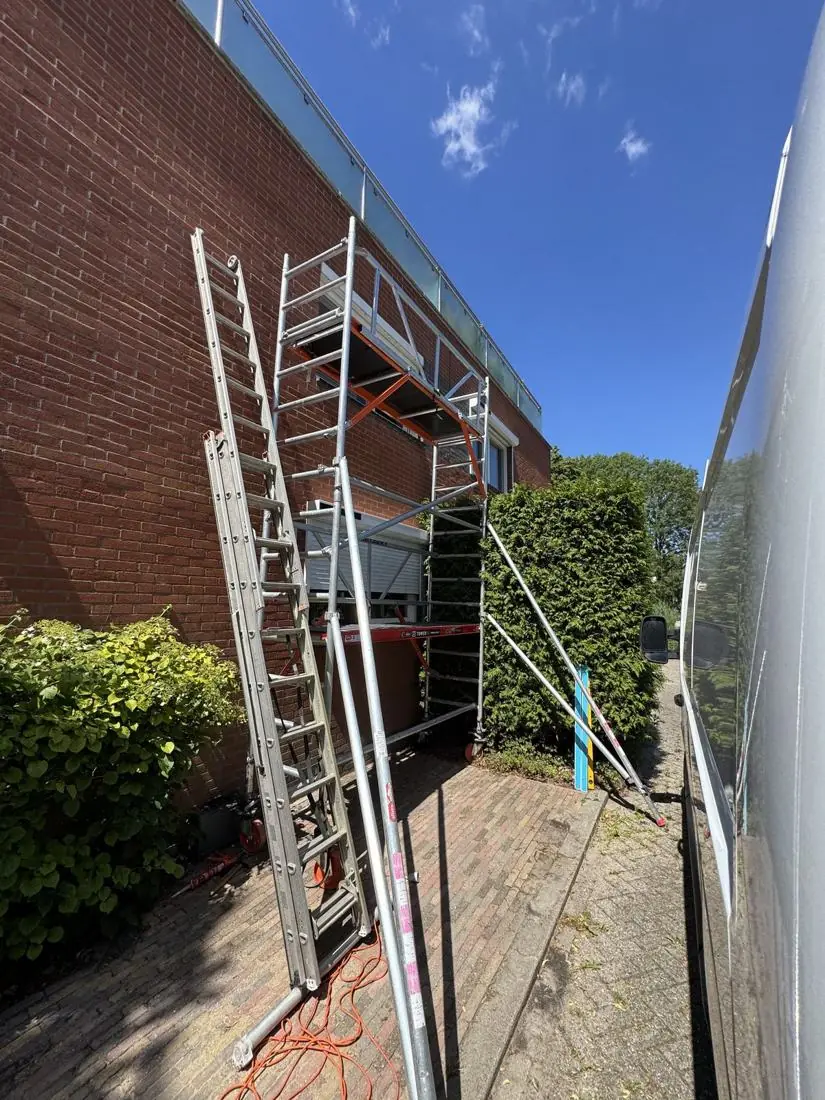
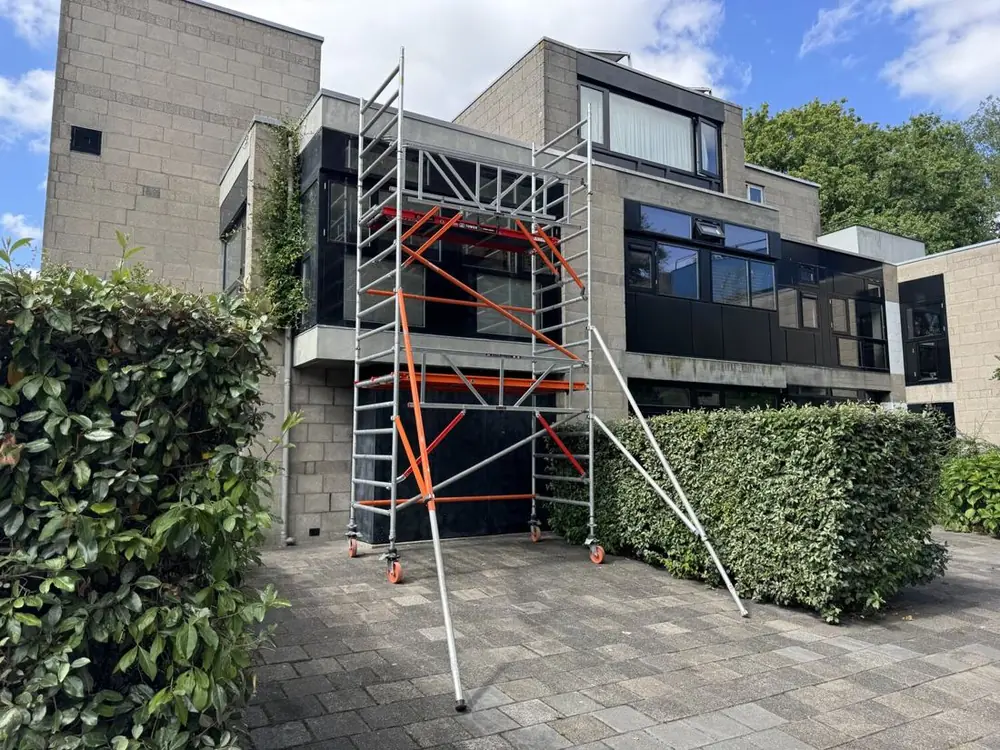
Erected tower with guard rails and a built in climbing ladder standing on paving beside a brick wall

In the hanging round the weight of the unit joins in. From a deck 245 centimetres long you take in one opening and can lower the unit into its brackets without stretching. Do that with two people and check at every window that it hangs level and runs smoothly before you move the tower on. Coming back later for one window means the whole build starts again from the ground, and that costs you a hire day you had never planned for.

Hiring a scaffold with delivery for a facade of shading

The scaffold arrives as a counted set of loose parts, dropped where you point. Pick a corner you pass in both rounds, beside the gate or on the drive, so that you are not walking round a stack of tubes every time you move. Get the order in on a working day before the clock strikes 15:00 and the set is delivered on the next working day. That way the following morning starts with building rather than with waiting for a van at the kerb.

Putting it together is your own work, and the printed instructions come with it; a film on the site runs through the order of decks, guard rails and braces. At this height two of you spend about half a morning on it. Have the delivery made the day before your drilling round begins and you lose no hire day to waiting. Installing sun shading then begins on a full morning. What bringing and fetching costs is shown at the transport costs per province.

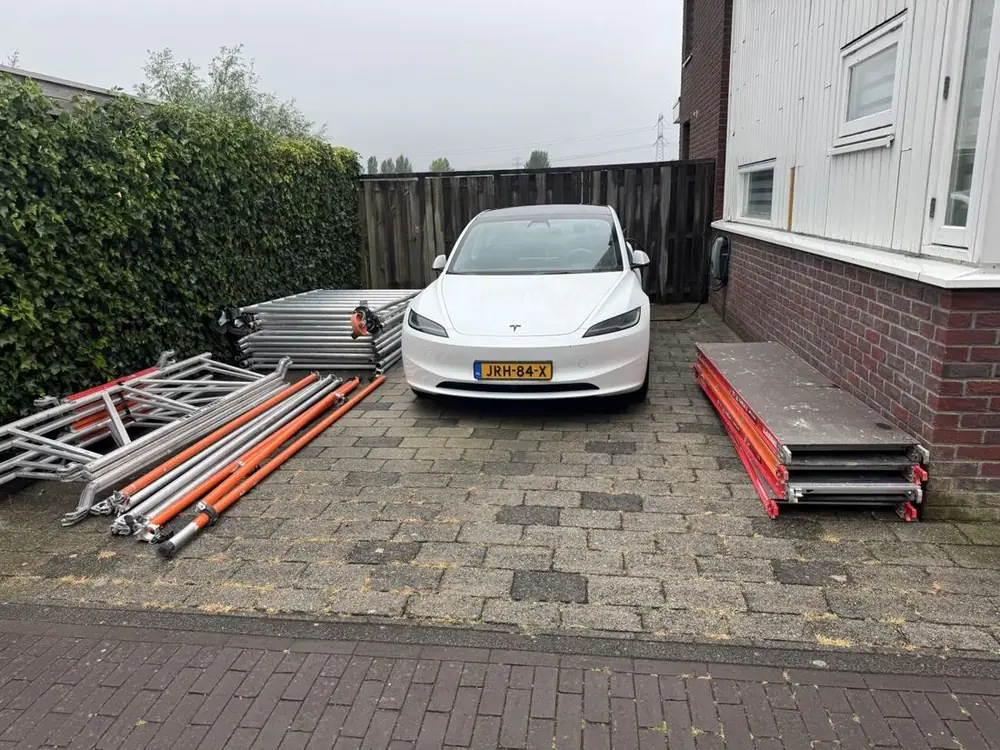
Scaffold parts laid out along both sides of a driveway beside a hedge, with a car parked in the middle

After the last hanging round we come and take the set away again, on the day you passed to us. Break the tower down and gather the parts in one place rather than leaving them spread across three gardens because you moved along the wall. Count the braces and deck boards while you dismantle. Then you know for certain that nothing is still standing behind the hedge to be found weeks later, when the van is long gone.

Drilling safely from the tower into different kinds of wall

Up to 200 kg on a single square metre is what this deck takes, which is what EN 1004 allows in load class 3. On shading work you stay well under that in the drilling round, but in the hanging round two people are up there with a unit between them. Lay that unit flat rather than standing it against the guard rail. More on what the class means is set out at the note on this scaffold standard, so you know what two of you may safely take up the ladder together.

As soon as anybody steps onto the tower the castors are braked. Moving to the next window happens only once the deck is empty and nobody is aboard, so tools do not stay up there simply because it is two metres along. In strong wind you stop hanging, since a loose unit turns every way at once the moment you lift it. Carry on with the drilling round instead and hang the next day. Still mornings are the best hours for this part of the work.

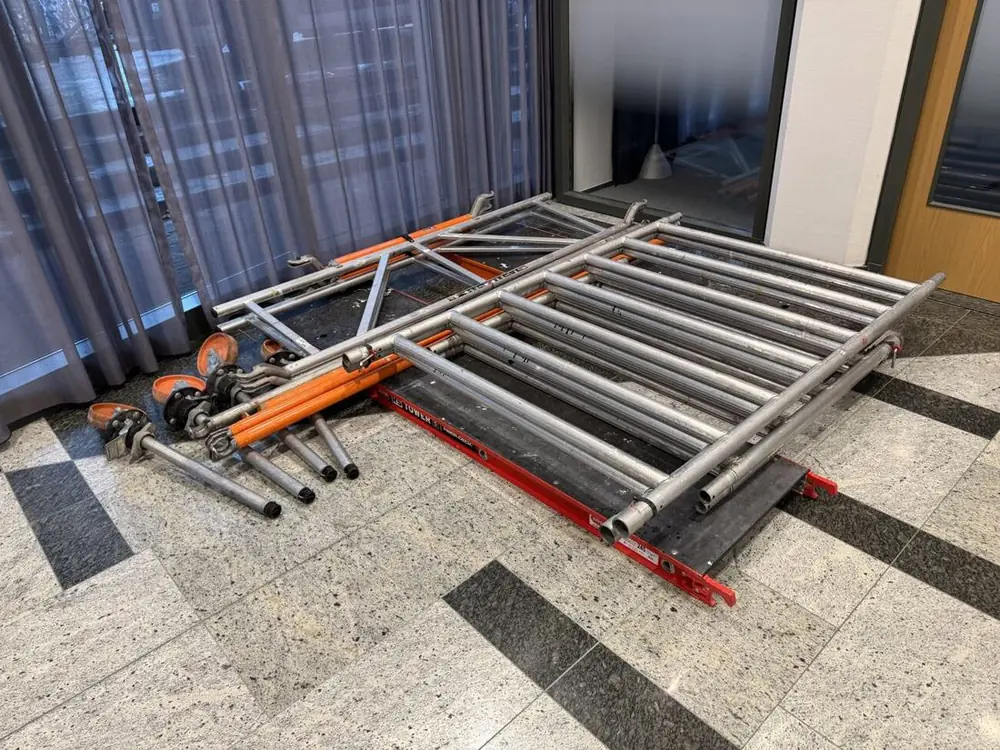
Counted set of frames, decks, braces and castors laid out indoors on a tiled floor beside full height glazing

Drilling carries the greatest risk on this job. You are working with a machine above shoulder height and with dust coming straight into your face, so glasses and hearing protection are no luxury. Keep the strip beneath you clear, especially when you go into a cavity and lumps of brick come down. Warn the neighbours if you are standing right on the boundary line, and sweep grit off the deck before you move on to the next window. The remaining requirements are at the rules for working at height.

In 5 steps

How hiring a mobile scaffold works

1
Choose working height

Pick the height that suits your job.

2
Book online

Sorted in 60 seconds, price shown instantly.

3
We deliver

At the agreed spot the next working day.

4
Assemble safely

Assembled by you, with a manual.

5
We collect

One call and we collect the scaffold.

Good to know

Practical tips for installing sun shading

1

Number the windows on a rough sketch of the elevation and note the substrate against each one. In the hanging round you then know at a glance which hardware and which anchor belong to which opening on the wall.

2

Drill one trial hole on each face before you begin. If cavity air or insulation comes out of it, you learn on day one that other fixings are needed, rather than halfway through the hanging round itself.

3

Hang the first unit and leave it a day before you finish the rest. If anything drops or runs out of true, you adjust the remaining windows accordingly instead of doing the whole elevation a second time over.

4

Push the tower straight through to the next window rather than dismantling it. Clear the deck first and fold the stabilisers in, and a move like that costs you ten minutes at the very most between openings.

5

Take the south face in the morning and the west face later in the day. You then see with your own eyes how the light falls inside and whether your chosen shading really does what you wanted there.

6

Ask for one extra day at the point of hire when more than four windows are due. Coming back for the last opening means a whole fresh build of the tower, which never repays the single day you saved.

Frequently asked questions

Frequently asked questions about installing sun shading

Which mobile scaffold do you hire for shading along a facade?+

The narrow version at 75 centimetres is the better buy here. You move it from window to window, and a slim deck simply travels more willingly than a wide one. The 245 centimetres of length is enough to take in a whole opening. Neither the drilling nor the hanging needs extra width, since the hardware and the machine lie beside you and the unit itself only goes up in the second round. A wide tower sticks on a narrow path. Installing sun shading is a job of many short moves.

How does the hire work when you install shading window by window?+

Online you choose the version and the build stage, then fix the arrival day and the day it goes back. Our van unloads the parts at your address, you put the tower up and work the elevation in two rounds. At the end you hand the scaffold back dismantled and complete on the day you named yourself. The hire runs between your two dates and the amount is fixed in advance with VAT in it. Nothing else about the tower is arranged on the day.

How long a hire period does a full elevation of shading take?+

Three days of hire is a realistic plan for four to six windows. The first covers the build and the measuring and drilling round, the second the hanging and adjusting, and the third is your margin for surprises and for taking the tower apart. With more openings, or with one face where the fixings turn awkward, you simply add a day. That is almost always cheaper than making a second reservation later. Installing sun shading over eight windows wants four days of hire.

How is the hire priced, and what does a third day add?+

The build height and the model set the tariff, with the transport line added on top of it. All the amounts appear with VAT included at the hire rates per mobile scaffold. Because only the opening day counts in full, a third day barely shows on the total. For a job with two rounds along the wall that is a comfort, since you cannot know in advance which window will cost you an extra hour. That transport line is settled before you confirm the booking.

Which working height do people hire for shading over two storeys?+

In most cases you hire 6 to 8 metres. Measure up to the hardware above the highest window in the run, not to the top of the glass, because half a metre hides between those two points. Take the highest point of the whole side as your figure, since one build of the tower serves every opening on it. On the page about an eight metre stage you can see what that gives you. Reserve the taller stage if the topmost window sits between two of them.

When hiring, is the shading tower delivered or fetched from Amsterdam?+

Either is possible. Delivery means the set is at your door on your date and goes away again after the last hanging round, for a sum fixed before you book. You may also fetch it yourself: Zeeburgerpad 89 in Amsterdam hands the parts over at no charge once a slot is agreed, provided your transport handles the long components. With a facade full of shading most people have the scaffold brought, since the car is already loaded with units. Installing sun shading fills a boot quickly enough on its own.

Do you assemble the mobile scaffold that I hire for this?+

No, that work sits with you. We unload the components and pick them up afterwards; building, pushing along the wall and dismantling all belong inside your hire period. The instructions supplied walk through the sequence step by step, and the stabilisers go out before anybody climbs. So we fit nothing for you, and the hire fleet holds no facade scaffolding and no cherry picker in any case. Count that build into your first hire day so the drilling round starts on time.

The units are running late: can the tower stay on hire?+

Yes, tell us as soon as you know and the collection day travels with it, unless that set is already booked to somebody else. With units made to measure that happens regularly, certainly in spring when lead times stretch. Cleverer still is to do the drilling round with the tower you already have standing, so that only the hanging remains when the delivery lands. Your hire period then stays short and predictable. Handing the tower back a day early is allowed just as readily.

How much level ground does each standing position on the wall need?+

Per position you want a level patch a good two metres across, with room on every side for the stabilisers. That has to hold at each opening, so walk the elevation before you hire the tower. Shrubs, a shed against the wall or a raised terrace can make one spot unusable, and then you work that window at an angle from the side. Keep the route between openings clear as well, because you push the hired tower through rather than lifting it around obstacles.

When is the deposit returned once the hire has finished?+

The deposit is back with you one working day after the tower is handed in and counted as complete. So while you dismantle, watch for parts left standing along the wall, because with two rounds around the house something goes astray sooner than it does from one fixed position. Count the pieces as they come down. What is looked at on return is described in the rules on the deposit. A complete set goes through that check without any questions at all.

Rain on my drilling day: does that waste a hire day?+

For the drilling round rain is no disaster, though a wet machine above your head is nobody's idea of fun. The hanging you do postpone, since damp fabric has to be run out again later to dry. The tower simply stays standing and your hanging round shifts a day. Keep the units covered while they wait on the ground. Because you set the collection date, that costs one extra day of hire at most. Wet hardware is worth drying before it goes on the wall.

Is one hire period enough to hang and wire the shading?+

It usually is, and planning both jobs at once is worth the trouble. Electric shading needs a cable running into the wall, and that penetration is made from the same deck you hung the unit from. Have the connection done by somebody trained for it. To hire a mobile scaffold again purely for that step is a waste, because every window would then want its own position and another journey by the van. One hired set-up serving both trades is simply the cheaper route.

Hire a mobile scaffold for installing sun shading today?

Calculate your rental price now or ask for free advice.

Rolsteiger van SteigerTaxi geleverd op locatie
Book it online

Your scaffold sorted in 2 minutes.

Choose your scaffold and working height, see the price instantly and book online.