
See your price
Application

Fitting a sun blind? Choose the right scaffold.

Fitting a sun blind turns on one window and on one position that sits neatly underneath. Usually it is a folding arm unit: a cassette above the frame with two arms pushing the fabric out and down. You have to reach the brackets above the opening and still leave room below the hem. For a window on the first floor people hire the narrow RS51 at 75 cm wide, built out until the working height reads somewhere between 6 and 8 metres. What that means for your hire days is set out below.

  • Order before 3 pm, delivered tomorrow
  • Professional Altrex scaffolds
  • Up to 14.2 metres working height
  • Easy to assemble yourself
4,2 tot 14,2 mWorking heights available
12Provinces served
7Days a week
200 kg/m²Load class 3
In short
  • For fitting a sun blind we recommend the Narrow mobile scaffold.
  • For one folding arm unit above a window hire the slim RS51, 75 cm across, taken up to 6 to 8 metres.
  • The 245 cm deck spans the full width of the unit, so both end brackets are reached from a single position.
  • Two hire days is enough: marking and drilling on the first, hanging the cassette and running the fabric out on the second.
  • First 24 hours from €150 incl. VAT and delivery; every day after that 95% off.
Key facts for this job
FeatureValue
Recommended scaffoldNarrow mobile scaffold (Altrex RS TOWER 51)
Working height for this job6 to 8 metres
Available working heights4.2 to 14.2 metres
StandardEN 1004, load class 3 (200 kg per m²)
DeliveryOrdered before 3 pm, delivered next working day
Each extra day95% off, from €7.50 a day
Why a mobile scaffold for fitting a sun blind?

Safe, stable and professional work at height

A folding arm unit hangs above a window opening, and that is exactly where a ladder fails you. The cassette goes up in one piece, you need both hands to lay it into the brackets, and the arms are under spring tension that may only be released once everything is bolted home. The height is not free either: there has to be room above the head of the frame for the housing, and enough clearance under the hem for somebody to walk beneath it. Anyone hiring a mobile scaffold for this looks at the height of the brackets, at the width of the unit and at the free ground under the window. The swing of the fabric counts in that sum as well.

  • Projection decides how far the fabric reaches out
  • Clearance under the hem to walk beneath
  • An outward opening window fouls the fabric
  • Spring tension released only after the cassette is fixed
Read more about working safely →

Hiring a mobile scaffold for one sun blind above a window

A folding arm unit hangs above one window opening, which keeps the job neat: you are working inside a strip no more than three metres wide. The RS51 suits that exactly, the narrow Altrex version with a deck 75 centimetres across. That measurement threads past a bay, a downpipe or a parked car without you having to clear half the front garden first. Sizes and build stages for the whole fleet are listed with the mobile scaffolds in our hire range, including the heights you can order against.

The deck length of 245 centimetres covers the full width of the unit above an ordinary window. Both end supports are therefore within reach without climbing down in between, and the cassette can be laid into the brackets in one movement. That matters a great deal when fitting a sun blind, because the housing goes up as a whole and there is nowhere to rest it halfway. Work in a pair: one holds the cassette while the other runs the bolts into the brackets.
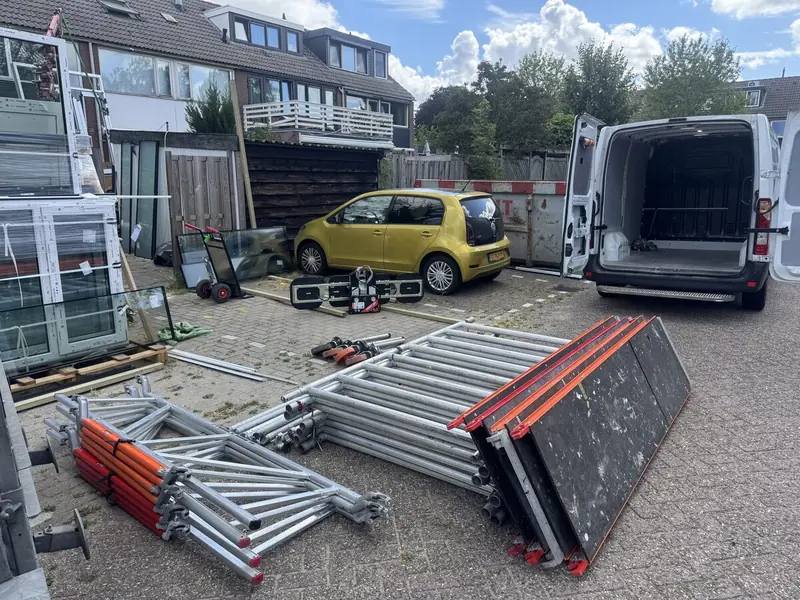
Frames, a deck board, orange braces and castor tubes spread on paving in front of glazed doors before assembly

Where the plan is not one unit above one window but shade across an entire elevation, the approach changes completely; that story sits on the page about shading fitted across a whole facade. Here it stays one tower under one opening, and then the slim deck beats a wide floor you could not fill anyway. Fitting a sun blind above one window needs one position and no more. A wide unit over the garden doors at the back is a different job again, and that one is set out at installing an awning above a terrace.
Hiring the working height up to the sun blind brackets

The highest point of this job is the pair of brackets, and those always sit above the head of the frame. With that window on the first floor you land at 6 to 8 metres of working height. The sum behind it is simple: platform height with about 2 metres of reach standing on top of it gives the figure you order against. You want the fixing points at chest height, since drilling above your own head costs you exactly the accuracy the cassette will later hang on.

The unit sits higher on the wall than the drawing suggests. Above the head of the frame you still need room for the housing and for the pivots of the folding arms, and on top of that comes the mounting clearance the manufacturer prescribes. So measure from the pavement to the upper edge of those brackets and not to the top of the glass, or you will be half a metre short. What that stage looks like in practice is shown at an eight metre build.

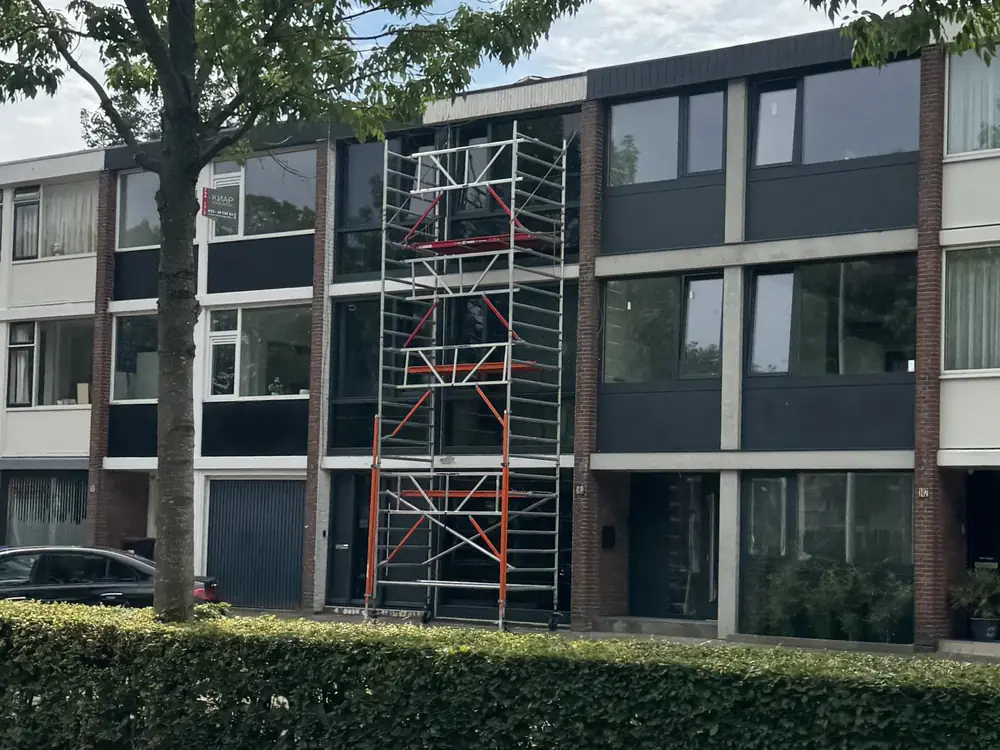
Mobile scaffold standing assembled against a three storey block, reaching past the windows on the upper floors

Remember too that the fabric drops outwards rather than straight down. If you want to run the unit right out while the tower is still up, you need to be able to shift a little to one side. Where your window sits above an extension or a bay, take the measurement from that roof and not from the grass beside it. On a window at first floor level that can save a whole stage of build on the order. Half a metre of misjudged height is the usual mistake made here.

Hiring a tower to stand under one window opening

The position sits directly under the window the unit is going on, which on a front elevation means the pavement or half a parking bay. See whether you can free a strip of roughly two by three metres there, because the four stabilisers splay outwards from the base and every one of them has to find support. Leave a route past the wall for pedestrians, and if in doubt, ask your council what may stand in your street while the hire period runs. Fitting a sun blind over a public footway needs that check first.

Watch for the things that live under a window in particular. A sill with a projecting cill below it, a border, a gravel margin or the grating over a basement light all make the ground you want to stand on smaller than it looks. Where a drive falls away underneath, work the difference out on the spindles and check with a level that the deck really is flat before anyone climbs. A low box hedge is easier removed than worked around. Level ground under all four feet is not negotiable on this job.

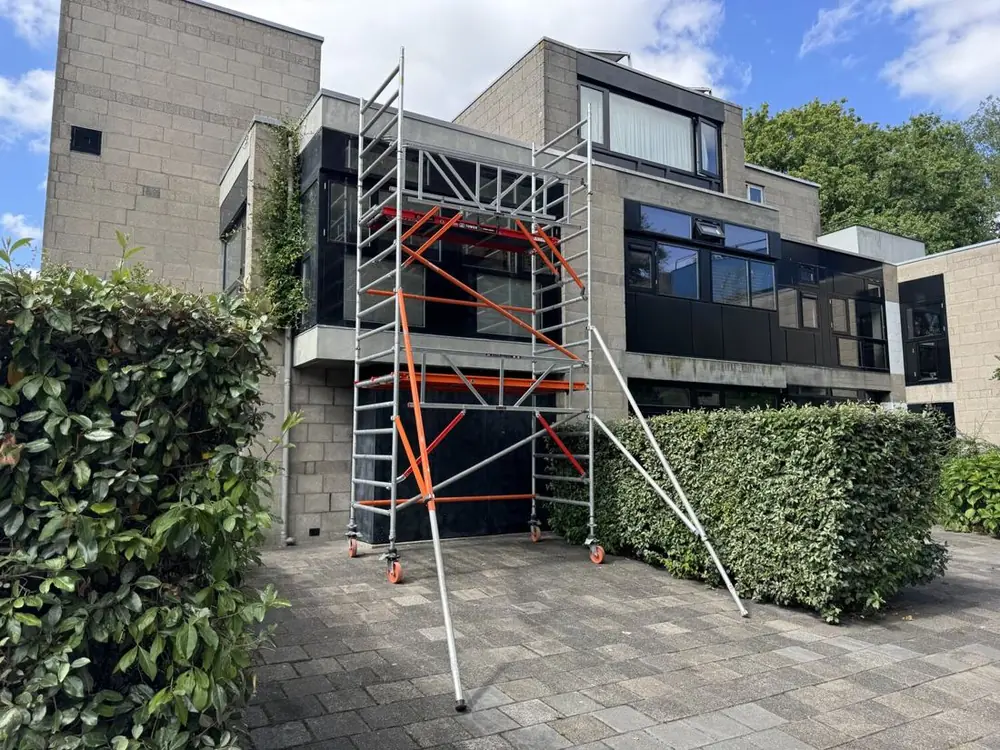
Long stabiliser legs splayed from a tower onto block paving in front of a house with wide dark windows

Keep the swing of the fabric clear as well. A folding arm unit travels outwards and downwards on its first run, so you want no bicycle, planter or garden chair standing in that path. The cassette and its housing wait indoors by the door rather than out in the garden, since neither may get dirty or damp before it hangs on the wall. Getting the base solid is covered at steadying and tying a tower. Mark the swing path with tape if children use the garden.

How many hire days fitting a sun blind really takes

Hiring a tower for one unit above a single window costs you two days in most cases. On the first you put the set-up together, mark the brackets out and drill the holes. Bolting the cassette in, adjusting the folding arms and running the fabric out happen the day after, which leaves room to correct anything that is not quite right. Anyone keeping to a tight schedule with two people occasionally finishes in one long day and hands the tower back later anyway.

Overruns nearly always come out of the wall. Land in a cavity where the plug finds nothing to bite on and you have to switch to a through fixing, which costs half a day of searching and trial. A unit made to measure can also turn up later than the supplier promised. So set the end of the hire a day beyond whenever you expect the sun blind to be hanging straight, rather than taking the tower down with the blind still crooked. Order the anchors for a cavity wall before you start drilling.

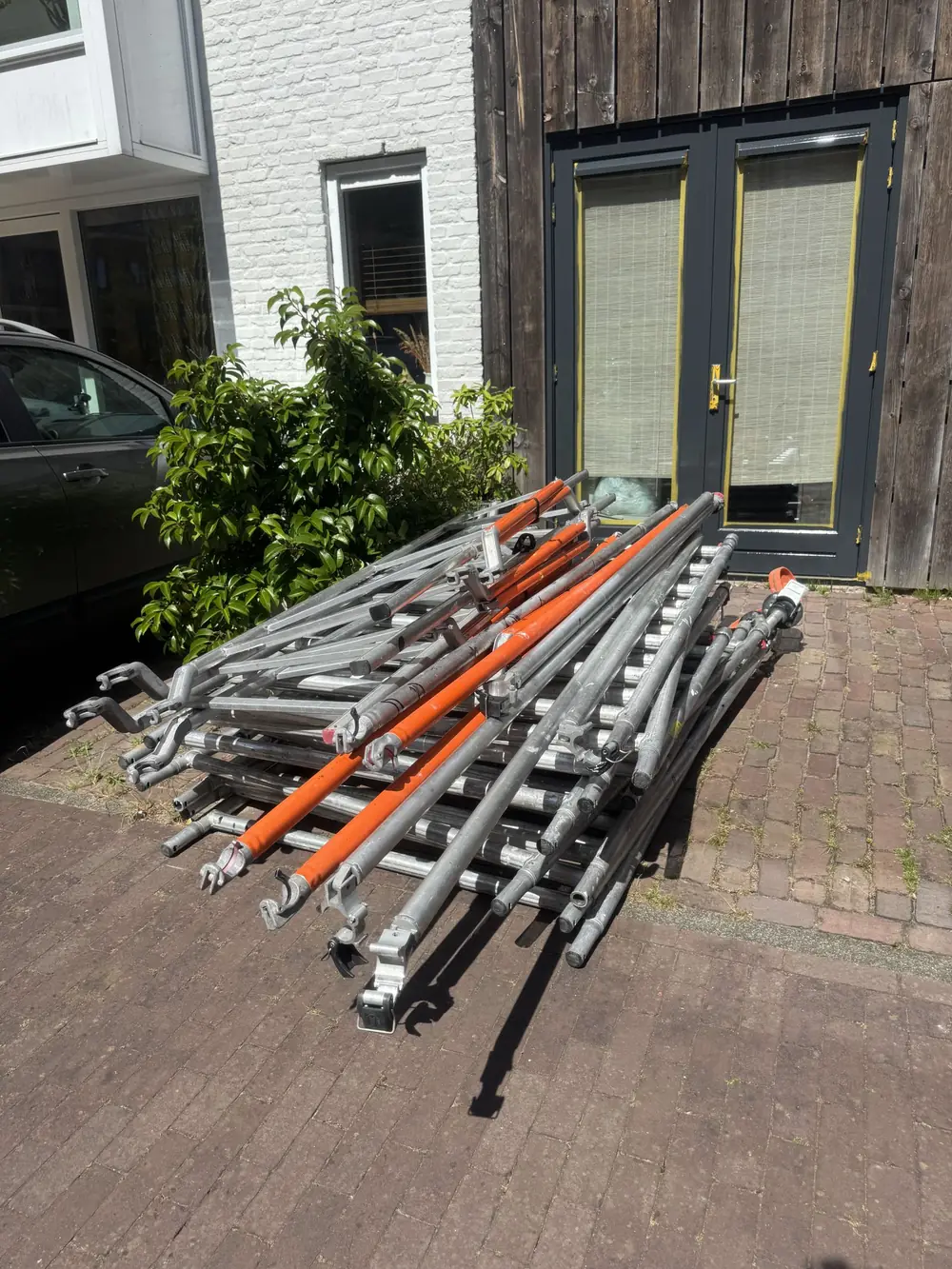
Loose scaffold parts and orange braces stacked on a brick drive beside a house with timber cladding and glazed doors

The way the tariff is built makes that extra day affordable. Day one is the one billed at the whole rate; after that a reduction of 95 per cent lands on every further date, so slack costs you next to nothing. That is welcome with a made to measure unit whose delivery date may still move. What the rental price comes to depends on model and height, listed at the rates per mobile scaffold, so you can see beforehand what a spare day adds. That extra day of hire is easier than a second visit.

Which mobile scaffold suits fitting a sun blind?

Kamersteiger RS44
  • Working height up to 4 metres
  • Compact and narrow
  • Great for indoor and small jobs
View and calculate →
Most chosen
Smalle rolsteiger RS51
  • Working height up to 14.2 metres
  • Narrow (75 cm)
  • Ideal for narrow passages
View and calculate →
Brede rolsteiger RS52
  • Working height up to 14.2 metres
  • Wide platform (135 cm)
  • Extra stability and workspace
View and calculate →
1-persoons steiger MiTower
  • Working height up to 6.2 metres
  • Very compact
  • Quick and easy to assemble
View and calculate →

Fitting a sun blind from the deck: projection and spring tension

Start by settling the projection, because that figure governs everything else. The projection is how far the fabric travels outwards, and you choose it so the hem still hangs above the pavement when the sun is low. Count back from the mounting height and keep enough clearance under the hem for somebody to pass without ducking. Check that against the wall before the first bracket is fixed, since correcting later means fresh holes and a row of old plugs to fill. Fitting a sun blind starts with that single number.

Then look at how the window itself opens. A casement or a top hung light that swings outwards fouls the fabric once it is run out, and that usually comes to light the first time somebody throws the window wide. Hang the unit higher in that case, or pick a projection that leaves the sash free. From a deck of 245 centimetres you take in the whole opening from one position and can try it calmly before anything is screwed down. Do that with the sash thrown wide.

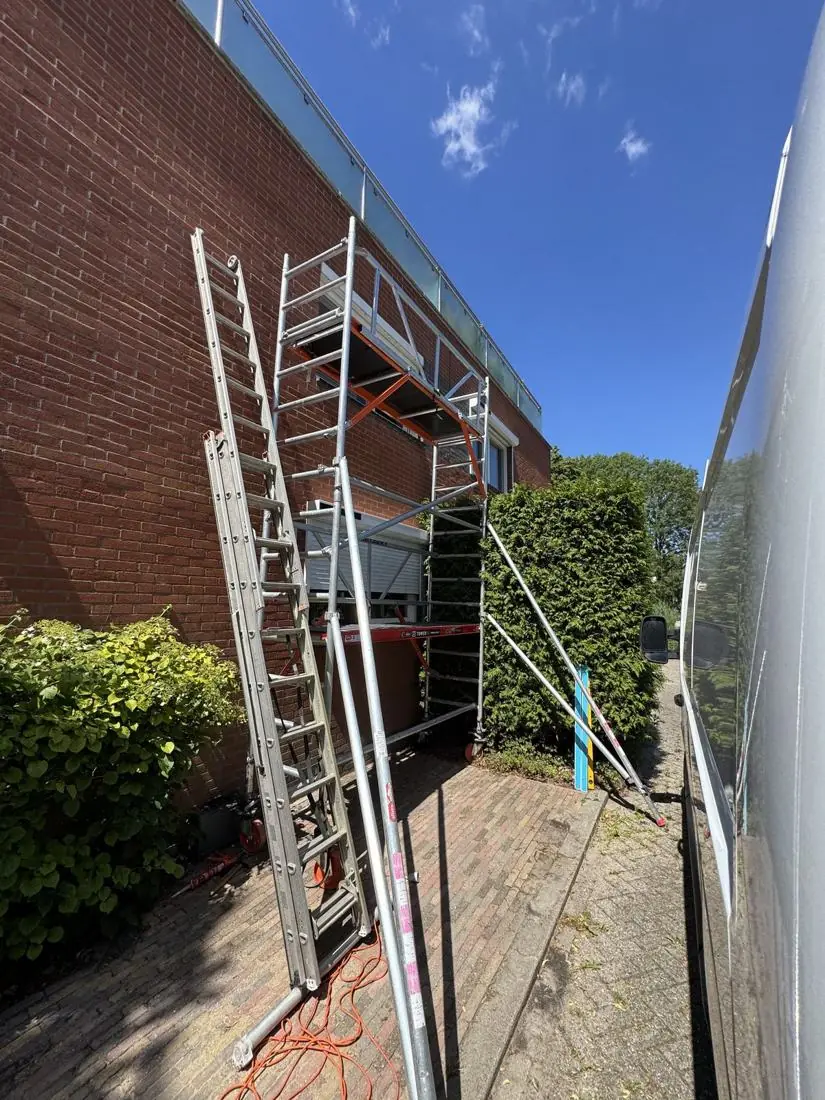
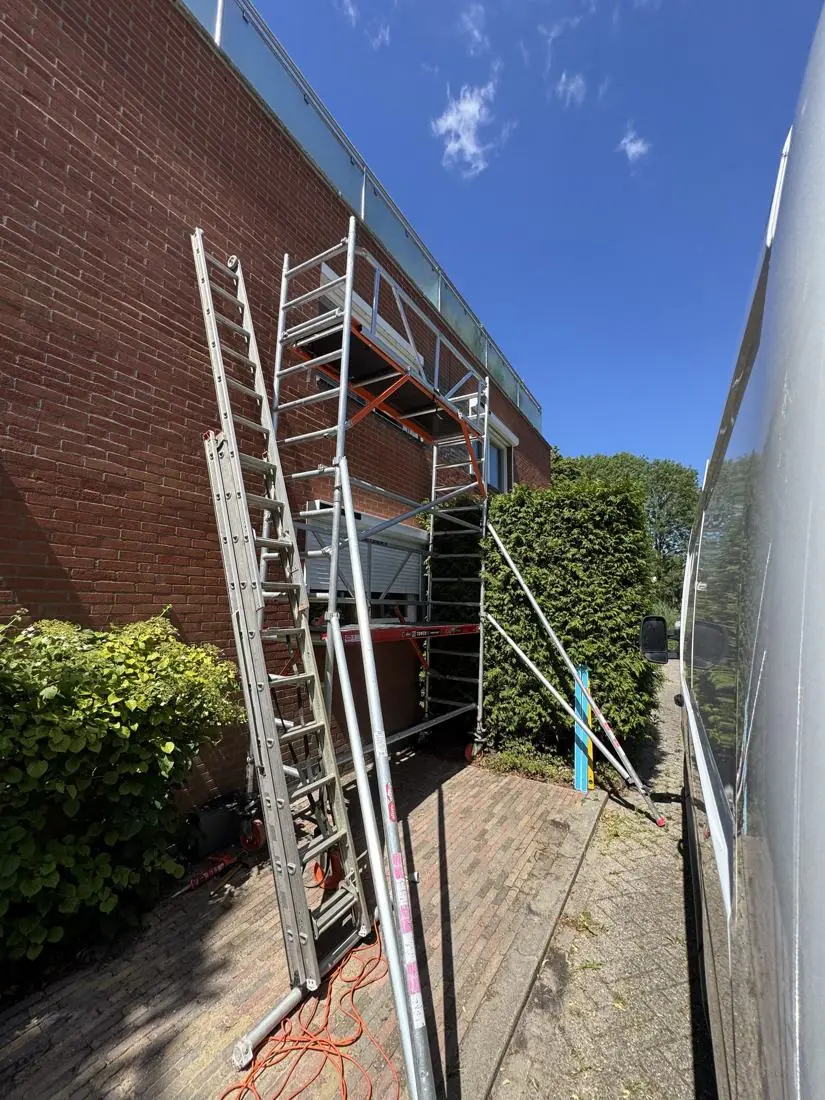
Built tower in a passage with its decks at two levels, and a sliding ladder leaning on the brickwork beside it.

The folding arms are under spring tension, and that is the sharpest part of fitting a sun blind. Leave the transport brackets on until the housing is bolted home, and keep your face out of the path of an arm. Then wind the unit slowly out for its first run and watch whether the fabric comes up evenly taut across the width. If a crease stays in it, adjust the arms while the tower is still under the window and you can reach them.

Delivery of the hired scaffold on your fitting day

A counted set of loose components turns up on the day, dropped wherever you point. Do not have that pile placed directly under the window the sun blind is going on, because that is the ground you want to keep free. A garage, the side of the house or a corner of the drive works better. Confirm before the 15:00 deadline on any weekday and the set travels out on the very next working day, so you know exactly which morning to keep clear. Point that spot out before the van arrives.

Building it is your job, and a manual comes with the parts; a film online shows how the decks and the guard rails go in. Reckon on a pair of you spending a couple of hours on the build at this height. Put the delivery on the day before the unit itself is due to arrive, so the tower is ready and waiting rather than the other way about. The cost of that run out and back is listed province by province at the charges for delivery and collection.

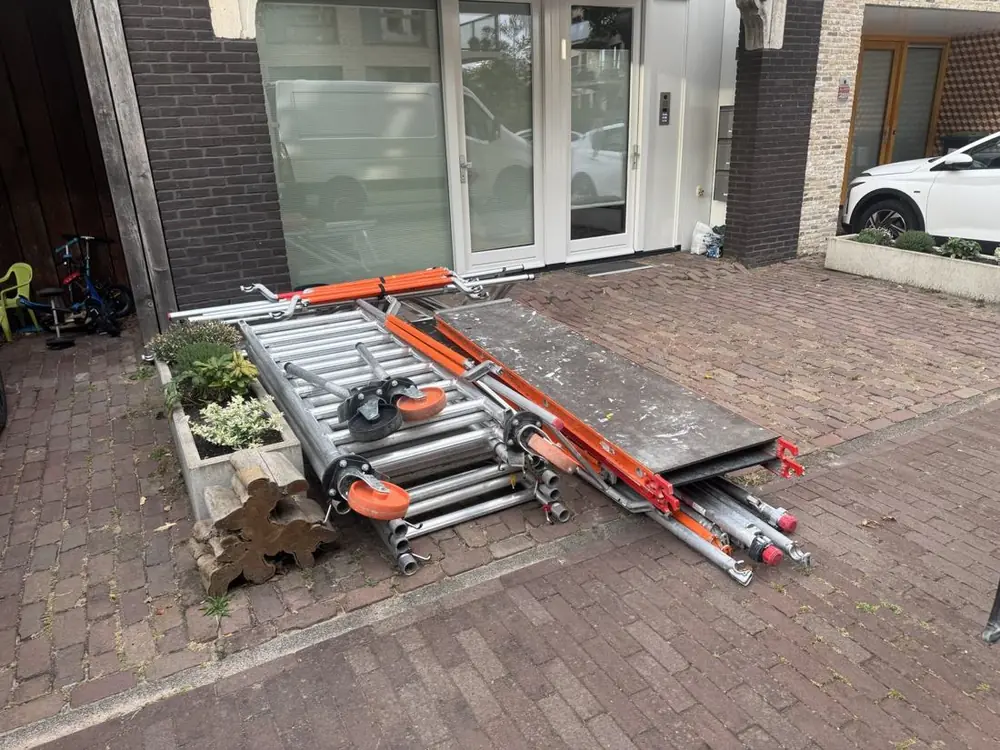
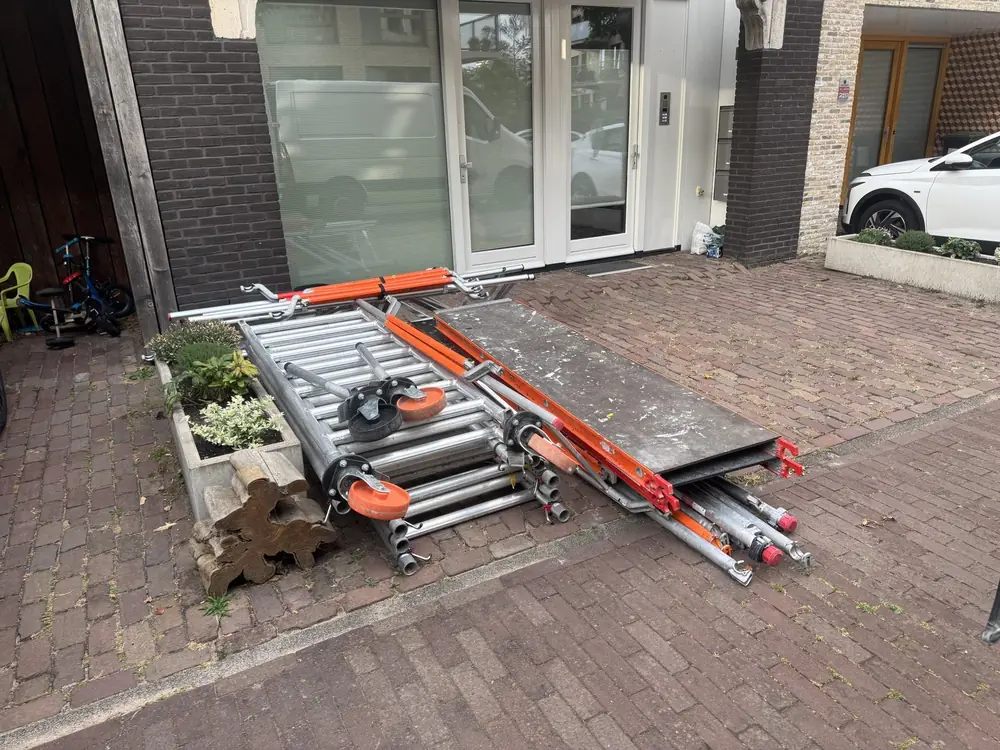
Counted set of scaffold parts, decks and braces lying on paving by a front door with a planter alongside

Once the first run is behind you and the site is tidy we collect the lot again, on the date you fixed yourself. Take the tower down and stack the parts somewhere the driver can get to them, with nothing left in the hedge or behind the bin. Put that end date a day after your last fitting day and you keep time in hand to run the fabric out in sunshine and watch how it falls.

Working safely with spring loaded arms on a hired tower

Everything in the hire fleet is built to EN 1004 in load class 3: the deck takes 200 kg for every square metre of its area. Fitting a sun blind does not take you near that ceiling, but do count what is up there at once: two people, a cassette of about three metres and a cordless drill with its case. Spread the weight across the deck boards. The standard and what it permits are unpacked at this note on the standard, with examples of what people take aloft.

The brakes go on before anybody takes the first rung, and the tower stays put as long as material is lying on the deck. Moving it with the cassette aboard is asking for trouble, even for one metre to the left. If the wind picks up, the fitting waits: an extended sheet behaves like canvas and pulls at everything it is fastened to. Up at deck height you feel a gust well before anyone notices it down in the street. Close the fabric and wait for a calmer morning.

Assembled mobile scaffold in a narrow passage between a brick wall and a hedge, guard rails on every deck

The real danger on this job is the spring tension in the arms. One of them can fly open with force if the restraint comes off too early, so follow the order the manufacturer sets out and never stand with your head in front of it. Keep the zone under the tower empty while you drill, because dust and a falling plug land exactly where people walk past. The remainder is at the rules that apply at height. Warn anybody using that pavement while the drill is running.

In 5 steps

How hiring a mobile scaffold works

1
Choose working height

Pick the height that suits your job.

2
Book online

Sorted in 60 seconds, price shown instantly.

3
We deliver

At the agreed spot the next working day.

4
Assemble safely

Assembled by you, with a manual.

5
We collect

One call and we collect the scaffold.

Good to know

Practical tips for fitting a sun blind

1

Mark the height of the hem on the wall with tape before you drill. From the pavement you then see at once whether anybody still walks upright underneath it when the sun sits low in the evening.

2

Open and close the window fully while the hired tower is still standing. A casement that swings out into the fabric is something to discover now, not in July with the scaffold long since collected.

3

Leave the cassette lying on a blanket in the hall until the brackets are bolted home. Sun blind fabric picks up dirt from whatever it touches, and a housing that has stood out in the wet never comes clean again.

4

Drill one hole per bracket first and hang the unit loosely in place. Only when the line and the projection both look right do you tighten the remaining bolts, which saves you a second row of holes in the brickwork.

5

Save the first run of the fabric for a still day and look at it from below as well. From the deck of the hired tower you never judge a sloping sheet as honestly as from the garden path.

6

Bring a second pair of hands for the day the cassette goes up. A unit of three metres is not heavy so much as unwieldy, and tackling it alone costs you more time than the help would ever have done.

Frequently asked questions

Frequently asked questions about fitting a sun blind

Which mobile scaffold should you hire for one folding arm unit?+

The slim version with a deck 75 centimetres wide is enough. You work above a single opening, so width buys you nothing, while the full 245 centimetres of length lets you reach both end supports without moving. A narrow tower also squeezes past a bay or between two parked cars, so walk that route to the front of the house before you book. For fabric along a whole elevation you would rather hire several positions than a wider deck. That route matters more than the reach ever does.

How does hiring a tower work for this kind of fitting?+

Online you settle on a version and a build height, mark the day the set is to arrive and the day it may go, and pay one fixed amount with VAT included. Our driver drops the parts, you build the tower under the window, hang the unit and run the fabric out once to check it. After that you dismantle and stack everything for collection. The hire runs exactly between those two dates you chose yourself, and fitting a sun blind follows them from start to finish.

How long a hire period does fitting a sun blind need?+

Two days is the usual period for one folding arm unit. Day one swallows the build, the marking out and the drilling; day two goes on the cassette, the adjustment of the arms and the first run of the fabric. With two experienced pairs of hands and a wall that cooperates it can be done inside a single working day. Awkward masonry or a late delivery is what makes you glad of the second. The build itself has to fit inside that opening day of hire as well.

What are you paying for when you hire a tower for this?+

The amount follows from the version and the height you choose, and from the run out to your address. VAT already sits inside every figure you see on the rate list per tower. On a two day job the useful thing to know is that the opening day weighs heaviest, while anything you add behind it counts for a fraction. Booking room around the delivery of your unit is therefore seldom an expensive decision. Delivery and collection are handled as one movement rather than two separate trips.

Which working height do you hire for a unit on the first floor?+

Work on 6 to 8 metres. You measure from ground level up to the top of the brackets the cassette will rest on, so above the head of the frame rather than above the glass. Where the window sits over a single storey extension, take your reading from that flat roof instead. Hire too little height and you end up drilling above your own head, which shows immediately in the line the brackets sit on. Fitting a sun blind half a metre too low is hard to correct.

Is the hired scaffold delivered, or do you fetch it yourself?+

Both are possible, and for a job on the front of the house delivery is usually easier. You give a date, the parts are there, and afterwards we drive them away again on the day you named. Fetching it yourself costs nothing: book a time and load up at Zeeburgerpad 89 in Amsterdam, provided your vehicle swallows the long components. For a single unit most people still have the tower brought, because the car is full of the sun blind itself. Say so if a van cannot reach the street.

Does the tower arrive built, or do I put it up after hiring it?+

Assembly is left to you. We deliver the components counted and complete and fetch them again after your final day of hire, but standing the tower up under the window belongs to your side of the job. The braces and stabilisers go out at the same time, following the printed sequence. We do not come out to build, and no facade scaffold or cherry picker sits in the hire fleet either. Allow the first morning of your period for that alone.

Can I hire for longer if the sun blind is delivered late?+

That is usually settled without fuss. Say so the moment you know your supplier has missed the date and the collection day shifts, unless the set is already booked to somebody else. With a unit made to measure this happens often enough, so allow a day of slack when you reserve. Handing the tower back earlier is equally possible when the fitting runs smoothly, so a generous hire period rarely backfires. Late fabric is the commonest reason people hire a mobile scaffold for an extra day.

How much room under the window does the hire actually need?+

Reckon on roughly two by three metres of free ground beneath the opening, level enough to take the four stabilisers. On a pavement you keep a walking route clear beside it as well. The strip the fabric will sweep through has to be empty too, because you would rather test that while the hired tower still stands there. Bikes, planters and a garden chair therefore move aside for the duration. Chalk the outline on the ground before the parts are delivered.

Too windy to run the fabric out: does my hire period suffer?+

The tower stays exactly where it is, and it is the first run of the fabric that waits. The sheet of a folding arm unit catches a great deal in a breeze, and you do not want the arms snatching while they are still being adjusted. Use the day to bolt the housing home and leave the fabric closed. Since the collection date is yours, a delay like that normally costs one further day of hire. Fitting a sun blind in a gust is not worth the risk.

How quickly is the deposit returned once the hire ends?+

The deposit you paid is repaid one working day after the returned tower has been counted complete. On this job that seldom causes trouble, because no paint or mortar is involved. Watch instead that no guard rail or brace is left lying in the front garden when you dismantle, and that drilling dust and sealant are wiped off the deck boards before the scaffold goes on the van. A complete set, counted back in, clears that check fastest.

My sun blind has a motor: can that be wired during the hire?+

It can, and that is precisely why the tower is left standing an extra day. The cable leaves the cassette and passes through the wall, and you make that hole standing on the very deck that carried the unit up. Let somebody qualified make the connection. Hiring a mobile scaffold a second time for that one job is money wasted, since both tasks happen at identical height. One hire period covering both keeps the whole thing simple.

Hire a mobile scaffold for fitting a sun blind today?

Calculate your rental price now or ask for free advice.

Rolsteiger van SteigerTaxi geleverd op locatie
Book it online

Your scaffold sorted in 2 minutes.

Choose your scaffold and working height, see the price instantly and book online.