
See your price
Application

Replacing draught strips? Choose the right scaffold.

Replacing draught strips is small work in an awkward place. The section itself costs you a few minutes, but you have to be able to stand at it, swing the window open and shut five times over to check the gap, and press a strip to length with two hands. At upper windows that means a floor under your feet instead of a rung under your shoe. So for this you take a MiTower, the one person tower from Altrex, ordered at 4 to 6 metres of working height.

  • Order before 3 pm, delivered tomorrow
  • Professional Altrex scaffolds
  • Up to 14.2 metres working height
  • Easy to assemble yourself
4,2 tot 14,2 mWorking heights available
12Provinces served
7Days a week
200 kg/m²Load class 3
In short
  • For replacing draught strips we recommend the 1-person scaffold.
  • For replacing draught strips upstairs you hire the MiTower: 75 cm slim and light enough to shift along the wall alone.
  • Do the paper test first and measure the gap, because that figure decides which section you buy and how much of it.
  • Watch for windows that open outwards, since the sash swings over your platform and that settles where the tower goes.
  • First 24 hours from €100 incl. VAT and delivery; every day after that 95% off.
Key facts for this job
FeatureValue
Recommended scaffold1-person scaffold (Altrex Mi Tower)
Working height for this job4 to 6 metres
Available working heights4.2 to 14.2 metres
StandardEN 1004, load class 3 (200 kg per m²)
DeliveryOrdered before 3 pm, delivered next working day
Each extra day95% off, from €5 a day
Why a mobile scaffold for replacing draught strips?

Safe, stable and professional work at height

The quantity of material on this job is negligible; the precision is not. You measure a gap of a few millimetres, cut to length, press home and test again, and that repeats itself at every window. On a ladder it falls apart, because there is always one hand left over for holding on, and moving the sash while you hang alongside it simply cannot be done. Hiring a scaffold for replacing draught strips gives you a steady floor beside the reveal, room to let the window swing open, and somewhere to lay your roll of section, your knife and your tape. That saves a quarter of an hour of fiddling per window.

  • Measuring a gap of a few millimetres accurately
  • Opening and closing the window many times over
  • An outward swinging sash above your work floor
  • A short, precise operation at every window
Read more about working safely →

Hiring a MiTower for replacing draught strips at upper windows

For work like this the Altrex MiTower is the obvious pick: a tower 75 cm wide, calculated for a single user, ordered here at 4 to 6 metres of working height. You need very little up there, and that is exactly what this model is built around. A roll of draught section, a knife, a tape and a screwdriver fit together in one bucket beside your feet. What can be reserved in this width is gathered at the single user MiTower we hire out.

The narrow foot counts for more than you would think. Upper windows often sit above a border, a hedge, a bike rack or a sloping cellar entrance, and with three quarters of a metre between the standards you get into places a broad set-up will not. On top of that, replacing draught strips means shifting from window to window, and a light tower rolls along the wall on its castors without a second person to help.
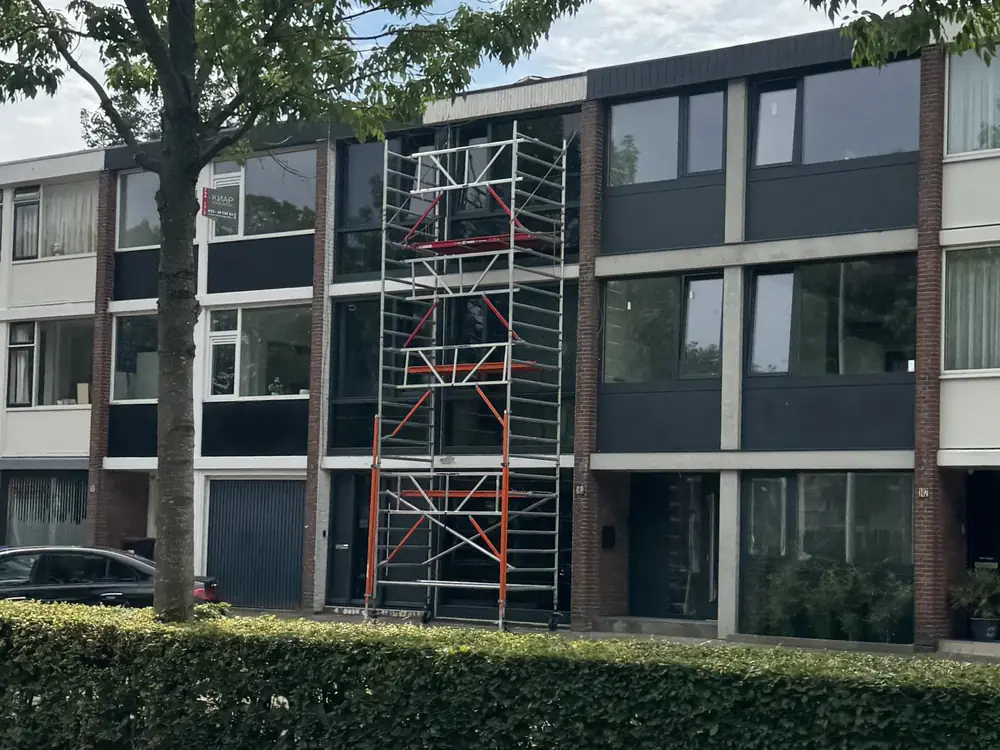
Slender mobile scaffold erected against a building alongside the upper windows, the narrow width you hire for a row of them

With 245 cm of platform you have an ordinary window frame in front of you complete, corners included, along with the jamb where the last piece gets pressed home. A wide sliding window or a double door turns it into two stands, and a dormer opening into three. To hire a mobile scaffold broader than this buys no extra reach, only more parts to carry through the garden. If general upkeep of the window frames follows on, the same tower does that too.
Which working height to hire to reach draught strips upstairs

Measure not to the cill but to the head of the highest window you are taking on, because your strip has to run round there as well. On an ordinary family house the top of a first floor window sits about five metres above the garden path. Standing on a platform that is too low, you work along that head with lifted arms and never press the section tight into the corner, and that corner is precisely where the draught comes back a season later.

With 4 to 6 metres of working height you sit right for those windows. The deck itself then lands somewhere around three metres, since working height is whatever the platform gives you plus the couple of metres your arms and shoulders add. Your zero point is the surface the castors rest on rather than the doorstep, because a front garden on a fall shifts that starting point by half a metre. Usual builds for work on the first floor are set out separately.

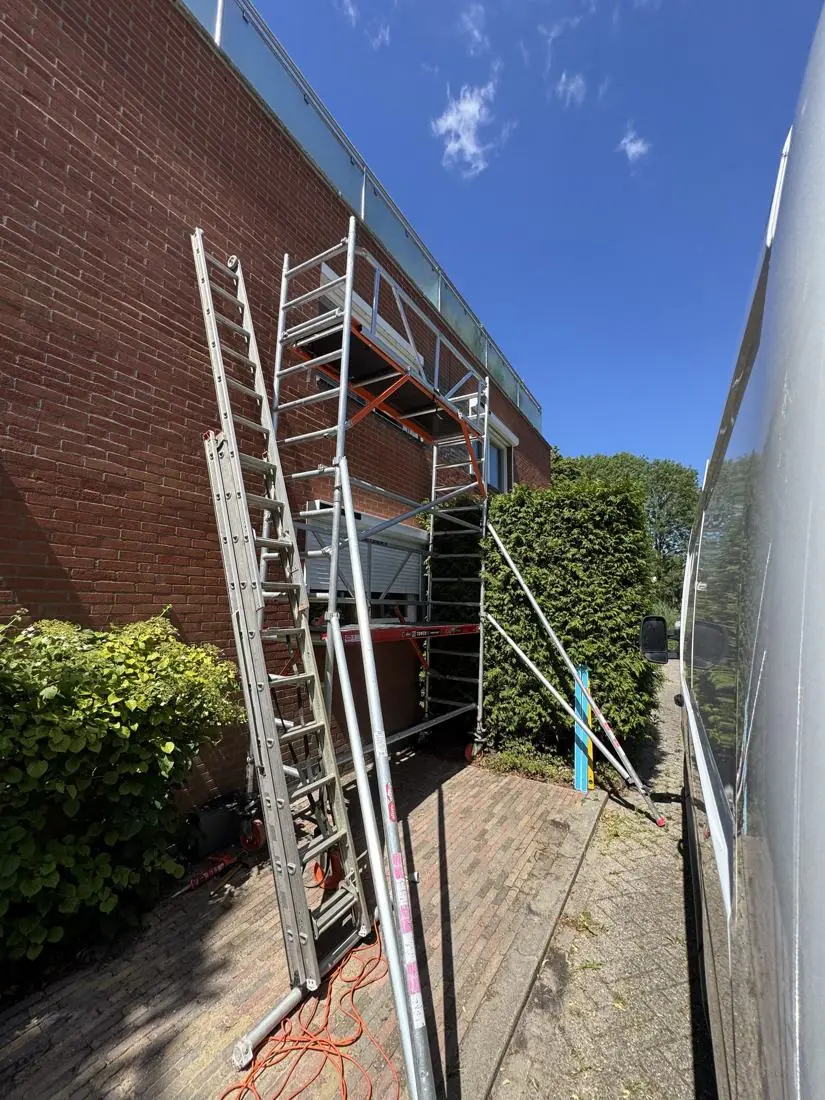
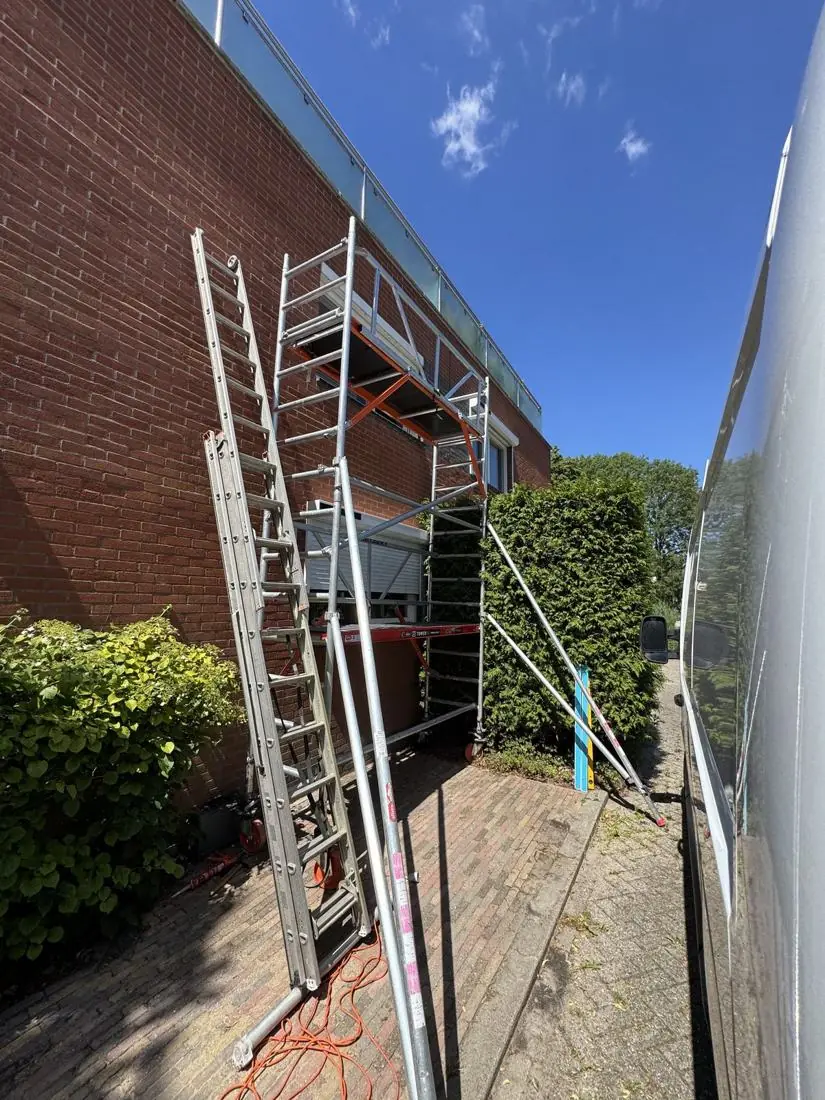
Erected mobile scaffold in a narrow side passage, with two extension ladders leaning on the brickwork next to it

Choosing tight is not only about reach here. You have to open and close the window while standing beside it, and that works only when the handle sits at a comfortable height for you. Stay under it and you are reaching up to a catch you can barely see, and with a knife in your other hand that is no posture to hold for an afternoon. So take one stand more rather than one less when you settle the build.

Where the hired tower stands under an outward opening window

The set-up goes beside the window opening and not straight in front of it. A window that opens outwards describes an arc over the spot where you are standing, and if you swing the sash against your guardrail you can no longer get past it to the head. Go and look from inside first to see which way it opens and how far, then put the tower on the hinge side. The sash then swings away from you and the reveal stays clear for your hands.

Under upper windows there is rarely tidy paving. Usually it is a strip of soil with planting, a gravel path or a garden path falling towards the boundary. Put levelling plates or a couple of loose slabs under the castors as soon as one sinks, and check that again after a wet night. The stabilisers have to go out on all four sides, and that is just where a hedge, a water butt or the bin from next door tends to be standing.

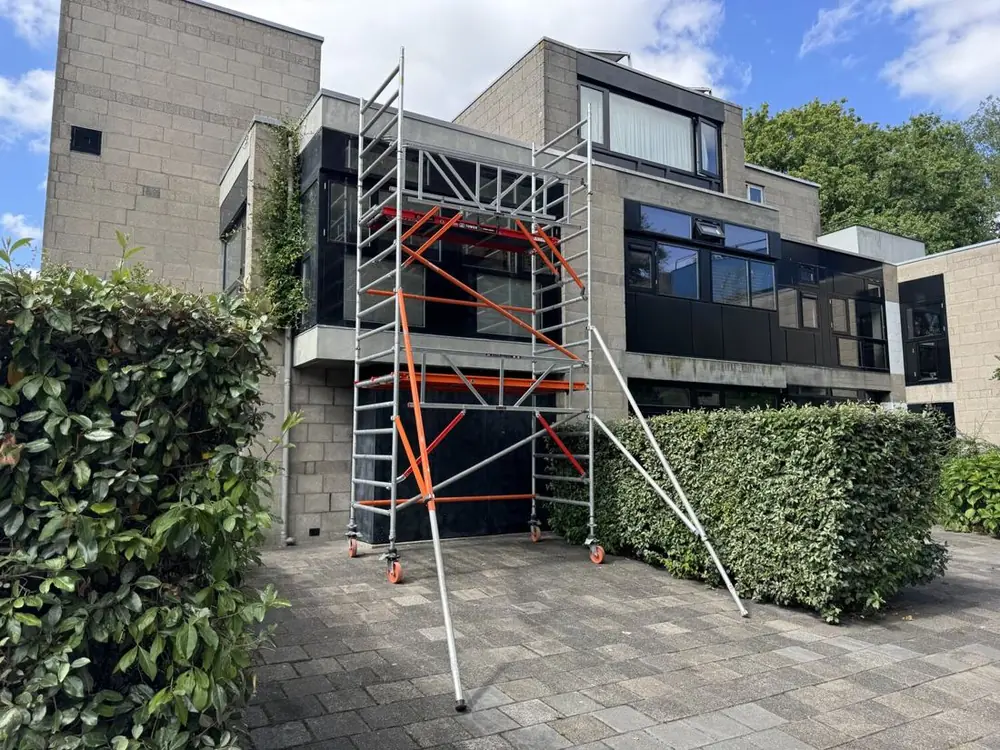
Stabilisers projecting from the foot of a hired tower on paving, the ground you keep free under an outward opening window

Look at what hangs below and above the window as well. A canopy over the front door, a roller shutter box, an outside tap or a satellite dish decide whether the tower just fits or just does not. Move planters and bicycles aside in advance, because replacing draught strips has you up and down more often than you expect. A clear path to the steps saves you a detour with tools in hand at every opening. For sloping ground the approach is set out at a set-up on uneven ground.

How many hire days to allow for replacing draught strips

Per window you spend half an hour measuring, cutting and pressing, with the paper test counted in. Six upper windows in a terraced house therefore fall inside a working day, provided the right section is already in the house. Moving the tower costs more time than the stripping itself: climbing down, stabilisers in, a few metres along, out again and checked over runs to a quarter of an hour, and you do that at every window.

Even so you are better off reserving two days. If the rebate at the first window turns out dirty or damaged, cleaning, sanding or even a repair joins in and your whole plan slides. Switching from self adhesive rubber to a clamped section means a groove has to be routed first, which costs a serious slice of extra time per opening. Rain counts too, because a wet rebate will let no self adhesive strip hold at all.

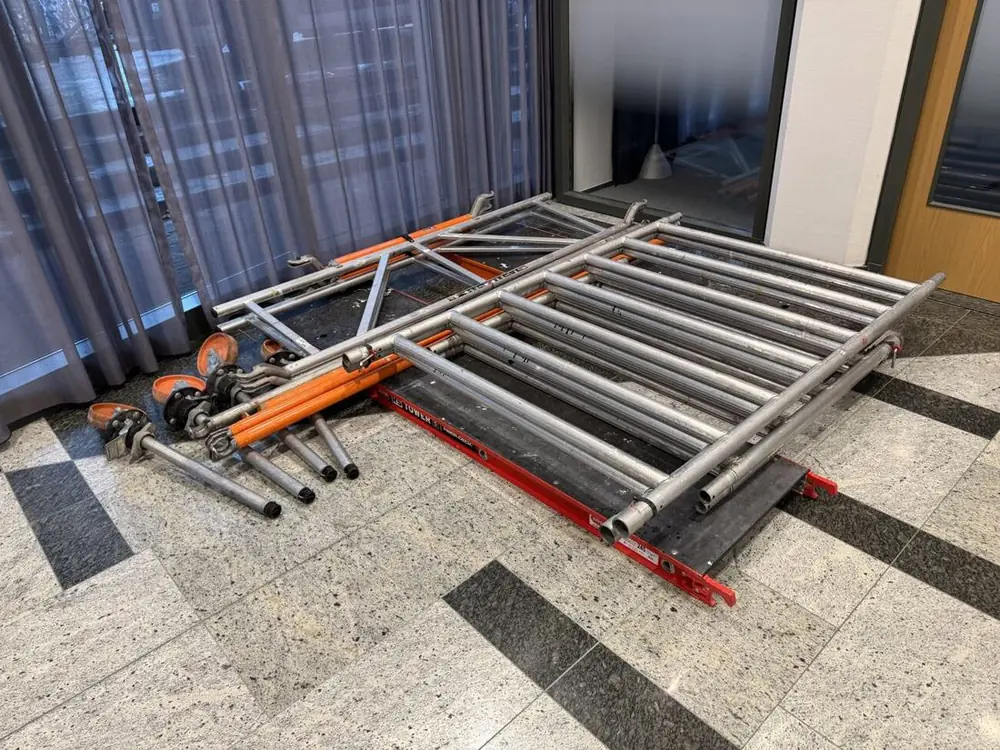
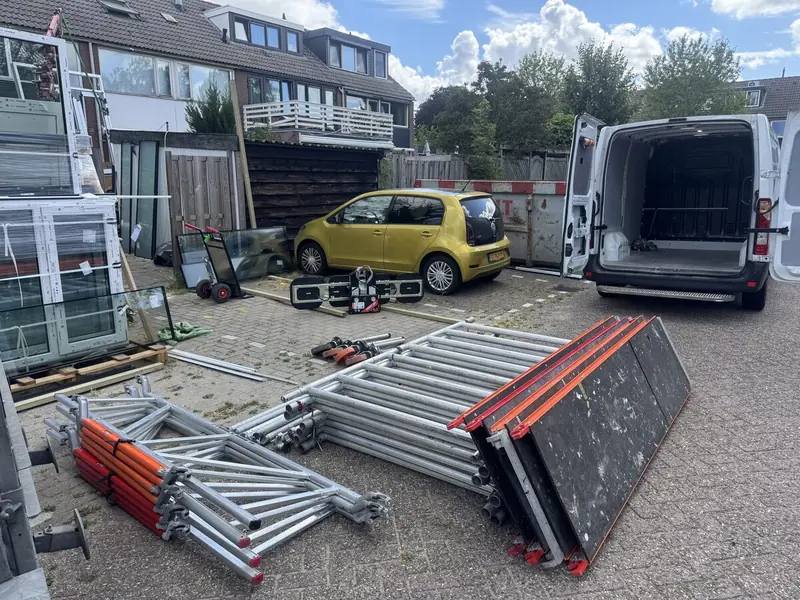
Scaffold frames, castors, orange braces and a red edged deck laid out on a tiled floor, a set counted before hire

The shape of the tariff helps you there. A spare date barely registers on the bill, because after the opening day the rate falls by 95 per cent, so a reserve day next to your working day is the cheapest insurance against an afternoon of drizzle. Booking short is the expensive option, since a second visit means a second build. Replacing draught strips is one of the few jobs where the moving eats the day rather than the work. How others judge such a period is at a breakdown of typical hire lengths.

Which mobile scaffold suits replacing draught strips?

Kamersteiger RS44
  • Working height up to 4 metres
  • Compact and narrow
  • Great for indoor and small jobs
View and calculate →
Smalle rolsteiger RS51
  • Working height up to 14.2 metres
  • Narrow (75 cm)
  • Ideal for narrow passages
View and calculate →
Brede rolsteiger RS52
  • Working height up to 14.2 metres
  • Wide platform (135 cm)
  • Extra stability and workspace
View and calculate →
Most chosen
1-persoons steiger MiTower
  • Working height up to 6.2 metres
  • Very compact
  • Quick and easy to assemble
View and calculate →

Replacing draught strips from the platform: measure, cut, press

Start with the paper test before you pull anything off. Lay a strip of paper between the sash and the rebate, close the window and pull on it: if the paper slides out without resistance, the strip no longer seals at that point. Do that all round at four or five points, because a window seldom shuts equally well everywhere along its perimeter. Then measure the gap itself with a feeler gauge or a thin lath, since that figure sets the thickness of the section you need.

Then the choice between two systems. A clamped section sits with a spine in a routed groove in the reveal and stays there for years; where the groove already exists, the new section simply clicks in. Self adhesive rubber goes on the flat part of the rebate and wants a background that is clean, dry and free of grease. Take the old strip out completely, adhesive residue included, or your new one is half off within a season.

Assembled tower standing in a narrow passage against brickwork, the sort of stand you work one window frame from

Work the whole perimeter of a window before you move the tower on. With a platform of 245 cm an average frame is within reach complete, including the top corners where you want the section to meet in a tidy mitre. Cut the pieces a shade longer than the measured length, because a strip that ends up just short lets the draught straight back through in the corner. Test with paper again before shifting the tower along to the next opening.

Hiring a scaffold with delivery for an afternoon at the windows

The tower is dropped at your home as a set of loose parts, counted and checked beforehand. Find a place for that stack in advance: on the drive or along the fence it lies fine, but not directly under the window you mean to start at, or you will be stepping over your own components while building. The ordering deadline sits at 15:00 on working days, and an order inside it is delivered the working day after.

You state yourself when the parts may come and when they may go again. With draught strips that is mainly a question of picking dry weather, since self adhesive material wants a dry rebate and a rainy Wednesday is a lost hire day. Assembly is yours to do, with a manual in the set and the instruction video alongside. Pick a settled half week and the tower simply waits for the dry morning. The steps are described at the step by step assembly guide.

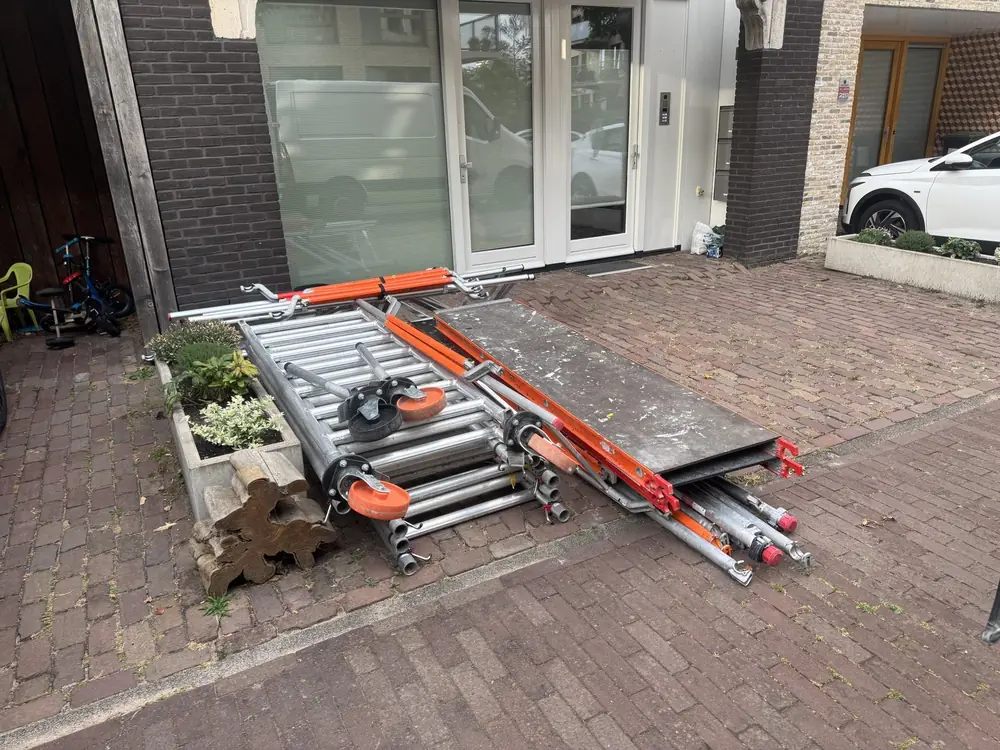
Frames, deck boards, braces and stabilisers set down on block paving outside a pair of tall glazed garden doors

Once the last strip is bedded in, the tower comes apart again and everything is laid ready where the van can get at it; collection happens on the day written into the reservation. Count the components through while striking, because a small connector vanishes among the shrubs under a window in no time. Wipe the deck boards off if you have been walking through the planters, so the whole set goes back clean and the count is quick.

Safe hire and safe work beside a window that swings open

Load class 3 in EN 1004 allows two hundred kilogrammes per square metre of platform. On this job you stay far under it, because you plus a bucket with a few rolls of section weigh next to nothing. That does not mean you can leave things lying loose up there: a knife and a roll of tape going off the edge are the genuine risk here. More about those limits is at the load figures for a mobile scaffold deck.

Brakes go on all four castors before anybody climbs, and the tower rolls along only once the deck is empty of tools and people. On this job a rule joins in that you meet nowhere else: never shift the tower while the window stands open. A sash hanging outwards can hook behind the guardrail and travel with it, which costs you the window and your balance in one go. Shut it, climb down, then move along to the next opening.

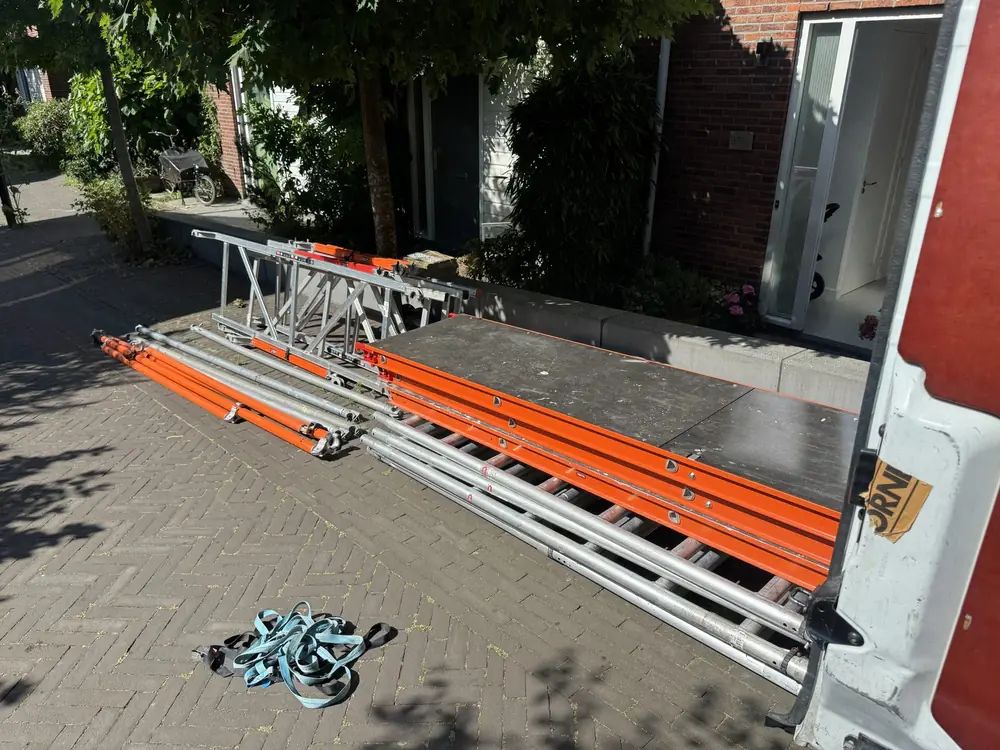
Braces, frames and a deck laid on herringbone paving at the open back of a white van, lashing straps alongside

Wind deserves extra attention, because an open window catches it like a sail. In a stiff breeze a sash slams shut or swings wide, and that happens at the moment your fingers are in the rebate. Stop work in a hard wind even though the job itself looks harmless, since a broken hinge is a repair you do not want on top. Keep the ground under you clear as well, because tools land on a path where people walk.

In 5 steps

How hiring a mobile scaffold works

1
Choose working height

Pick the height that suits your job.

2
Book online

Sorted in 60 seconds, price shown instantly.

3
We deliver

At the agreed spot the next working day.

4
Assemble safely

Assembled by you, with a manual.

5
We collect

One call and we collect the scaffold.

Good to know

Practical tips for replacing draught strips

1

Do the paper test at four points on every window: top left, top right and halfway up both stiles. A window drops over the years, so the bottom can still shut while the top corner has been letting draught through.

2

Take a piece of the old strip to the shop rather than only writing a size down. The profile shape differs by make, and a spine that is slightly different will not sit in the existing groove.

3

Cut all the pieces for one window to size on the ground and carry them up together. That way you climb on once per window and keep your knife on the platform in the bucket beside you.

4

Begin at the window that shuts worst rather than the one nearest your set-up. Within half an hour you then know whether you bought enough section for the whole elevation and can still fetch more.

5

Leave the window shut with the handle down while the strip beds in. The rubber then takes the shape of the gap as the adhesive grips, which beats adjusting afterwards with the strip already stuck.

6

Set the tower so the handle comes at hip height. On this job you open and close a window dozens of times, and a catch above your shoulders turns that movement into a task of its own.

Frequently asked questions

Frequently asked questions about replacing draught strips

Which scaffold should you hire to replace draught strips at upper windows?+

The MiTower fits best here: a tower of 75 cm calculated for a single user, ordered in the 4 to 6 metre bracket. You need little material aloft, so a large platform earns you nothing, while a narrow scaffold does slot between the border and the wall. On top of that you shift it from window to window on your own. Check the tightest point on the route to the elevation you begin at before booking, because that decides the width you can get to the wall.

How do you arrange the hire of a scaffold for stripping windows?+

Online you settle which tower and which build stage, say when delivery may come and when we take it away again, and see at once what it costs including VAT. The scaffold arrives in parts, you build it along the wall, work down the windows and then strike it. We take the set back on the agreed day. Nothing more has to be arranged than picking a dry day for the work itself, since replacing draught strips waits on the weather rather than on us.

How many days do you hire for a row of upper windows?+

Six windows go in a working day if the section is ready and the rebates are clean. Even so you do better to reserve the scaffold for two days, because a dirty or damaged rebate costs extra time and rain stops work with self adhesive material altogether. If you are routing a groove for a clamped section, count on a second day. Hiring wide is cheaper here than stopping halfway. Replacing draught strips is a job you would much rather finish inside one hire period.

What does the hire come to and what changes after day one?+

The rental price of the scaffold comes out of the chosen model and how high you build; bringing and taking away sit together in a fixed amount that differs per province. At the current hire rates per model you see all the figures including VAT. On a job of this shape the tariff works in your favour: the first day carries the greater part and every day after it hardly counts, which leaves room for a spare date without the total moving much.

Which working height do you hire for draught strips on the first floor?+

A reach of 4 to 6 metres does for nearly every upper window in a family house. Take your measurement from the spot the castors will occupy up to the head of the highest window, because your strip has to run round there. If your front garden falls towards the pavement, measure at the lowest bit, or you hire a scaffold that comes out just short. The working height overview lays out what each build stage gives you in reach on a tower this size.

Does the scaffold come to you or do you fetch it from the depot?+

Delivery runs throughout the Netherlands, with the outward and return journeys settled as one item. If you would rather drive, an agreed pick up slot at Zeeburgerpad 89, 1019 AD Amsterdam costs nothing whatever, as long as your transport is long enough. For a job of a day many people still take delivery, because the hired scaffold then only has to be carried from the pavement to the wall and the car stays free. Measure the boot or the trailer before you decide to fetch a set yourself.

Do you put the scaffold together yourself when you hire it for this?+

Yes, erecting and striking are in your name. We bring the parts complete and take them away again, but the tower comes upright through you, with the video and the paper instruction as a guide. At this height that takes you about an hour, alone as well. System scaffolds, fixed façade scaffolds and cherry pickers you will not meet in our range, so for work at upper windows hiring a mobile scaffold is the route to take and usually the quickest.

Can you hire longer if a rebate has to be repaired first?+

Yes, an overrun is usually no trouble. Give us a nudge and we set the collection day later, unless the scaffold is scheduled elsewhere after you. With older frames it regularly happens that rot or lifted paint appears under the old draught strip and you want to deal with that first. So put an extra day into the reservation in advance, because a half finished elevation is an awkward place to stop. Handing it back sooner is allowed as well, so a roomy booking ties you to nothing.

How much room does hiring a scaffold under a swinging window need?+

Allow the width of the tower, add the swing of the stabilisers and bear in mind the arc an outward opening window describes. In a front garden that often means bicycles gone, planters aside and the wheelie bin a few metres further along. Look upwards as well, at a canopy or a roller shutter box. Walk those points before the scaffold arrives, because shifting everything midway costs more time than replacing draught strips at a window does.

What do you do if it rains on the days you hire the scaffold?+

The scaffold can stay standing, but the work cannot go on: self adhesive material only bonds on a dry, clean rebate and a wet reveal makes every strip worthless. With a clamped section in an existing groove you can sometimes carry on under a canopy above the window. Otherwise wait for a dry half day and use those hours to take old strips and adhesive residue off. You fix the collection day yourself, so such a delay stays inside a single extra hire day.

How is the deposit settled if you want to hire this tower?+

You settle a deposit at booking; once the returned scaffold has been checked over we transfer that amount within one working day. On this work it is mostly about completeness, since small connecting parts vanish among the planting when you have been standing in a border under a window. So count the parts as you strike and glance into the border. A quick look under the window costs a minute. At the explanation of the deposit refund the rest is described.

Can you take in every window of the house in one hire period?+

Usually you can, and it is precisely why a tower gets hired for this job instead of a ladder being shuffled about all afternoon. As long as you stay within the reach of the tower you work down the whole front elevation, moving it a few metres per window. For the rear elevation measure separately whether you can get round with the parts. Do plan an extra hire day for it, because the shifting takes more time than the stripping and a rear elevation adds its own stands.

Hire a mobile scaffold for replacing draught strips today?

Calculate your rental price now or ask for free advice.

Rolsteiger van SteigerTaxi geleverd op locatie
Book it online

Your scaffold sorted in 2 minutes.

Choose your scaffold and working height, see the price instantly and book online.