
See your price
Application

Inspecting roofing? Choose the right scaffold.

Inspecting roofing is not about the whole roof but about the layer itself: the seams between the sheets, the bonded edges along an upstand, blistering and places where water stands. You judge that from close up, with your eyes half a metre away and both hands free for your phone. For a flat roof section on the second storey you hire the wide mobile scaffold of 135 cm, booked at 8 to 12 metres of working height. One rental day is usually enough, and below is how to divide it.

  • Order before 3 pm, delivered tomorrow
  • Professional Altrex scaffolds
  • Up to 14.2 metres working height
  • Easy to assemble yourself
4,2 tot 14,2 mWorking heights available
12Provinces served
7Days a week
200 kg/m²Load class 3
In short
  • For inspecting roofing we recommend the Wide mobile scaffold.
  • For roofing on the second storey you hire the wide RS52, with a working height somewhere between 8 and 12 metres.
  • You are judging the layer itself: seams, laps, bonded edges at the upstand, blistering and spots where water stands.
  • One to two rental days will do, because you apply nothing and repair nothing; you look and you record.
  • First 24 hours from €175 incl. VAT and delivery; every day after that 95% off.
Key facts for this job
FeatureValue
Recommended scaffoldWide mobile scaffold (Altrex RS TOWER 52)
Working height for this job8 to 12 metres
Available working heights4.2 to 14.2 metres
StandardEN 1004, load class 3 (200 kg per m²)
DeliveryOrdered before 3 pm, delivered next working day
Each extra day95% off, from €8.75 a day
Why a mobile scaffold for inspecting roofing?

Safe, stable and professional work at height

You do not judge a roof covering with binoculars from the ground, nor from a single drone photograph. A seam beginning to let go is a line a few millimetres wide, a blister under bitumen only shows when you look across it at an angle, and whether a bonded edge along the upstand still holds you notice by running a careful finger along it. So you hire a mobile scaffold that puts you at eye level with the roof edge: you stand still, your hands are free and you can take your time. That calm, unhurried looking is half the work on any roofing inspection, and no ladder will give it to you.

  • Seams and bonded edges judged from close up
  • Blistering only shows in raking side light
  • Eyes just above the upstand of the roof
  • Short rental period, since you repair nothing yet
Read more about working safely →

Which mobile scaffold to hire to view roofing close up

For this inspection the RS52 is the model to pick: an Altrex tower with a floor 135 cm wide. Judging a roof covering, you often stand up there in twos, one leaning over the edge and pointing, one noting or photographing. On a narrow floor you swap places the whole time. On top of that you lean forwards over the upstand for this work, and then a deep floor with your feet planted well behind you is a good deal more comfortable.

The platform length of 245 cm sets how much roof edge you can go along per build. That is just enough to look at a run of seams and a stretch of bonded edge in one go, without moving halfway and losing the thread. Bring a moisture meter, a scraper and a torch and they lie beside you rather than in your coat pocket, which saves fiddling at height. What else stands ready is shown at the mobile scaffolds you can hire by the day.
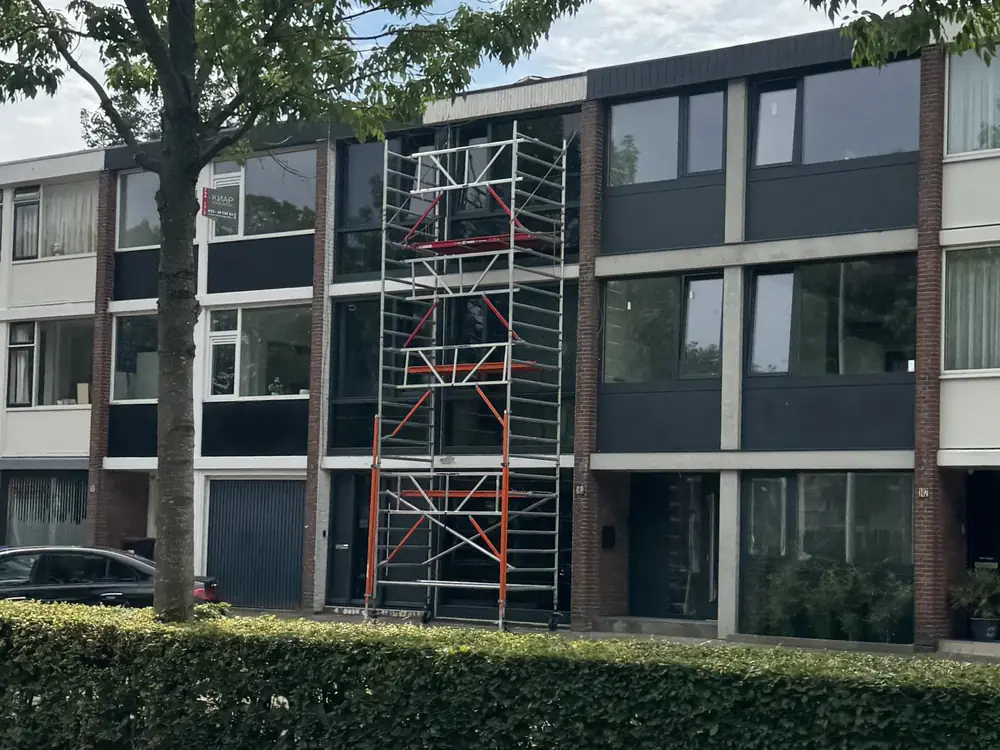
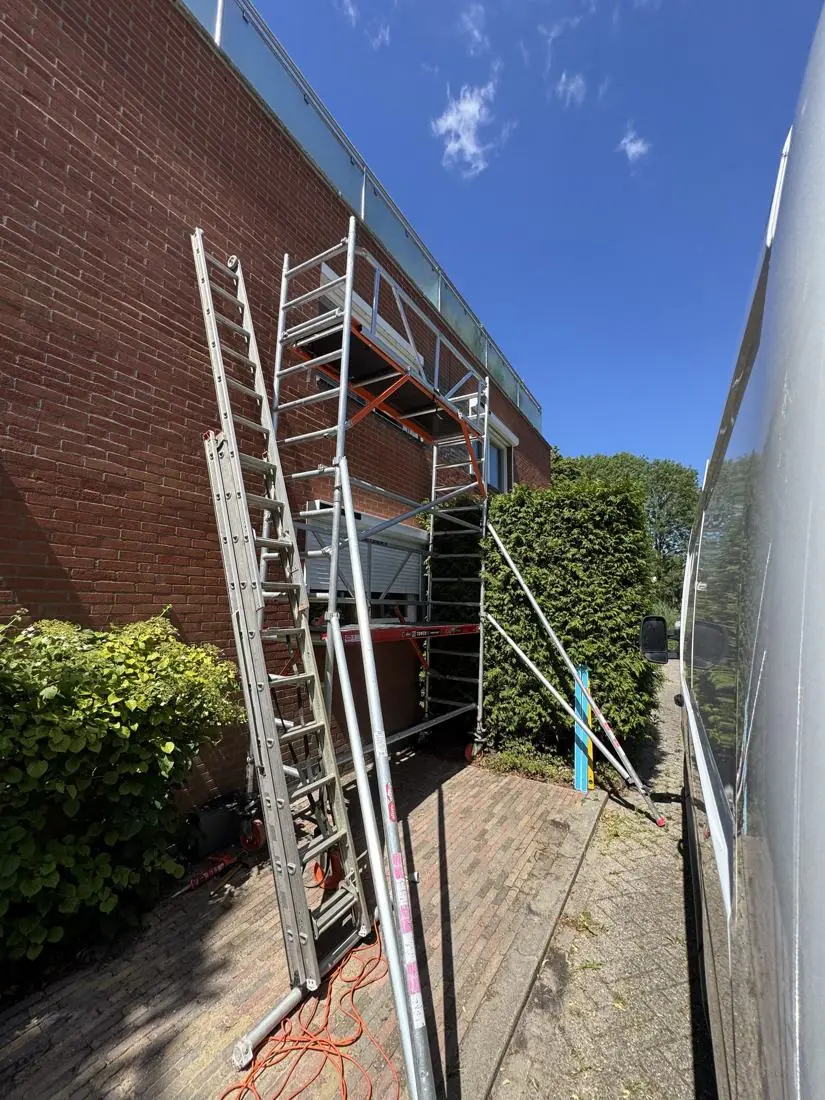
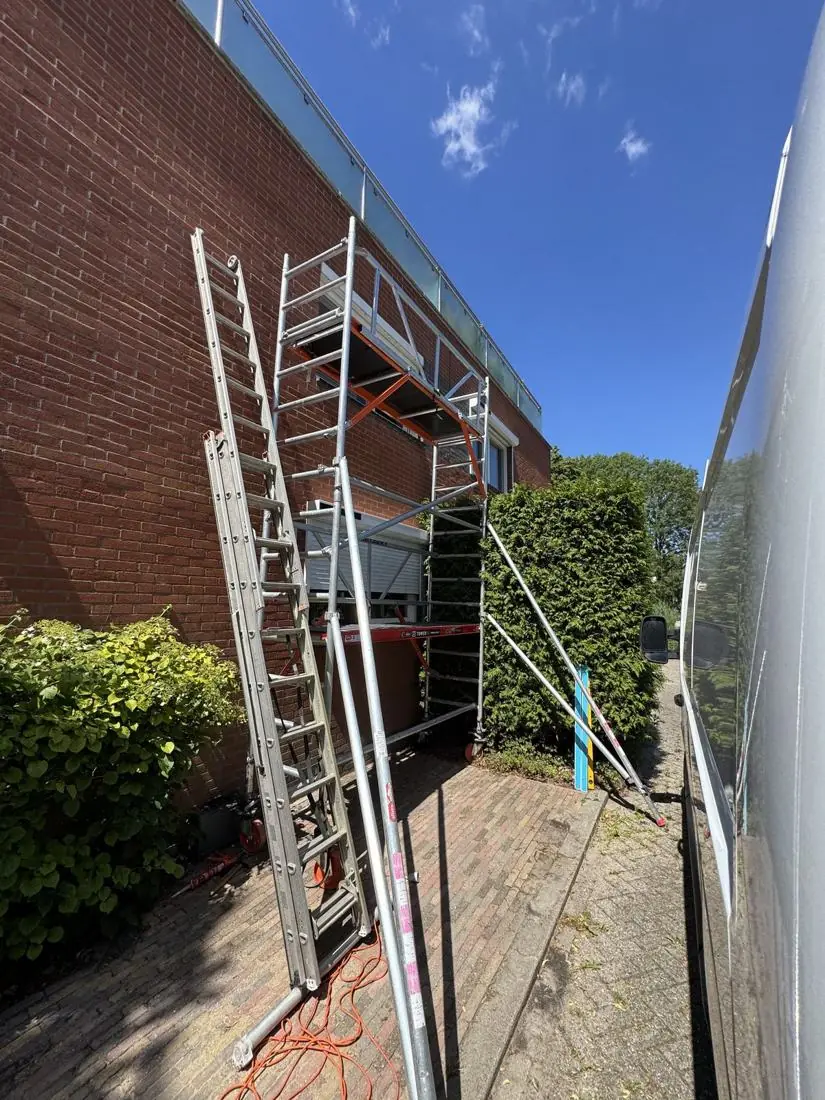
Wide mobile scaffold built alongside a house, the steady place from which roofing is judged at close range

If the flat section sits on an extension or garage only one storey high, the one person MiTower with a working height to 6.2 metres is enough and you work with fewer parts. For a dormer or a flat roof on the second storey it falls short. The slim RS51 at 75 cm stays the alternative when the way through to the back is tight, and the RS44 room scaffold you hire purely for indoor work at limited height.
Which working height to hire to judge the roof covering

Your highest measuring point on an inspection is the top of the upstand or the roof edge trim, because that is where the covering starts and where it most often goes wrong. For a flat section on the second storey that sits at 8 to 12 metres of working height. If it is the small flat roof of a dormer, measure up to that little roof rather than to the ridge of the main roof, or you hire more build than you actually use.

To get from height to build you use the usual relation: your platform stands about 2 metres of reach below the working height you state. On an inspection, though, it is not about reaching but about seeing, so look for the setting where your eyes come just above the roof edge. Stand too high and you look straight down on it and miss the blistering entirely. Which build belongs to that is set out on the page about 10 metres of working height.

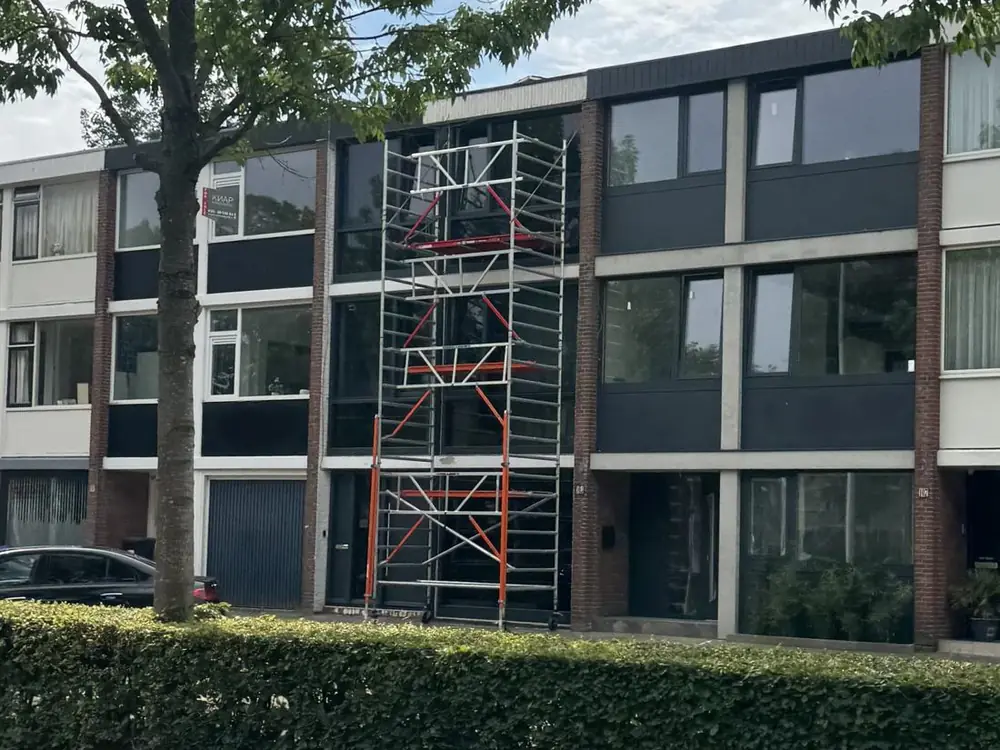
Mobile scaffold built along an elevation to roof edge height, the level at which seams and upstands are judged

Choose too tight and the assessment stops halfway. You see the surface but not the joint where the covering runs up against the wall, and that is precisely where water gets in. So measure from the spot your build will stand on, and remember that a terrace or a sunken garden puts your starting point lower than the pavement at the front. In doubt you hire the height above, because an assessment you cannot finish costs you the whole day.

Where to stand the hired tower along a flat roof

Flat roof sections are rarely on the street side. Usually you are looking at an extension at the back, a bay beside the kitchen or a dormer to the rear, which makes your position the back garden or the path along the boundary. Walk that spot before you hire the mobile scaffold, because at many houses that is precisely where the obstacles sit: a shed, an outdoor air conditioning unit, a water butt or a raised terrace.

The ground has to be flat and carry the weight, including after a night of rain on it. Slabs and bricks are suitable, a lawn with a molehill in it is not. Around the foot you need room on all sides for the stabilisers, which stick outwards and must not end up half in a border. Half a metre of play all round is no luxury. For a sloping terrace or a settled path, see setting up on uneven ground.

Stabilisers folded out at the foot of a tower on slabs, holding the build still while you inspect

Think about the route there as well. The parts have to go from the drop off point to the back, and a gate of 80 cm then decides more than the size of your garden. If a wide set will not pass, you would rather hire the slim version than lift everything over the fence. If part of your build ends up on the terrace next door, ask beforehand and not on the morning of your inspection.

How many days to hire for a roofing inspection

An inspection is short work, and that makes this job different from most. You apply nothing, you have nothing to wait for and there is no drying time. For one flat section or a dormer you are usually through in a single day, building, looking, photographing and dismantling included. If you want to go along several sections, or the build has to move to the other side of the house, you hire it for a second day.

Even so that one day is tightly planned if you really only hire it for a day. The building takes half a day, and if it rains that morning you are looking at a wet covering on which cracks and loose seams are hard to see. Better then to book two days when you hire: the first to build and start, the second to finish calmly and take it apart without having to watch the clock all afternoon.

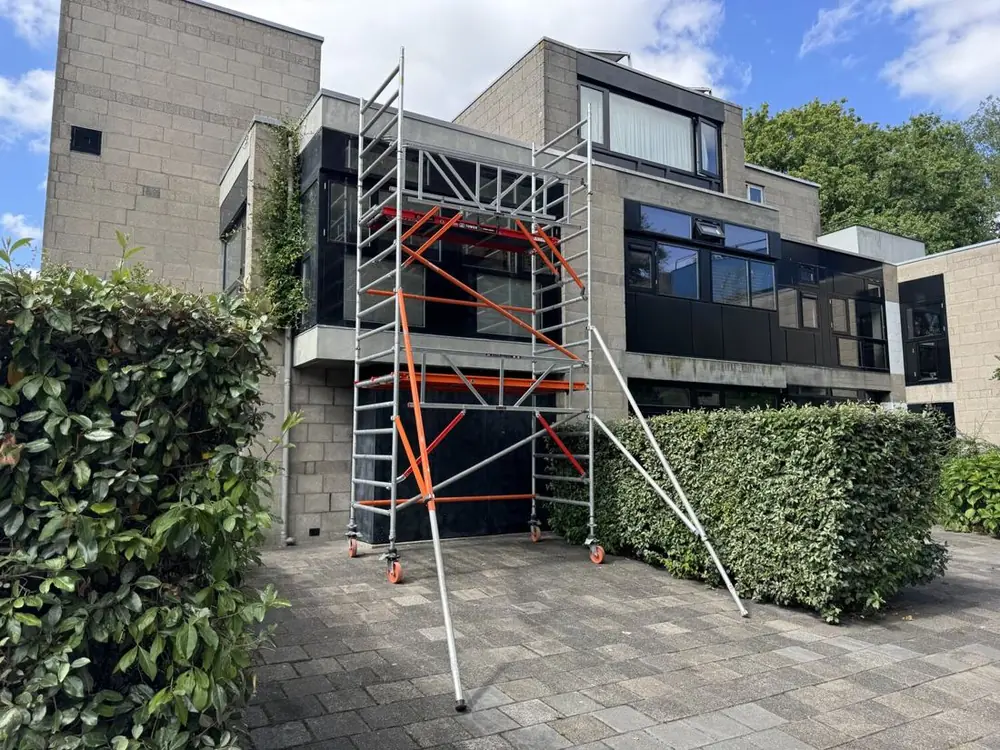
Mobile scaffold built along a side elevation, the short standing position you keep up for one inspection day

That costs less than you would think, because the full rate covers the first 24 hours alone, and a discount of 95 per cent applies to every day you add behind it. For a short job like this the second day effectively runs along free, while it gives you the room to go up once more when you have doubts about a photograph. See as well what stands in the piece on how long to keep a scaffold.

Which mobile scaffold suits inspecting roofing?

Kamersteiger RS44
  • Working height up to 4 metres
  • Compact and narrow
  • Great for indoor and small jobs
View and calculate →
Smalle rolsteiger RS51
  • Working height up to 14.2 metres
  • Narrow (75 cm)
  • Ideal for narrow passages
View and calculate →
Most chosen
Brede rolsteiger RS52
  • Working height up to 14.2 metres
  • Wide platform (135 cm)
  • Extra stability and workspace
View and calculate →
1-persoons steiger MiTower
  • Working height up to 6.2 metres
  • Very compact
  • Quick and easy to assemble
View and calculate →

What the platform shows you of seams and bonded edges

From the floor you go over roughly two and a half metres of the roof edge for each build, and you do that in a fixed order. Begin at the upstand against the wall, move on to the bonded edge and the trim along the rim, and only after that look out across the surface. Stroke a seam with a flat hand rather than pulling at it, because a seam still closed feels tight while one letting go gives under your fingers.

Blistering only shows when the light falls across the surface at an angle, so look low over the covering instead of straight down at it. Watch for pools left standing after a shower, for gravel that has blown away and for the point where a rainwater outlet is starting to silt up. Be honest about the limits of this workplace: from the tower you take in the roof edge and the first few metres, but the middle and the far corner stay out of sight.

Mobile scaffold against an elevation with the deck at roof edge height, the workplace for a precise inspection

Where this job often goes wrong is the difference from an ordinary roof survey. With inspecting the whole roof you look at tiles, lead, chimney and gutter, while here you judge only that one layer and sit far closer to your work. As a result you stand longer in the same place, move the tower less often and hire it for a shorter period, but per metre you look far more precisely than on a walk round the whole roof.

Rental and delivery for a single roofing inspection day

You get the mobile scaffold supplied in parts, counted and complete, and you put it together yourself. On a short job the planning therefore matters more than on a long one: book the delivery for the day before your inspection, so you are not waiting for the van while it happens to be dry outside. A booking that is complete before 15:00 on a working day lands on your pavement the next working day, ready to build.

The assembly is your part: with the manual and the accompanying video to hand, two people are busy for half a day. You decide yourself on which date the set is brought and on which date it goes away again, so you can put your inspection on the first dry day of the week. That is the biggest advantage of hiring by the day here: you tune the build to the forecast and not the other way round.

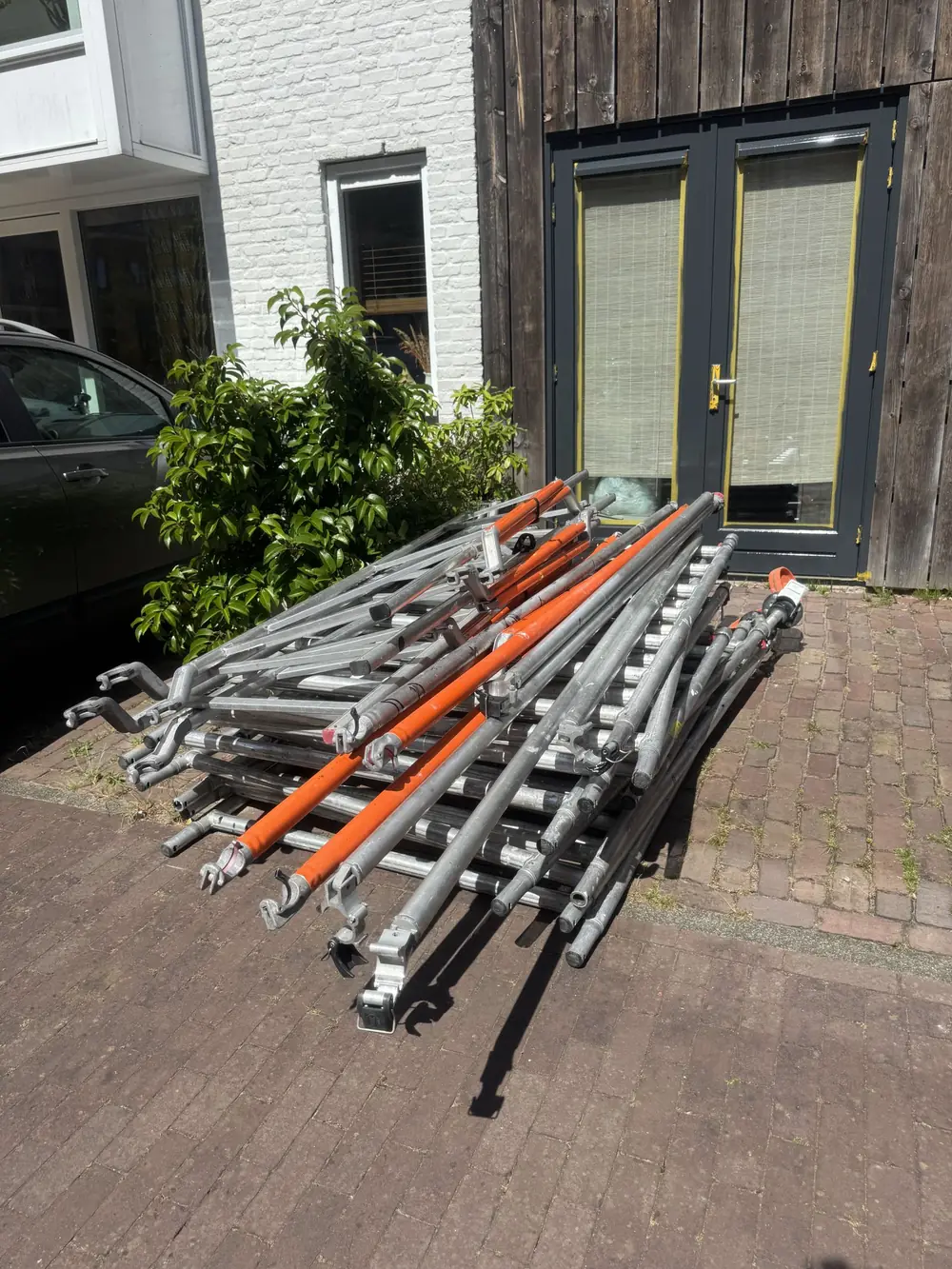
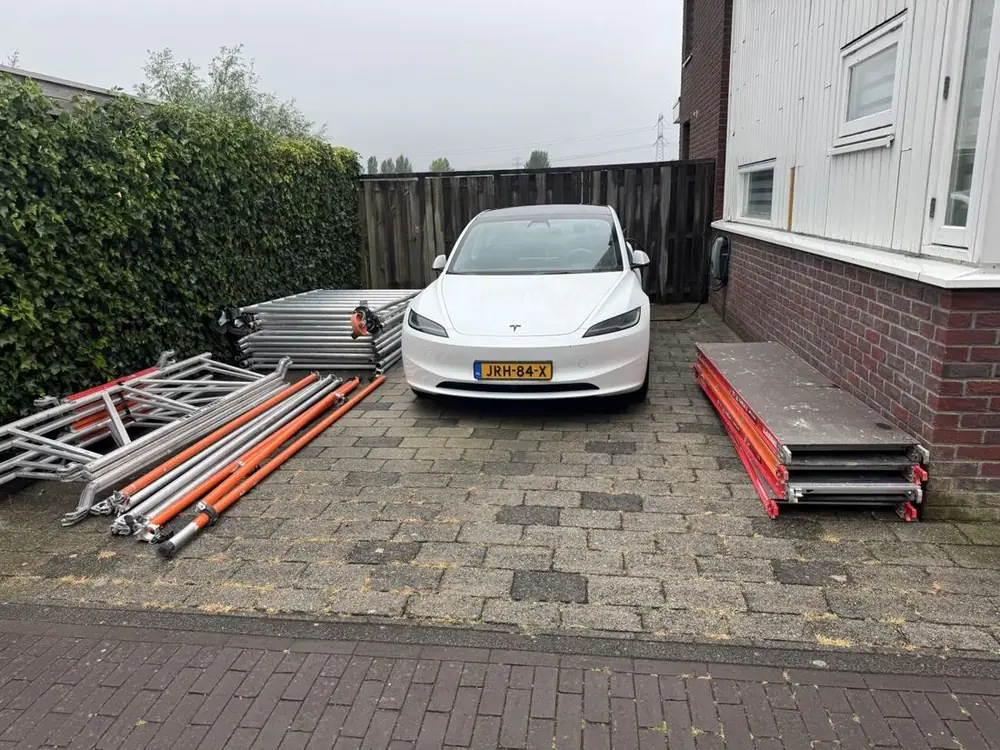
Counted scaffold parts delivered at the door of a house, the set you build your inspection tower from

Afterwards you take the build down again and put all the parts together, after which we collect them. On an inspection that is quickly done, because nothing has got dirty and no material has been left behind. Go along the parts as you take them apart and you can be sure nothing has stayed lying among the plants. What the run out and back comes to is stated with the cost of delivery in your province.

Staying safe while inspecting roofing at ten metres

According to EN 1004 this mobile scaffold belongs in load class 3, with a permissible floor load of 200 kg per square metre. On an inspection you come nowhere near that, because you carry only a phone, a lamp and some hand tools. It is exactly that light work which tempts people into sloppiness: they step on without braking the wheels because they will only be up there briefly. Do not, not even for that one photograph.

So brake the wheels the moment you step on, never move the build while anyone or anything is on it, and set the stabilisers properly again after every move. In hard wind an inspection does not go ahead, because you lean forwards over the edge on this work and you do not want a gust in your back. A day of postponement is rarely a problem, certainly not when you already fixed a second day at the hire.

Mobile scaffold with guard rails and an inside ladder, the way up to your viewing spot at the roof edge

The risk belonging to this job is over reaching. You want to see that seam two metres further along as well, and then your upper body goes over the guard rail. Move the tower along instead, one extra build. Nor should you step off onto the roof for a better view: on the scaffold you stand within rails, on a bitumen surface you are protected by nothing. What else applies is in the rules around working at height.

In 5 steps

How hiring a mobile scaffold works

1
Choose working height

Pick the height that suits your job.

2
Book online

Sorted in 60 seconds, price shown instantly.

3
We deliver

At the agreed spot the next working day.

4
Assemble safely

Assembled by you, with a manual.

5
We collect

One call and we collect the scaffold.

Good to know

Practical tips for inspecting roofing

1

Take an overview photograph of the whole roof section first and only then the details. Without that overview you no longer know afterwards whether the loose seam was left or right of the outlet.

2

Bring a torch, even in bright weather. Under a curled bonded edge and behind an upstand it is dark, and that is exactly where you see whether water has already stood underneath.

3

Inspect a day after a decent shower rather than after a dry week. Pools still lying on the covering show you precisely where the surface has too little fall towards the outlet.

4

Tie your phone to your wrist with a cord before you look over the roof edge. A device falling ten metres is gone, and with your photographs your whole inspection goes with it.

5

Write your findings down while you are still up there, with the place noted beside them. Reconstructing afterwards from memory which seam you meant costs more time than the writing itself.

6

Ask for a second day straight away at the hire if the forecast is changeable. Wet roofing gives a distorted picture, because everything gleams and small cracks simply do not stand out.

Frequently asked questions

Frequently asked questions about inspecting roofing

Which mobile scaffold do you hire to inspect roofing?+

The RS52 is the obvious one here, a mobile scaffold with a floor width of 135 cm, ordered on a working height of 8 to 12 metres for a second storey. On an inspection you are often up there with two people and you lean out over the roof edge, and then you want a wide floor under your feet. If the flat part sits on a low extension, the MiTower will do. Where the passage to the back is narrow, you hire the RS51 at 75 cm.

What is involved in hiring when you only need one day up there?+

You choose the model and the working height at the booking, give a delivery date and a collection date and settle at once against a fixed price including VAT. The parts of the mobile scaffold come to you, you build, do your inspection and set the dismantled set out again for us. For a job of one day the order matters most: delivery a day earlier, inspecting on the dry day, and dismantling calmly afterwards.

Is one day of hire enough to go over the roof covering?+

Often yes, but tightly. Building the tower takes half a day and after that you still have to look, photograph and dismantle. For one flat section you manage that on a long, dry day. If there are several sections, or the build has to go to another side of the house, reckon on two days. Because an extra day of hire costs little here, most people choose that wider margin anyway.

What does hiring a mobile scaffold for a roofing inspection cost?+

The rental price hangs together with the model of tower and the working height you state, and besides that you pay a fixed amount per province for bringing it and taking it away. All the figures are given including VAT on the price page. On a short job you mainly notice that the first day weighs heaviest: taking another day to wait out the weather costs a fraction of that.

Which working height do you hire to view a flat roof from close by?+

Measure to the highest point of the upstand, or of the trim along the rim, because that is where your eyes want to be. On a second storey that gives 8 to 12 metres, the size at which you hire the tower. For a dormer, measure to the top of its own little flat roof. Look for the setting where you just see over the edge, not the highest one. The page with working heights shows the build per height.

Does the tower come to me or must I collect it myself when I hire?+

That is entirely your choice. Have it delivered and the mobile scaffold arrives on your chosen date and goes back with the van afterwards; bringing and fetching costs a fixed amount per province. Would you rather collect it, collection by appointment at the Zeeburgerpad in Amsterdam is free of charge, as long as the load fits in your vehicle. For a job of one or two days having it brought is usually handiest.

Do I have to assemble the mobile scaffold myself after hiring it?+

Building is your own job. The parts arrive complete and go back afterwards, but between delivery and collection you are in charge. With two people, the description and the video, that costs half a day. System scaffolds, facade scaffolds and cherry pickers do not appear in our range at all. For an inspection along a roof edge a mobile scaffold is nicer anyway, because you stay standing quietly and steadily in one place.

What if the inspection runs over and I want to hire the tower longer?+

Then we move the collection date, provided the tower has not already been promised to the next hirer. When inspecting roofing it regularly happens that you find more than expected and then want to look at a second section as well. Do tell us the same day and we will arrange it before the collection run. The reverse works too: finished early, you hand it back early with no strings.

How much space has to be free to set the scaffold down?+

You need the footprint of the build plus the room in which the four stabilisers stick out, and besides that a clear route for carrying the parts to the back. In a back garden you quickly run into a shed, a raised terrace or an outdoor unit. Clear that route before the delivery arrives, because moving a half built tower is laborious and costs you the dry part of your day.

Is it worth hiring if it stays wet for those days?+

For building the tower rain matters little, for the inspection all the more. Wet roofing gleams, so small cracks and starting blisters drop out of sight, and a bonded edge feels different when it is wet. Better to wait a day. Because you set the collection date yourself, you simply keep that extra day, and a day after the shower you also see exactly where water stands on the surface.

How does the security sum run when you hire for a single inspection day?+

A deposit is charged at the booking; once the returned scaffold set has been counted, that amount is back with you within a working day. On this looking work it rarely leads to discussion, because no sealant or primer is involved and the aluminium stays clean. Do go and find the small parts: a brace or a wheel brake disappears into the gravel easily. More is in the note on the security sum.

Can I go straight on to a repair after the inspection?+

You can, but it is a different job with a different rhythm. For repair work you need material, tools and sometimes a gas torch on the platform, and you then hire the mobile scaffold a few days longer. Many people inspect first, order the right material afterwards and plan the repair as a separate rental period. To do it in one go, book generously straight away and count on dry weather.

Hire a mobile scaffold for inspecting roofing today?

Calculate your rental price now or ask for free advice.

Rolsteiger van SteigerTaxi geleverd op locatie
Book it online

Your scaffold sorted in 2 minutes.

Choose your scaffold and working height, see the price instantly and book online.