
See your price
Application

Staining façade cladding? Choose the right scaffold.

Staining façade cladding stands or falls on dry timber. The stain has to sink into the grain, and it only does that when the boards are dry through and no shower lands on them in the first few hours. That makes the forecast, rather than your free weekend, the thing that sets your dates. For a timber elevation across two storeys you book an RS51, 75 cm wide, in a build that comes out at 6 to 8 metres. Below is what that hire involves in practice and how many days to allow.

  • Order before 3 pm, delivered tomorrow
  • Professional Altrex scaffolds
  • Up to 14.2 metres working height
  • Easy to assemble yourself
4,2 tot 14,2 mWorking heights available
12Provinces served
7Days a week
200 kg/m²Load class 3
In short
  • For staining façade cladding we recommend the Narrow mobile scaffold.
  • For staining façade cladding you take the narrow RS51 of 75 cm, hired in a build that reaches 8 metres.
  • You carry on along the length of the boards, so where your set-offs fall decides how often you reposition the tower.
  • Book four to six rental days and lay them in a dry spell, because damp boards simply will not take stain.
  • First 24 hours from €150 incl. VAT and delivery; every day after that 95% off.
Key facts for this job
FeatureValue
Recommended scaffoldNarrow mobile scaffold (Altrex RS TOWER 51)
Working height for this job6 to 8 metres
Available working heights4.2 to 14.2 metres
StandardEN 1004, load class 3 (200 kg per m²)
DeliveryOrdered before 3 pm, delivered next working day
Each extra day95% off, from €7.50 a day
Why a mobile scaffold for staining façade cladding?

Safe, stable and professional work at height

On this job the timber sets the planning and the scaffold sets the execution. You have to walk a full brush along a board from one end to the other without stopping halfway, because an edge that has already pulled comes back after drying as a dark stripe. That asks for standing still at the right height and for shifting sideways, and neither of those works from a ladder you also have to hold on to. On top of that the bottom row of boards sits differently from the top row. Hiring a scaffold for façade cladding is therefore about height, about stand positions and above all about dry days in a row.

  • Working the full length of every board
  • Dry timber before the first coat goes on
  • A reach of 6 to 8 metres over two storeys
  • Set-offs at a joint or behind a downpipe
Read more about working safely →

Which mobile scaffold to hire for staining façade cladding

Timber boards are seldom on the easy side of a house. More often it is a side elevation, a rear elevation or a gable above an extension, and the route runs past a fence or through a gate. That is why the Altrex RS51 at 75 cm is the model here: it gets to places where a wide tower jams, and you push it along on your own. Which builds go with which model is listed on the page for mobile scaffold hire.

Very little goes up with you: one tin of stain, a stirring stick, a broad brush for the face and a narrower one for the seams and the end grain. For that kit a wide deck is beside the point. What you do notice is the platform length of 245 cm, because it sets how many running metres of board you carry on across before you climb down and move. Every centimetre of length is a gain on this job, every centimetre of width is not.
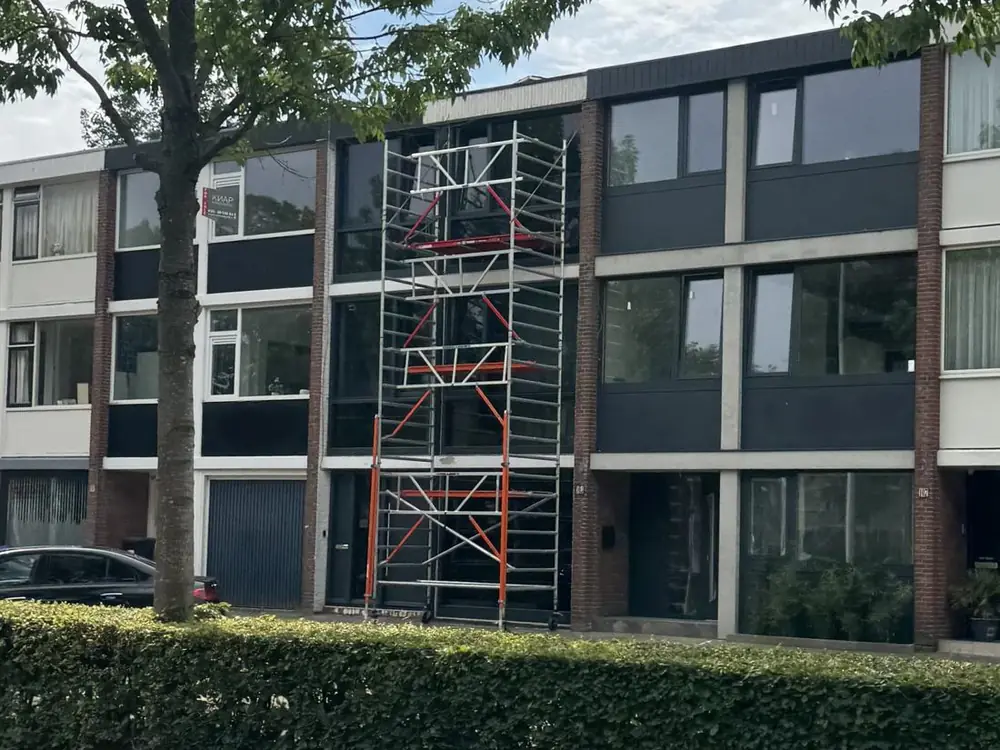
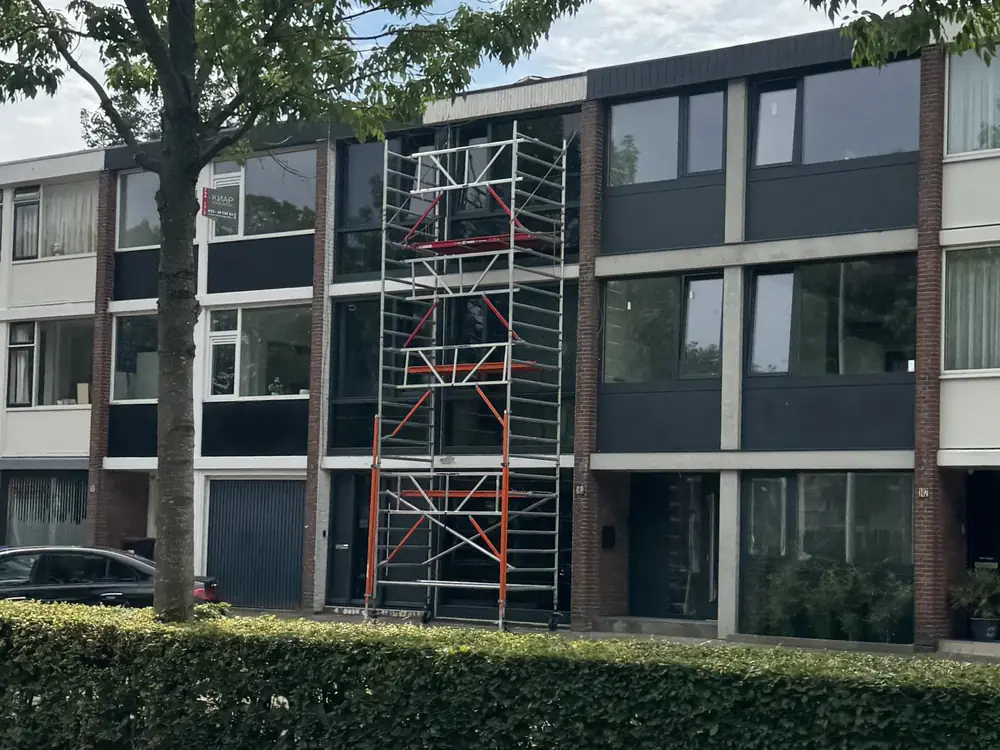
Narrow mobile scaffold standing at the front of a house, the stand timber boards get stained from along their length

A wide tower of 135 cm, the RS52, gives you less for staining than you would think. Two people on one deck get in each other's way lengthwise, and it is wiser for each to take an elevation of their own. If filler, abrasive paper and a vacuum have to go up alongside the stain, then that extra room does become welcome after all. For the approach face by face, read on at the page about staining a timber elevation.
Which working height to hire for cladding over two storeys

Your highest point is the top board, and that usually finishes under the fascia or behind a bargeboard. Measure to there and not to the roof tiles, because the roof edge itself belongs to another job. If the cladding carries on up into a gable, count that peak in. Two storeys bring you to somewhere between 6 and 8 metres of reach, and with that figure in your hand you fix the build when you hire.

Your platform then lands somewhere between four and six metres above the ground. The difference with your reach is what you cover standing up: allow around 2 metres of reach with a brush in your fist. Keep the distinction clear, because the RS51 as a model handles 14.2 metres, and that number is about the structure and not about what ends up in your garden. Your build stays far lower, as you can see at a working height of six metres.

Mobile scaffold built up to just under the fascia along an elevation, the reach that timber cladding over two storeys asks for

Choosing too low costs you more here than on other paintwork. Stand under the top row and you stain with your arm stretched up, the stuff runs down the handle into your sleeve and you get an uneven, streaky top edge that shows from the pavement. You also miss the full length of a board in one movement. Take half a metre too much rather than too little, and measure from the path where the wheels will stand, not from the terrace.

Hiring a mobile scaffold and standing it along timber cladding

Timber elevations usually look out over the garden, and a good standing place is scarcer there than at the street side. Under your boards lie borders, a strip of gravel or grass that sinks after a shower. The four stabilisers point outwards at an angle and all four want something firm underneath, so put a paving slab or a stout board under each wheel where you need to. If the ground still slopes, the explanation about uneven ground gives you a workable answer.

Unlike insulation work, here you want to stand close in to the timber. The tip of your brush has to get into the seam between two boards and strike over the bottom edge, and that only works while the tower stays within arm's reach. Do keep enough air to avoid pressing the guard rail against a proud board. Around the foot you want a strip clear for tins, sheeting and a bucket of water, so you are not stepping over your own kit on the way down.

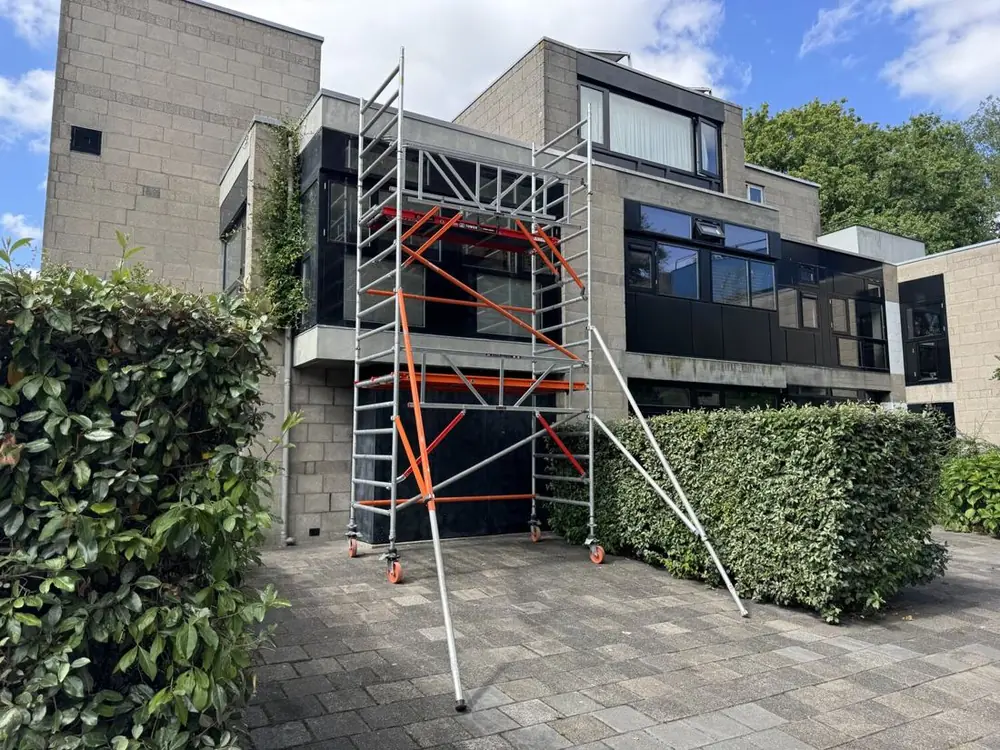
Stabilisers splayed out under a mobile scaffold, the four bearing points you set on firm ground in a garden

Sheet the ground under the stand with dust sheets or cardboard before you start. Stain is thin, it drips readily and it soaks into paving and decking boards just as well as into your elevation, and it does not come out again. Finally, walk round the obstacles that belong to a garden elevation: the water butt, an outside tap, the terrace canopy and the low branches of the hedge. Clear those away before the parts are delivered, not once your tower is half up.

Staining façade cladding: how many days to hire the scaffold

The first question is not how many days you need but when those days are allowed to start. Stain finds its way into the grain, and that only happens in timber that is dry inside. If it has rained for a week, give the boards two or three sunny days to dry out again before you put the first coat on. So do not pin your rental period to a calendar date but to a window in the forecast.

Only then does the work itself count. A front and a rear elevation over two storeys, in two coats, come out at four to six rental days with the waiting already in that figure. The first coat has to have sunk in before the second may go on, and a shower within a couple of hours means you do that band again. Reckon on a half day to put the tower up and another to take it down.

Mobile scaffold left standing beside a house, exactly what the extra drying days in a staining hire are booked for

That is exactly why booking generously is so attractive here. The whole rate covers your opening 24 hours, after which 95 per cent comes off every further day you add behind it. Two spare days for a turn in the weather therefore weigh next to nothing, while a tight booking leaves you with a half stained elevation and a second build later on. What cold and wet do to your planning is set out in the piece on hiring in winter.

Which mobile scaffold suits staining façade cladding?

Kamersteiger RS44
  • Working height up to 4 metres
  • Compact and narrow
  • Great for indoor and small jobs
View and calculate →
Most chosen
Smalle rolsteiger RS51
  • Working height up to 14.2 metres
  • Narrow (75 cm)
  • Ideal for narrow passages
View and calculate →
Brede rolsteiger RS52
  • Working height up to 14.2 metres
  • Wide platform (135 cm)
  • Extra stability and workspace
View and calculate →
1-persoons steiger MiTower
  • Working height up to 6.2 metres
  • Very compact
  • Quick and easy to assemble
View and calculate →

Staining along the length of the boards from the platform

A stained face gives away every interruption. So you work along the length of the boards, from one end grain to the other, and you keep the edge wet until you have reached the end of the plank. The awkward part is that a horizontal shiplap board nearly always runs longer than the 245 cm you face at one position. Decide in advance where you will stop, rather than finding out halfway along with a dripping brush and nowhere to put it down.

There are two workable answers. The first is to place the set-off deliberately on a vertical line: at a butt joint, behind a downpipe or against a corner trim, so the change falls away into something that is there anyway. The second is to carry on with two people in two positions side by side, with the second picking up the edge before it pulls. Moving the tower costs you five to ten minutes, and in that time an edge on a sunny elevation dries closed.

Mobile scaffold with the deck at height along a side elevation, the position from which 245 cm of boards is worked off

Work each stand from the top down and finish the full height of your position before you roll on. Anything that runs then lands on boards you have still to do. Take one tin up at a time and leave the rest below in the shade, because stain that warms up in the sun goes tacky. Do not underestimate the number of stands: eight metres of elevation already counts three to four positions, and with two coats you do every one of them a second time.

Scaffold hire and delivery at the start of a dry week

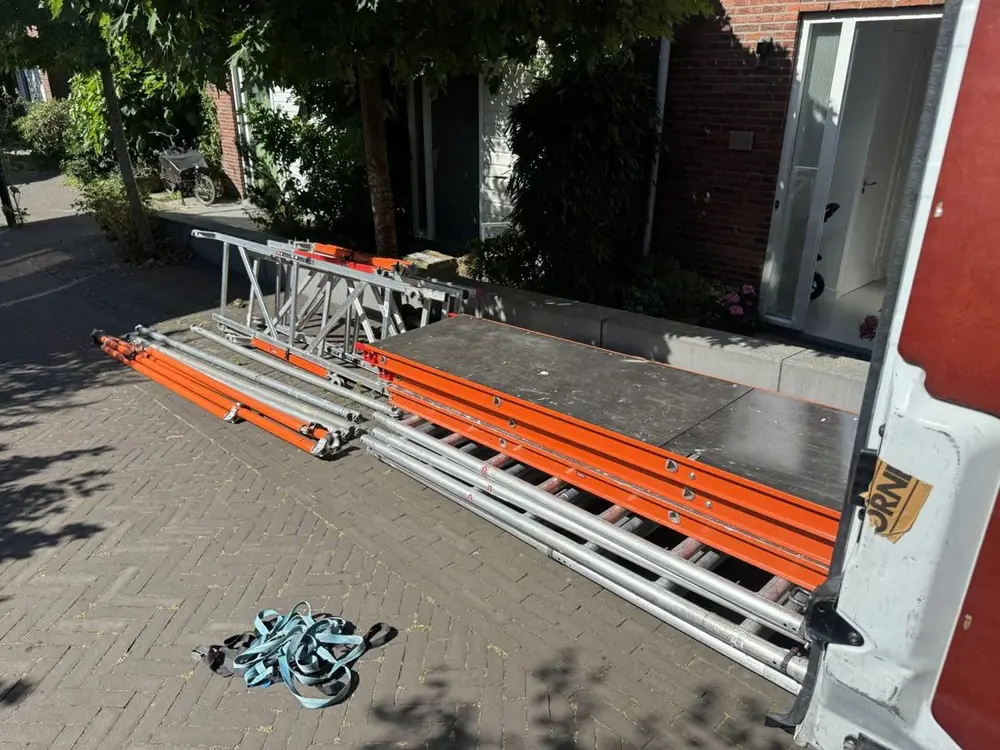
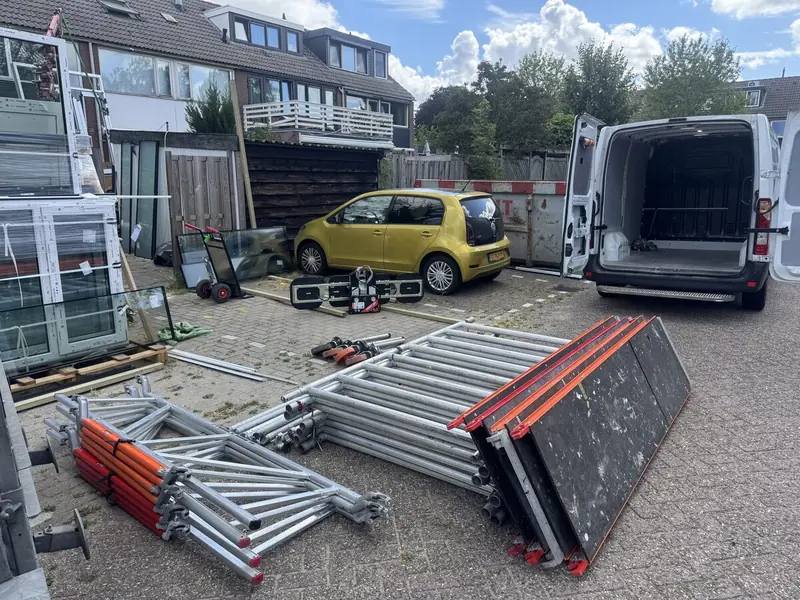
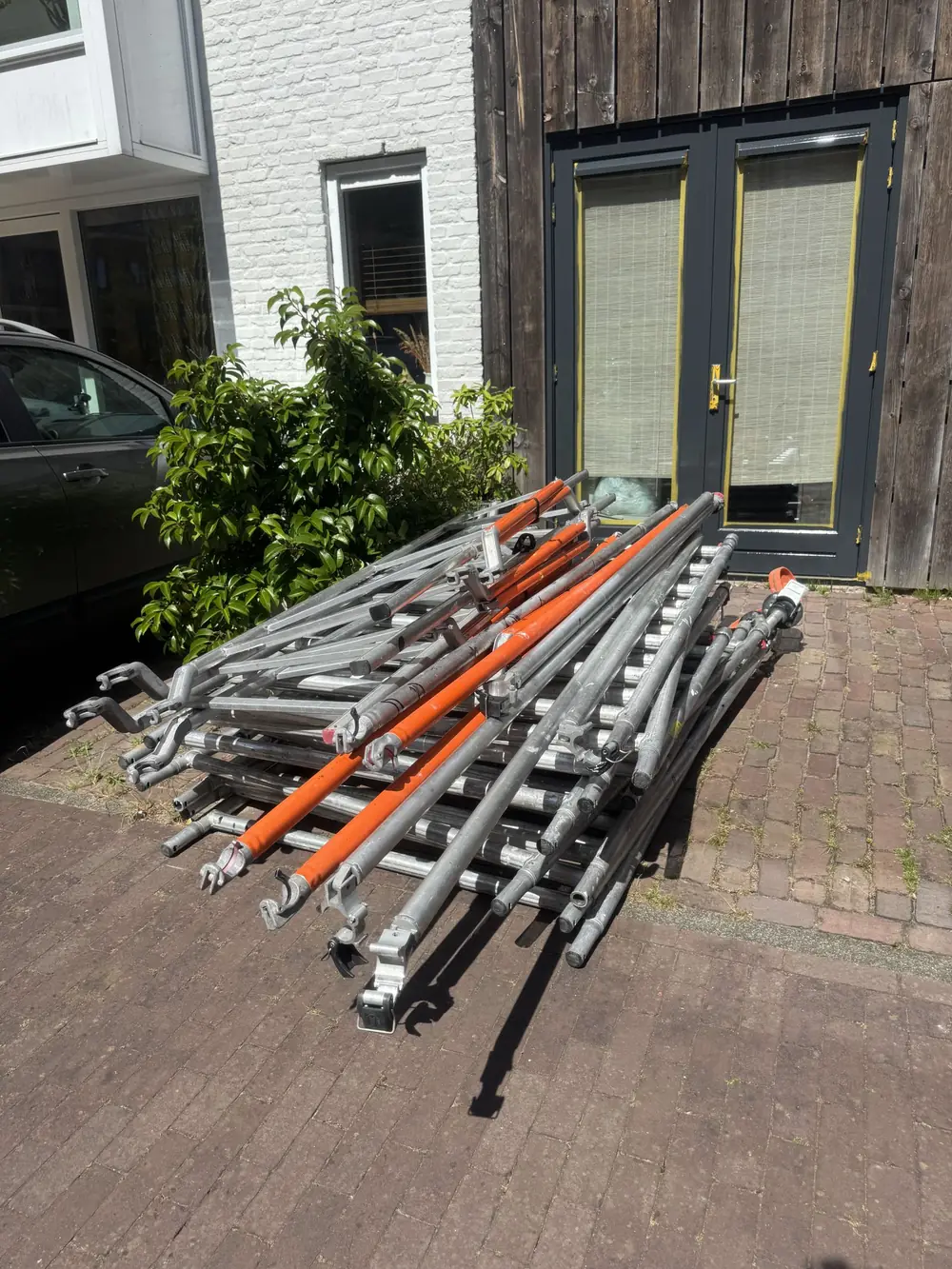
What turns up at your address is a counted set of loose frames, tubes and deck sections. Work out beforehand where that stack may go, and do not choose the strip under the cladding, because your sheeting goes there shortly. A driveway or a corner of the terrace works better. If your booking comes in before 15:00 on an ordinary working day, the set travels to your address the next working day and you can build that same afternoon.

You pick the date it is brought and the date it goes again, so let the delivery fall at the start of a dry spell. Put it a day before your first staining day and building does not eat into the weather you need. Assembly is down to you: a manual sits in the set and an instruction video runs through the order, and two people spend half a day on it. The step by step guide to building the tower runs through it all.

Scaffold parts laid out on the street ready to be built up, the delivery you plan for a dry staining week

Dismantling is your work, collection is ours. Wait until the last coat has sunk in, or you will drag a frame past a board that is still tacky and see that smear on it all summer. Count the parts off as you take them apart and lay the lot together somewhere the van can pull up to. What the run to your province and back comes to is set out clearly at the delivery charges per province.

Working safely on a hired tower along timber façade cladding

Load class 3 in EN 1004 tells you what your deck takes: two hundred kilos on every square metre. Staining rarely goes near it, because a tin of a few litres, a brush and yourself stay well under that limit. Only when someone stands with you and a box of sanding gear goes up does adding it up become worthwhile. With two of you above, spread the weight along the deck. What sits behind that standard is explained briefly in the article on this scaffold norm.

The fixed rules still hold on a quiet garden elevation. Put every wheel on the brake before you go up the ladder and never move the tower while anyone or anything is on it. After each move, fold the four supports out firmly again until all of them bear. When the wind gets up, put the work down: not only for the tower's sake, but because dust and grit settle into fresh stain and that board goes again.

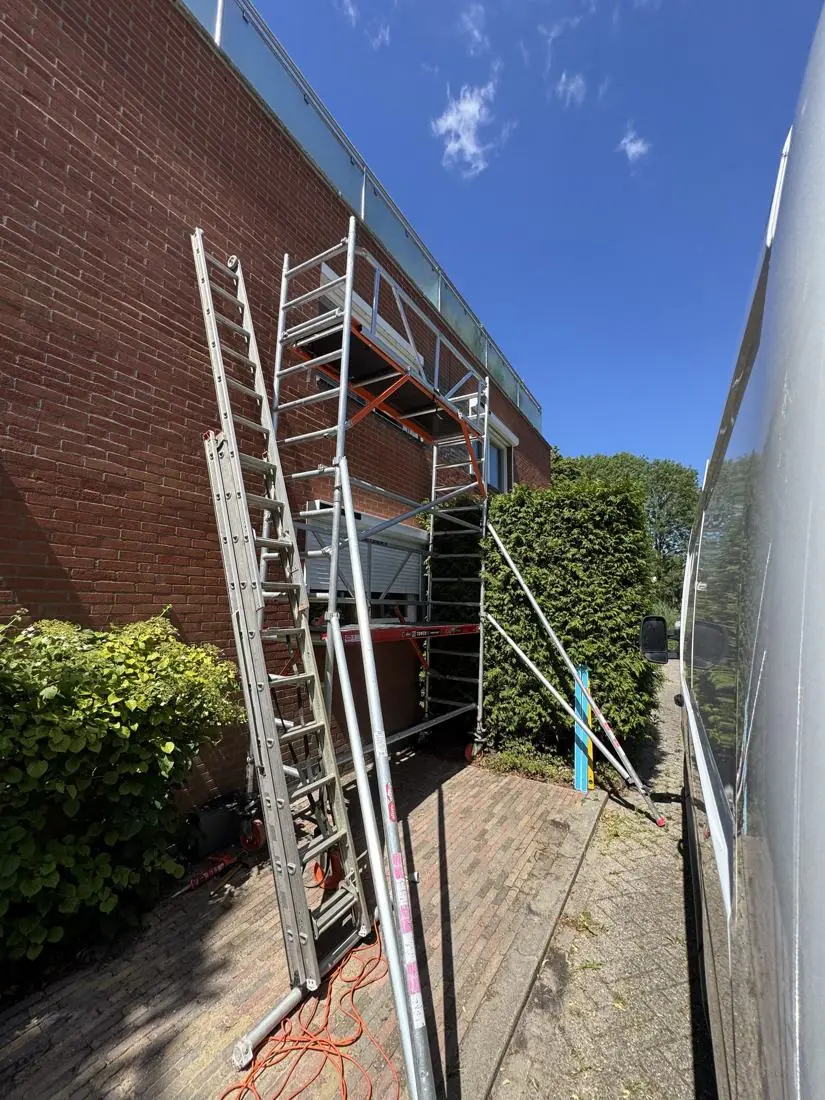
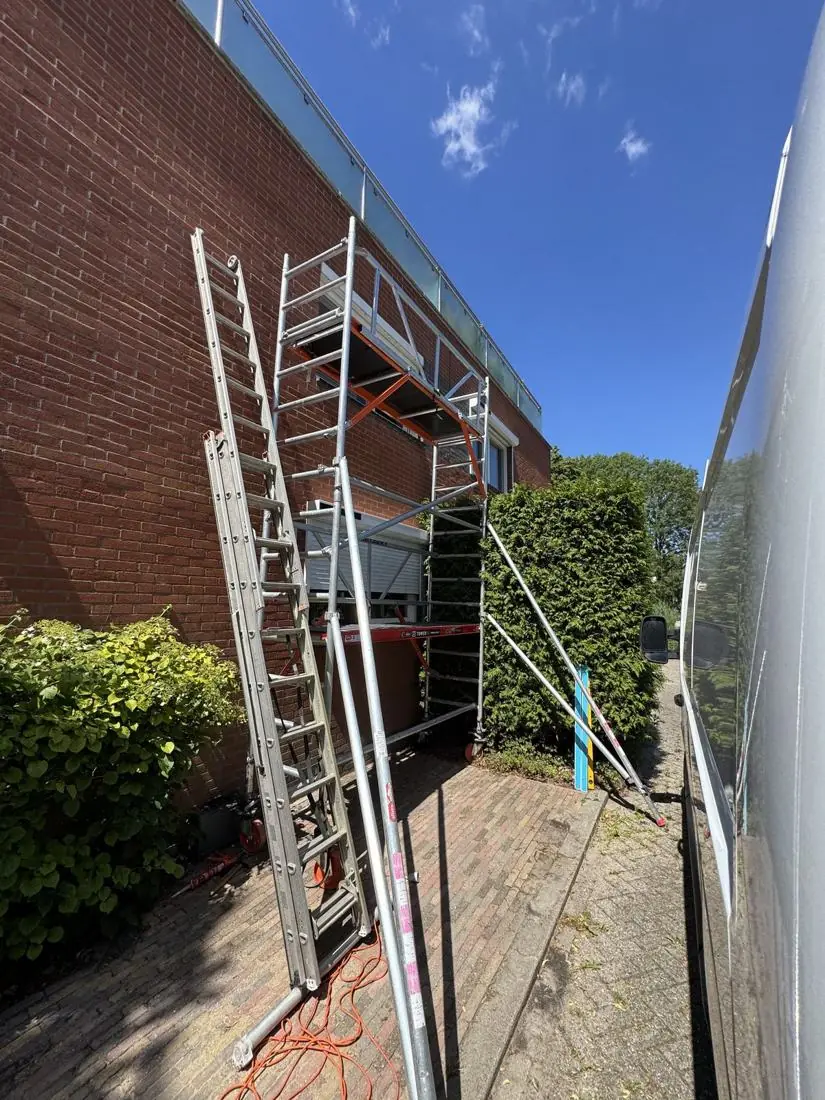
Mobile scaffold built against a brick elevation, a separate ladder resting on the wall, decks in load class 3 under EN 1004

The risk that belongs to this job is how thin the stuff is. Stain runs off your brush, down the handle and onto the platform, where it turns slippery without your seeing it happen. Lay cardboard down and replace it as soon as it feels wet, stand your tin in a tray or hang it from the guard rail in a bracket, and keep the strip below your deck clear of people. All the rules in one place are at the explanation of working safely at height.

In 5 steps

How hiring a mobile scaffold works

1
Choose working height

Pick the height that suits your job.

2
Book online

Sorted in 60 seconds, price shown instantly.

3
We deliver

At the agreed spot the next working day.

4
Assemble safely

Assembled by you, with a manual.

5
We collect

One call and we collect the scaffold.

Good to know

Practical tips for staining façade cladding

1

Push a moisture meter into a few boards on the shaded side before you order the tower. If the readings come out too high, move your delivery day instead of putting a first coat on wet timber.

2

Stir your tin through every time you go up. The pigment settles out, and boards you do with the bottom of the tin come out noticeably darker than the planks you took off the top.

3

Follow the shade round the house with your stand positions. A face in full sun lets the stain pull far too quickly, and then you get exactly the set-offs you were carrying on to avoid.

4

Check whether the bottom row of boards can simply be done standing on the grass. If it can, that saves a whole stand position per elevation and therefore time in the period you keep the tower.

5

Cut cardboard to size for the deck before you build. Hunting for a sheet up top with your tin already open does not work, and thin stain is everywhere within a quarter of an hour.

6

Only agree your collection day once the outlook for that week is settled. Two dry days after your last coat give you room to dismantle calmly and hand back clean parts to the van.

Frequently asked questions

Frequently asked questions about staining façade cladding

Which model of mobile scaffold should I hire for façade cladding?+

For timber boards over two storeys everything points to the RS51 at 75 cm. Cladding often sits on a side or rear elevation, and at that width you still get past a fence or through a gate to the back. Up top you do not miss the extra centimetres, because you work with one tin and two brushes. If there are two of you and sanding comes into it as well, a wider tower of 135 cm is worth considering when you hire.

How does hiring a mobile scaffold for a staining job actually work?+

You hire a mobile scaffold online by model and reach, mark your own delivery day and collection day and pay a fixed amount with VAT in it up front. We drop the counted set at your place and the tower is then yours for a few days: build it, work the elevation in bands, and lay it out dismantled on the final day. The only thing you have to plan sharply is the weather, because your first coat wants dry timber and a dry day overhead.

How many days do I need to rent the tower if I stain two coats?+

Two elevations over two storeys, in two coats of stain, ask for four to six days of scaffold hire with drying time counted in. If you are only doing a gable or one end wall, two days is sometimes enough. Allow half a day for putting it up and another for taking it down. If sanding or timber repair runs ahead, put those days in the same booking. Cladding on three sides heads towards a full week.

Why does an extra drying day barely add to the rental price?+

Because the rental price sits mostly at the front. The first 24 hours weigh heavily and every day you hang on it afterwards hardly at all, and on staining work that is worth its weight in gold: you let a wet day pass without your budget suffering. What you pay for a given model and a given build, plus the run for bringing and collecting, sits with VAT already in it on the page listing the prices. So book with room to spare.

What reach do I hire if the boarding runs up under the roof line?+

Then the top plank is your measuring point and not the roof edge above it. Over two storeys that gives 6 to 8 metres of reach, with a deck that comes out between four and six metres. If the timber carries on into a gable, measure to the peak. Which build of the mobile scaffold belongs to that, and how many frames it costs, is shown in the overview of working heights. Always measure from the ground where your wheels land.

Can the scaffold be delivered round the back or do I collect it myself?+

We unload the parts at a reachable spot at your house; carrying a mobile scaffold through to the back is your part, and that is precisely why the narrow 75 cm is so handy. If you would rather drive it yourself, you can load free of charge by appointment at our yard on Zeeburgerpad in Amsterdam. With a garden elevation, count on walking back and forth a good few times with frames and deck sections.

Do you build the mobile scaffold as part of the hire?+

No, building it falls under your work. We drop the tower off and pick it up afterwards, while putting it up, shifting it along and taking it apart stay yours, helped by the supplied instructions and a video showing the order. With two people it takes half a day, so plan those hours on a day when you cannot stain anyway. We hold no cherry pickers, no system scaffolding and no facade scaffolds, which leaves this mobile tower as the answer for the elevation.

What if the timber is still too wet and I want to hire for longer?+

Let us know and we will move your collection day, unless that same tower is already down to a following customer. On staining work this comes up more often than on other painting, because the timber decides when you may start. If you want to cover that risk, hang two days on the end straight away when you book. You set the final date yourself, and handing back a day early is fine as well, with nothing owed for it.

How much room do I need alongside the cladding for the tower?+

Count on the width of the tower plus the four splayed supports either way, with a further strip left open for sheeting, tins and a bucket of water. Along a garden elevation that usually means emptying a border for a while. Move planters, the water butt and the garden furniture aside before the parts are brought. Shoving a built up tower sideways halfway through costs you half an hour, and in that time your wet edge simply closes.

Can I keep the scaffold on hire if rain is forecast on my staining days?+

The tower can happily stay standing; only your work shifts. Fresh stain that gets wet within a few hours washes out of the grain, so you would rather wait a day. Use a day like that to sand, touch in end grain or set out where your set-offs will fall. Because the end date is in your hands, that kind of delay stays limited to one extra day of hire, and your stand can stay exactly where it is.

What happens to the deposit if there is stain on the parts?+

We transfer the deposit back within one working day of the return run, once the set has been counted and looked over. Dried stain on frames and deck sections weighs as heavily as a part that is missing, so wipe a splash away while it is still fresh. A rag and a bucket of water within reach on the platform save you half an hour of scrubbing on the last day of the hire. That way the refund stays a formality.

Do I need to hire a higher tower for the top boards than the bottom row?+

No, you hire one build for the whole elevation and work each position from the top down. That is exactly why you should not aim at the bottom planks when you order: finish half a metre under the top row and you are either building a second time or working the rest at full stretch. Take the reach that belongs to your highest plank and the rest of the cladding falls within reach by itself. One build always beats two.

Hire a mobile scaffold for staining façade cladding today?

Calculate your rental price now or ask for free advice.

Rolsteiger van SteigerTaxi geleverd op locatie
Book it online

Your scaffold sorted in 2 minutes.

Choose your scaffold and working height, see the price instantly and book online.