
See your price
Application

Staining a wooden facade? Choose the right scaffold.

Staining a wooden facade is mainly a question of surface area. Where a garden shed is done in an afternoon, here you stand at the same face for days, with a product that has to sink into the grain and therefore wants dry timber. If the boarding runs across three storeys, reserve an RS52: 135 cm wide, built to a working height of 8 or 12 metres. Below is why the broad deck earns its keep, how many hire days are realistic and how the forecast sets your delivery date.

  • Order before 3 pm, delivered tomorrow
  • Professional Altrex scaffolds
  • Up to 14.2 metres working height
  • Easy to assemble yourself
4,2 tot 14,2 mWorking heights available
12Provinces served
7Days a week
200 kg/m²Load class 3
In short
  • For staining a wooden facade we recommend the Wide mobile scaffold.
  • For an elevation clad wholly in timber you take the wide RS52 and build it to a working height of 8 or 12 metres.
  • A face this size drinks litres of stain, so you want the bucket and a second pair of hands on the deck.
  • Book five to eight rental days and lay them in a run of dry weather, because stain only sinks away into dry boarding.
  • First 24 hours from €175 incl. VAT and delivery; every day after that 95% off.
Key facts for this job
FeatureValue
Recommended scaffoldWide mobile scaffold (Altrex RS TOWER 52)
Working height for this job8 to 12 metres
Available working heights4.2 to 14.2 metres
StandardEN 1004, load class 3 (200 kg per m²)
DeliveryOrdered before 3 pm, delivered next working day
Each extra day95% off, from €8.75 a day
Why a mobile scaffold for staining a wooden facade?

Safe, stable and professional work at height

On a timber elevation of this size the difficulty lies in the quantity rather than the technique. Dozens of square metres of boarding all have to take the same treatment, and all that time the weather overhead decides whether you carry on. That turns the scaffold into your workplace for a run of days rather than a step up, supplies included, because you will not want to fetch every tin from below. From a ladder you drop back to small pieces of wall at a time, exactly what this product punishes. Hiring a scaffold for a timber facade is therefore about area, about stock and about a window of dry days in a row.

  • Many square metres of boarding in one hire period
  • A broad deck for buckets and two painters
  • Reach up to 12 metres at a gable
  • Dry days in a row drive the planning
Read more about working safely →

Which mobile scaffold to hire for staining a wooden facade

For an elevation clad entirely in timber the RS52 from Altrex comes first, the version measuring 135 cm across. Going wide rests on a practical argument here, not a comfortable one. You are on it for days at a stretch, your stock sits up there with you, and usually somebody else works the same face alongside you. Edging past one another on a cramped deck tells over this many square metres. In the hire range of mobile towers the versions stand side by side.

More goes up with you on this job than on a single window frame: a bucket of stain, a separate tin for the end grain, two brushes, a stirring stick, abrasive paper and a cloth for the runs that creep down the boards. With 135 cm underfoot you set that bucket down beside you and still walk past it. That saves you two or three climbs at every position, and over a complete elevation those climbs run into dozens.
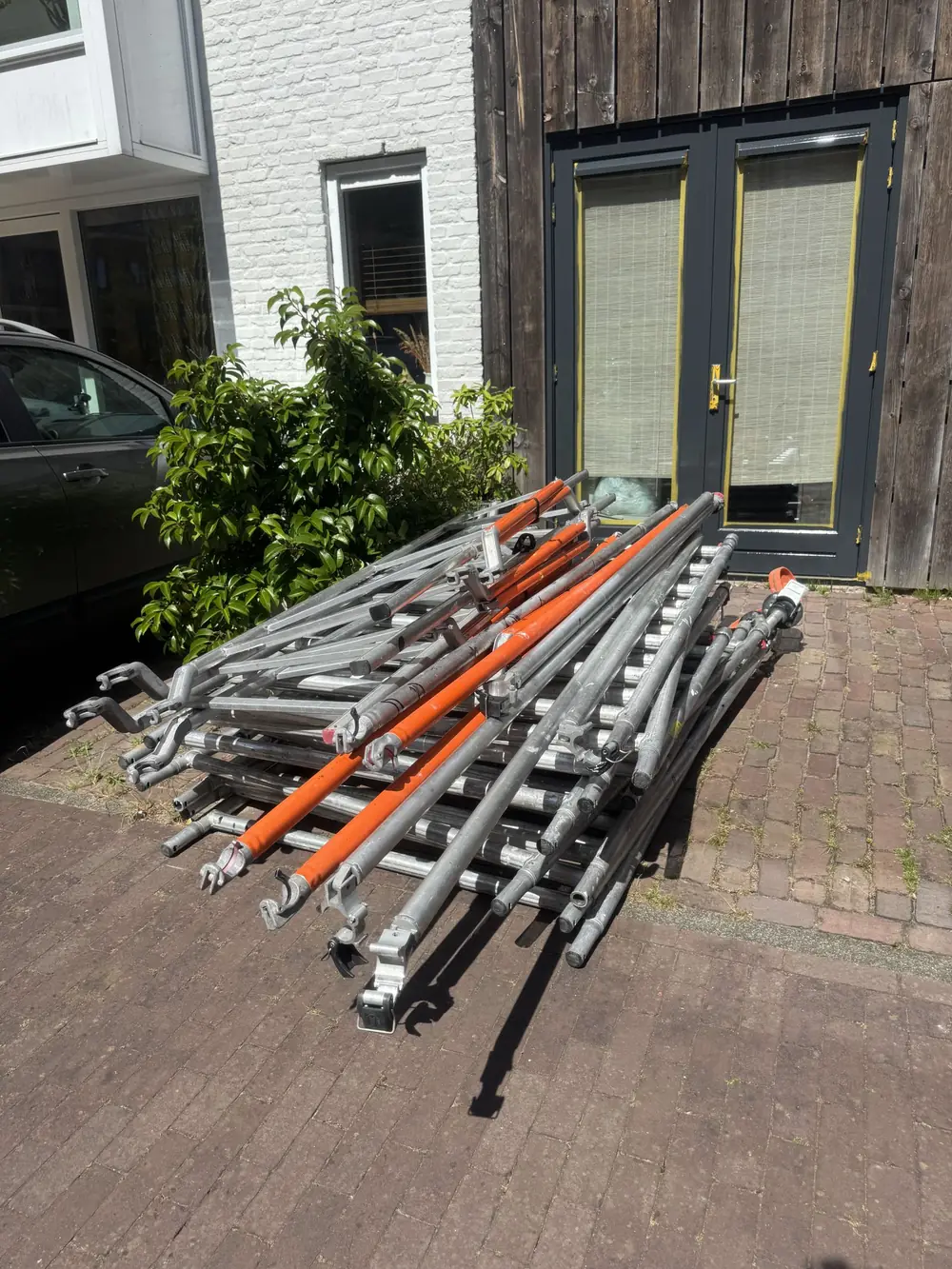
Wide mobile scaffold standing along a house wall, the roomy deck you want underfoot when you stain timber boarding

If the route to the boarding is decided by a gate of eighty centimetres or an alley between two houses, you end up on the RS51 at 75 cm instead. Measure that run before you reserve, because the loose parts have to travel through it too. A room scaffold for indoor work or a one person MiTower is no answer to this job: those reach roughly four and six metres, and cladding across three storeys sits far above them. Otherwise compare the dimensions of the different mobile scaffolds.
What working height to hire when timber runs into the gable

The highest point of this job is rarely the gutter. Timber cladding usually carries on into the gable or runs tight up under the fascia, and that top row takes just as much stain as the bottom one. Measure, then, to the last board your brush has to touch. On a house of three storeys that lands you between 8 and 12 metres. The arithmetic behind that is short: to the height at which your platform hangs you add roughly two metres of reach from outstretched arms.

Your starting point is the spot where the wheels come to rest, not your doorstep. At many houses the ground falls away towards the street, or the back garden sits half a metre below the terrace. That half metre is precisely what decides whether one build is enough or whether a section has to go on. Where the gable comes to a steep point, measure to the apex and not to the edge of the roof slope, because two metres hide in that difference. Write your figure down before you book.

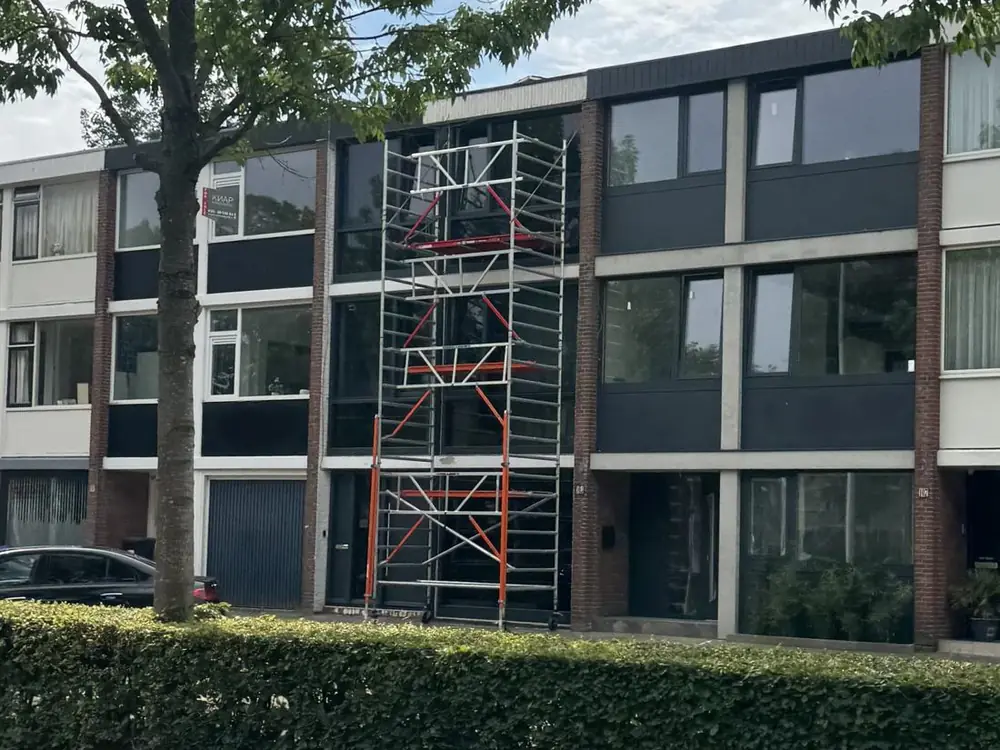
Tower erected against a front elevation right up to the gable point, the reach you hire for boarded walls

Hiring too tight only shows up once the stain has dried. Come up just short at the top row and you do that later from another position, leaving a horizontal set-off halfway along a board. On dark stained timber that line never really goes away. A roomier build costs comparatively little; a second round of assembly costs a day. Which build suits an elevation of this height is set out at working on the second floor.

Hiring a mobile scaffold to stand along a tall timber elevation

Unlike a repair at one point, here you travel the whole elevation with the tower. The strip it rolls over must be flat and clear along its full length, not only at the front door. Walk it before you order and note where it pinches: a border with a raised edge, a water butt at the downpipe, a cellar hatch, a row of bicycles or a terrace that sits a slab higher. Whatever you clear now you will not be dragging aside between two positions later.

The higher you build, the further the stabilisers splay outwards. Towards 12 metres that is no modest triangle any more but a solid piece of ground on all four sides, on top of the footprint of the tower itself. Reckon on a wider strip than you would guess by eye and make sure the ends do not finish up in the planting. Setting them out and locking them off is covered at length in the piece on stabilising and tying in.

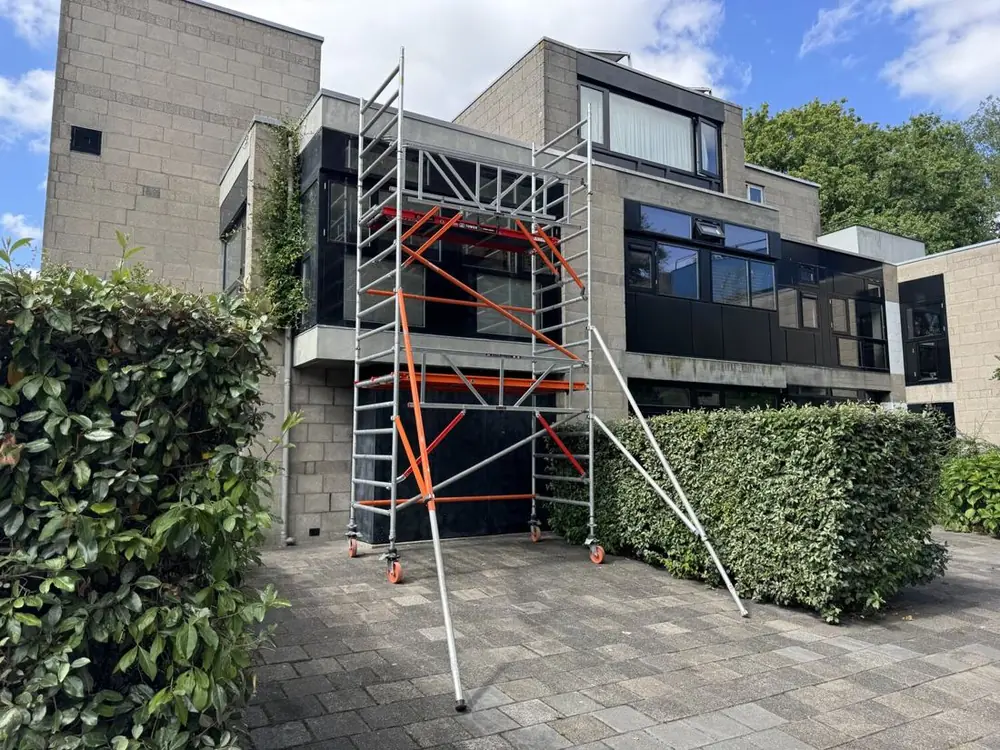
Stabilisers folded out under a mobile scaffold, the ground that must stay clear along the whole length of the boarding

Where the elevation faces the street, ask beforehand what your council allows on a stretch of pavement or a parking bay. This is not an afternoon but a whole week, so you hold that spot for a run of days. The same courtesy applies to the neighbours once the tower rolls along the boundary. Finally, sheet the border or terrace under your working face, because stain that creeps down the boards ends up there and soaks into the slabs.

How many days to hire the scaffold for a staining job

On a complete timber elevation, reckon that the scaffold stands with you for five to eight days. The staining itself moves along nicely, since a broad brush lays off large areas in the length of the board. The days disappear into everything around it: washing the boarding down, sanding back the weathered patches, treating the end grain separately and then going over those same metres a second time. If the cladding carries on round the corner as well, add two days before you fix a date.

There are pauses in this you cannot shorten by any means. The timber has to be dry through before the first coat goes on, and after that the stain has to pull away before the second follows. A shower in the night means you do not start at eight the next morning, and on a face in full sun the stain pulls in so fast that you are better off moving to the shaded side. So the forecast sets your order of work, not your own diary.

Mobile scaffold left standing along a side elevation for days, as a hire period for staining work usually runs

The tariff makes generous planning cheap. Only that opening twenty four hour period is billed at the whole rate; on each further day 95 per cent comes off that figure, so a couple of days of slack scarcely move your rental price. Set your end date well past the day you think the last coat will be on, not exactly on it, because that coat rarely lands when you planned. How others judge a period like this is described in this piece on the length of your hire.

Which mobile scaffold suits staining a wooden facade?

Kamersteiger RS44
  • Working height up to 4 metres
  • Compact and narrow
  • Great for indoor and small jobs
View and calculate →
Smalle rolsteiger RS51
  • Working height up to 14.2 metres
  • Narrow (75 cm)
  • Ideal for narrow passages
View and calculate →
Most chosen
Brede rolsteiger RS52
  • Working height up to 14.2 metres
  • Wide platform (135 cm)
  • Extra stability and workspace
View and calculate →
1-persoons steiger MiTower
  • Working height up to 6.2 metres
  • Very compact
  • Quick and easy to assemble
View and calculate →

Staining a wooden facade from a platform of 245 cm

At each position you take on a vertical bay exactly as wide as your deck is long: 245 cm. With stain you work that bay most easily from top to bottom, hanging the platform a level lower each time instead of rolling the tower on. The wet edge then sits at the side of the bay and not halfway along a board. Only when the bay is done from apex to plinth do you move along to the next position on the face.

That makes the number of positions easy to predict in advance. A wall nine metres wide asks for four of them, and because two coats have to go on you walk that route twice. If the side elevation is boarded as well, the count very nearly doubles. Take up what you need in one go, because going back for a forgotten stirring stick costs more minutes at this height than you allow for. A short list left on the deck saves pointless trips.

Mobile scaffold positioned in front of a house, the 245 cm bay you shift along step by step while staining

What people misjudge are the edges and the junctions. End grain, the seam at a corner profile and the timber tucked under the overhang all drink far more than the flat boards between them and want separate attention with a smaller brush. The same goes for the bottom row just above ground level, which has caught the most moisture over the years. Walk the elevation before delivery takes place and write those spots down, so you know in advance where the extra hours are going to go.

Scaffold hire with delivery at the start of your staining week

The mobile scaffold arrives as a complete, countable set of loose parts. Settle in advance where that stack lands, and do not pick the grass or the terrace directly under the boarding: that is where you want to roll, and that is where the drips from your brush come down. A driveway or the far end of the front garden works better, particularly if your van or trailer fits there too. Book on a working day and settle it before 15:00, and the whole set stands at your door the next working day.

You choose the morning the set turns up and the day it goes back, and on a staining job you obviously do that with the forecast beside you. Have it arrive on the eve of a dry spell, then you build on the first morning and use the afternoon to wash down and sand. Erecting it falls to you, with the manual and the instruction film propped up beside the parts; for a tower of this height two people should allow half a day.

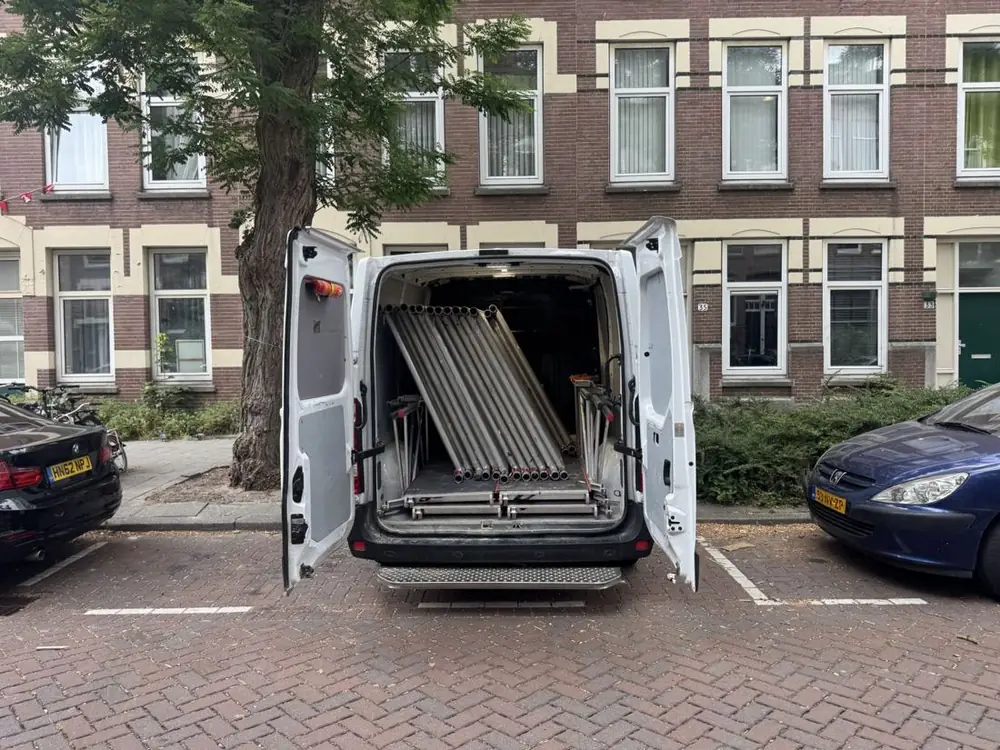
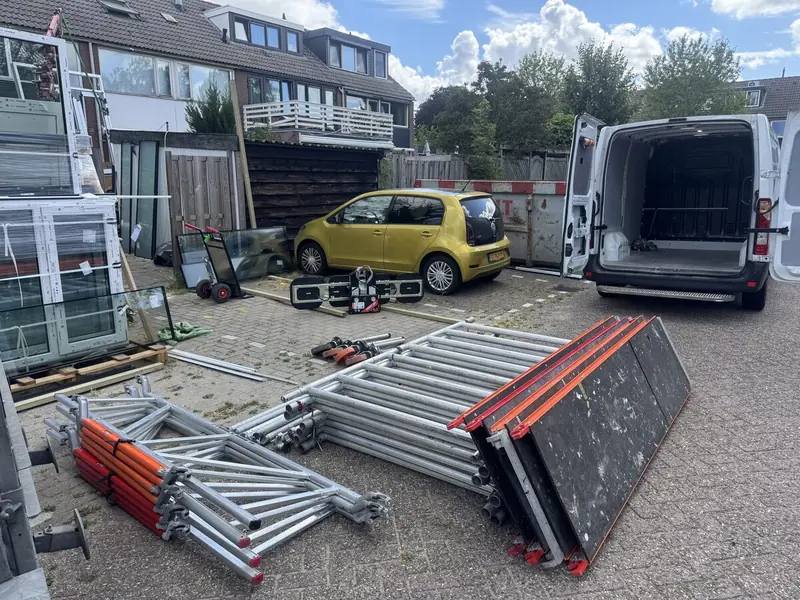
Delivery van with scaffold parts parked at a house, ready for a hire period that falls in a dry week

When you are done we come back to take everything away again. Your part is to dismantle and lay the parts out complete, preferably on a morning that stays dry, because wet aluminium is awkward to stack. Count them as you take the tower apart and you will not be hunting a stray brace at the van. What is added per province for bringing and fetching is listed with VAT included under the cost of delivery.

Working safely at height when you stain timber cladding

The deck under your boots is rated at two hundred kilos for every square metre: load class 3, the banding EN 1004 gives these towers. That figure counts for more on this job than it looks. Two painters side by side, each with a full bucket, a bag of tools and a pack of abrasive paper, sit closer to the limit than brushwork suggests. Spread the weight along the length of the deck rather than stacking it all by the hatch and leaving it there together.

The fixed rules weigh heavier at ten metres than they do just off the ground. Brake the wheels the moment anybody climbs, never roll the tower with a person or material on it, and stop work once it begins to blow hard. You feel a gust up there long before you feel it on the terrace, and an open tin of stain in your hand is the worst moment for it. Check all four stabilisers again after every move.

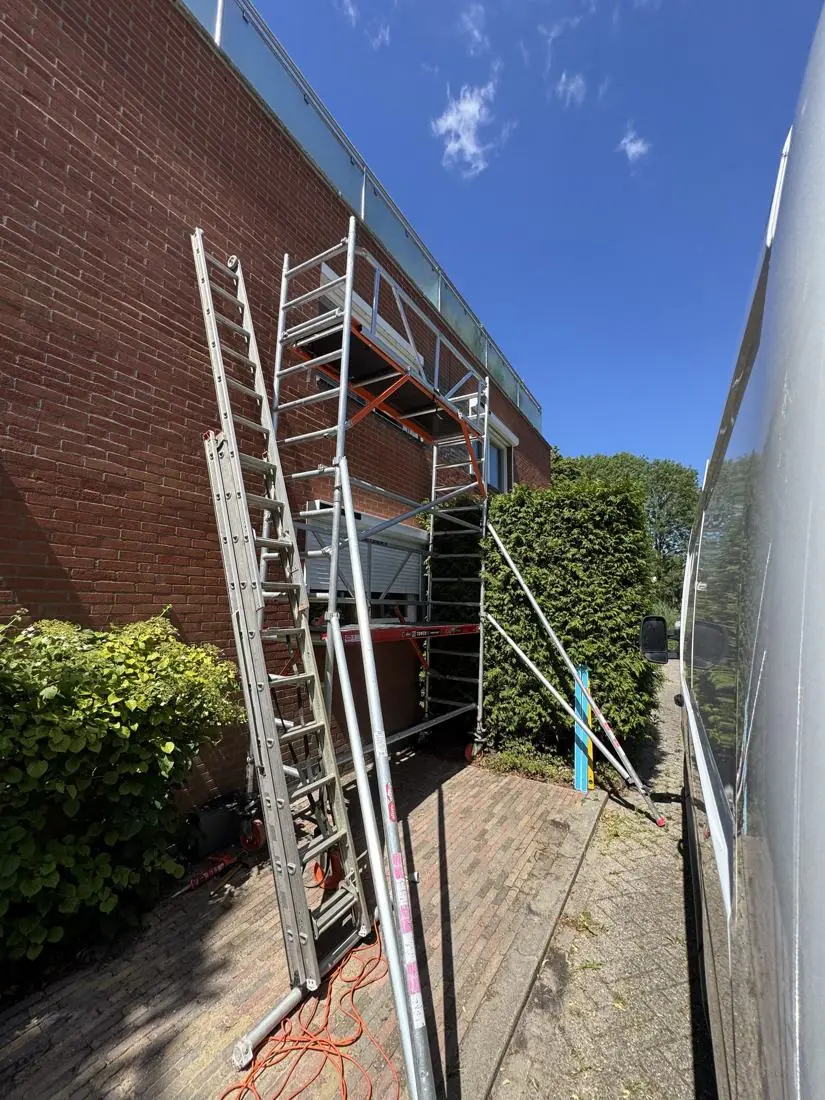
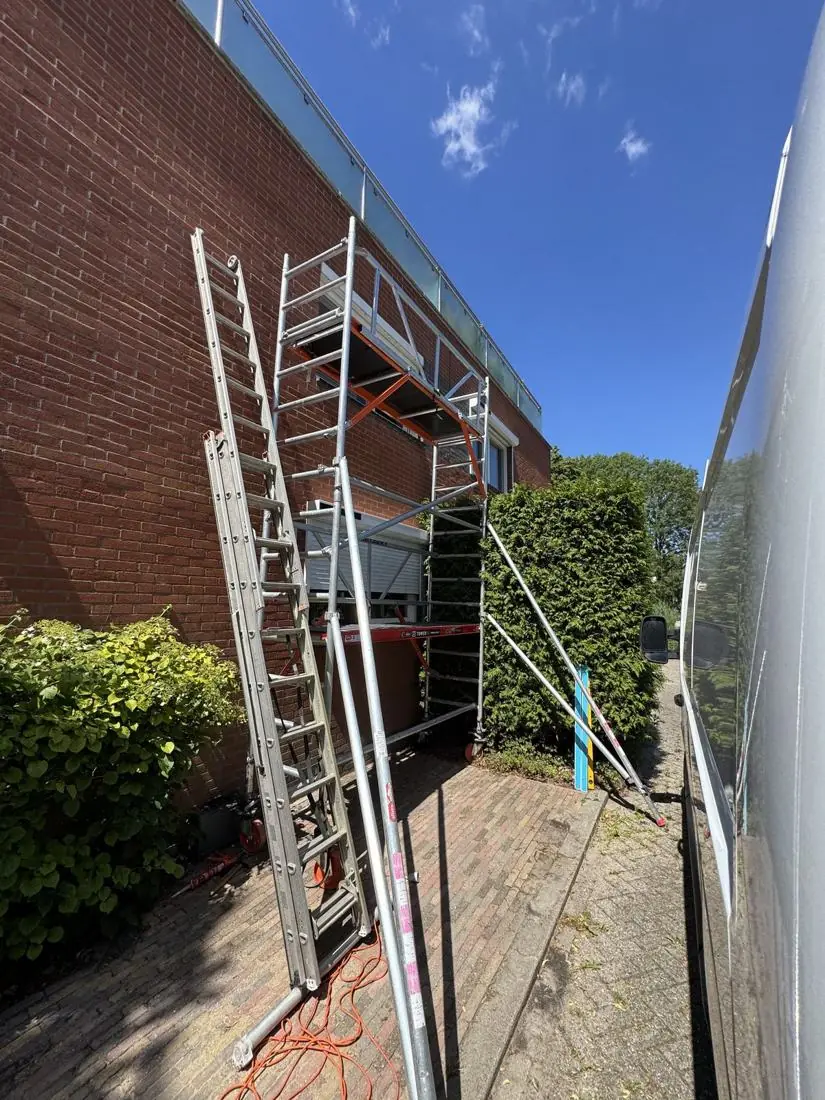
Erected mobile scaffold in a tight passage next to a loose extension ladder, its full deck length taking the load

The hazard that really belongs to this product is slipperiness. Stain is thin and drips easily, and a handful of spots make an aluminium deck treacherous. Lay something over it that you can replace once it starts to shine, and wipe up spills straight away. Keep the zone under the tower empty as well, because a brush or a tin falling from this height lands hard. The remaining rules are gathered in this overview of rules for work at height.

In 5 steps

How hiring a mobile scaffold works

1
Choose working height

Pick the height that suits your job.

2
Book online

Sorted in 60 seconds, price shown instantly.

3
We deliver

At the agreed spot the next working day.

4
Assemble safely

Assembled by you, with a manual.

5
We collect

One call and we collect the scaffold.

Good to know

Practical tips for staining a wooden facade

1

Order stain for the whole elevation in one go and check the batch number on the tins. A difference in colour between two batches shows up at once on an unbroken timber face, certainly in full sun.

2

Do the top rows of boards while you are still fresh. Those are the metres where you work longest with your arms stretched above your head, and they get noticeably worse by the end of a day.

3

Hang your bucket on a hook at the rail rather than letting it stand loose on the platform. Stain that goes over at ten metres runs off the edge and lands on the terrace below.

4

Talk the neighbours through which days the tower stands along the boundary. You keep it here for longer than a weekend, so their fence, car and planting sit beside it for that whole period.

5

Leave the bottom row of boards until last and do it standing on the ground. That saves lowering the platform once at every position, and therefore saves time inside your hire period.

6

Walk the elevation for loose, split or soft boards before you order the tower. Repairs are better arranged before the hire period runs than halfway through your second coat, with the collection already booked.

Frequently asked questions

Frequently asked questions about staining a wooden facade

Which model of mobile scaffold is best to hire for a wooden facade?+

Where the timber cladding carries on across three storeys, hire a mobile scaffold in the wide RS52 version, which gives you a deck width of 135 cm. You are busy for days, you drag stock up and there are usually two of you at the same face, so that width is no luxury. Should the access prove too tight for the wide version, the choice falls on the narrow RS51 at 75 cm. Walk that route before you commit.

How does the hire run from booking to collection on a timber elevation?+

Online you put together the model and the build that suit your wall, pick for yourself when delivery happens and when we take the tower away again, and settle one fixed amount that has VAT built into it. We set the parts down at your place, you assemble the scaffold and stain bay by bay, and on the last day you lay everything out dismantled. Beyond that, only the ground the tower rolls along needs arranging.

How many days should I rent the mobile scaffold for two coats of stain?+

For a fully boarded elevation in two coats, five to eight days is an honest estimate. Washing down and sanding fill the first day, then you lay the first coat, let it pull in and walk the route once more. If the cladding turns the corner or a dormer sits in the face, allow two days on top. Rent the scaffold tight and you will be waiting on dry weather halfway through the second round with the collection already fixed.

What does hiring this wide tower cost, and what happens after day one?+

The rental price follows two choices: the model you take and the height you end up at. Transport out and back is added per province. All amounts are shown with VAT included through the current tariffs per model. For staining work that shape falls out kindly: day one carries the weight and everything after it counts lightly. One generous period is therefore better value than two short blocks in a row.

Which working height do I hire if the timber runs up into the gable?+

Measure to the topmost board in the point and not to the gutter, because that triangle is soon two metres higher. Across three storeys that puts you at a reach of between 8 and 12 metres, with the deck itself hanging at six to ten. Start your tape at the spot where the wheels will stand, certainly on falling ground. Which build belongs to which mobile scaffold is shown on the page with all the working heights.

Is the mobile scaffold delivered, or can I come and collect the set?+

Both routes are open on this job. Choose delivery and the set stands ready on the day you name, and we drive back after your last staining day to fetch the tower, for a fixed amount per province. Would you rather drive yourself, then by appointment you may load up at Zeeburgerpad in Amsterdam without charge, provided your transport takes a full build. With three storeys of timber there are a great many parts, so bringing it usually wins.

Do you build the tower, or is that mine to do once it is hired?+

Assembly is your work. We bring and fetch, but you put the tower together yourself, move it along the elevation yourself and take it down again at the end. With two of you it is done in a morning, certainly with the video beside you. Bear in mind that not much stain goes on that first day. Our hire list holds mobile towers only, so facade scaffolding, system scaffolding and cherry pickers come from somewhere else.

What if the stain work runs on and the tower has to stay on hire?+

Let us know and we move the collection date, provided the mobile scaffold is not already reserved for somebody else. On a timber elevation that happens regularly: there are more metres in it than you counted, or the boarding stays damp longer than you hoped. To stay ahead of that, book generously from the outset, because giving the set back sooner costs you nothing. You are then never forced to break off mid face just because the collection van has arrived.

How much clear ground does a tower of this height need along the wall?+

Take the footprint of the tower itself and add the splay of the stabilisers on either side, which stand a long way out on a high build. In practice you want a flat, empty strip along the whole wall, because you roll the mobile scaffold corner to corner. Border, water butt, bicycles and loose slabs go before the parts arrive. Set aside a place for the stack of components as well, outside that running line.

Can I keep the scaffold on hire on days that are too wet to stain?+

You can, and on this job that is the rule rather than the exception. The tower simply stays put with the brakes on while you wait for the boarding to feel dry again. Spend such a day sanding, working the end grain, tapping loose nails home or getting the next bay ready. Because an extra day of hire costs only a small part of the first, waiting is better value than dismantling and having the scaffold brought back later.

How does the deposit work during the hire and after handing back?+

When you hire you pay a deposit up front. As soon as the set has been taken back and counted, we return that amount within 1 working day. With stain, watch two things: hand in every part, and leave no dried spatter on tubes or decks. Something laid over the platform while you work saves scrubbing on collection day. More on this stands in the article on getting your deposit back.

Can I take the fascia and the bargeboards along on the same build?+

If your build reaches into the point, you usually get at the fascia and the bargeboards that close the cladding off as well. That is worth doing, because that timber wants the same treatment and the tower is standing there anyway. Allow extra hours, since those edges keep you at each position longer than a flat run of boards. If you also want to take on the fascia boards, pick the roomier build straight away.

Hire a mobile scaffold for staining a wooden facade today?

Calculate your rental price now or ask for free advice.

Rolsteiger van SteigerTaxi geleverd op locatie
Book it online

Your scaffold sorted in 2 minutes.

Choose your scaffold and working height, see the price instantly and book online.