
See your price
Application

Installing ventilation? Choose the right scaffold.

Installing ventilation is largely indoor work until the outside wall has its turn. The unit hangs in the loft, the ducts run outward, and somewhere a sleeve has to pass through the masonry: a core hole of ten to fifteen centimetres, often high in the gable or just under the roof edge. For that hole you hire an RS52, the wide mobile scaffold on a 135 cm frame, taken up to the build that reaches 8 to 12 metres. Where the tower belongs and how many hire days it costs follows below.

  • Order before 3 pm, delivered tomorrow
  • Professional Altrex scaffolds
  • Up to 14.2 metres working height
  • Easy to assemble yourself
4,2 tot 14,2 mWorking heights available
12Provinces served
7Days a week
200 kg/m²Load class 3
In short
  • For installing ventilation we recommend the Wide mobile scaffold.
  • For installing ventilation you hire an RS52 with a 135 cm frame, in a build reaching 8 to 12 metres of working height.
  • The route the ducts take inside the house decides where the sleeve leaves the masonry, and therefore where the tower stands.
  • Installing ventilation needs a wide deck, because the drill stand, the motor, a bucket of water and a second person share it.
  • First 24 hours from €175 incl. VAT and delivery; every day after that 95% off.
Key facts for this job
FeatureValue
Recommended scaffoldWide mobile scaffold (Altrex RS TOWER 52)
Working height for this job8 to 12 metres
Available working heights4.2 to 14.2 metres
StandardEN 1004, load class 3 (200 kg per m²)
DeliveryOrdered before 3 pm, delivered next working day
Each extra day95% off, from €8.75 a day
Why a mobile scaffold for installing ventilation?

Safe, stable and professional work at height

With ventilation the facade is the last stage and immediately the awkward one. You do not settle the position of the sleeve outside; you settle it indoors, where the duct passes a purlin or crosses a knee wall, and the hole belongs where that duct meets masonry. Only once that is fixed do you know the level and the spot for the tower. Add the kit a core hole demands, none of which you hold in your hands: a stand, a water fed motor and a bucket beneath it. Hiring a scaffold for installing ventilation is therefore about a wide deck at exactly the right level.

  • The indoor duct run fixes the drilling point
  • Core drilling needs a stand and wide decking
  • Intake and extract set far enough apart
  • Installing ventilation ends at the outer wall
Read more about working safely →

Which mobile scaffold to hire for installing ventilation

For a sleeve at loft level you hire the Altrex RS52, a wide tower on a 135 cm frame. That width is not indulgence. A core drill stand already claims half a square metre of decking, a bucket of water sits beside it, and there is usually a second person working the motor while you watch the stand stay true. Three things like that will not sit side by side on a 75 cm tower. The other widths and build heights sit in the overview of towers available for hire.

The RS52 comes in several builds and for this work you take the one giving 8 to 12 metres of working height. A room scaffold is meant for indoor jobs and drops away at once; a one person tower is not reckoned for two people with heavy kit between them. Something else counts too: a 135 cm frame will not pass a ninety centimetre garden gate. Walk the route before you book, from the kerb to the patch where the build has to stand.
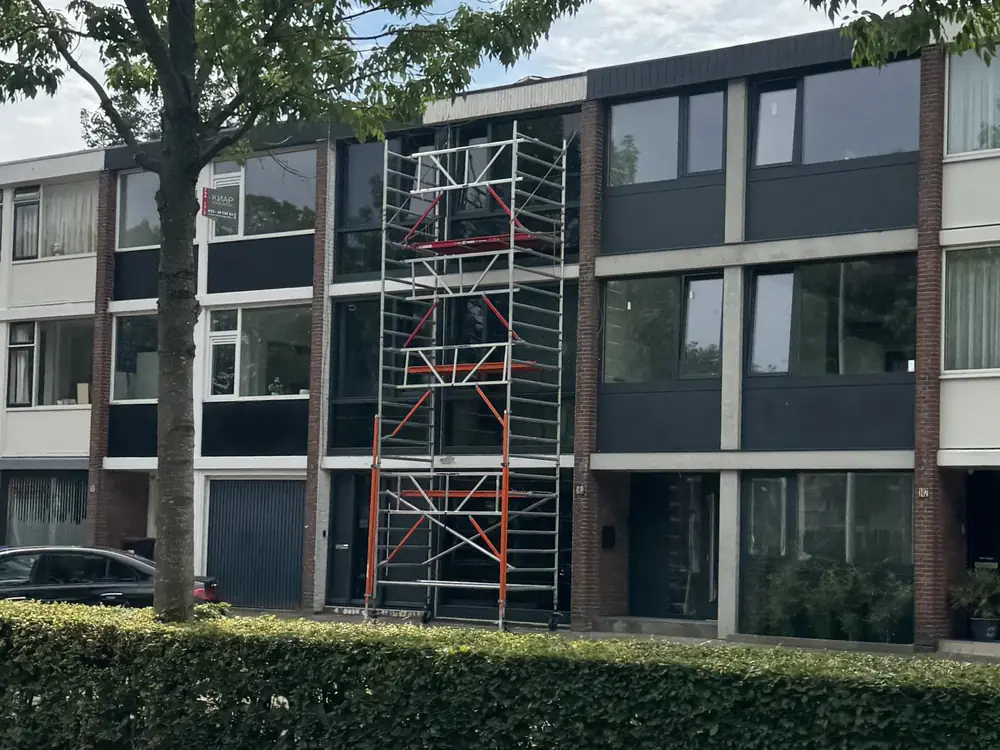
Narrow mobile tower standing against the front of a three storey block, built up past the upper row of windows

The platform is 245 cm long and that decides whether two sleeves come off a single position. If intake and extract sit within that length of one another, you cut them in turn and save yourself a move. Lie further apart, which with a ventilation system is more often the case than not, and you plan for two standing positions. Measure that distance on your drawing before you commit to a build, because it is worth half a working day.
Working height to hire when installing ventilation through a gable

Start indoors. Hang the unit where it is going to live, set out the duct run and see where that run touches the outer wall. That point is your drilling point and it nearly always sits higher than people expect: with a unit in the loft you come out in the gable or just under the roof edge, and on a two storey house that is soon eight to ten metres above the street. A thin pilot hole from inside finds it again from the deck.

Take the measurement from the ground under the tower and not from your front doorstep. Working height, in the way you book it, is deck height with something like 2 metres of arm and shoulder added on top, yet a core cut uses none of that reach: the stand belongs against the wall at chest level, so you lay the deck about a metre below the drilling point. Keep that in mind when you pick a build, because half a metre too high works as badly as half a metre too low.

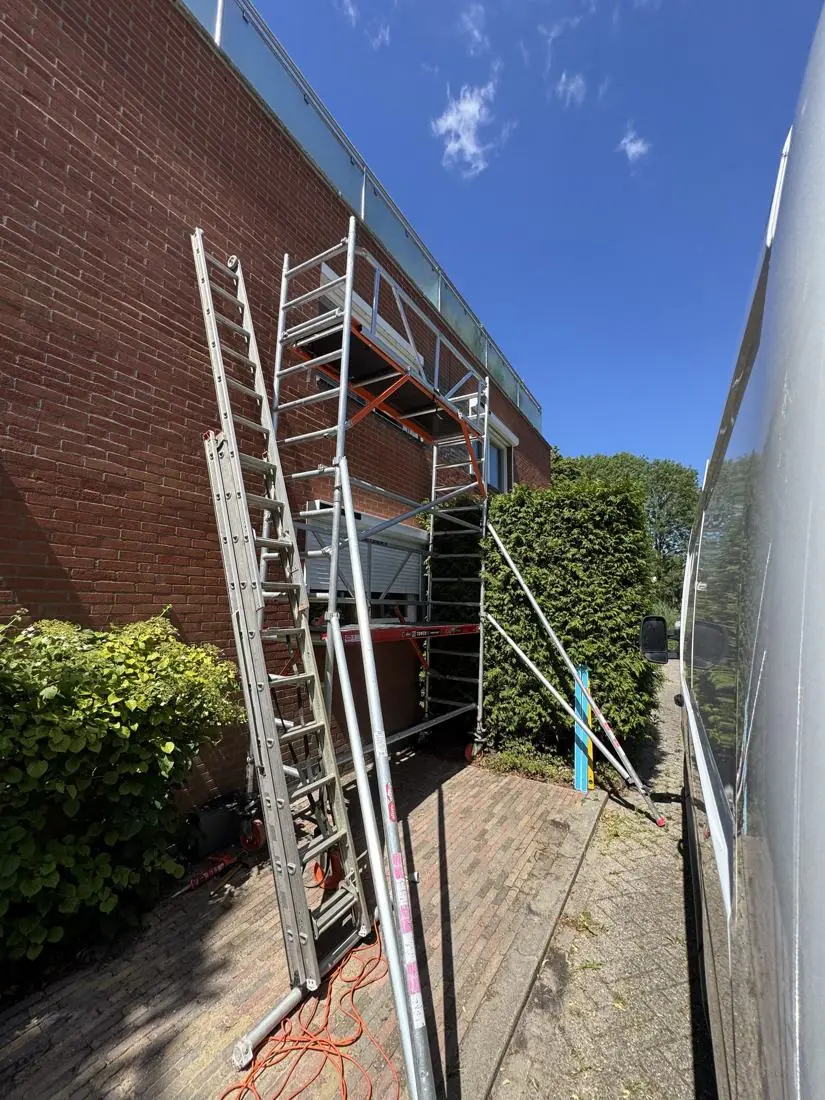
Tower standing in a narrow side passage against brick, an extension ladder propped alongside it and cable across the paving

Choosing too tight is expensive here. A core cut you have to make with your arms stretched above your head runs off line, and a crooked duct through a cavity wall never comes straight again. Fitting the facade hood afterwards also asks that you stand square to it. Take the build that clears the drilling point comfortably, even if the deck ends up a rung higher than strictly needed. What such a position gives you is described at a working height of ten metres.

Hiring a scaffold and standing it under the core hole

The tower has to stand directly under the drilling point. A core drill stand is either bolted to the wall or braced between the deck and a stand tube, and that only works when you are square in front of it. A position two metres to one side is no alternative here. So look at what lies on the ground in that spot: with a gable it is often a side path, a strip of gravel along the boundary or the piece of pavement where the bins live.

The RS52 measures 135 cm across the frame and with the outriggers out the base wants another half metre on every side. Reckon on a clear lane of well over two metres holding nothing at all, where every one of the four base plates comes down flat and level. Watch for drain covers, for a basement light and for the lip of a drive that falls away to the road. If the ground drops, see how to take that up on an uneven surface beneath a tower.

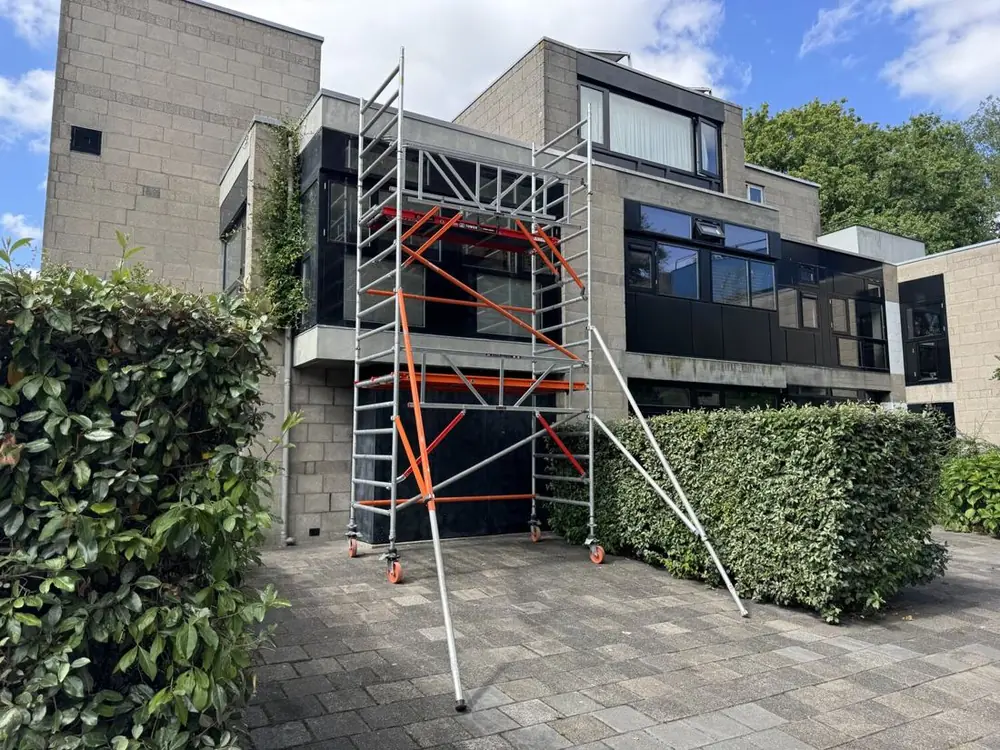
Mobile scaffold standing on paving before a house, with four stabiliser legs angled out and down to the ground

Core drilling brings water with it and that water runs down the wall. Put a bucket under the drilling point, lay a sheet over whatever stands below and expect the slurry to mark paving. If the tower takes part of the pavement, tell your neighbours and keep a strip open for people to pass. What is allowed on the footway is worth asking the council about a week beforehand rather than on the morning itself.

How many days to hire the tower for installing ventilation

The work outside is short; the work around it is not. Before the scaffold earns its keep the duct run has to be in and the unit hung, and those are one or two days you do without a tower. Then comes the core cut, half an hour to an hour per sleeve, and after that the hood goes on and gets sealed. All together you land on three to five hire days, depending on the number of sleeves and the thickness of the wall.

Inside those days sit waiting times you cannot hurry. Sealant round a facade hood has to cure before rain touches it, and a cavity wall you have just opened is better left a day to dry before you close the hood over it. Rain or a stiff wind pushes the drilling back. So set your collection date a day or two beyond the day you hope to be finished, rather than on it, and the last morning stays calm.

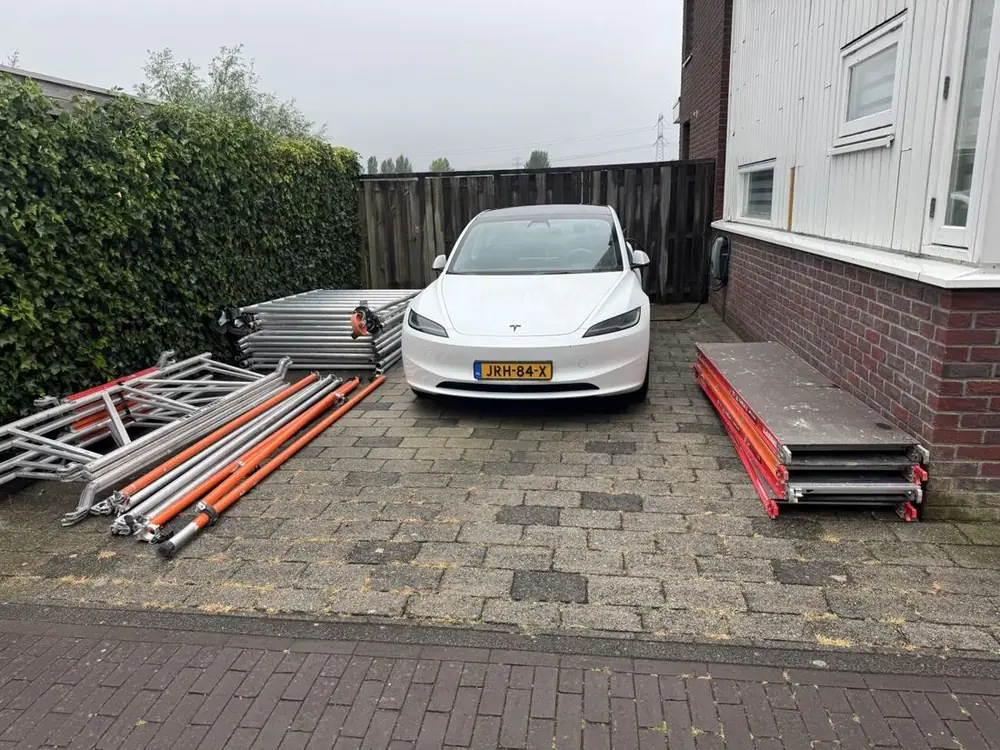
Two stacks of scaffold frames, braces and decking resting on a block paved drive beside a parked white car

Booking with room to spare barely shows in the total. Only the opening twenty four hours count at the whole rate; from your second hire day onwards 95 per cent is taken off, so a reserve day held back for poor weather weighs nothing against a second delivery run. What this build costs is set out on the page with the rate per model. With a tower this size that weighs all the heavier, because raising it and stripping it is work you carry out yourself.

Which mobile scaffold suits installing ventilation?

Kamersteiger RS44
  • Working height up to 4 metres
  • Compact and narrow
  • Great for indoor and small jobs
View and calculate →
Smalle rolsteiger RS51
  • Working height up to 14.2 metres
  • Narrow (75 cm)
  • Ideal for narrow passages
View and calculate →
Most chosen
Brede rolsteiger RS52
  • Working height up to 14.2 metres
  • Wide platform (135 cm)
  • Extra stability and workspace
View and calculate →
1-persoons steiger MiTower
  • Working height up to 6.2 metres
  • Very compact
  • Quick and easy to assemble
View and calculate →

Installing ventilation from a 245 cm platform on a wide tower

The core cut is the moment the width of the deck pays for itself. You set the stand down, bring it plumb, connect the water hose and let the barrel feed in slowly. Meanwhile someone has to be able to stand at the motor without treading on the other one's feet. On a floor of 135 by 245 cm that is comfortable; on a narrow tower you would be shuffling round each other with a turning drill in your hands.

Bear in mind that the core comes out of the wall as a solid cylinder of stone. On a wall of thirty centimetres that is a few kilos, and you do not want it dropping outwards. Catch it, lay it on the deck and leave it there until you go down yourself. Work steadily as well, because a barrel that binds gives a jolt through the stand, and you feel that jolt right through the build under your feet.

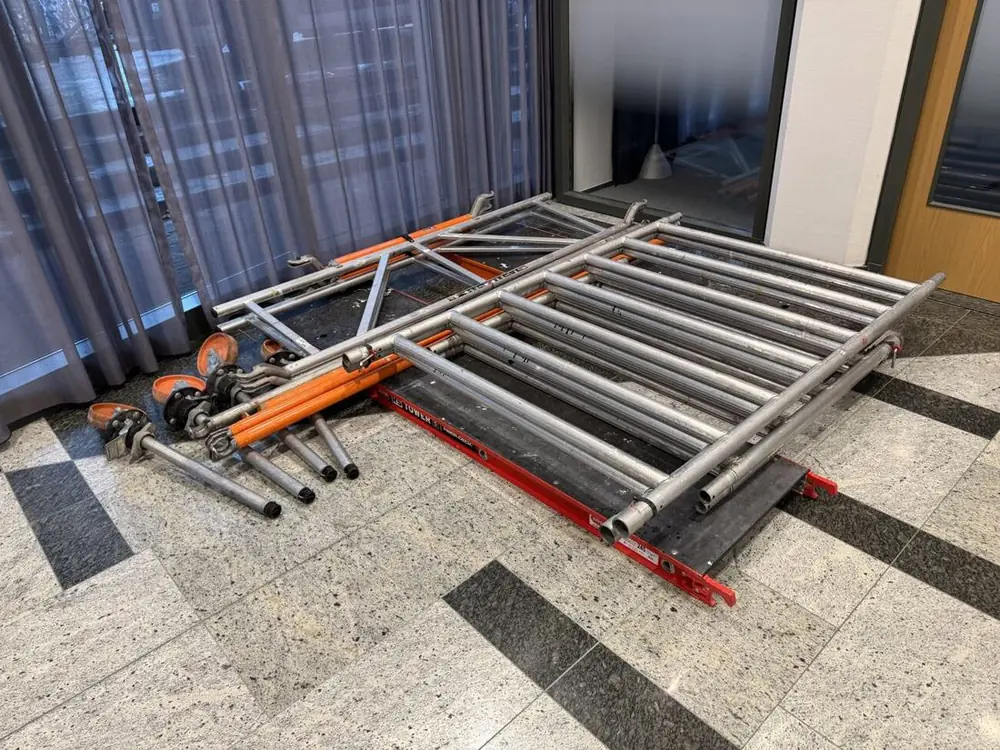
Scaffold frames, castors and a red edged platform deck laid out on a tiled indoor floor before assembly

When you mark out, think about short circuiting the air. If the sleeve for fresh air and the one for stale air sit too close together, the system draws its own exhaust back in and works against itself all year round. Keep them well apart and preferably not in the same lee. That is precisely why two standing positions are so often the answer rather than one. Fix that second spot before you settle the build height, because the second hole sometimes sits half a metre lower.

Hiring a scaffold for ventilation work: where the parts land

You pick your own delivery date and collection date when you book. An order finished before 15:00 on any working day goes out to you the working day after that. When installing ventilation, let the scaffold come on the day the indoor work is finished and not sooner, because a tower standing unused in front of your house for a week eats hire days for nothing. Line the delivery up with a spell of calm weather too, since a core cut in driving rain gains you nothing.

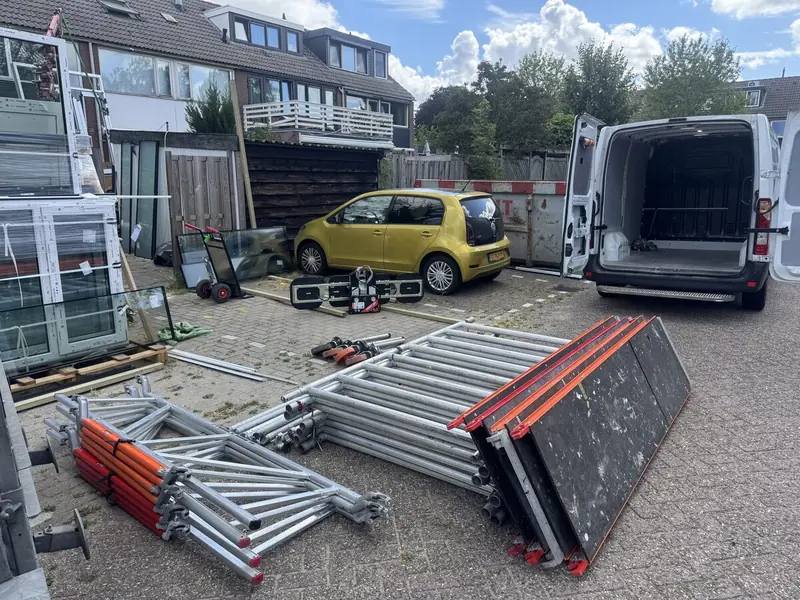
A build of this size reaches you as a sizeable pile of separate parts, counted through in full before it leaves the depot. Work out ahead of the delivery day where such a stack can lie for four days or so without blocking anything; a drive, a garage or the side of a path all work. Bear in mind that you carry a good many more pieces than on a low tower, so drop the stack as close as you can to the assembly spot and keep a barrow handy.

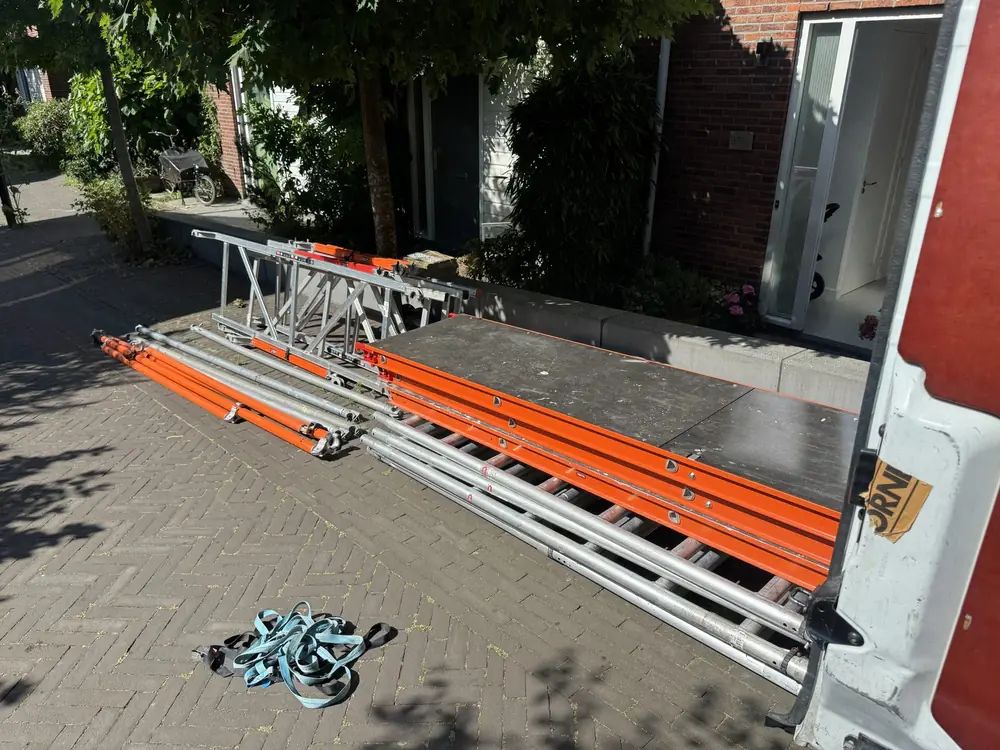
Platform decks, ladder frames and orange braces set down on herringbone brick beside a van with its back open

Raising it falls to you, with the manual to hand and the video on the site. We do not come and assemble, and we do not deliver a standing tower. At 8 to 12 metres of working height this is no job on your own either: work with two people, build one lift at a time from the deck you are standing on, and fit the outriggers before you climb higher. Afterwards we take the set away again on the date in your reservation.

Safe working on the scaffold you hire for installing ventilation

At this height the load rating genuinely matters. Every deck we hire out answers to EN 1004 within load class 3, so 200 kg is the most that may stand on a square metre. Add up what stands on it during a core cut: two people, a stand, a motor, a bucket of water and a cylinder of stone. That comes closer to the limit than painting ever does, so take up only what you need at that moment and leave the rest on the ground.

Lock the castors as soon as the tower is on its spot and check them again before the drill starts, because a turning barrel puts sideways force into the build. Never move the tower with anyone on it or tools left up top; at this height repositioning is work for two people and an empty deck in any case. In a strong wind you do not go up: ten metres against a gable carries far more wind than you notice at street level.

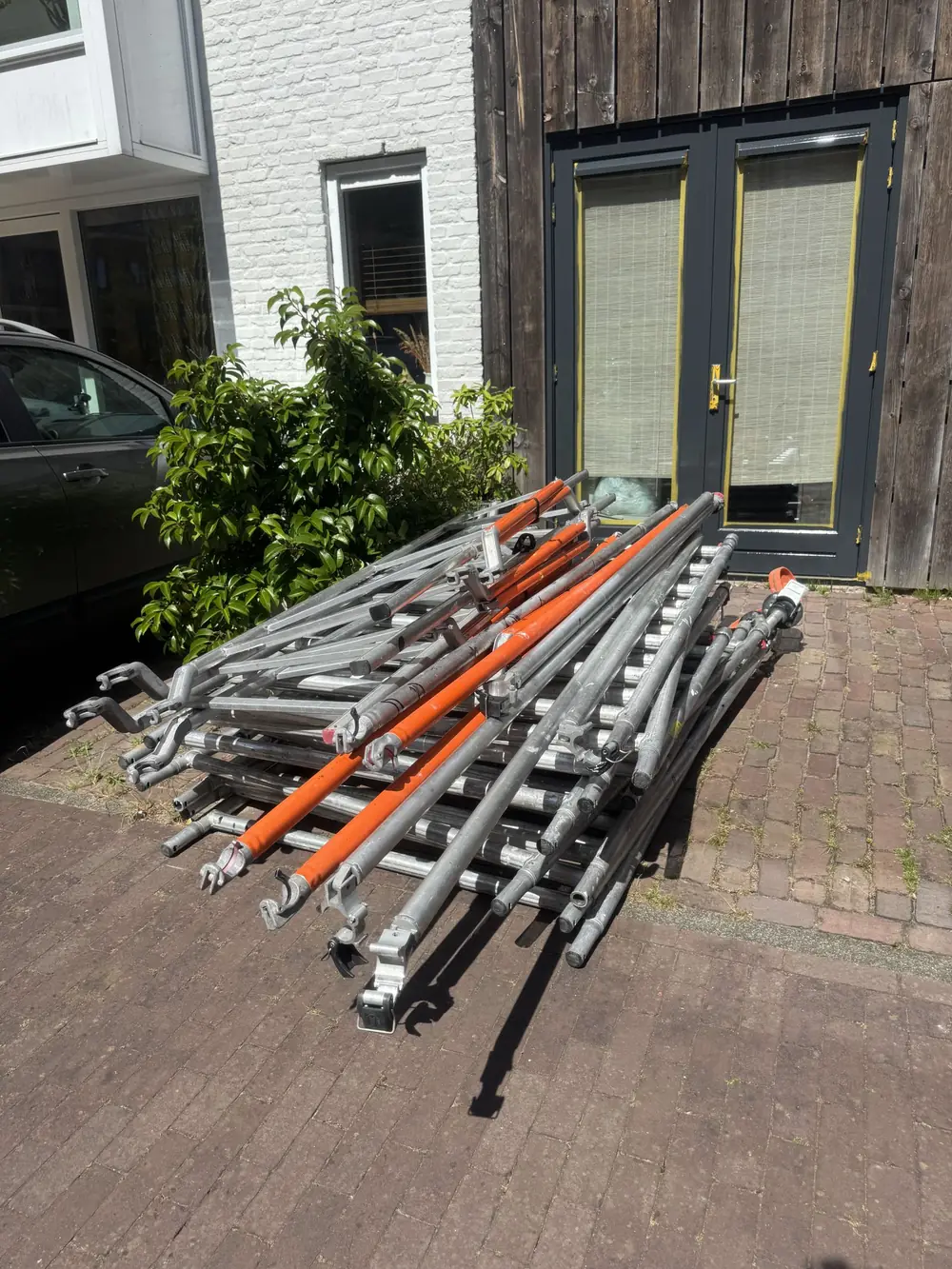
Loose scaffold tubes, frames and orange braces heaped on a brick drive in front of a house with glazed doors

Keep an eye on what is happening below you as well. Ventilation work sends down pieces of stone, sealant and tools, and water runs the wall besides. Tape off the ground under the tower and keep children and visitors away while the drill is turning. Wear eye protection and gloves throughout, even though it looks like no more than a single hole in a wall. On a wet deck with a film of slurry across it you lose your footing a good deal sooner than you would think.

In 5 steps

How hiring a mobile scaffold works

1
Choose working height

Pick the height that suits your job.

2
Book online

Sorted in 60 seconds, price shown instantly.

3
We deliver

At the agreed spot the next working day.

4
Assemble safely

Assembled by you, with a manual.

5
We collect

One call and we collect the scaffold.

Good to know

Practical tips for installing ventilation

1

Drill a thin pilot hole from the inside at the point where your duct comes out. From the deck of the hired tower you spot that hole at once and never have to measure and mark outside again.

2

Take a spare battery or an extension lead up with you before you start. Climbing down halfway through a core cut leaves the barrel stuck in the wall, gripped tight by its own grit and dust.

3

Hang a bucket on the guardrail for the drilling water and run the hose down inside the frame. Outside the frame it tangles in the outriggers the very moment you turn round on the deck.

4

Do not fix the facade hood until the hole is clean and dry. Stone slurry in the sealant joint will not stop the hood going on, but it will have it working loose within a year.

5

Choose the position of the second sleeve before the tower is delivered. Shifting it a few metres later on means an extra standing position for the tower, and that swallows a good part of a hire day.

6

Lay a sheet of plywood on the paving under the build. Drilling water carrying stone dust soaks straight into concrete and porous slabs, and no amount of rinsing afterwards will ever get it out again.

Frequently asked questions

Frequently asked questions about installing ventilation

Which mobile scaffold should you hire for installing ventilation?+

The RS52 at 135 cm across, taken up to the build that reaches 8 to 12 metres. That width earns its place because a core hole is not made by hand: a stand sits on the deck, a hose hangs off it and there is usually a second pair of hands beside you. A narrow 75 cm tower is simply too tight for kit of that sort. For the hole itself and for the hood that follows it you also want to be standing square to your work.

How does hiring a scaffold for ventilation work actually go?+

On the site you put together the build that suits your drilling point, pick a day for the parts to arrive and a day for them to leave, and pay a fixed price with VAT included. The parts are set down on the spot you agreed with us. After that you assemble everything yourself, cut the sleeve, fit the hood and take the tower apart again. On your collection day the van pulls up and every piece goes back with it, which is the whole of the paperwork.

How many hire days does installing ventilation take?+

Three to five hire days will cover the work at most ordinary houses. The indoor work is finished before the scaffold arrives; the days after that go on assembly, the core cut, the facade hood and the sealing, plus the time the sealant needs to cure. If two sleeves sit a long way apart, add a day to the hire for the second standing position of the tower. Take a roof sleeve on as well and the hire soon runs towards a full week rather than a long weekend.

What decides the rental price for installing ventilation?+

The model you take and the height you decide to build it to are what settle the figure. The run out to your address is settled separately and carries a figure fixed in advance. Everything is quoted with VAT included, so you know what the scaffold costs you at the moment you reserve rather than afterwards. With a build of this size it is nearly always better value to keep the tower a little longer than to have it brought out to you twice over.

Which working height do I hire for a sleeve below the roof edge?+

Measure from the ground under the tower to the point where the duct leaves the wall, so to your drilling point and not to the roof edge. With a unit in the loft that usually falls between eight and ten metres, which puts you on the 8 to 12 metre build. Do not run the scaffold right out: lay the deck about a metre under the drilling point so the stand sits at chest level and you work square to the hole.

Is the hired scaffold delivered, or is fetching it myself an option?+

That depends on what suits you. With delivery the parts lie at the door or on the drive on the day you agreed, and they are taken away from that same spot afterwards; bringing and fetching together carries one fixed figure per province. If you would rather load them yourself, the set is put ready at no cost, by appointment, at Zeeburgerpad 89 in Amsterdam. Do bear in mind that a scaffold set for this working height wants a sizeable van or a trailer behind the car.

Do you put the tower up for me when I hire it?+

Assembly belongs to the job and not to the hire. We bring the counted set, take it back afterwards, and in between the scaffold is in your hands. At 8 to 12 metres that is work for two people: you climb to the deck you have just laid and build on from there, with the step by step guide and the instruction film within reach. Allow a couple of hours for the first build, fit the outriggers in good time and keep the deck clear as you go.

Can I extend the hire if the core drilling hits trouble?+

Yes. Let us know before your collection day and we move that date, so your hire simply runs on. With a ventilation system this is no rarity: you meet a wall tie, a lintel or masonry that turns out thicker than the drawing says, and half a day becomes a whole one. Sending the scaffold away and ordering it again later costs you two assemblies, two dismantles and a fresh wait for a free delivery slot on the calendar.

How much clear ground does this hired build need at its feet?+

Work on a strip a good two metres wide and about three metres long. The tower measures 135 cm over the frame and the outriggers reach out beyond that on every side. All four base plates have to land flat, so bins, bikes and planters go away beforehand. Check as well that the parts can reach that spot before you book, because a frame this size does not pass a narrow gate and certainly not along a bike store.

Does the rental keep running when it is too windy to drill?+

Yes, the tower stays where it is and your hire days keep counting, so build some slack into the plan. You do not drill at height in a strong wind, and a wet wall with slippery slurry on the deck does the safety no good either. Use a bad weather day for the indoor side of the system instead: finish the ductwork, connect the unit and mark the sleeve out from inside. That way the scaffold never stands there for nothing.

When do I get my deposit back after this hire?+

A deposit is settled alongside the hire at the moment you reserve, and it comes back to you inside 1 working day of the parts returning and being counted off against the list. This job brings one thing to watch: rinse slurry and drilling water off the decks and the tubes before you strip the tower. Dried slurry sits rock hard and counts at the check as soiled material, so a quarter of an hour of scrubbing pays for itself.

Do I need the same wide scaffold to hire for a new ventilation grille?+

For that job you go neither so high nor anything like so wide; see the page on replacing a ventilation grille. For installing ventilation as a complete system with a sleeve through the wall, the wider build stays necessary, because here you work with kit that has to stand on the deck. If in doubt, look at what must fit on your platform and choose your hire on that basis. Tools you carry in your hand want a narrow tower.

Hire a mobile scaffold for installing ventilation today?

Calculate your rental price now or ask for free advice.

Rolsteiger van SteigerTaxi geleverd op locatie
Book it online

Your scaffold sorted in 2 minutes.

Choose your scaffold and working height, see the price instantly and book online.