
See your price
Application

Replacing a ventilation grille? Choose the right scaffold.

Replacing a ventilation grille looks like a fifteen minute errand until you see where the thing sits: high in the head of a window frame with a pane directly beneath it. The worn profile has to come horizontally out of its fixing while you stand perfectly still, and that asks for a floor under your feet rather than a rung. This page therefore puts the narrow RS51 at 75 cm centre stage, built up for 6 to 8 metres of reach.

  • Order before 3 pm, delivered tomorrow
  • Professional Altrex scaffolds
  • Up to 14.2 metres working height
  • Easy to assemble yourself
4,2 tot 14,2 mWorking heights available
12Provinces served
7Days a week
200 kg/m²Load class 3
In short
  • For replacing a ventilation grille we recommend the Narrow mobile scaffold.
  • For replacing a ventilation grille upstairs you hire the RS51, a tower of 75 centimetres built up for 6 to 8 metres.
  • Look first at which type sits in the head: a glass grille in the rebate, a surface model, or an acoustic box.
  • Every window costs one shift of the tower, so two hire days usually cover a whole house of four or five openings.
  • First 24 hours from €150 incl. VAT and delivery; every day after that 95% off.
Key facts for this job
FeatureValue
Recommended scaffoldNarrow mobile scaffold (Altrex RS TOWER 51)
Working height for this job6 to 8 metres
Available working heights4.2 to 14.2 metres
StandardEN 1004, load class 3 (200 kg per m²)
DeliveryOrdered before 3 pm, delivered next working day
Each extra day95% off, from €7.50 a day
Why a mobile scaffold for replacing a ventilation grille?

Safe, stable and professional work at height

Anyone freeing a ventilation grille works with their hands at eye level and their weight forward. You push a profile up, tilt it and draw it towards you, and all of that force runs down through your feet. Stand on a rung and the ladder travels with you, so your tools meet the glass; stand on a deck and nothing shifts at all. That difference is the whole argument. Hiring a scaffold for replacing a ventilation grille buys you a steady surface at head height, room to lay old and new profile beside one another, and the freedom to move sideways along a wide frame.

  • The profile sits directly above vulnerable glass
  • Freeing it takes two hands and still feet
  • Upper window heads want 6 to 8 metres
  • Replacing a ventilation grille means a stand per window
Read more about working safely →

Hiring an RS51 for replacing a ventilation grille along the windows

For grille work on a house the RS51 is the size to take: a tower 75 cm wide out of the Altrex programme. Narrow is no compromise here but a gain, because the route to the front elevation runs past a hedge and a bike rack, and round the back through a gate as well. A tower of three quarters of a metre you take to the next window on your own without first clearing half the garden path. Which widths and heights stand ready is shown by the list of towers we hire out.

You need very little deck area for this errand. Beside your feet lie a cordless drill, a box of screws, a trimming knife, a tube of sealant and the new profile, and that is the entire inventory for the day. What matters more is being able to turn on the spot with a grille a metre and a half long in your hands without catching it on anything. Extra deck width does nothing for that, though it does bring you a stack of heavier parts that somebody has to carry to the back first.
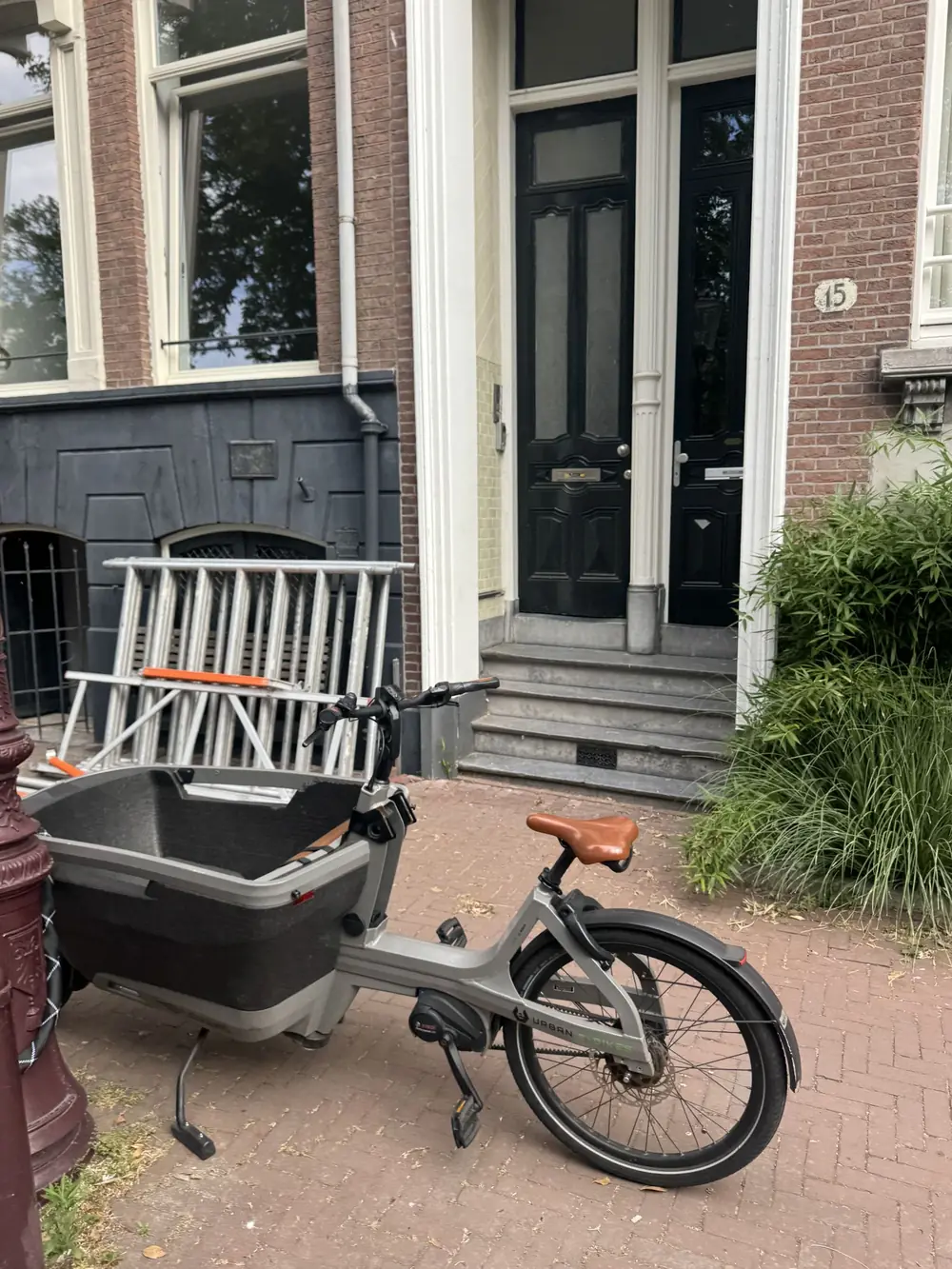
Aluminium guardrail frames loaded upright in a cargo bike standing at the steps of a brick townhouse

The wide RS52 at 135 cm only becomes attractive when two people work a whole elevation together and a supply of profiles goes up with them. If the item to be swapped is indoors instead, above a stairwell or in a partition, outdoor work does not arise and you take a room scaffold from our hire range, which still passes an interior door from about 70 cm. For a row of windows outside, the narrow version stays quickest, simply because you move it more often than you stand on it.
Which working height to hire for a grille in the head

On this errand the top reference point is neither a gutter nor a ridge, but the head of the highest frame that holds a ventilation grille. That is what you measure to, and on an ordinary family house that head falls within a reach of 6 to 8 metres. Of that figure roughly two metres is the reach above the deck; the rest is the platform height you state when you book. What such a build means in practice is set out under eight metres of reach.

The zero point of that measurement lies under the castors and not at your front door. If the front garden falls away towards the pavement, if there is a basement window below, or if the tower stands behind the house on a sunken terrace, you begin half a metre to a metre lower than you had it on paper and hire one section more. Where the top frame sits under an overhang or right beside a dormer, check at once that your head and a lifted profile still clear it.

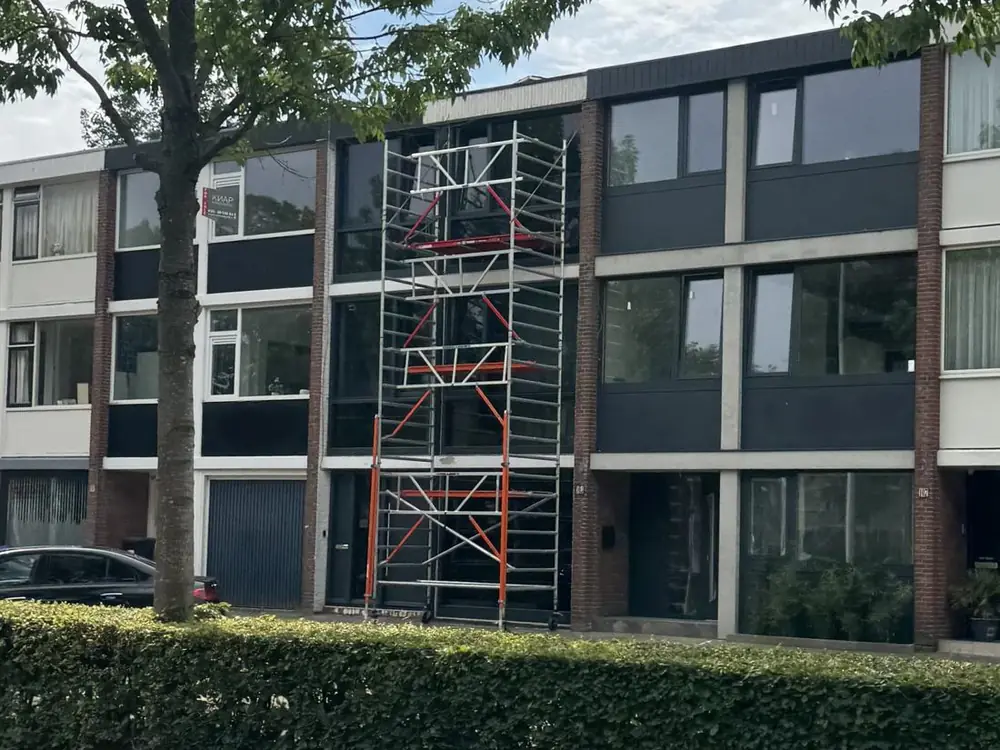
Mobile tower erected against a three storey block of flats, standing level with the windows on the upper floors

When replacing a ventilation grille, standing too low punishes itself immediately. Come out with your eyes below the head and you cannot see the clips lying in the rebate, so you lever by feel right beside a sealed unit. You also end up working with straight arms above your head, exactly the posture in which a profile shoots out of your fingers. For frames on a second storey take one section more than you think; in the hire it makes little odds and it saves half a day of irritation.

Hiring a mobile scaffold and setting it under the window

The tower belongs square under the frame, with the deck a shade above the head so that you can look down into the rebate. Under the castors belongs a flat, closed surface: paving slabs, block paving or the asphalt of a drive. A border that gives way beneath a wheel after rain will not do, and neither will a freshly filled strip of soil along the foundation. The four extendable supports at the base ask more room on each side than the tower itself takes up.

What gets in the way on this errand is almost always directly under a window. That means a low hedge along the front, a row of planters on the sill, the outside tap, a bike rack and the downpipe on the corner where you now need to put a support. Move those things away before the scaffold parts arrive, because steering an assembled tower between obstacles costs you more time than freeing two ventilation grilles put together does.

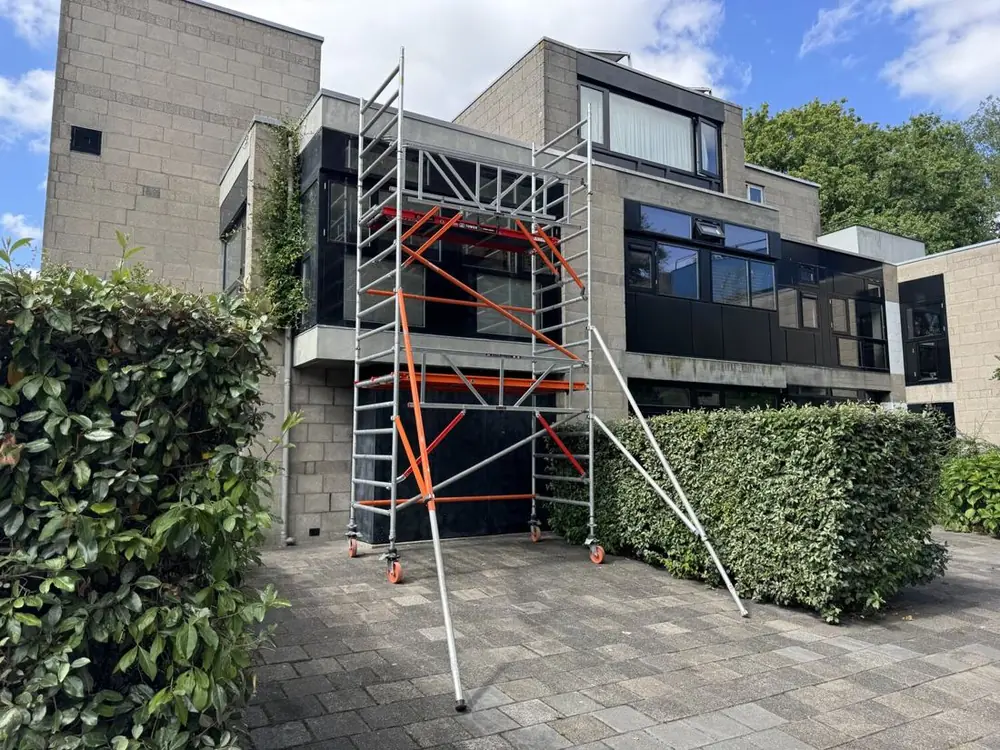
Scaffold tower on paving outside a house, four adjustable outriggers braced out to the ground on every corner

If the footway falls away towards the gutter you correct it with the adjustable feet and check with a spirit level that the standards really are vertical; how that goes is described at working on ground that is not level. If the tower ends up with two legs on the footway, keep a path open for pedestrians and check with the council what the rules are in your particular street. Such things you arrange beforehand rather than on the morning of your first window.

How many days to hire the tower for every grille

Per window, replacing a ventilation grille takes about three quarters of an hour of freeing, fitting, fixing and sealing, and that is for a profile which comes away without surprises. Shifting to the next opening adds a quarter of an hour every time: brakes off, supports in, roll, line up and lock everything again. Four to six grilles on the top storey will fill a working day at that pace. So here you think in days that the tower stands there and not in the number of screws you turn.

Two days is a sensible reservation for an average house. Day one goes on assembly and the front; day two on the rear and the dismantling. If a profile jams in the rebate, if a size turns out to have been ordered wrong or if a piece of rotten head timber has to be made good first, you genuinely need that second day. The weather has a say as well, because a sealant joint goes onto dry timber and never onto a clammy head.

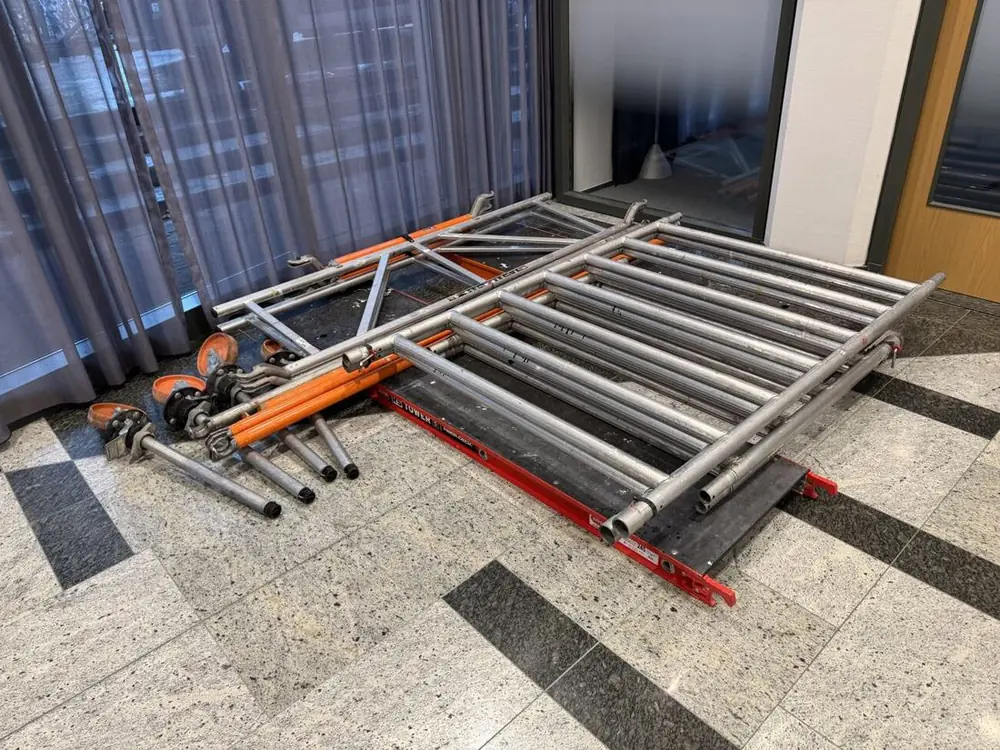
Scaffold frames, a red edged deck, castors and loose tubes set out on a tiled floor indoors

Booking on the generous side costs you almost nothing here. In the way the hire is worked out, only the first day counts at the whole rate; each further day arrives with 95 per cent knocked off it. Adding a spare day is therefore better value than stopping halfway along the rear elevation because the van is already pulling up with a window half open. How long a job needs is set out in this piece on the length of a hire period.

Which mobile scaffold suits replacing a ventilation grille?

Kamersteiger RS44
  • Working height up to 4 metres
  • Compact and narrow
  • Great for indoor and small jobs
View and calculate →
Most chosen
Smalle rolsteiger RS51
  • Working height up to 14.2 metres
  • Narrow (75 cm)
  • Ideal for narrow passages
View and calculate →
Brede rolsteiger RS52
  • Working height up to 14.2 metres
  • Wide platform (135 cm)
  • Extra stability and workspace
View and calculate →
1-persoons steiger MiTower
  • Working height up to 6.2 metres
  • Very compact
  • Quick and easy to assemble
View and calculate →

Replacing a ventilation grille from a 245 cm platform

Look carefully first at what sits in the head, because the fixing differs by type. A glass grille clamps with springs between the pane and the rebate and shows no screw at all from outside. A surface model is screwed through a flange onto the frame timber and does show those heads. An acoustic box, finally, is let into the head and has a separate flap on the inside. From the deck you see that distinction in seconds; from the ground you are simply guessing.

Then the worn profile has to come out without your touching the edge of the glass. Cut the sealant joint through over its full length with a fresh blade, press the clip springs in one by one and draw the profile square towards you. What you never do is put a chisel or a screwdriver between profile and pane to lever with: that is where the butyl edge of a sealed unit tears or the pane goes altogether. That controlled pull is only possible with both feet still on the deck of the tower you hired.

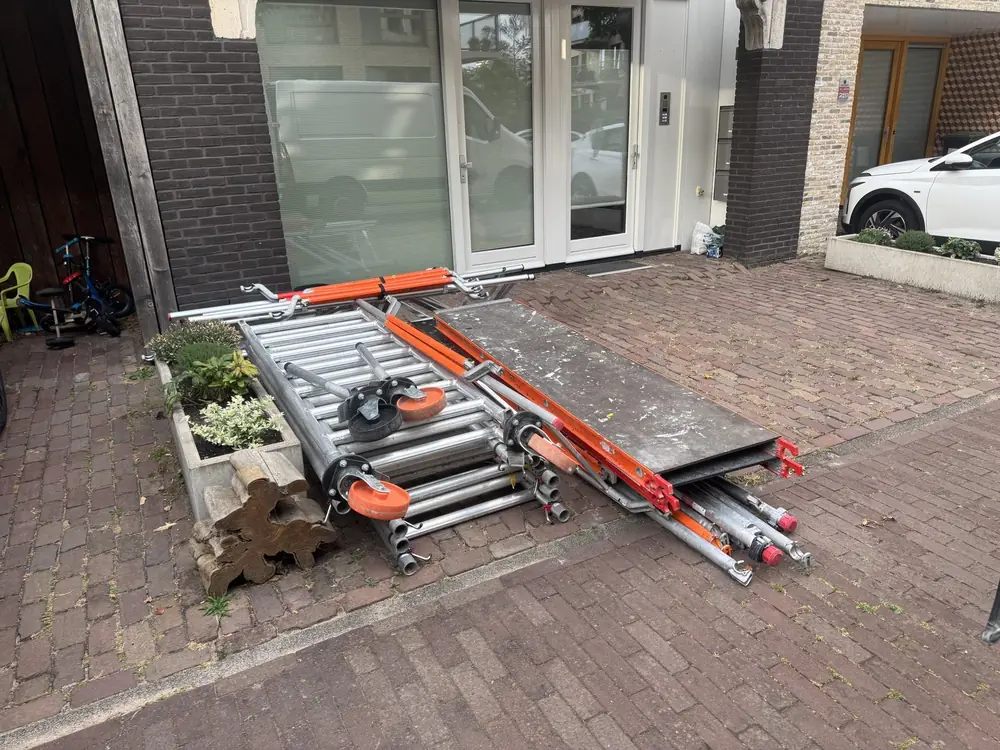
Platform decks, ladder frames and orange braces laid across block paving in front of a house with glazed doors

A deck of 245 cm covers one window opening in practice plus a little margin towards the corners of the frame, and there it stops. At a wide screen or a made up frame arrangement you shift once more halfway along. So take everything up in one round: the new profile, the screws, the sealant, a cloth and a narrow nozzle for the rebate. Every forgotten accessory means climbing down and up again, and over six windows that weighs more than the errand itself.

Hiring a scaffold with delivery: where the parts go down

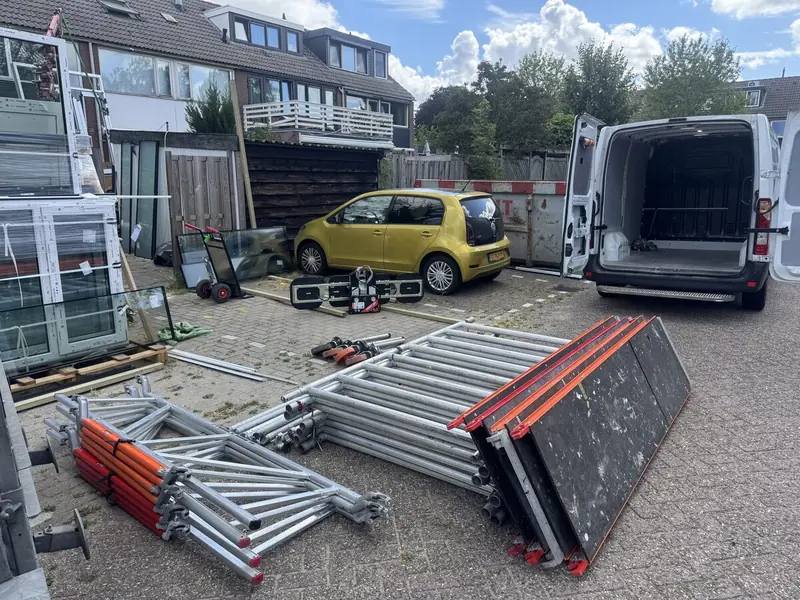
What is delivered to you is a countable stack of separate parts, complete but flat, and not a finished tower. Decide beforehand where that stack may lie, preferably on the drive or on a strip of grass beside the house and certainly not right under the window you want to start on next morning. If your order is settled before 15:00 on a weekday, everything heads your way the next working day, so the delivery can safely fall the day before your start.

Assembly is your task, and on this errand it is not much of one, because you build once and after that only roll. With two people you are about an hour and a half at it; the manual supplied and the video explain each step in the right order. Do not put that build on the same morning that you begin replacing a ventilation grille, because then you start precise work with arms that have just lifted twenty scaffold parts, and you feel it at the first clip spring.

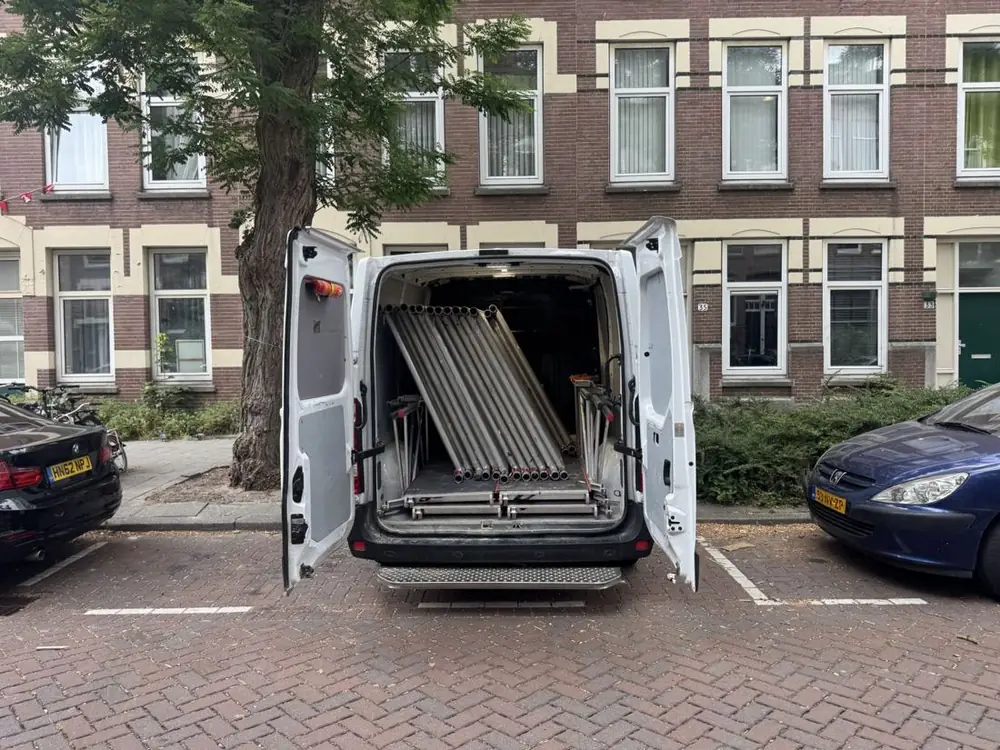
White van with its rear doors open at a kerbside bay, loaded with stacked scaffold frames

You pick an arrival day for the parts yourself when you reserve, and a day on which they disappear again. Afterwards we pull up to fetch everything; you strip the tower and lay every part back complete on the spot where they were unloaded. What that driving to and fro costs depends on your province, and the figures stand with VAT included at the rates for delivery. Take that into your budget before you fix a date for good.

Safe work on a hired tower just above the glass

Load class 3 under EN 1004 is what the whole hire fleet is built to, and it permits 200 kg on a square metre of decking. For replacing a ventilation grille that is far more than you ever draw on: you, a tool bag and three profiles together come nowhere near the limit. Do run the sum anyway once somebody climbs up with you to pass a long profile. What else the standard settles is set out in this note on the scaffold standard.

For the rest, the fixed habits of this trade simply apply. Set the wheel brakes before anyone climbs, keep the deck empty of people and tools whenever the tower is on the move, and come down as soon as the wind rises enough to twist a loose profile out of your hand. After every move, walk round the four supports and feel whether the brakes have truly bitten before your boot touches the first rung again. Two seconds of checking is cheaper than a tower that shifts under you halfway up.

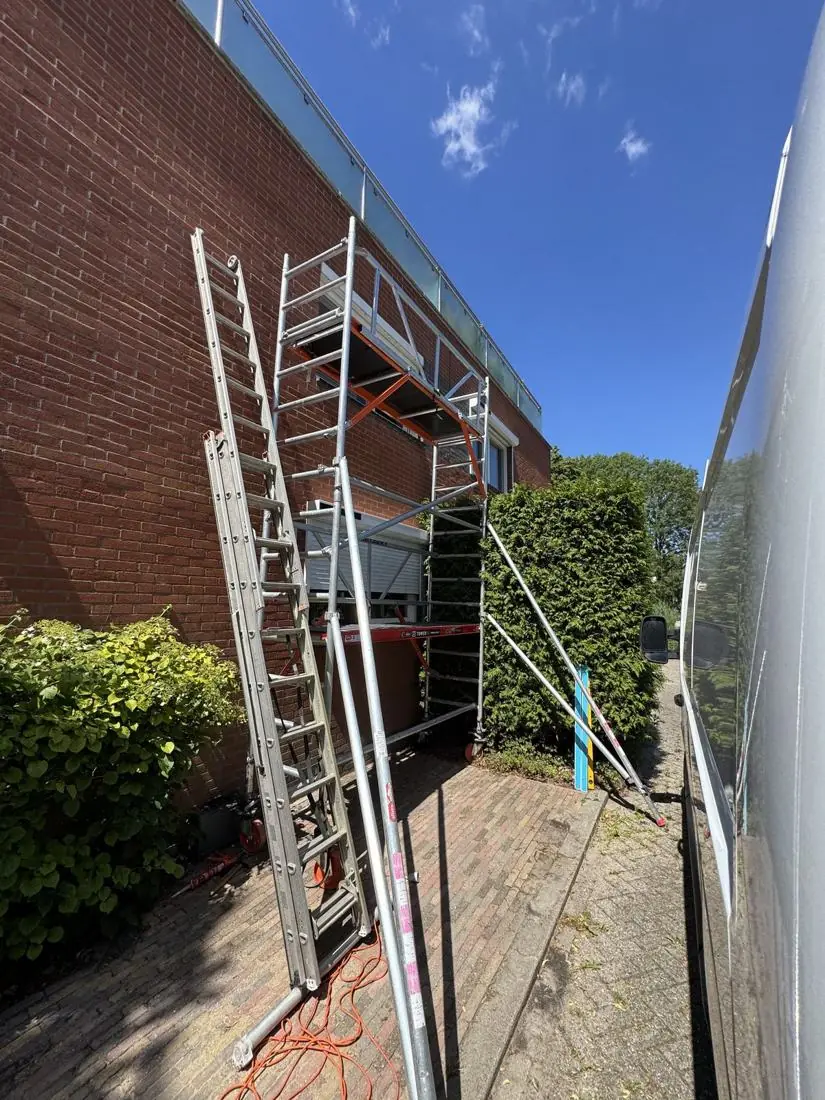
Aluminium tower built beside a brick wall with an extension ladder resting against the brickwork next to it

The particular danger of this errand lies in the glass and in what can fall. A profile pulled free has sharp cut ends, screws roll off a deck without warning, and under a front window there is often the footway where people walk past. Put a tray or a traffic cone down there and keep that strip of pavement empty for as long as you are busy with a frame. Everything else that applies is gathered at the rules that apply at height.

In 5 steps

How hiring a mobile scaffold works

1
Choose working height

Pick the height that suits your job.

2
Book online

Sorted in 60 seconds, price shown instantly.

3
We deliver

At the agreed spot the next working day.

4
Assemble safely

Assembled by you, with a manual.

5
We collect

One call and we collect the scaffold.

Good to know

Practical tips for replacing a ventilation grille

1

Photograph the existing grille close up with a rule beside it before you free it. With that picture you order a profile in the right length and flange size instead of driving twice to the merchant.

2

Change the blade in your trimming knife at every frame you take on. A blunt edge slides out of the sealant joint towards the pane, and that slip is the last thing you want beside a sealed unit.

3

Hang a magnetic tray on the guardrail for the screws from the old profile. Let them roll off the deck into the hedge and you spend longer searching than fitting the replacement takes.

4

Take the side that lies in shade first thing and leave the sunlit elevation until the afternoon. Frame timber standing in full sun expands, so a snug profile no longer wants to go in by the middle of the day.

5

Chalk a mark on the paving at every position of the castors. If you have to go back to a window that turned out not to close properly, the tower is back on its spot within a minute.

6

Leave the inner flap of the old system in place until the new profile is fixed on the outside. While that opening stays clear you see from the deck how deep the rebate runs and where sealing is needed.

Frequently asked questions

Frequently asked questions about replacing a ventilation grille

Which mobile scaffold should you hire for replacing a ventilation grille?+

For this errand the narrow RS51, 75 cm across, is the obvious pick. With that width you pass a hedge, a bay or a slim garden path where a broader tower sticks fast, and up top you miss nothing, because only a handful of tools goes with you. If two of you are working a whole elevation and you want a supply of profiles lying on the deck, you can choose the wider 135 cm tower when you hire.

How does hiring a scaffold for grille work run, from booking to collection?+

You settle model and build height online, name the arrival day for the parts and the day they leave again, and pay a sum known in advance with VAT included. We unload the parts at the street, you raise the tower yourself, you work window by window and then strip it again. On the date you named, the van returns for the pieces. Nothing else needs arranging during the hire beyond deciding which windows are next in line.

How many days do I hire the scaffold for replacing a ventilation grille?+

For an ordinary house two hire days is a realistic estimate. Each frame costs about three quarters of an hour, and rolling the tower on to the next window adds to that every time. The first day goes on assembly and the street side, the second on the rear elevation and the dismantling. If there are grilles in a dormer or in an extension as well, count a third day into your hire period from the outset.

What does grille work cost to hire, and what comes on top of that?+

What decides it is the model you take together with the build height; the run out to your province counts separately from that. Everything stands with VAT included at the rates per scaffold model, so you know your total before you make anything final. Booking one generous period works out better than two separate ones, because each period brings a delivery and an assembly of its own along with it.

Which working height do I hire and where do I start measuring?+

Start measuring on the ground under the tower and stop at the head of the highest frame with a grille in it. On a normal terraced or semi detached house you land on the build that manages 6 to 8 metres, with the deck itself staying a good deal lower because you still reach up from there. If the top one sits in a dormer, measure to that head. Which build suits which tower is on the overview of working heights.

Does assembly belong to the hire, or do I put the tower together?+

Raising it falls under your tasks. We bring the mobile scaffold as a countable set and take it away again later, while putting it up, rolling it and taking it apart stay your own work. With a second pair of hands you are up at height soon enough, and the video points out the order in which the parts have to go together. We keep no built facade scaffolds and no cherry pickers, so a rolling tower stays the handiest tool for this.

Can I extend the hire if a profile turns out not to fit?+

That can be arranged. A word is enough and we move the collection day of your scaffold, unless the tower is already on the list for the next customer. With grille work it usually overruns because a size was ordered wrong, or because the rebate has to be repaired before anything new goes in. To keep that risk small, take an extra day at the reservation; ending sooner is fine too, since you choose the closing date.

How much clear ground under the windows does the hired tower need?+

Reckon on the tower width plus, on each side, the swing of the four supports; you are soon at a level run of several metres along the elevation. Under a window there is very often a hedge, a bike hoop or a sill full of pots standing exactly in the way. Clear that before your hire period starts, and keep free as well the spot where the delivered scaffold parts may lie, because that stack wants a few square metres itself.

Does the hire keep running if rain stops the work for a morning?+

The mobile scaffold can stand outside through a shower without trouble; only the sealing round a new profile waits until the frame timber feels dry. Use such a morning for the windows that sit under a wide overhang, or to take sizes and collect missing profiles from your supplier. Because you choose the closing date of your hire period yourself, such a delay adds no more than a single day to the tower being there.

How quickly is my deposit back once the hired scaffold is collected?+

Once the parts are back with us and counted through, the deposit is repaid within one working day of that return. So make sure every piece lies ready complete and that no sealant residue, stray screws or drilling dust have been left behind on the decks or in the tubes. A quick round of the parts on your last hire day saves you a good deal of bother at the check afterwards. How that settlement runs is explained at the refund that follows a hire.

Can I have new ventilation fitted during the same hire period?+

That combines perfectly well, because the scaffold is standing there anyway in those days and your positions are already set. Do keep in mind that fitting a whole new system is a different job with its own preparation; that is what the page on installing ventilation covers. If you want both one after the other, add a day to the hire, because replacing a ventilation grille takes the tower past every window again.

Hire a mobile scaffold for replacing a ventilation grille today?

Calculate your rental price now or ask for free advice.

Rolsteiger van SteigerTaxi geleverd op locatie
Book it online

Your scaffold sorted in 2 minutes.

Choose your scaffold and working height, see the price instantly and book online.