
See your price
Application

Insulating a roof? Choose the right scaffold.

Insulating a roof is work measured in square metres, and you notice that at once in the scaffold it takes. Insulation board is light, but the panels are large, they catch wind like a sail and a great many have to go up. So what you mainly need is a steady supply point at the roof edge, plus a rental period that suits a job lasting days. On a house of two storeys that means a wide mobile scaffold with a working height of 8 to 12 metres.

  • Order before 3 pm, delivered tomorrow
  • Professional Altrex scaffolds
  • Up to 14.2 metres working height
  • Easy to assemble yourself
4,2 tot 14,2 mWorking heights available
12Provinces served
7Days a week
200 kg/m²Load class 3
In short
  • For insulating a roof we recommend the Wide mobile scaffold.
  • For roof insulation you take the wide 135 cm version, built to a working height between 8 and 12 metres.
  • Insulation boards are light but bulky, so hire a mobile scaffold with wind and the route upwards in mind.
  • Count on four to seven rental days, because this is about square metres and not about one spot you repair.
  • First 24 hours from €175 incl. VAT and delivery; every day after that 95% off.
Key facts for this job
FeatureValue
Recommended scaffoldWide mobile scaffold (Altrex RS TOWER 52)
Working height for this job8 to 12 metres
Available working heights4.2 to 14.2 metres
StandardEN 1004, load class 3 (200 kg per m²)
DeliveryOrdered before 3 pm, delivered next working day
Each extra day95% off, from €8.75 a day
Why a mobile scaffold for insulating a roof?

Safe, stable and professional work at height

With roof insulation the problem is not weight but volume. A panel weighs little and still you can barely control it in a breath of wind, certainly not at ten metres while you lift it over a gutter. On top of that, dozens of those panels have to go up, plus membrane, battens and fixings. Renting a scaffold for roof insulation is therefore about three things: a steady set up that copes with a side wind, a deck a panel fits on, and days enough to finish the whole surface. Skimp on any of the three and you stand halfway through with a half insulated roof and a tower facing the wrong way.

  • Large panels that catch a lot of wind
  • A deck an insulation board fits on
  • Supply route from the stack to the edge
  • A longer hire for the whole roof surface
Read more about working safely →

Which mobile scaffold to hire for insulating a roof

For roof insulation you pick the wide frame. With 135 cm between the uprights you lay a board flat down instead of leaning it against the rail, and across the 245 cm of platform length several fit behind one another. That sounds like a detail, but it decides whether you carry one board per climb or three. On a roof surface of dozens of square metres that difference mounts up fast in the number of trips up the ladder.

The slim 75 cm version is an emergency measure here. A board will go on it, but no walking room is left, and that is precisely what you need when there is wind and you are holding a panel with two hands. If you truly cannot reach the back any other way, work with smaller sizes and accept climbing up and down more often. Both widths and their reach sit beside one another in the hire range of mobile scaffolds.
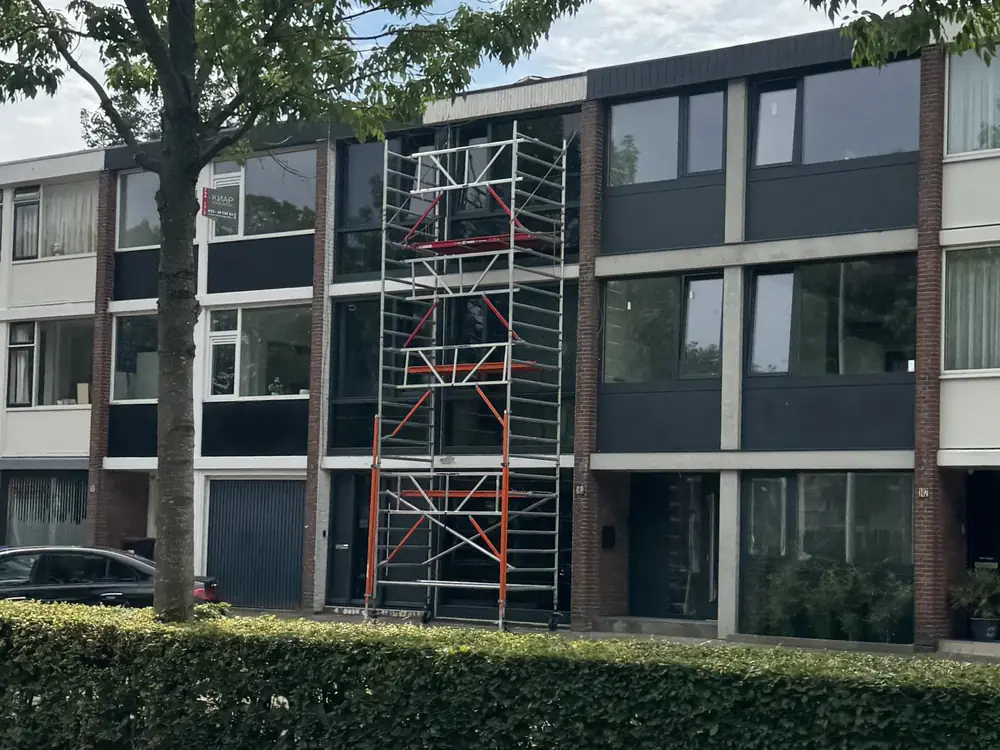
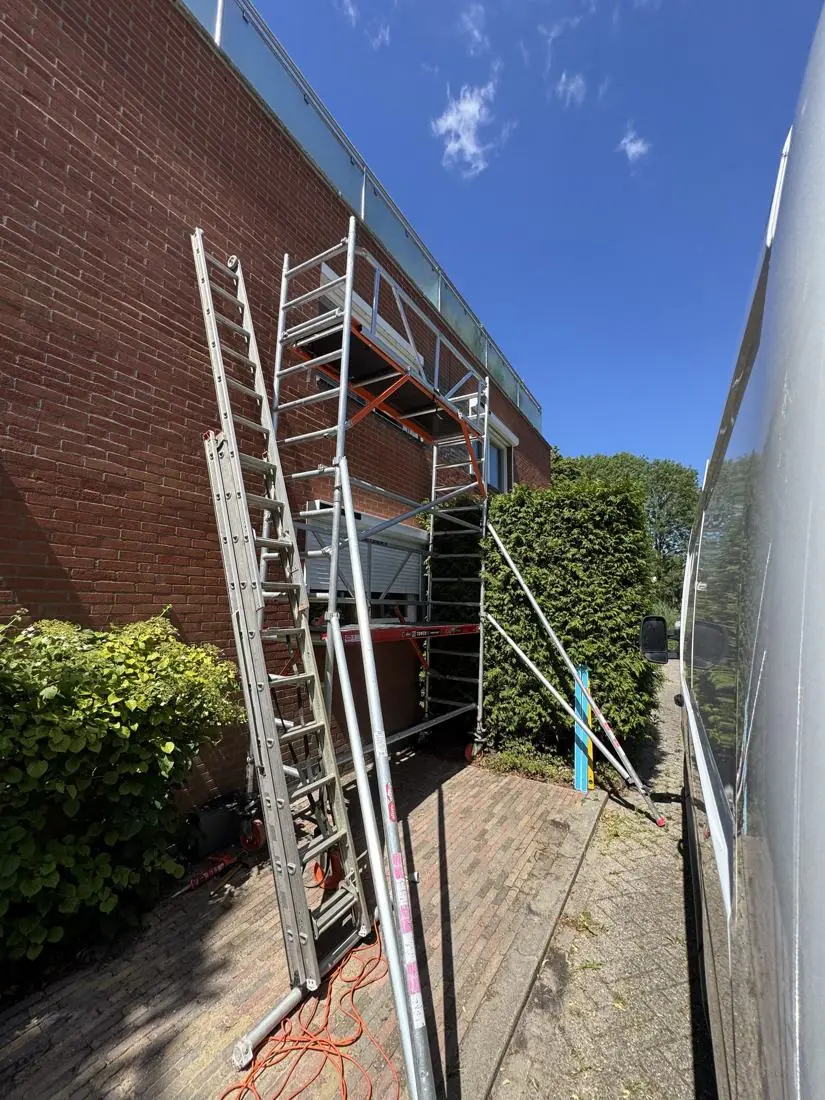
Wide mobile scaffold built up along a modern house, the set up that carries insulation boards to the roof edge

On this job also choose deliberately for one set up that you move, rather than a series of separate places. You build the tower, insulate the strip you can reach, and then wheel it further along the roof. What you get in outside dimension and stabiliser spread is shown in the survey of scaffold measurements, which is handy when you check the route past the house for gates, garden walls and other places where you get stuck.
Working height up to the roof edge when insulating

The point you have to reach is the roof edge the panels go over, so run your tape to the top of the gutter or to the fascia board above it. On a house of two storeys that lies somewhere around 6 to 8 metres, which lands you squarely in the 8 to 12 metre bracket that most people hire for this work. Your platform height plus a reach of roughly 2 metres together make up the working height you enter when you hire.

Always measure from the level where the castors will rest. If the back garden lies lower than street level, your whole build shifts upwards with it. Look as well at whether an overhang or a projecting roof edge sticks out past the wall, because you have to get the panel past that and it costs you height. The page about a reach of 10 metres shows what such a build looks like and how many platforms it takes.

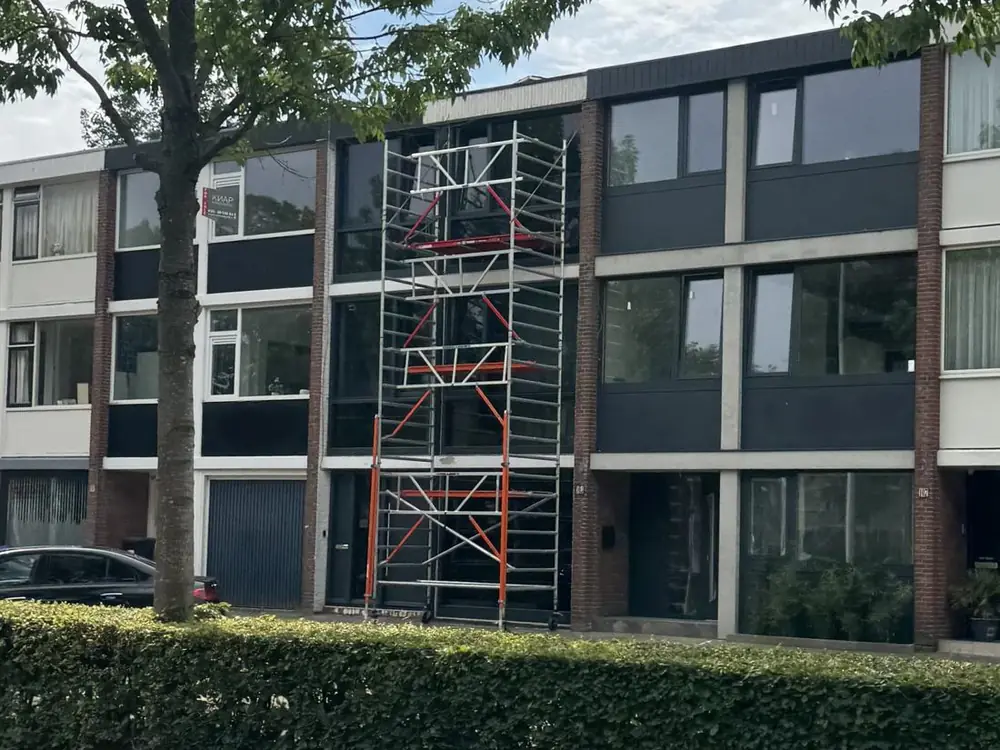
Mobile scaffold built along a front elevation up to the gutter, the reach roof insulation demands of you

Underestimating is nastier on insulation work than on other maintenance. Stand below the roof edge and you have to lift every panel above your head and hold it straight in the wind at the same time, and one day that goes wrong. Stand with your hip above the edge and you slide it across calmly. Working on a house with the gutter at second storey level, take the generous reach and not the tight variant.

Standing place for the scaffold you hire for roof insulation

On this job you need two places: one for the tower and one for the stack of panels. You want that stack near the access point, but not so near that you trip over it while climbing. Lay it to one side, flat on the ground and with some weight on top, because a loose pile of insulation blows through the whole garden at the first solid gust. A carport or a garage is better still for that stock.

Under the scaffold itself the stabilisers have to rest on firm ground, and that asks more width on each side than the frame has. Watch the surface with extra care here, because you are busy for days and the terrain changes with the weather. What is a solid grass path on Monday has gone soft after two days of rain. The approach for a sinking or crooked base is described in the guidance on uneven ground, including what to put under the stabilisers.

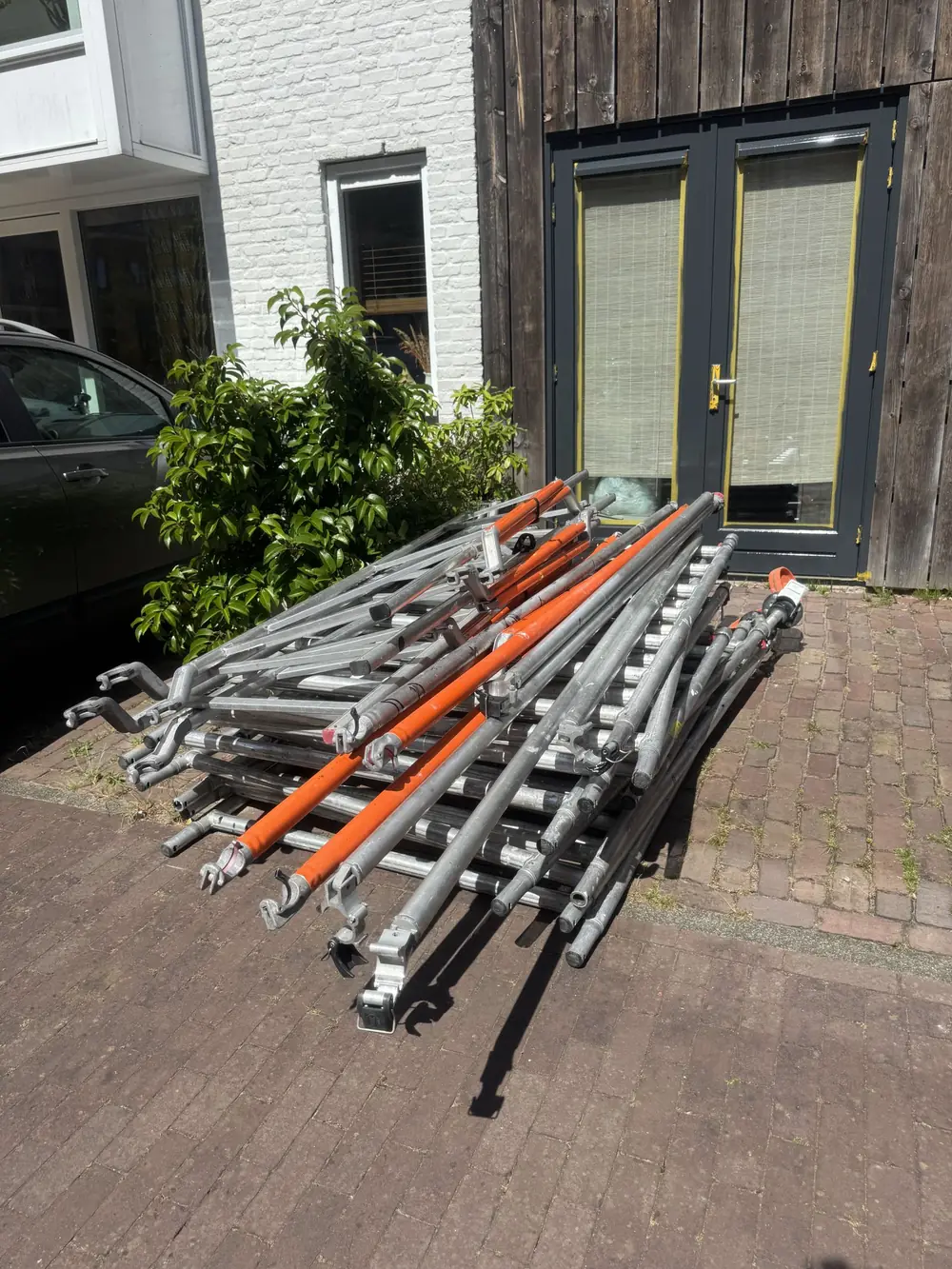
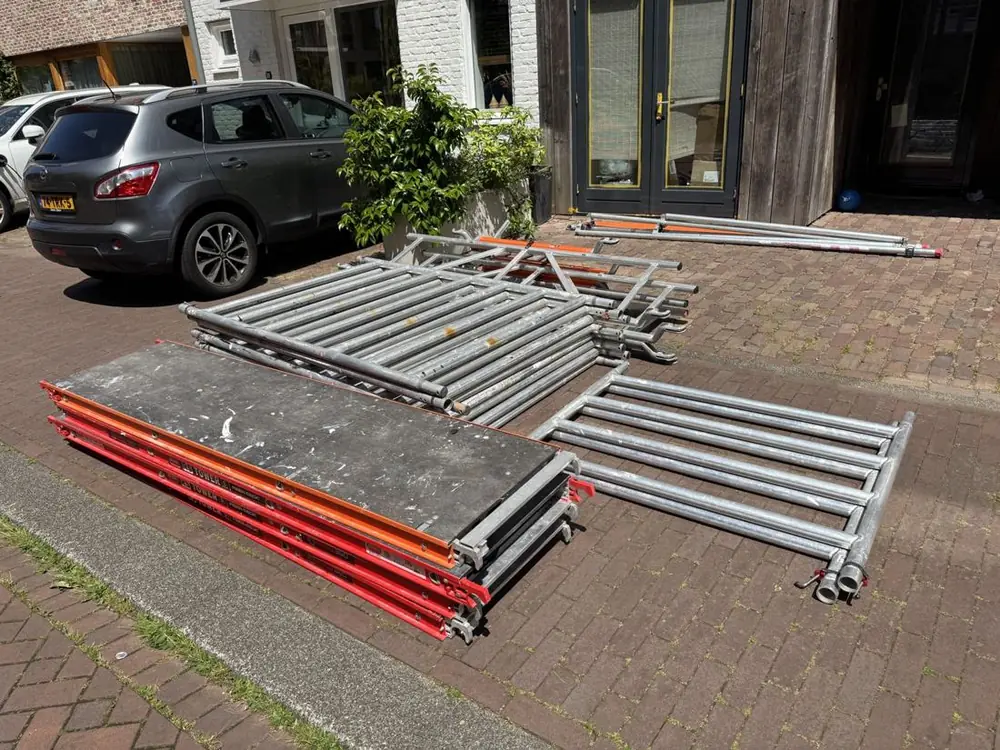
Scaffold parts on the street beside a house, where a stack of insulation boards also has to find room

Look at the wind direction on the spot where you stand as well. Between two houses or along an open back there is often far more draught than you judge from the street, and that is exactly where you walk with large panels. So set the tower on the sheltered side of the house if the layout of your roof allows it. Keep the walking route clear of garden furniture, because you carry material back and forth here for days.

Hiring a scaffold longer because roof insulation counts square metres

Insulating is not a spot job. You replace no single tile and you repair no piece of gutter, you treat a complete surface, which means the size of your roof sets your rental period. For a terraced house with one roof surface you are quickly at four to seven days, and on a house where you take in two surfaces and the roof edge it runs up further. Work out in advance how many square metres you realistically manage per day.

That planning includes the days on which you can do nothing. Wind is the chief spoiler: with large panels above your head you stop sooner than on other work, and a day of stiff gusts you simply write off. Rain matters as soon as you have taken tiles away and the boarding lies open, because then you want to be certain you are closed again the same day. So plan with margin and not with your sharpest estimate, especially in autumn.

Mobile scaffold erected along a side wall, standing several days in a row during a roof insulation job

Financially that margin is modest. After the first 24 hours, which you pay in full, the meter runs on slowly: every following rental day comes with 95 per cent off. Two spare days therefore cost you less than one repeat delivery because you booked too tight. How to build up such a period for a larger job is explained in the piece on the number of rental days, with worked examples for work running over several days.

Which mobile scaffold suits insulating a roof?

Kamersteiger RS44
  • Working height up to 4 metres
  • Compact and narrow
  • Great for indoor and small jobs
View and calculate →
Smalle rolsteiger RS51
  • Working height up to 14.2 metres
  • Narrow (75 cm)
  • Ideal for narrow passages
View and calculate →
Most chosen
Brede rolsteiger RS52
  • Working height up to 14.2 metres
  • Wide platform (135 cm)
  • Extra stability and workspace
View and calculate →
1-persoons steiger MiTower
  • Working height up to 6.2 metres
  • Very compact
  • Quick and easy to assemble
View and calculate →

Getting boards up from a platform of 245 centimetres

A platform length of 245 cm tells you two things: how much roof edge you serve per set up and how much material you can keep up there. In practice you lay a few boards flat, slide them over the edge one by one and finish the strip before you move. What you should not do is stack the deck full until you cannot stand anywhere; you need walking room to turn a panel and that will not happen between two piles.

The real work sits in the hand over at the roof edge. A board a metre wide catches the full wind there and wants to twist out of your hands the moment you let go at the top. So work with two people: one below or on the platform passing up, one above taking it. Never alone, and never with a panel larger than you can still control at arm's length while the wind blows.

Mobile scaffold set against a wall, the standing place from which you insulate a good two metres of roof edge

When estimating your set ups, count on a good two metres of roof edge each time. For eight metres of wall that means three to four standing places, and before each move you take everything off the deck first. If you also take on insulating the roof edge, extra time comes with every position, because you are then busy both on top and at the side of the edge and the scaffold has to stand a good deal more precisely.

Scaffold hire with delivery for a multi day insulation job

The scaffold turns up as a complete set of loose parts, counted, on the place you point out beforehand. Choose that place with the rest of your job in mind, because with roof insulation a pallet of material also lands in your garden or on your drive. So do not put the parts where the insulation supplier has to leave his pallet. Reservations in before 15:00 on a working day travel out with the van the next working day.

You fix both the delivery day and the collection day yourself, so you can make the scaffold match the arrival of your insulation material. Have it come a day before the panels and the set up is standing before your garden fills up. On a job of a week that is the difference between starting calmly and being behind from the first morning. The survey of delivery rates per province shows that item before you book.

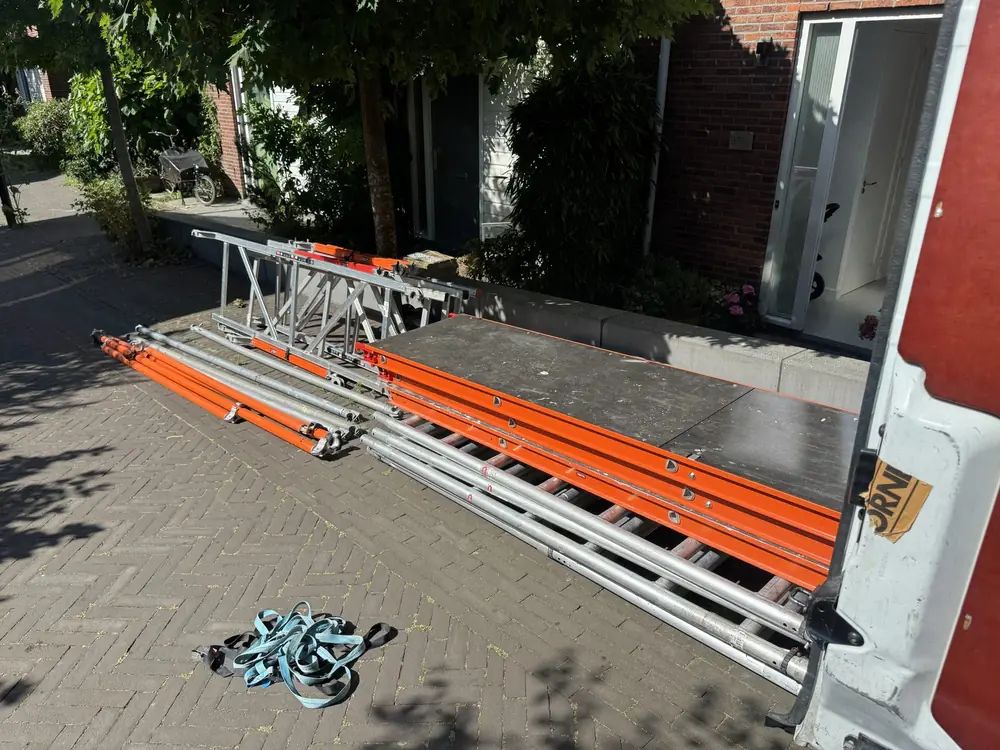
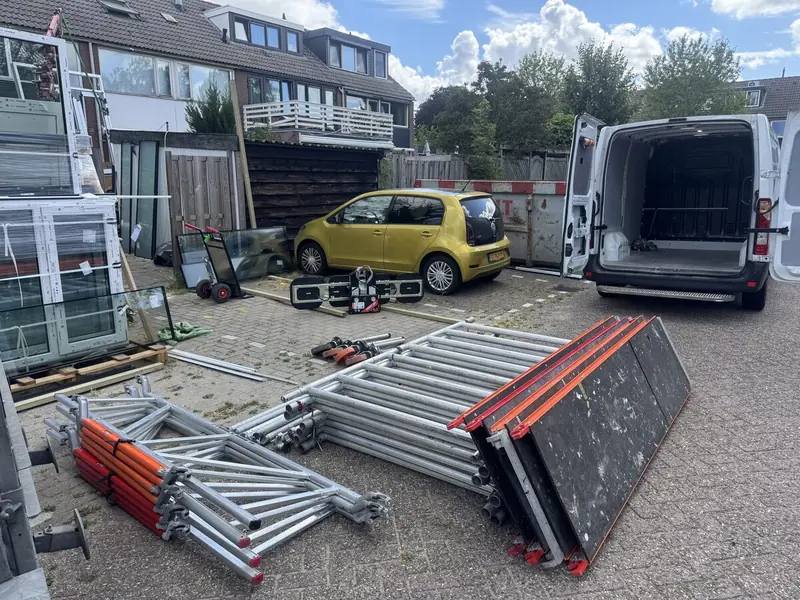
Scaffold parts loaded in a van, ready for delivery at a house where the roof is to be insulated

Once the roof is closed we come and fetch the scaffold again. Dismantling is yours, after which all parts lie complete on the agreed spot. Sweep the insulation dust and the sawn offcuts off the deck boards before you stack, because it gets in everywhere. Do that on a still day, or keep an open bin bag to hand while you work, otherwise the cuttings end up in the neighbours' garden or down in the gutter after all.

Safe work on the scaffold you rent for roof insulation

The platform is approved to load class 3 under EN 1004, meaning 200 kg per square metre. With insulation material you do not reach that ceiling quickly, but that is precisely the trap of this job: because the panels are light, people stack far more on than there is room for and start climbing over it. The weight is not the problem, the volume is. Keep the deck free enough to put your feet down anywhere.

The basic rules stand. Castors go on the brake as soon as anybody climbs up, the set up is never wheeled with material or people aboard, and when the wind gets up you stop this work sooner than any other. An insulation panel acts as a sail: it pulls you off balance before the scaffold itself notices anything. Tie loose boards down up there or lay them flat the moment you go down, even for a few minutes.

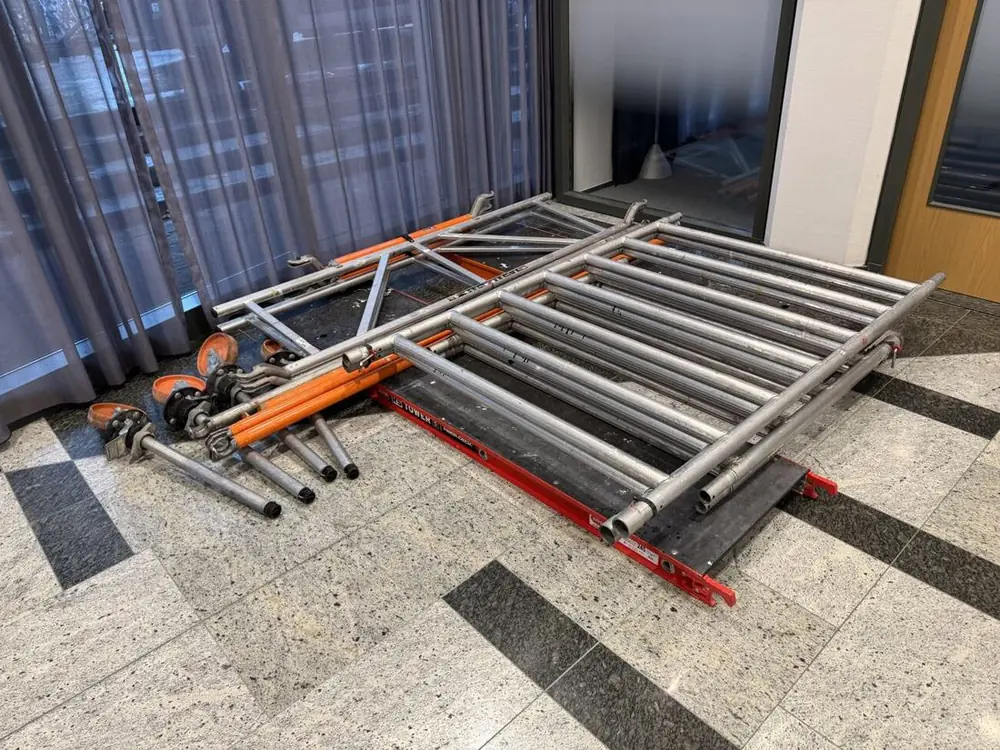
Complete and inspected set of mobile scaffold parts, as supplied when you hire for a roof insulation job

Then there is the offcut material. Scraps of board, membrane and bits of tape make the deck slippery and blow across the boundary, so sweep up as you go and keep a closed bag to hand. Watch your knife too: cutting often happens on the deck and then the blade sits close to your own knees and your power lead. All further agreements are found in the rules that hold at height and in the notes on this standard.

In 5 steps

How hiring a mobile scaffold works

1
Choose working height

Pick the height that suits your job.

2
Book online

Sorted in 60 seconds, price shown instantly.

3
We deliver

At the agreed spot the next working day.

4
Assemble safely

Assembled by you, with a manual.

5
We collect

One call and we collect the scaffold.

Good to know

Practical tips for insulating a roof

1

Cut your panels to size at the bottom and not up on the deck. The platform stays clear, you cut more accurately on a flat surface and the offcuts do not blow straight across the garden.

2

Never lift a whole panel over the roof edge on your own when there is wind. Saw it into two pieces instead; it costs you an extra joint but saves a dangerous moment at height.

3

Lay a strap over the pile of boards on your platform. Then nothing is left flapping when you go down for a moment to fetch tools or a fresh roll of membrane.

4

Look at the wind forecast first thing every morning before you start. On roof insulation the wind sets your day, so turn the order round and do the sheltered side first if need be.

5

Keep the number of boards on the deck low and top up as you go. A half empty platform works faster than a full one, because you can stand anywhere and never step over stacks.

6

Book your collection day one day after your last insulating day. That leaves time to close the roof, check it over and dismantle the tower calmly instead of working in a hurry.

Frequently asked questions

Frequently asked questions about insulating a roof

Which model of mobile scaffold do you hire when insulating a roof?+

The wide version, because you lay an insulation board flat on it and still keep walking room. That matters more here than load capacity, since the panels are light but take up a lot of space and want to go every way in the wind. If you can only reach the back with a slim frame, work with smaller sizes and accept that you climb up and down more often during the hire.

What is involved in hiring a scaffold for roof insulation?+

You choose a model and a reach online, fix the delivery day and the collection day, and see a fixed amount including VAT beforehand. We deliver the parts, after which the tower goes to its place and shifts along the roof with you as you insulate surface after surface. At the end you set it dismantled and complete ready for the collection run. Further arrangements are listed in the common questions about hire.

Why do you have to hire longer for roof insulation than for a repair?+

Because you treat a whole surface rather than one place. Four to seven rental days is normal for an average house, and that comes from the number of square metres, the constant repositioning of the scaffold and the days you lose to wind. A repair is done after a morning, insulation is not. So set your end date generously and reckon on at least one day when the work stops completely.

What is the rental price for such a longer period and how does the discount count?+

Model and reach set the basic amount, with the transport to and from your province counted separately. You see each tariff including VAT on the page with prices before you commit to anything. On roof insulation the structure works in your favour: the first day counts in full, the days after it almost disappear. Hiring a week at a stretch is therefore considerably cheaper than booking two loose blocks of three days.

Can you have the scaffold delivered if you want to hire it for insulation work?+

Yes, and on this job that is usually handiest. We put the mobile scaffold down on the day you pick and fetch it once the roof is closed, at a fixed tariff per province. Collecting is possible as well: the set is ready for you by appointment at Zeeburgerpad in Amsterdam, free of charge. Bear in mind that your trailer is probably already full of insulation material during those days.

Do you have to build the scaffold yourself when you hire for roof insulation?+

Yes, building and dismantling belong to your part. We bring the parts and fetch them later; putting the scaffold up, moving it along and taking it apart you arrange yourself with the manual and the video that come with it. On an insulation job of several days that is not so bad, because the build time spreads over the whole period. Do follow the step by step build plan in the right order.

What if the insulating overruns and you want to hire the scaffold longer?+

Let us know the moment you can see it happening; we move the collection day for as long as the tower is not fixed for somebody else. On roof insulation it often overruns through wind or because a surface turns out bigger than expected. So book generously from the start and hand back early if it goes well; that is always allowed and it spares you the tension of a collection date closing in.

How much room has to be free around the set up and the stack of panels?+

Besides the width of the frame you count in the spread of the stabilisers, and the place for your boards comes on top of that. You want that stack lying flat, out of the wind and close to the access point. In practice a clear strip of several metres along the wall is the minimum. Clear the walking route as well, because you carry material to the scaffold for days on end.

May you keep the scaffold on hire on days when it blows too hard?+

The mobile scaffold simply stays standing, but the work stops. An insulation panel behaves like a sail in the wind and that is not manageable at height, however light it feels in your hands. Use such a day for sawing, for laying material ready or for working on the sheltered side of the house. Because an extra rental day hardly counts in what you finally pay, postponing on this job is almost always the sensible choice.

How does the deposit work over a longer hire period for roof insulation?+

Hiring involves a deposit. With the set counted after return, the amount is transferred back inside one working day. Watch for sawdust, dust and adhesive residue on the deck boards of the scaffold: a quick wipe before you stack them saves bother later. A forgotten toe board lying somewhere in the garden also holds up the settlement of your hire needlessly. What else plays a part you read in the explanation about the deposit.

Can you hoist the insulation panels up with the hired scaffold?+

On a rope along the outside that works fine for small boards, provided it is still and somebody steers from below. Large panels are better passed hand to hand, because a hoisted board in the wind pulls at the whole set up. Hoisting gear and builders lifts are not part of this hire; you rent a mobile scaffold and arrange the rest with manpower, good planning and a calm day.

Which working height do people hire for insulating a roof?+

Mostly 8 to 12 metres, because on a house of two storeys that is what you need to get your hip above the gutter. You start measuring on the ground under the castors of the scaffold and stop where the panels go over the edge. If a substantial overhang is in the way, choose the roomier reach. Which build belongs to it is shown on the overview of working heights.

Hire a mobile scaffold for insulating a roof today?

Calculate your rental price now or ask for free advice.

Rolsteiger van SteigerTaxi geleverd op locatie
Book it online

Your scaffold sorted in 2 minutes.

Choose your scaffold and working height, see the price instantly and book online.