
See your price
Application

Insulating a roof edge? Choose the right scaffold.

Insulating a roof edge is work along a line: the narrow transition where the roof plane lands on the facade and the cavity meets it from below. That is where the cold bridge sits, and you need both hands on it without twisting a shoulder into the gutter. That only works if your deck sits at the right level. On two storeys that means the wide RS52, taken up to a reach of 8 to 12 metres. Below you read how to make that choice and what the job asks in hire days.

  • Order before 3 pm, delivered tomorrow
  • Professional Altrex scaffolds
  • Up to 14.2 metres working height
  • Easy to assemble yourself
4,2 tot 14,2 mWorking heights available
12Provinces served
7Days a week
200 kg/m²Load class 3
In short
  • For insulating a roof edge we recommend the Wide mobile scaffold.
  • For insulation work at the roof edge you hire the wide RS52, a deck of 135 cm, built somewhere between 8 and 12 metres.
  • Set your deck just below the transition, so the joint of cavity and roof plane sits straight in front of your chest.
  • Count on three to four hire days, because this cold bridge runs along all four sides of your house.
  • First 24 hours from €175 incl. VAT and delivery; every day after that 95% off.
Key facts for this job
FeatureValue
Recommended scaffoldWide mobile scaffold (Altrex RS TOWER 52)
Working height for this job8 to 12 metres
Available working heights4.2 to 14.2 metres
StandardEN 1004, load class 3 (200 kg per m²)
DeliveryOrdered before 3 pm, delivered next working day
Each extra day95% off, from €8.75 a day
Why a mobile scaffold for insulating a roof edge?

Safe, stable and professional work at height

Insulating a roof edge is not the same as insulating a roof surface: it is a strip half a metre deep at most, but that strip runs the whole way round. The top of the cavity, the wall plate, the start of the overhang and the rim of the roof covering all sit close together. You not only have to reach it, you have to stand in front of it for half an hour at a time with both hands free. From a ladder you end up in exactly the wrong place, hanging under the edge instead of in front of it. Renting a mobile scaffold gives you a deck you set to the right level and then move corner by corner.

  • Cold bridge where the facade meets the roof plane
  • Top of the cavity reachable from a deck
  • Working height of 8 to 12 metres along the edge
  • Moving round the house along one single line
Read more about working safely →

Which mobile scaffold to hire to insulate a roof edge

For this insulation work you take the RS52, the roomier Altrex model whose deck measures 135 centimetres. You need that width because the job stays in one place for a long stretch. A roll of insulation material, a foam gun, sealant cartridges, a knife and a short saw all want to be within arm's reach at once, and on a cramped deck you shuffle those things about all day. What else is available sits together on our page about the mobile scaffold range, with the sizes and possible builds per version.

At a roof edge you are seldom up there on your own, either. Opening up and closing again goes a good deal faster with two people: one fills the strip, the other passes up the finishing pieces and catches the offcuts. On 135 centimetres you fit side by side without anyone having to step back each time. That saves a quarter of an hour per setup, and reckoned across twelve setups you win back half a day on your hire period.
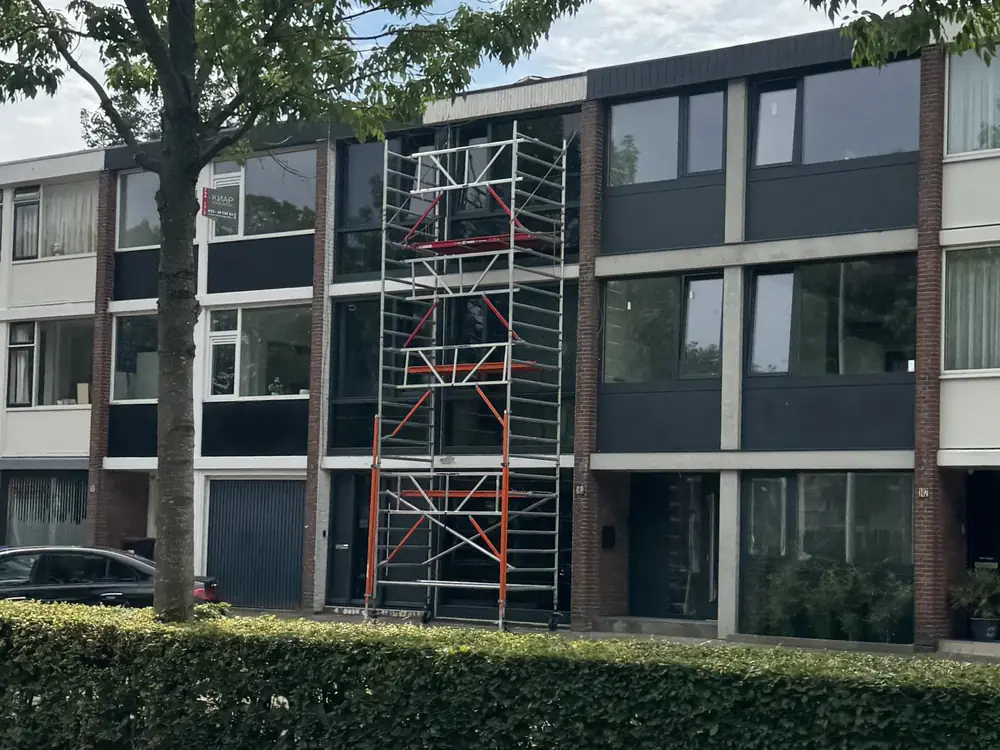
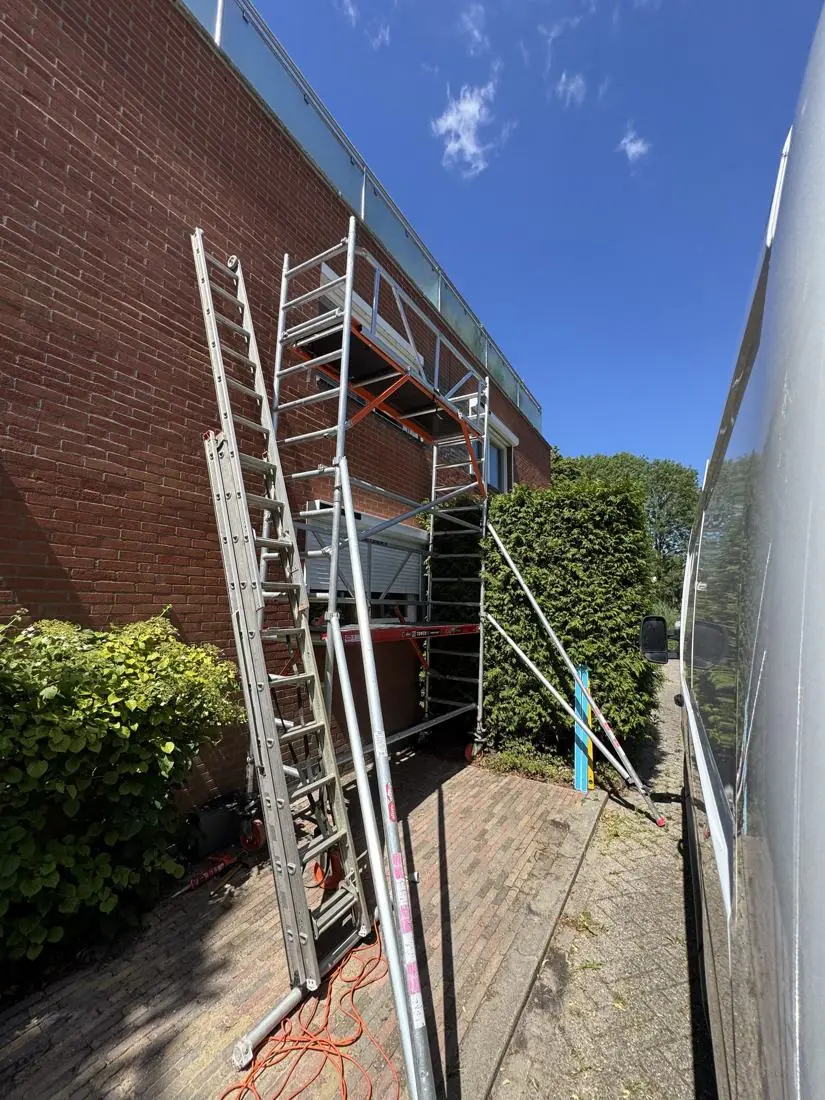
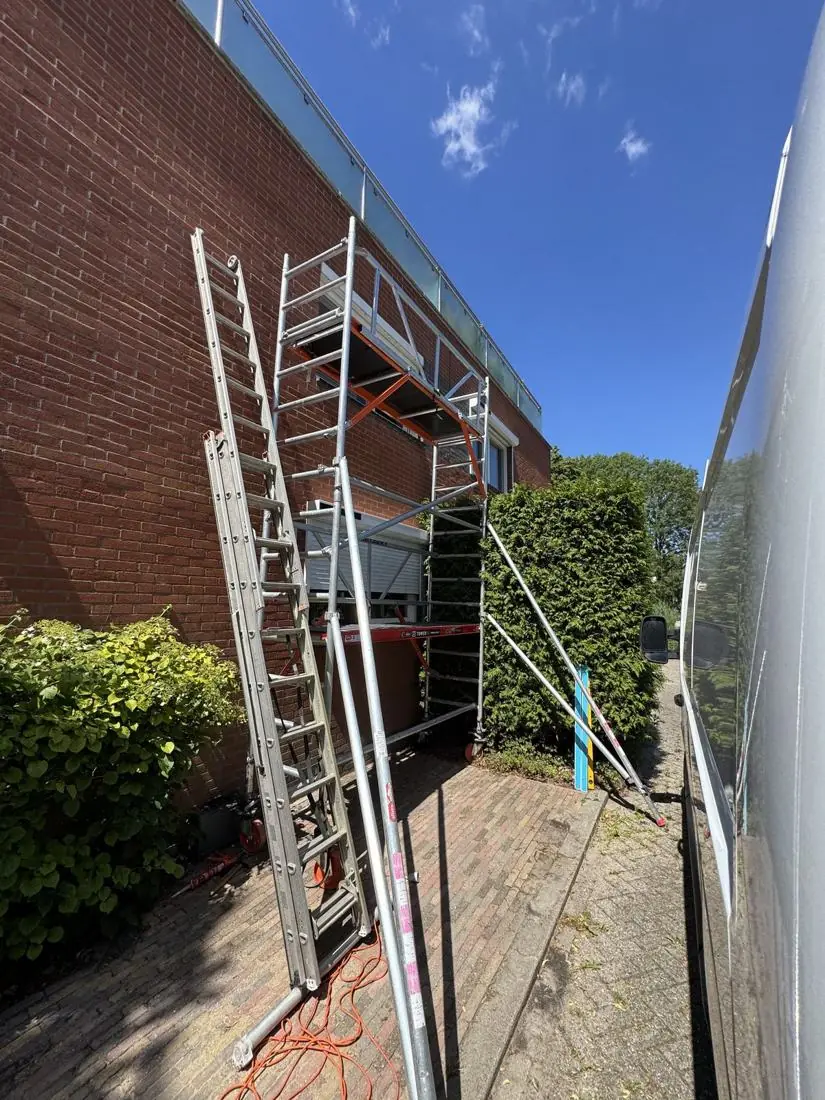
Wide mobile scaffold built up alongside a house as far as the roof edge, the model you hire for edge insulation

The slim 75 centimetre model only comes into the picture here when you have to reach the back through a gate under a metre wide. Weigh that honestly: you win that one passage, but you give up working room at every standing place on the whole round. If you can carry the parts round the house, choose the roomier version. Both widths sit side by side in the explanation of scaffold sizes. Measure that gate at its narrowest point, between the hinges and not between the posts.
What working height to hire for roof edge insulation

The measuring point for this job sits lower than for roof maintenance in general. You do not need to go to the ridge, and not even to the row of tiles, only to the line where the roof plane and the facade touch. On an ordinary terraced house of two storeys that line sits somewhere between six and ten metres, which lands you on a build reaching 8 to 12 metres. Start measuring at the level where the castors will stand; a sloping drive counts in that sum.

Then work back to the deck. On top of the height at which that deck hangs comes roughly 2 metres of reach, and it is that sum you enter as the working height when you book. With roof edge insulation you would rather turn the sum around. You do not want the transition above your head but straight in front of you, so look for the build that leaves the deck half a metre under the rim. That way you look into the cavity opening instead of at it, which spares your neck.

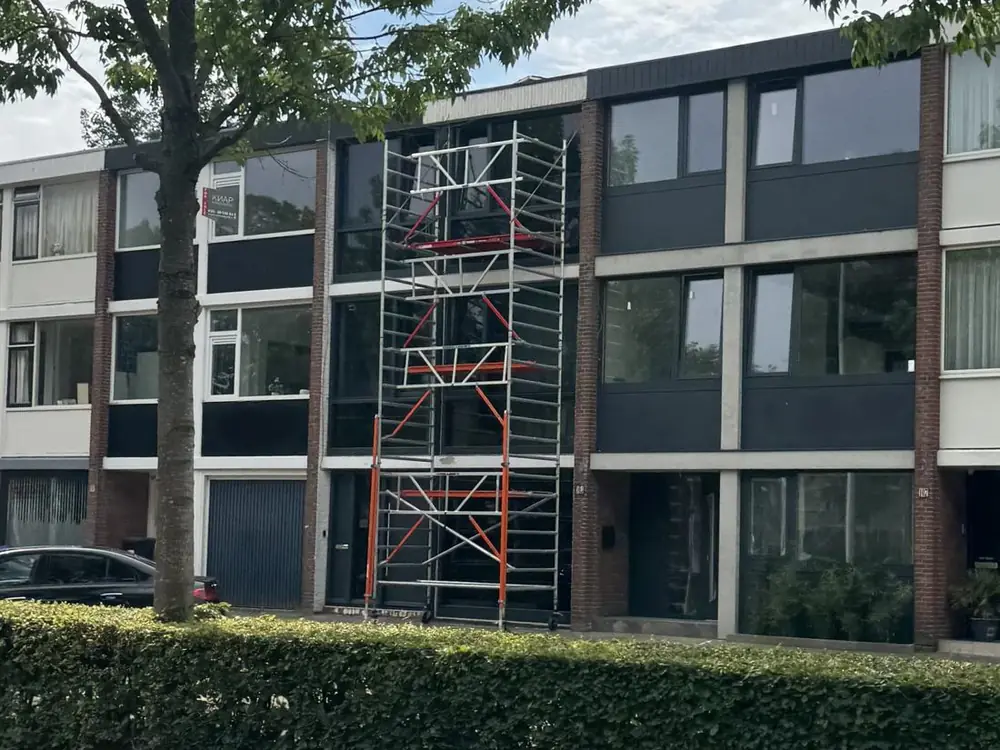
Mobile scaffold built against a front elevation, the stance in which your deck stays just under the roof edge

Choosing too low punishes you harder on this work than on painting. Foam and sealant applied above your head with straight arms drop back into your face and bond poorly, and a joint you cannot see is a joint you never check. Hiring one extra build section is quickly arranged; a badly sealed cold bridge is something you repair years later. If you are torn between two builds at a roof edge on the second storey, take the higher one.

Hiring a mobile scaffold: standing places along the facade

The cold bridge runs right round, so your standing places run round with it. That means a different surface on each side of the house. At the front the castors rest on block paving, at the side on a narrow path that falls away towards the boundary, at the back on slabs that sink into the sand beneath them after a shower. Walk that round once with a spirit level in your hand, so you know in advance which corner wants a base plate or a thick plank.

At the foot the four stabilisers claim their space on every side, and along a facade that is exactly where things are in the way. A downpipe with a shoe under it, an outside tap, a crawl hatch, a row of planters and the hedge the neighbours have let grow up to the boundary. Clear that away before the set arrives, because a stabiliser you can only half extend does not count. Differences in level you take up as described for a tower on uneven ground.

Stabilisers angled outwards under an erected mobile scaffold, the room every standing place along the facade demands

One more detail weighs heavily on this job: the overhang. If your roof projects half a metre past the facade, you cannot get the setup tight against the wall and your deck stands some way out. Measure that projection from the ground beforehand, because it decides whether you still reach the cavity opening comfortably. With a substantial overhang, put the build a section higher rather than half a metre nearer. That single measurement often settles which reach you end up hiring.

Hire days needed to insulate a whole roof edge

An average mid terrace has thirty to forty metres of roof edge; on a corner house or a detached one that soon runs to double. Per setup you finish a little over two metres, and per setup you are three quarters of an hour busy with opening up, filling, sealing and closing again. Add the moving to that and you land on three to four days for an ordinary house. That is the period you reserve, not the number of hours in which you actually gun foam.

Those days contain interruptions you cannot compress. Foam has to expand and cure before you trim it, sealant needs to skin over before the cover batten goes on, and on a wet facade you do not start at all because the material will not take. A dry, still morning is worth more on this work than a full day with showers. So tune your planning to the forecast and not to the Saturday that happens to suit you.

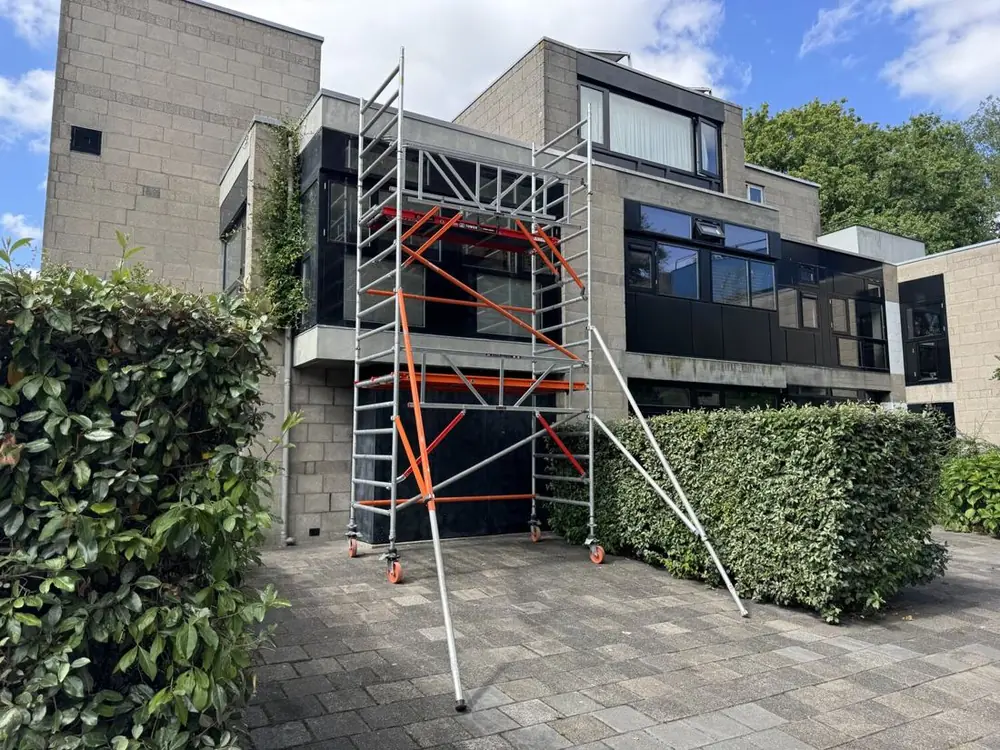
Mobile scaffold erected along a side elevation, the setup that stands through your hire days between two work rounds

Booking generously is cheap with us. The whole rate covers the opening 24 hours, after which a reduction of 95 per cent lands on each further hire day. Sticking a spare day on the end of your planning therefore costs you almost nothing, while stopping halfway with an open rim can leave you with a wet cavity. What a longer period means is set out under hiring by the day or by the week, and the rental price for each build stands on the price page, all including VAT.

Which mobile scaffold suits insulating a roof edge?

Kamersteiger RS44
  • Working height up to 4 metres
  • Compact and narrow
  • Great for indoor and small jobs
View and calculate →
Smalle rolsteiger RS51
  • Working height up to 14.2 metres
  • Narrow (75 cm)
  • Ideal for narrow passages
View and calculate →
Most chosen
Brede rolsteiger RS52
  • Working height up to 14.2 metres
  • Wide platform (135 cm)
  • Extra stability and workspace
View and calculate →
1-persoons steiger MiTower
  • Working height up to 6.2 metres
  • Very compact
  • Quick and easy to assemble
View and calculate →

Insulating the roof edge from a 245 centimetre deck

A deck 245 centimetres long decides exactly how much roof edge you take on per setup. That sounds like little, but it is a pleasant unit to think in: you open a stretch, insulate it, close it again and only then move on. That way there is never more than two and a half metres of rim lying open at the moment it unexpectedly starts to rain. Work from corner to corner and not at random, and you keep an overview.

Take up per setup what you are certain to use and nothing more: the insulation for that strip, the foam gun, sealant, a knife, your rule and a small bucket for waste. Anything missing up top costs you a climb of eight metres and a broken run of work. Cut the material to length below, because sawing on the deck produces dust, loose pieces that blow away and a messy surface you have to stand on yourself. A bucket with a lid keeps that waste together.

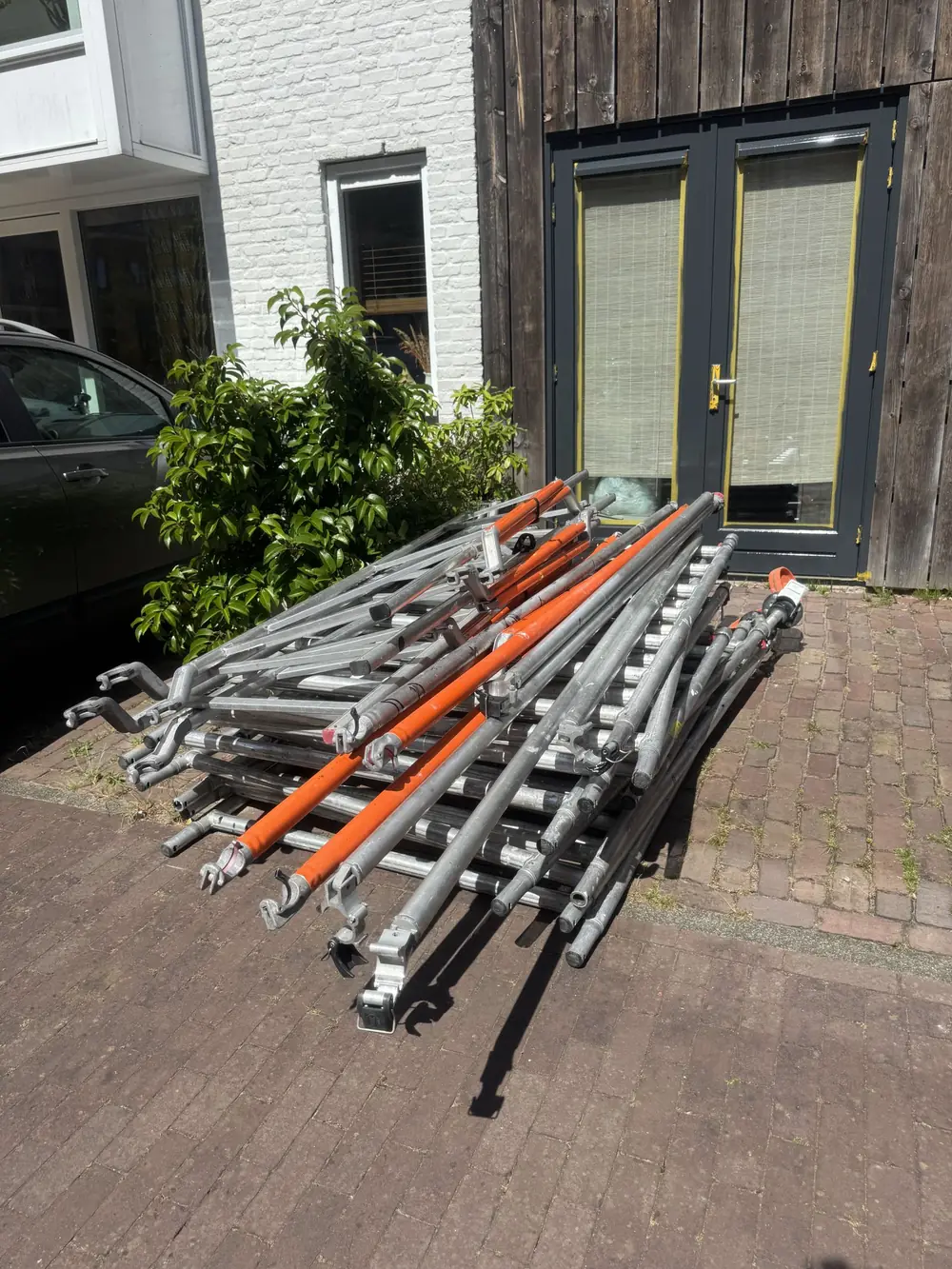
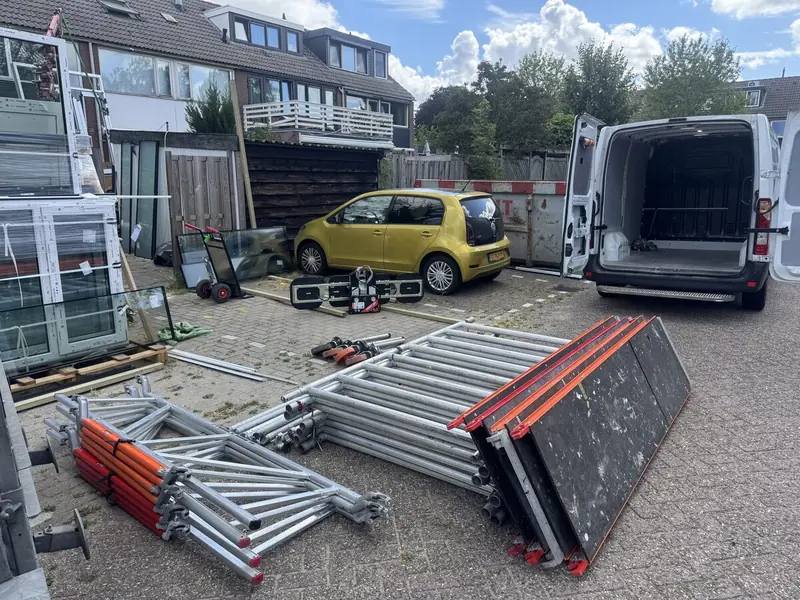
Frames and tubes on a drive by a white wall, the hire set behind every 245 centimetre position along a roof edge

What people misjudge are the corners and the interruptions. At every corner of the house, at the downpipe, at a dormer and at the junction with the neighbours the straight line stops and the fitting and measuring begins. Reckon on half an hour extra per interruption and on a setup you have to place slightly differently. If you combine this with painting the roof overhang, do that afterwards, because putting paint over a fresh cover batten is quicker than working the other way round.

Hire a mobile scaffold with delivery for edge insulation

You get the mobile scaffold supplied as loose parts, complete and counted beforehand. Point out a place where that stack may go: preferably on the drive or on a patch of grass you will not be using this week, and certainly not directly under the roof edge you are about to start on. Put your order through before 15:00 on a working day and the next working day is your delivery day. Both the bringing date and the collection date are yours to choose.

Putting the setup up belongs to your part of the job. A manual comes with the set, and the instruction video shows exactly in what order the parts go together; with two people the first build costs you half a day. Moving it after that goes far faster, because you wheel the whole build to the next corner in one piece. So do not start insulating on the day the parts arrive, and try to plan the delivery just before a dry spell.

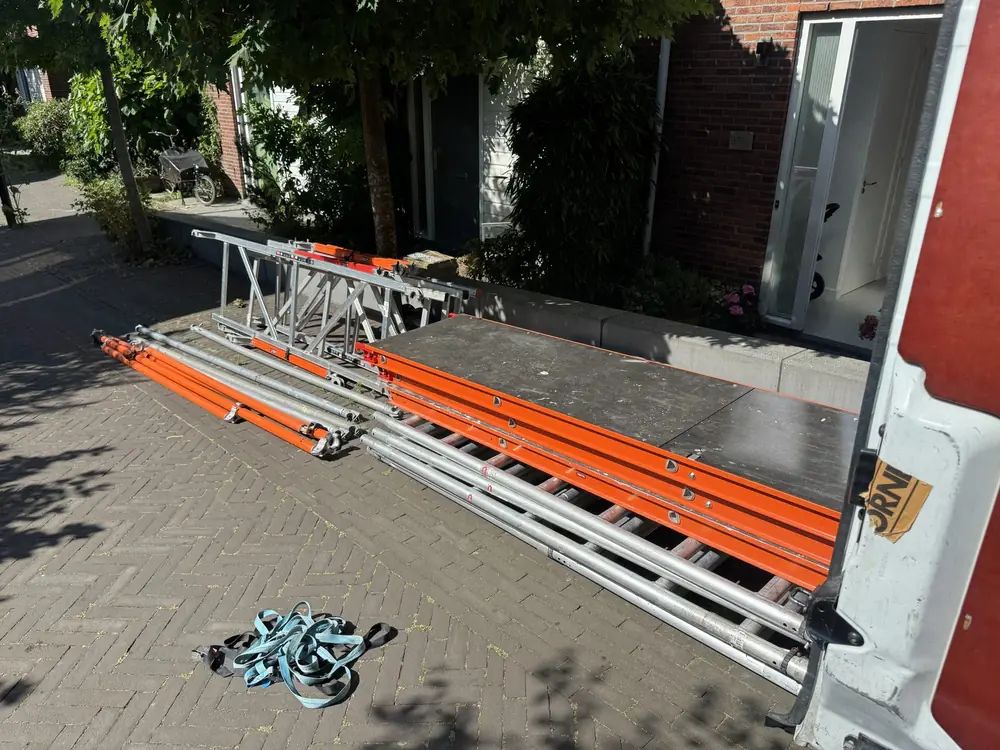
Scaffold parts beside the Steigertaxi delivery van, the counted set you have delivered for the insulation work

When you are finished you take the build apart and lay everything within reach of our driver; the collecting we arrange after that. Keep the count as you dismantle, so you do not discover afterwards that a brace is still lying behind the hedge. Which amount goes with bringing and returning in your own province is set out clearly under the costs per province, so you can budget that alongside your hire days from the start.

Safe working on the hired scaffold at the roof edge

If the two of you stand still in one place with a roll of insulation, a toolbox and a bucket of waste between you, the load approaches the limit sooner than you would think. That limit lies at 200 kg per square metre, laid down in EN 1004 as load class 3, and it applies per bay and not per tower. So spread your things along the length instead of putting everything by the access hatch. More on this under load and weight.

The ordinary rules of course still stand. Castors braked before anyone goes up, no moving at all while there is still a person or material on top, and in strong wind you stop work. With roof edge insulation something specific comes on top of that: you push and wrestle against the rim to get the material into place, and you feel that sideways force back in the build. Go back along all four stabilisers each time you have shifted position.

Erected mobile scaffold with the climbing ladder on the inside, the access you use for this insulation work

The risks that really belong to this job sit in the small things. Cured foam makes a deck slippery, offcuts blow in all directions, a knife you cut towards yourself with sits at the height of your colleague's face, and torn out old insulation or a rotten length of batten drops straight down. Keep the strip under the build clear and put a wheelbarrow or a cone there. Everything else that applies is described under working at height and the rules for it.

In 5 steps

How hiring a mobile scaffold works

1
Choose working height

Pick the height that suits your job.

2
Book online

Sorted in 60 seconds, price shown instantly.

3
We deliver

At the agreed spot the next working day.

4
Assemble safely

Assembled by you, with a manual.

5
We collect

One call and we collect the scaffold.

Good to know

Practical tips for insulating a roof edge

1

Take a photo of the roof edge on each side of the house before you build the first setup. You then see later where the cold bridge is worst and which stretches you certainly want finished within the hire period.

2

Cut your insulation strips to size on the ground and bundle them per setup. You then carry one package up instead of a whole roll, and keep room on the deck for the tools you want to hand.

3

Before you start, prod a screwdriver into the edge timber above the cavity. Find rot and you book an extra day of hire straight away, because repairing that timber always comes before insulating the rim.

4

Finish the side facing the wind first. If a stretch of rim stays open, it then sits on the sheltered side of your house and you run less risk of water in the cavity during a shower.

5

Number your standing places on a simple sketch of the floor plan and tick them off as soon as a strip is sealed. After a wet day you then know without thinking where the hired tower goes next.

6

Set your collection day one day after the moment the last strip is sealed. You then keep a morning free to check the cover battens, clear up offcuts and set the parts out dry.

Frequently asked questions

Frequently asked questions about insulating a roof edge

Which mobile scaffold should I hire to insulate the roof edge?+

The RS52 is the one to take here, the wide model whose deck measures 135 centimetres. On this work you stand in one place for a long time with insulation material, a foam gun and tools around you, and often with a second person as well. At that width you fit alongside each other without shifting things every time. The slim 75 centimetre tower only comes into play when you have to pass a gate or garden door under a metre. Measure that opening at its narrowest point first.

How does hiring a mobile scaffold for this insulation work go?+

Online you set down which model you want, to what height you build it and which two dates matter: when the parts come and when they go again. Everything is delivered counted, after which you put the tower up and work the roof edge corner by corner. On your closing day you take the build apart and leave the complete set ready for our driver. The rates are fixed and include VAT.

How many days should I hire the tower for the whole roof edge?+

On a mid terrace with thirty to forty metres of rim you land on three to four hire days. Per setup you finish a good two metres, and that costs about three quarters of an hour including opening up and closing again. Live on a corner or detached and the perimeter doubles, and with it the period you need the scaffold. Book a day too many rather than too few: an open strip should not sit waiting in the rain.

What does hiring cost for this job and why is day two light?+

What you pay hangs together with the model and the build you choose, plus the rate for bringing and collecting in your province. You see the amount including VAT before you commit to anything. For roof edge insulation the structure works out well: the first day and night weigh heavily and what you stick on behind them barely counts. Because this work is sensitive to damp, it pays to reserve the scaffold generously and allow yourself a margin.

What working height should I hire and how do you measure it?+

Your tape starts at the level where the castors will come and stops at the line where the roof plane meets the facade. On two storeys that sits somewhere between six and ten metres, so you hire a tower you can build to 8 to 12 metres. Within that, pick the stance where the deck stays just under the transition, so you look into the cavity. What each stance gives you is listed under the working heights.

Is delivery handier than hiring and fetching the set yourself?+

Usually yes. On this job you are already hauling insulation material about, and you would rather keep your car free for the builders' merchant. Choose delivery and we drive out on your date and a second time afterwards; the rate for that is fixed per province. Prefer to drive yourself, and the scaffold can be picked up from our Zeeburgerpad address in Amsterdam, by appointment and free of charge, provided your transport takes the longest parts.

Do you build the tower, or is that my own work when hiring?+

Putting it up is yours to do. We hire out the tower as a loose set and supply a manual and an instruction video with it; with two people the first setup takes half a day. Moving along the roof edge goes quickly after that, because you wheel the whole build to the next corner in one go. We keep no facade scaffolds, no system scaffolds and no cherry pickers, so at this height the mobile scaffold is what does the job.

What if insulating the roof edge overruns and I want to hire longer?+

Say so before the end and we can push your collection date, provided nobody else has that tower booked next. Overrun on this job usually comes from rotten edge timber you only discover once the strip is open. To head that off, book a spare day from the start; handing back early is fine too. That way you never have to stop with a cold bridge that is still half open.

How much clear space must there be at each hired setup?+

Start from the outside dimension of the tower, add how far the four stabilisers reach out, and remember the roof overhang keeps you further from the facade. In practice each side of the house wants a level strip several metres across. Move water butts, bicycles and planters aside before the parts are delivered, because clearing as you go costs a quarter of an hour per standing place. You need that same strip to wheel the tower onward.

Is there any point in keeping the hire going when damp stops work?+

The tower may quite happily stay standing; only the insulating shifts. Foam and sealant take poorly on a wet surface, and you do not simply leave an open strip out in the rain. Use such a day to measure up, check timber or cut material to length, and then pick the thread up again. Because you set the end date yourself, that postponement costs you an extra day at most rather than a fresh booking.

How does the deposit work when I hire a scaffold for this job?+

When you fix your period you put down a deposit against the complete set. Once the tower is back and the count is right, that amount comes your way again within one working day. On insulation work two things go wrong: parts that came loose while moving and do not travel back, and cured foam or sealant left on the decks. Lay a sheet under your work spot and you save yourself scraping on the last day. More under getting that sum back.

Can I check the top of the cavity in the same hire period?+

That is exactly the clever moment. While the rim lies open you look straight into the top of the cavity and see whether the insulation there has slumped or taken up moisture. Plan that check on your second hire day, when the first strips are open but nothing is sealed yet. Find something and the tower is still there, so you deal with it at once instead of renting again later.

Hire a mobile scaffold for insulating a roof edge today?

Calculate your rental price now or ask for free advice.

Rolsteiger van SteigerTaxi geleverd op locatie
Book it online

Your scaffold sorted in 2 minutes.

Choose your scaffold and working height, see the price instantly and book online.