
See your price
Application

Painting a roof overhang? Choose the right scaffold.

Painting a roof overhang is work you do almost entirely above your head. The underside is barely visible from the ground, so you have to be able to stand right beneath it, face turned up and both hands free. On a house of two storeys that means hiring the wide 135 cm mobile scaffold, built up to somewhere between 8 and 12 metres. Further down you will find which dimensions belong with that, how close the tower has to stand to the wall and how many rental days you sensibly book.

  • Order before 3 pm, delivered tomorrow
  • Professional Altrex scaffolds
  • Up to 14.2 metres working height
  • Easy to assemble yourself
4,2 tot 14,2 mWorking heights available
12Provinces served
7Days a week
200 kg/m²Load class 3
In short
  • For painting a roof overhang we recommend the Wide mobile scaffold.
  • The RS52 with its 135 cm deck is the model you hire here, built to a reach of 8 to 12 metres.
  • The tower must stand hard against the wall, or you will not reach the underside of the roof overhang above you.
  • Count on three to five rental days, because sanding, priming and topcoating above your head goes slower than on a flat wall.
  • First 24 hours from €175 incl. VAT and delivery; every day after that 95% off.
Key facts for this job
FeatureValue
Recommended scaffoldWide mobile scaffold (Altrex RS TOWER 52)
Working height for this job8 to 12 metres
Available working heights4.2 to 14.2 metres
StandardEN 1004, load class 3 (200 kg per m²)
DeliveryOrdered before 3 pm, delivered next working day
Each extra day95% off, from €8.75 a day
Why a mobile scaffold for painting a roof overhang?

Safe, stable and professional work at height

Painting a roof overhang costs you mostly arm and neck. You stand with your head tilted back, you hold the brush up and there is nothing to lean against, so a great deal is asked of your balance. A ladder is no help there: it stands at an angle, under an overhang it leans away from the wall exactly where you need it, and it leaves you working one handed. Hiring a scaffold for a roof overhang gives you a flat deck with guard rails all round, on which you can take half a step back to see what you have done. So when you hire, two things matter: the width of the platform and the gap between the tower and the wall.

  • Overhead work on the roof overhang underside
  • The platform pushed hard up to the wall
  • Working height up to where the overhang meets brickwork
  • Paint and sanding dust land on face and neck
Read more about working safely →

Which mobile scaffold to hire for painting a roof overhang

On an overhang at two storeys the choice falls on the Altrex RS TOWER 52, the wide model with a deck 135 cm across. You use that extra room differently here than on ordinary wall work: you do nearly everything with your head tipped back, your feet apart, and you want to move half a step sideways without walking into a guard rail. Narrower is possible, but then you give up exactly what makes this job heavy. Every model we let out sits side by side on the page about mobile scaffold hire.

On a narrow 75 cm deck you are forced to stand in a straight line under the overhang, and you notice that within the first hour. On this job your paint kettle, brush, sanding block and cloth belong on the deck and not in your hand, because everything you hold you hold above you. The platform length of 245 cm decides how many metres of overhang you take per set up, and the width decides whether you can turn comfortably beneath it while looking up.
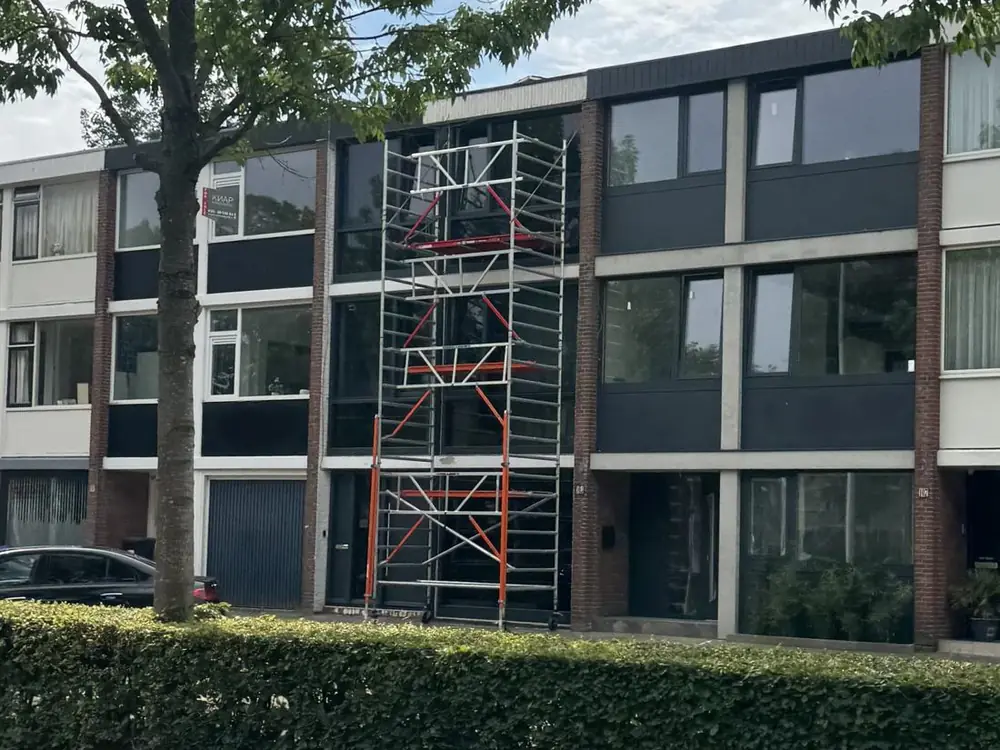
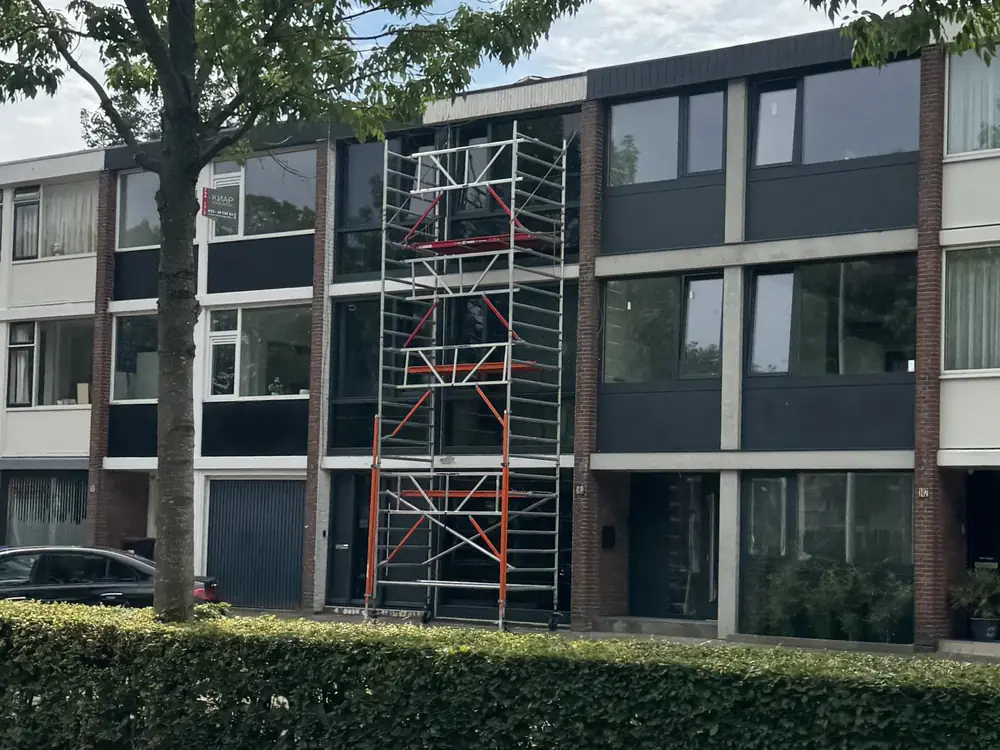
Wide 135 cm tower built against a front elevation, its top deck just under the roof edge

A 75 cm build only comes into view when the only route to the back is a gate or a path under a metre wide. Then you trade working room for passage, and on overhead work that feels like a concession. The MiTower stops at 6.2 metres and is too low for two storeys, while the RS44 room scaffold with its 3 to 4 metres of reach was made for indoor work. Weigh narrow against wide with the guidance on picking a scaffold for wall painting.
Choosing a working height under the roof overhang you paint

On this job your highest point is not the ridge and not the gutter, but the line where the overhang meets the brickwork. That is where the surface you have to paint begins, so that is what you measure to. For a house of two storeys you come out at 8 to 12 metres, depending on the storey height and on how far the roof projects. What such a reach means in frames is set out on the page for ten metres of working height.

The figure that goes into your booking is not the height of the deck you end up standing on. There is roughly two metres of reach between the two, and on an overhang that works in your favour: set your reach equal to the height of the eaves line and the timber hangs about an arm's length above your head. Measure up from the ground where the castors land. If your back garden lies lower than the pavement, the build differs per side of the house.

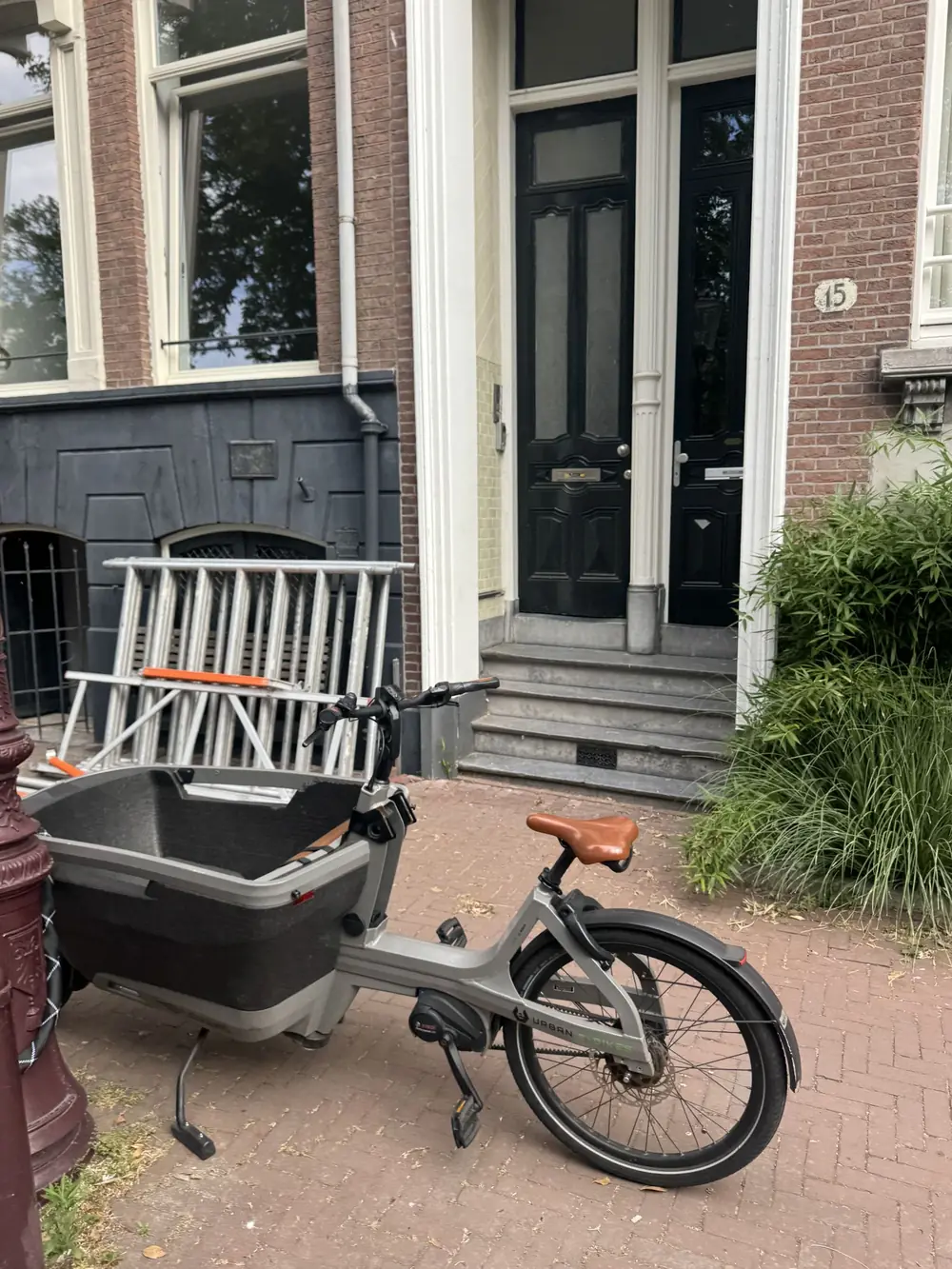
Scaffold components resting on the pavement of a two storey house, the delivery that precedes any work at the eaves

Choose too tight and you paint the top corner with your arm stretched, the topcoat runs down your sleeve and the strip where the roof overhang meets the wall stays untreated. Choose too generously and the timber sits straight in your face, so you can no longer angle the brush. Both cost you an extra set up. If in doubt, measure your eaves height with a long straightedge. If the wall of the second floor follows later, take the height that suits both.

Hiring a mobile scaffold tight against the wall under the overhang

Under a roof overhang you rarely find a tidy terrace. What is usually there is a gravel strip, a narrow border or a row of slabs along the wall, precisely where rainwater off the overhang has been landing for years. Gravel sinks away under the castors and wet earth faster still, so lay stout planks or setting plates beneath them. On this job the ground decides more than on most whether your build stays upright and whether you can still move it later. Check too that no drain cover sits under a castor.

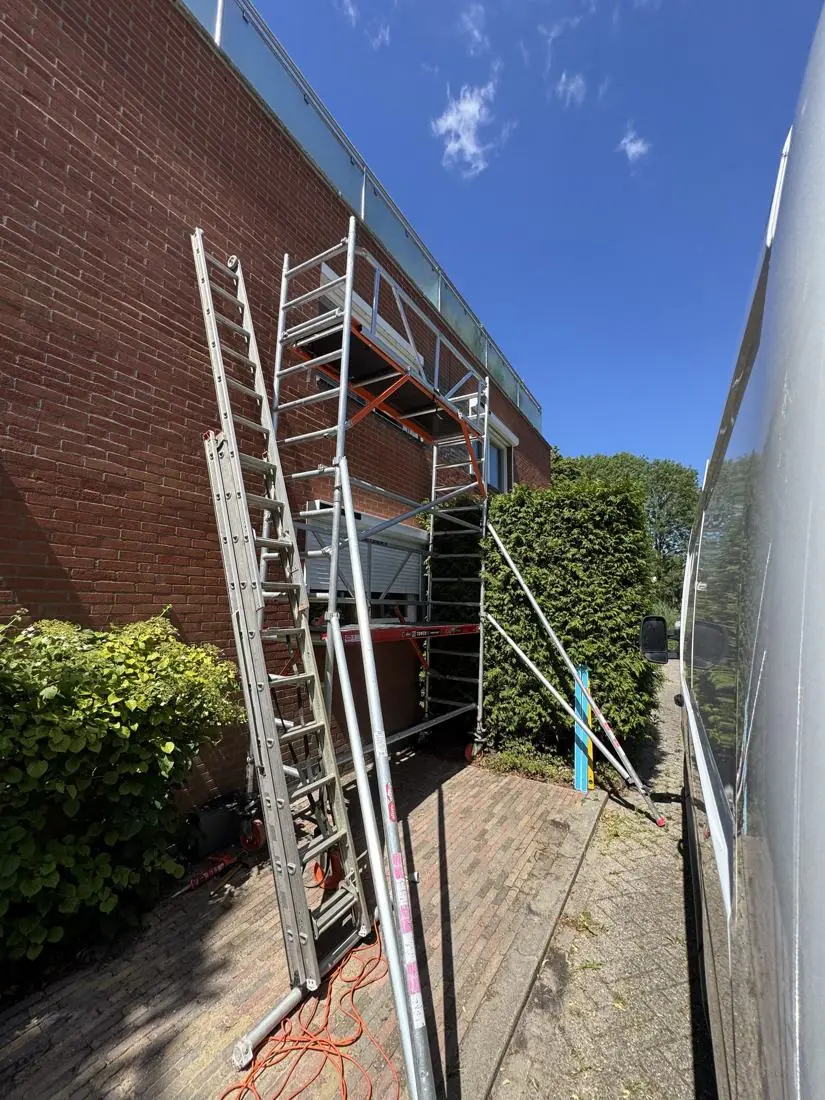
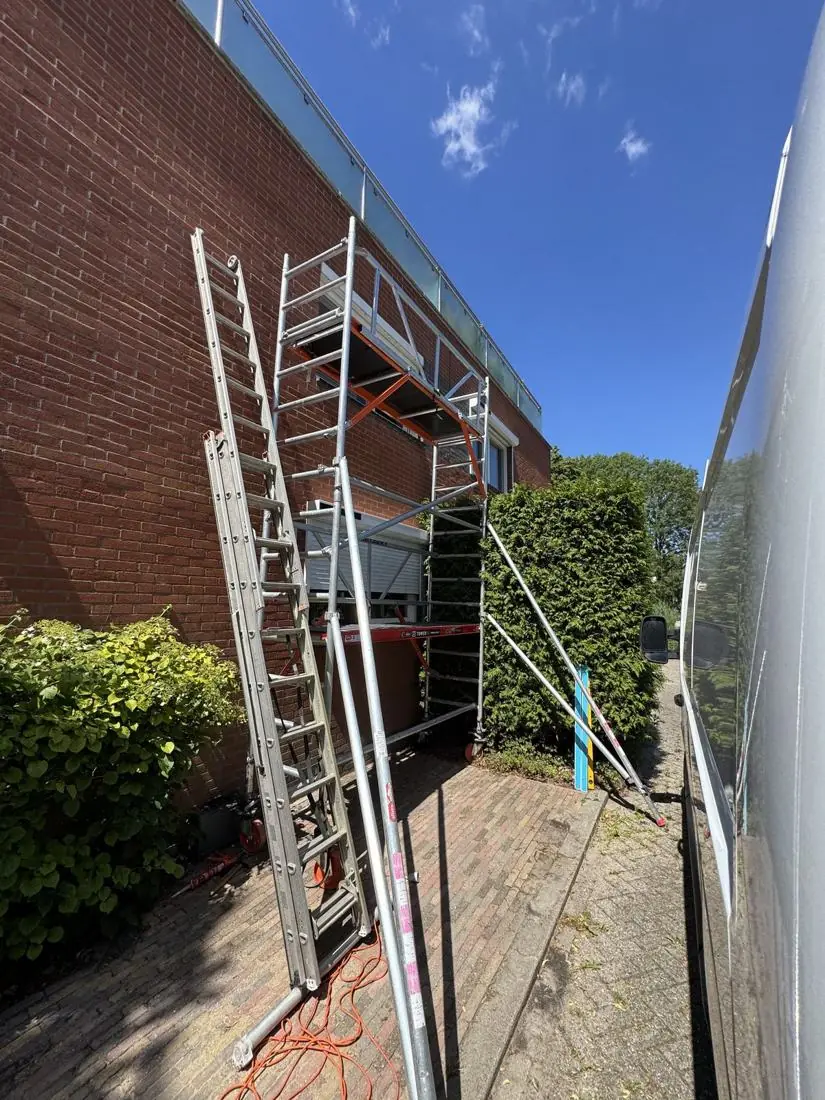
Then comes the question of how close you can get. An overhang projects thirty to sixty centimetres easily, and that projection has to fall above your platform and not against it. So push the foot of the tower up to the plinth and keep the top guard rail just under the fascia. Reckon at the same time with the four stabilisers splaying outwards; on the wall side they land in the border and outside them on the lawn or the path. Setting them is covered in the piece on stabilising a tower.

Stabilisers splayed out at the foot of a mobile scaffold on a narrow strip along a house wall

Along a wall there is always something in the way, and on this job those things are fixed. The downpipe runs exactly where you do not want it, there is an outside tap, a cellar window or a meter cupboard hatch, and against the brick stands a hedge you cannot simply move. Walk the route round the house before you hire the scaffold and count how many positions can genuinely be cleared. That number governs your planning more than the length of the overhang does.

How many rental days a roof overhang in paint takes

Putting a roof overhang in paint is more than laying on the topcoat. You start by wiping down and degreasing, because years of dust and cobweb hang under that edge. Then you sand, prime the bare patches, seal the joint between the board and the wall, and only then come the two coats of paint. Around an average terraced house you hire a mobile scaffold for three to five days for that, partly because at every new position you begin all over again.

There are waiting times in it you cannot shorten. The underside of an overhang never catches sun and therefore stays damp longer than a south facing wall, so let a coat stand overnight rather than a few hours. If rain drives against the house, water blows under the edge and you are working on wet timber. So plan through to the day you are certain to finish, and add a morning behind it for taking the tower apart.

Tower left standing along a side elevation between two painting days, as it does through the hire period

Booking generously happily costs you little. You are charged the full rate for the opening twenty four hours alone; each further rental day carries a discount of 95 per cent, so a day of slack hardly registers in your rental price. Set the end date too tight and you stand beside a half finished overhang waiting for a new booking. Per model and working height every amount including VAT sits on the page listing hire prices, so you know beforehand where you stand.

Which mobile scaffold suits painting a roof overhang?

Kamersteiger RS44
  • Working height up to 4 metres
  • Compact and narrow
  • Great for indoor and small jobs
View and calculate →
Smalle rolsteiger RS51
  • Working height up to 14.2 metres
  • Narrow (75 cm)
  • Ideal for narrow passages
View and calculate →
Most chosen
Brede rolsteiger RS52
  • Working height up to 14.2 metres
  • Wide platform (135 cm)
  • Extra stability and workspace
View and calculate →
1-persoons steiger MiTower
  • Working height up to 6.2 metres
  • Very compact
  • Quick and easy to assemble
View and calculate →

Overhead painting of the roof overhang from a 245 cm platform

Per set up you take a 245 cm strip of overhang, the length of the deck. On a straight wall that is quickly done, but above your head the pace drops. You work in short strokes, you have to stop more often to rest your neck, and you keep checking at an angle whether the surface still covers. Sanding, priming and painting one strip easily fills half a day in practice, and that number of half days decides how long you hire the tower.

Take up only what you can put down on the deck: a small kettle, a brush, a small roller on a short pole, abrasive paper and a cloth. Leave a full tin of paint on the ground, because as soon as you work upwards everything you spill lands back on you. A cap and safety glasses are no luxury here; paint and sanding dust find your face and neck by themselves. Anything you forget means climbing down, so run through the list before you step on.

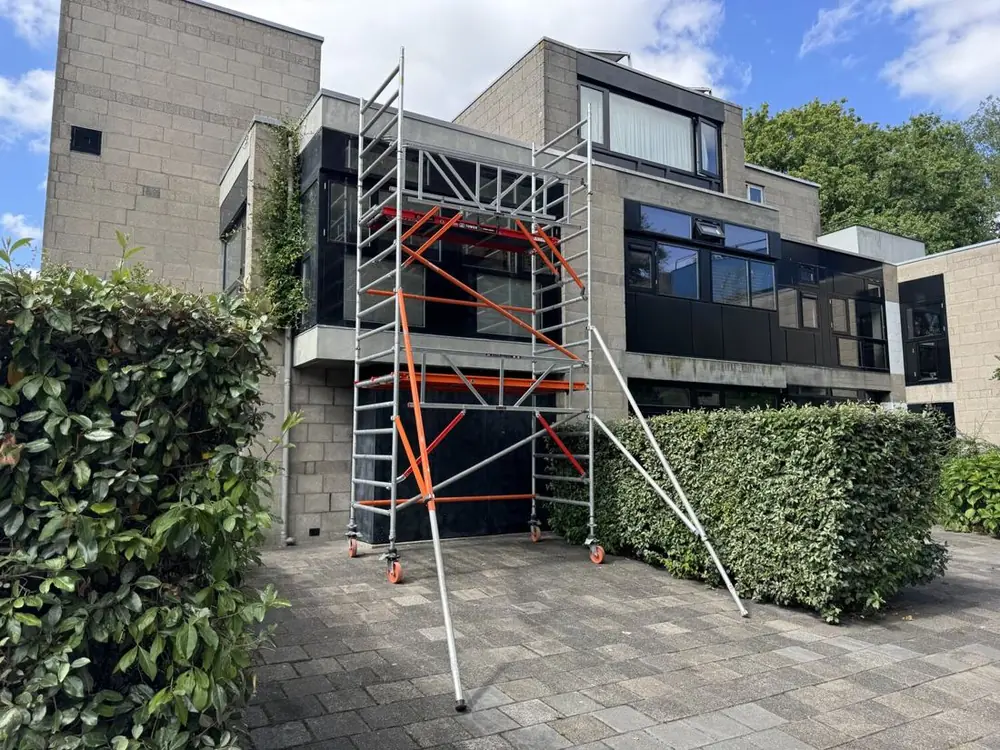
Erected mobile scaffold with a 245 cm deck against a house, the strip you finish per position

What people misjudge are the corners. At a corner the roof overhang runs round the house, and to take that last forty centimetres you have to move the tower and stabilise it again. Every corner therefore costs you an extra position, and a dormer or an extension breaks the run once more. Count those points beforehand and include them all in the number of rental days you book. If you take in the fascia boards along the roof edge in the same period, you finish everything per position.

Scaffold hire and delivery on the day you start the overhang

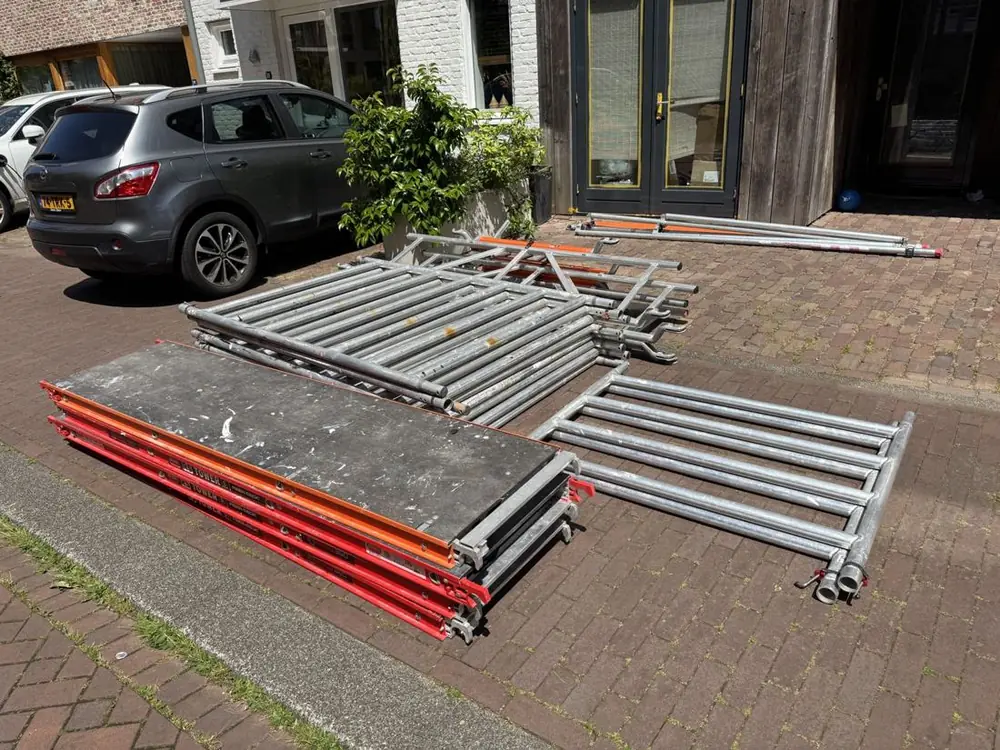
The scaffold arrives as loose parts, complete and counted in advance. Decide beforehand where that stack ends up, because you keep the strip under the roof overhang free for the build itself and you would rather not trample the border beside it. A driveway or a piece of lawn further along works better. The latest order time for delivery on the next working day is 15:00, so planning far ahead is not needed as long as you book on a weekday and have cleared the spot.

The date the set arrives and the date it is collected you fill in yourself, and on outdoor painting you let both move with the forecast. Preferably have the parts brought a day before your first working day, so the build can go calmly and you start cleaning the next morning. Erecting it remains your part of the work, using the instructions and the video that come with the set, ideally with two people. Watch the projection above you: it sits exactly at the height at which you lift a frame.

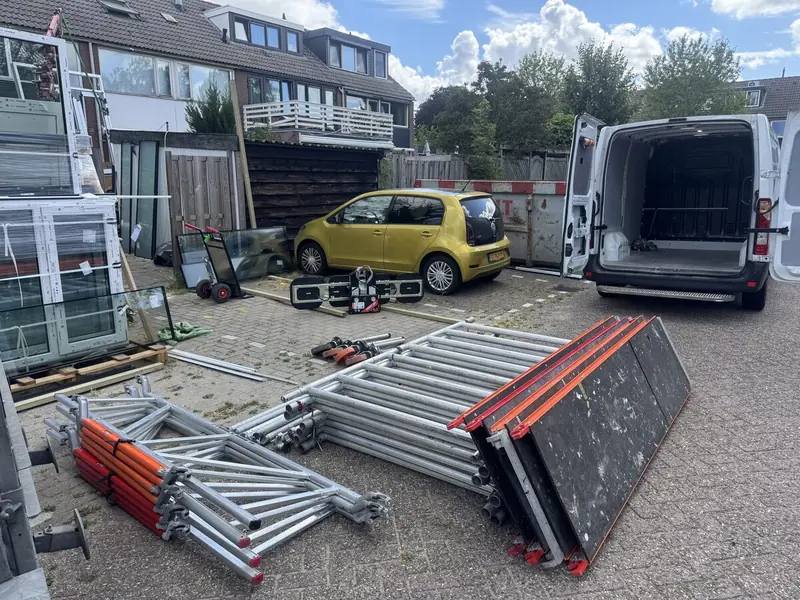
Loose scaffold parts laid out on the paving in front of a house on the agreed delivery day

When you are finished you take the tower apart and put the parts together; we come and collect them afterwards. Count along while you dismantle, so you know for certain no brace or coupling has been left behind in the shrubbery. Check as well that no masking film has stuck between the deck boards. The charge for bringing and taking back differs per province and stands including VAT with the costs of delivery and collection, so you budget for it in time.

Working safely overhead on the hired mobile scaffold

Every mobile scaffold in our hire fleet is built to EN 1004 and sits in load class 3: 200 kg is allowed on each square metre of deck. When painting a roof overhang you are yourself by far the heaviest thing that goes on, so that limit is a long way off. If two of you work a long edge with tins and a sander beside you, add it up all the same. That classification is explained further in the article on this scaffold standard.

The fixed rules do not change with the job. Put every castor on the brake before you climb on, shift the tower only when the deck is empty and nobody is on it, and stop painting as soon as the wind picks up properly. Under an overhang you notice that wind late, because the edge shelters you, while at the top of the build you certainly feel movement. After every move go round the four stabilisers and set them down firmly again.

Mobile scaffold with guard rails all round and a built in climbing ladder up to the working deck

The risk that belongs to this job comes from above. You are looking up and therefore cannot see where your feet are, so keep the deck clear and put tools back in the kettle. Drips of paint and sanding dust fall straight down into your eyes, and a brush you let go above your head comes back onto the platform or past it. Keep the zone under the tower clear and set a cone or a bucket there if children are playing. The rest is at working safely at height.

In 5 steps

How hiring a mobile scaffold works

1
Choose working height

Pick the height that suits your job.

2
Book online

Sorted in 60 seconds, price shown instantly.

3
We deliver

At the agreed spot the next working day.

4
Assemble safely

Assembled by you, with a manual.

5
We collect

One call and we collect the scaffold.

Good to know

Practical tips for painting a roof overhang

1

Finish the joint between the overhang and the wall first and only then the flat underside. That angle is the hardest to see, and later you will not get at it neatly with a loaded brush.

2

Put on safety glasses and a peaked cap before you start sanding. On work above your head everything you loosen falls into your eyes, and with streaming eyes you stand unsafely at height.

3

Mark on the guard rail with tape where your previous strip ended before you move the tower along. From the ground you cannot see the join between two coats, and that way you miss no half metre.

4

Hang your paint kettle on a hook on the inside of the guard rail rather than standing it beside your feet. You are looking upwards anyway and will otherwise kick it over sooner or later.

5

Do everything at one position in a single go, so sanding, priming and topcoating one after another. Coming back for a second coat means realigning and stabilising the whole set up again, which costs you more time than waiting.

6

Book the collection a day after your final topcoat. You use that extra morning to take off film and tape and to go over the roof overhang once more before the parts lie counted and ready.

Frequently asked questions

Frequently asked questions about painting a roof overhang

Which mobile scaffold should you hire when painting a roof overhang?+

The RS52 with its 135 cm wide deck is the logical choice here, because working with your head back needs room to turn and to step away. If the wide model will not fit through the gate to the back, you fall back on the 75 cm RS51 and stand in a straight line under the edge. Measure that passage before you reserve a tower, because swapping on the delivery day is not possible.

How does hiring a scaffold for overhang work run from booking to collection?+

It all begins with choosing a model and a reach, after which you pick two dates in the booking itself: one for bringing and one for taking away. On the agreed morning the set is ready, you build it up and work the overhang position by position. After your last coat you take it down, and the hire is settled as soon as our van has loaded the parts back up again.

For how many days do most people hire a scaffold for an overhang?+

Three to five days is realistic for the roof overhang all round an average house. Topcoating goes quickly, but wiping down, sanding and priming per position eats time, and above your head your pace is lower than on a flat wall. If you limit yourself to the front, two days will do. Going right round the house, a day of slack in your scaffold hire is cheaper than a second booking afterwards.

What does hiring a mobile scaffold for overhang work cost from day two?+

What you pay follows from two choices, namely the model and the reach, with transport to your province on top. What that comes to exactly you read including VAT at the rates per build and height. More important for this job is how the build works: the first twenty four hours is by far the dearest part, and what you hang behind it in days is nothing beside it. Booking generously pays, certainly with a tower standing outside.

Which working height do you hire for the underside of an overhang?+

Your highest point lies where the underside of the overhang meets the brickwork, not at the ridge. Determine that height from the ground the tower will later stand on, so from the garden and not from the pavement if that sits higher. On two storeys you land between 8 and 12 metres, and that figure already includes the reach of your arm. Which build belongs with it is set out step by step at the different working heights.

Do you collect the mobile scaffold yourself or have it delivered when hiring?+

Delivery is easiest: the scaffold parts come on the day you set in the booking and after your last painting day we drive them away again, for an amount that depends on your province. If you would rather fetch it yourself, that is possible by appointment and at no extra charge at Zeeburgerpad in Amsterdam, provided your transport can load a full set of frames. Anyone doing the overhang over several days usually has it brought anyway.

Do you erect the hired mobile scaffold or is that my job?+

Erecting belongs to you. We arrange the hire and the transport both ways, you set the tower down, move it along and take it apart. Two people are busy with it for about half a day; the supplied manual and the video walk you through the order frame by frame. Set that half day aside on its own, because no painting happens that first afternoon. We have no cherry pickers, facade scaffolds or system scaffolds, so at this height this stays the right tool.

Can you extend the hire if painting the overhang overruns?+

Ring or email before the collection day arrives and we move that date, unless the model has meanwhile been promised to somebody else. Overrunning happens more often on roof overhang work than people expect, because every corner of the house asks for its own position and the underside dries slowly. Anyone wanting to avoid that simply books an extra day when hiring; bringing it forward is still possible later without objection. That way you need not stop with half a wall in primer.

How much clear space does a position under an overhang need?+

Add the splay of the stabilisers to the 135 cm deck width, on all sides, and you are soon at a strip a couple of metres across. Under an overhang that is exactly where the hedge stands, the water butt has been put or the bike rack leans against the wall. Clear that away before the scaffold is delivered. Keep a free piece over as well where the parts may lie while you are building.

Is it worth keeping the hire running when it is too wet to topcoat?+

The set up may stay standing; only your topcoating gets postponed. Damp timber under the edge takes paint badly and you see that back later as blisters and streaks. Sanding or sealing is fine on such a day, because under the overhang you stay largely dry as long as it is not blowing a gale. Because you decide the end date of the hire, a shift costs you at most an extra day and not your whole schedule.

When does the deposit come back after a roof overhang hire?+

When hiring you pay a deposit along with it and that amount comes back within one working day of the return trip, as soon as everything has been counted. Two things matter on painting work: the set must be complete and there must be no dried paint on the deck boards or the tubes. So lay cardboard or film down where you put your kettle. All the details are on the page about getting your deposit back.

Can you take the overhang and the gutter from the same hired set up?+

That is actually clever, because with an erected tower you are standing under it anyway. The gutter hangs right beside the surface you are going to paint, so scoop it out and rinse it before the first coat goes on the timber. Do reckon an extra day for it in your rental period, and bear in mind that leaves and silt land on your deck first and that you then have to sweep it.

Hire a mobile scaffold for painting a roof overhang today?

Calculate your rental price now or ask for free advice.

Rolsteiger van SteigerTaxi geleverd op locatie
Book it online

Your scaffold sorted in 2 minutes.

Choose your scaffold and working height, see the price instantly and book online.