
See your price
Application

Replacing a window sill? Choose the right scaffold.

Replacing a window sill is work that runs along a line. Every sill on an elevation sits at one height, and at each stone you stand still for roughly half an hour. That calls for the lightest stand we let out: the MiTower, a one-person build of 75 cm you roll from window to window unaided. For sills at ground and first floor level, 4 to 6 metres of reach is plenty. Below you will find how to measure that and how long the job holds the tower.

  • Order before 3 pm, delivered tomorrow
  • Professional Altrex scaffolds
  • Up to 14.2 metres working height
  • Easy to assemble yourself
4,2 tot 14,2 mWorking heights available
12Provinces served
7Days a week
200 kg/m²Load class 3
In short
  • For replacing a window sill we recommend the 1-person scaffold.
  • A sill on the first floor suits the MiTower: 75 cm across, made for one worker, built somewhere between 4 and 6 metres.
  • Every sill on one elevation lies on the same line, so most of the time you shift the tower by a single window width.
  • Replacing a window sill takes two to three hire days, because the mortar under a fresh stone has to set before you seal.
  • First 24 hours from €100 incl. VAT and delivery; every day after that 95% off.
Key facts for this job
FeatureValue
Recommended scaffold1-person scaffold (Altrex Mi Tower)
Working height for this job4 to 6 metres
Available working heights4.2 to 14.2 metres
StandardEN 1004, load class 3 (200 kg per m²)
DeliveryOrdered before 3 pm, delivered next working day
Each extra day95% off, from €5 a day
Why a mobile scaffold for replacing a window sill?

Safe, stable and professional work at height

A window sill sits slightly too high for a trestle and far too low for a build that reaches the gutter, which makes the choice trickier than it first looks. You want both hands free to chisel, you want to tilt the old sill towards you without stepping back, and then you have to bed the new one true while standing right in front of it. A ladder rules out all three, and a trestle will not get you near a first floor. So hiring a scaffold for replacing a window sill comes down to building low, staying light, and having a deck under you that one person can move.

  • Chiselling with both hands on one fixed line
  • The old sill out without pulling bricks with it
  • An outward fall when replacing a window sill
  • A light build that one person moves alone
Read more about working safely →

Hiring a narrow one-person tower for replacing a window sill

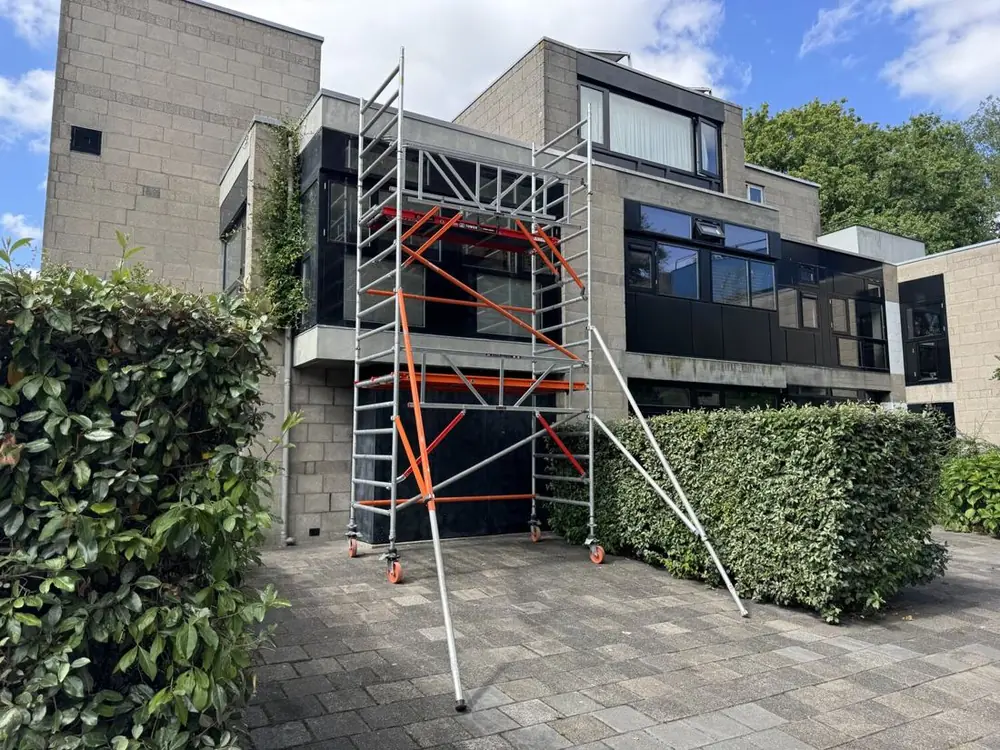
Sill work asks for the lightest model in the fleet, so the MiTower is where you land. It measures 75 cm across, takes one user at a time, and tops out anywhere between 4.2 and 6.2 metres. That suits the job: you pause briefly at each window sill, carry very little up, then roll on by a window width. Across eight openings, a tower one person shifts unaided saves the best part of a morning. That class of stand sits on the page about the one-person tower we let out.

A deck of 75 cm sounds mean, yet on this job your kit simply stands beside your boots. Up with you go a breaker with a wide chisel, a bucket of mortar, two spirit levels, a handful of packers and the replacement sill itself. Beyond that you want nothing at all up there. The moment you tilt the old stone towards you, the whole width of the deck is in use, and anything lying loose gets shoved aside with your foot. Keep the broken pieces on the side furthest from the opening.

Slim 75 cm tower built against a modern elevation, the sort of hire position you roll on by one window width

Where the run of sills sits higher than a first floor, or where you want a mate up there to pass the stone across, you can instead hire a mobile scaffold with more reach and a deck of 245 cm. On an ordinary family house that is money spent on nothing: you pay for height and floor area sill work never touches. Walk the row of windows before you decide and count how often you will be shifting, because that number tells you more about the right hire than the height of the wall does.

Hiring the right working height to reach a window sill

The highest point of this job sits lower than on almost any other bit of wall work. You need to be at the underside of the opening, and on a typical mid terrace that sill hangs somewhere between 3 and 4 metres above the footway on the first floor. A working height of 4 to 6 metres goes with that. Take the height of your deck and add about 2 metres for the distance your arms and upper body cover together, and you know at once where you come out on the wall.

On sill work you deliberately do not measure to above the opening. You want to finish beside the stone, with the brickwork below it at eye level, because that is where the work actually is. Hire a build that puts you too high and you look down on the window sill, losing sight of the front face, the outward fall and the drip groove. The chiselling suffers too: you drive the blade downwards into the bed instead of horizontally under it. Measure to the bottom of the frame and add half a metre at most.

Tower built up in front of a house at window level, matching a sill on the first floor of a terrace

Your zero point when replacing a window sill is the paving the castors will rest on, which is not the doorstep you instinctively measure from. At a house with a raised entrance, or a garden that falls away towards the boundary, that difference is easily half a metre. Pitch it too tight and you spend the last window up on your toes. The other way round costs you nothing, since nobody forces you to use the top deck. The page about a build reaching six metres shows what such a stand looks like.

Where the hired tower stands under the window sill

The ground below a window is seldom clear. There will be a planted border, a water butt against the brickwork or a gravel margin along the wall, and that is exactly the strip where the four stabilisers have to splay outwards. Empty it before the driver pulls up, because shifting a planter while half a sill hangs out of the wall is not an option. On soft ground put levelling plates or a couple of paving slabs under the castors, or the whole build settles crooked the minute you start swinging a chisel.

Then think about what is coming down. Cutting out produces old pointing, lumps of bedding mortar and now and then half a stone, and all of it falls in a straight line beneath you. Nothing should be parked there: no garden chairs, no bicycles, no glazed back door. A tarpaulin or two boards laid over the border catches the debris and you shovel it up in minutes afterwards. Where the elevation gives onto a public footway, keep a strip open for pedestrians and let the neighbours know there is a morning of hammering coming.

Four stabilisers angled outwards from the base of a hired tower, on the clear strip of ground below an opening

Look at the route between windows as well. While replacing a window sill you will nudge the build along ten to twenty times, a few metres each time, and that only goes briskly if the strip beside the wall is flat and clear. One sunken slab, a gully cover or a cellar window sticking out means levelling up afresh at every opening. How to take up a difference in the ground under the castors is set out in the article about levelling up on uneven paving.

How many hire days replacing a window sill really takes

Cutting one loose, offering it up, bedding it and pointing round it takes an hour to an hour and a half per window sill, and that stretches the moment the old stone is set in rock hard mortar. Four to six of them will fill a working day for you. Another day follows, because the bed under a new sill has to go off before you can seal the joint against frame and brickwork. On a front elevation with a handful of stones you therefore reach two to three days with the tower standing.

Weather weighs more heavily on replacing a window sill than on decorating. In a frost no mortar goes under a stone at all. In steady rain the fresh pointing washes out before it grabs, and sealant sticks badly to soaked brickwork. Those are waiting days you cannot claw back by pushing harder. So run your hire period from the day you are certain of starting to the day after the final bead of sealant, rather than to the date on which, at best, it might just be finished.

Tower left standing at the side of a house, the way it stays put across the hire days you book

Booking generously costs you very little here. Payment is arranged so that the first twenty four hours carry the full charge and every day you add after that comes with ninety five per cent taken off, which makes a day spent waiting on a mortar bed almost free. Cutting it fine is what hurts: the van turns up while a fresh stone still sits unsealed in the wall. What a sensible span looks like is covered in the explanation of hire periods.

Which mobile scaffold suits replacing a window sill?

Kamersteiger RS44
  • Working height up to 4 metres
  • Compact and narrow
  • Great for indoor and small jobs
View and calculate →
Smalle rolsteiger RS51
  • Working height up to 14.2 metres
  • Narrow (75 cm)
  • Ideal for narrow passages
View and calculate →
Brede rolsteiger RS52
  • Working height up to 14.2 metres
  • Wide platform (135 cm)
  • Extra stability and workspace
View and calculate →
Most chosen
1-persoons steiger MiTower
  • Working height up to 6.2 metres
  • Very compact
  • Quick and easy to assemble
View and calculate →

Lifting out and bedding a window sill from the deck

Getting the old stone out is the moment your hired platform earns its keep, because everything you do here pushes sideways. You chisel the bedding out from the middle of the sill towards the ends, and the deck under you has to take that without creeping. So brake all four castors, set the stabilisers down hard and stand square to the opening rather than reaching in from one corner. Anyone who levers from an end brings bricks down with the stone, and on a tower that shifts you will not feel the difference coming.

Bedding the new stone is where the height you hired shows itself. A window sill falls outwards so that water runs off the frame, and you set that fall on packers with a level while the mortar is still soft. From a platform you can drop to one knee and sight along the front face, which on a ladder is simply not possible and is the whole reason people hire a tower for an afternoon of stone work. Build a shade low rather than high, so the bed stays in view.

Mobile scaffold pulled in tight against the wall of a house, the stance you work from when replacing a window sill

One stone per position is the rule, two at most where the openings sit close together. Before you climb down to shift along, take away anything that can roll or fall: chisels, packers, the sealant gun and the bucket. Carry up what you need for the next opening in one trip instead of walking up and down three times. If you are taking on repairs to the frame above it in the same round, allow a good hour extra per window.

Hiring a mobile scaffold with delivery for sill work

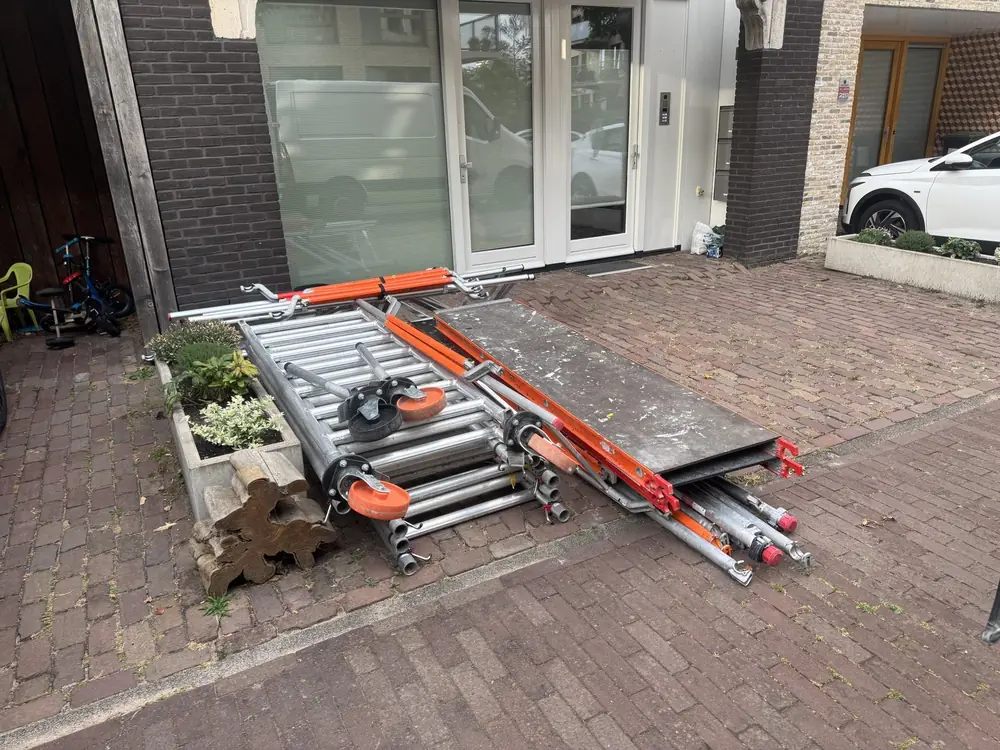
No assembled tower comes round the corner. What the driver drops off is a counted package of loose components that you turn into a scaffold yourself, and that stack has to go somewhere. Not under the windows, since that lane is reserved for rubble and a barrow. A corner of the drive, or the path beside the front door, works far better. Order on a weekday, before three in the afternoon, and everything reaches your address the next working day. You pin both the drop off date and the collection date yourself.

Building it is on your side of the arrangement. Printed instructions travel with the set, and a video online runs through the order the components go up in, so with a tower this low and this few parts a pair of people are done quickly. Have the load land the day before you start, then the first morning opens with a blade going round the sealant on stone number one. Glance at the forecast while you are at it, since building in driving rain takes twice as long.

Counted scaffold components set down on the kerb outside a terraced house, waiting to be built before any stone comes out

Once the last bead is run we come back round to take everything away. You strike the tower and pile the components somewhere a van can pull up alongside, preferably not beside the heap of rubble. Tick off the components list as you break it down and there is nothing to discuss afterwards. Every province has its own fixed sum for the journey there and back, listed under the cost of delivery, so the final day holds no surprises.

Safe hire and use of a tower with heavy stone sills

Each deck carries up to 200 kg per square metre, and that is what load class 3 means in EN 1004. On sill work you get nearer that figure than on other wall jobs: a natural stone window sill two metres long weighs tens of kilos, and you, a bucket of mortar and a breaker all count on top. So do not park a stone in the middle of the platform but lay it hard against an upright, and take it off the deck the moment it is bedded in the wall.

The ordinary rules apply here just as firmly. Lock the castors before your first foot goes on the step, never move the build with a person or tools aboard, and stop working when the wind gets up. That last one feels excessive on sill work, right up until a gust knocks over a loose stone propped against the guard rail. After every move, walk round the four stabilisers and set them out firmly again before any kit goes back up.

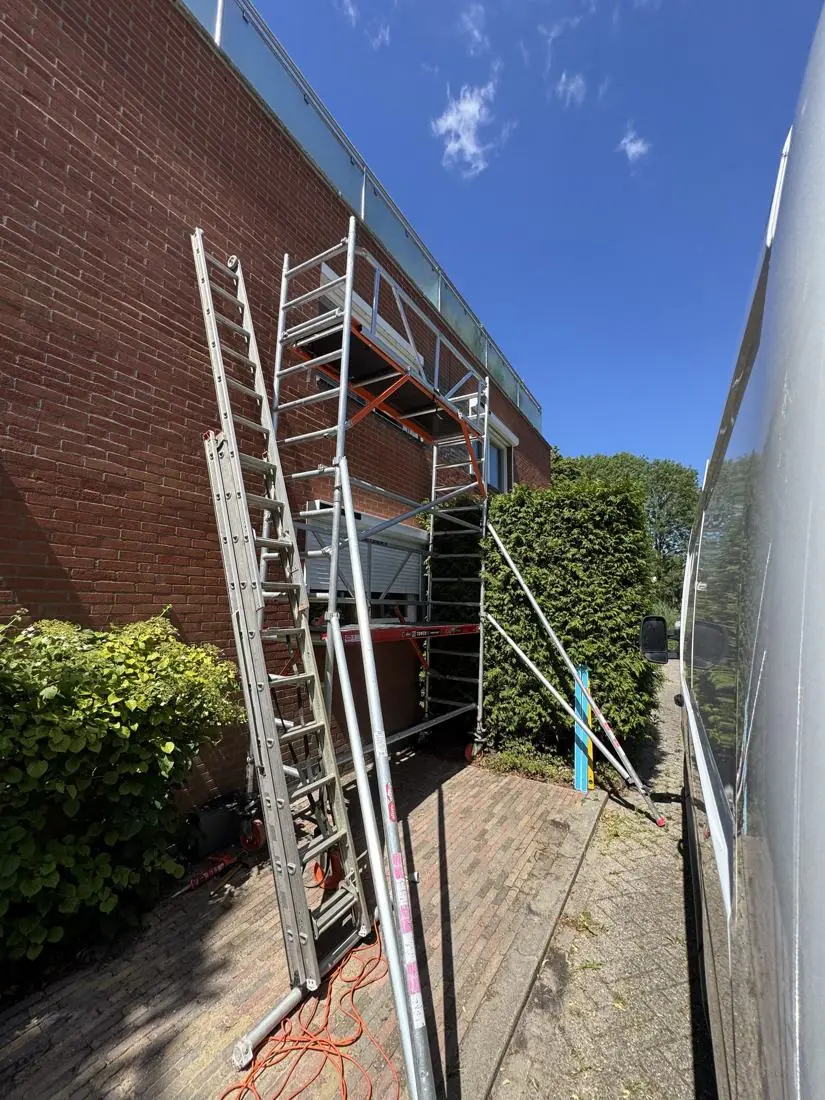
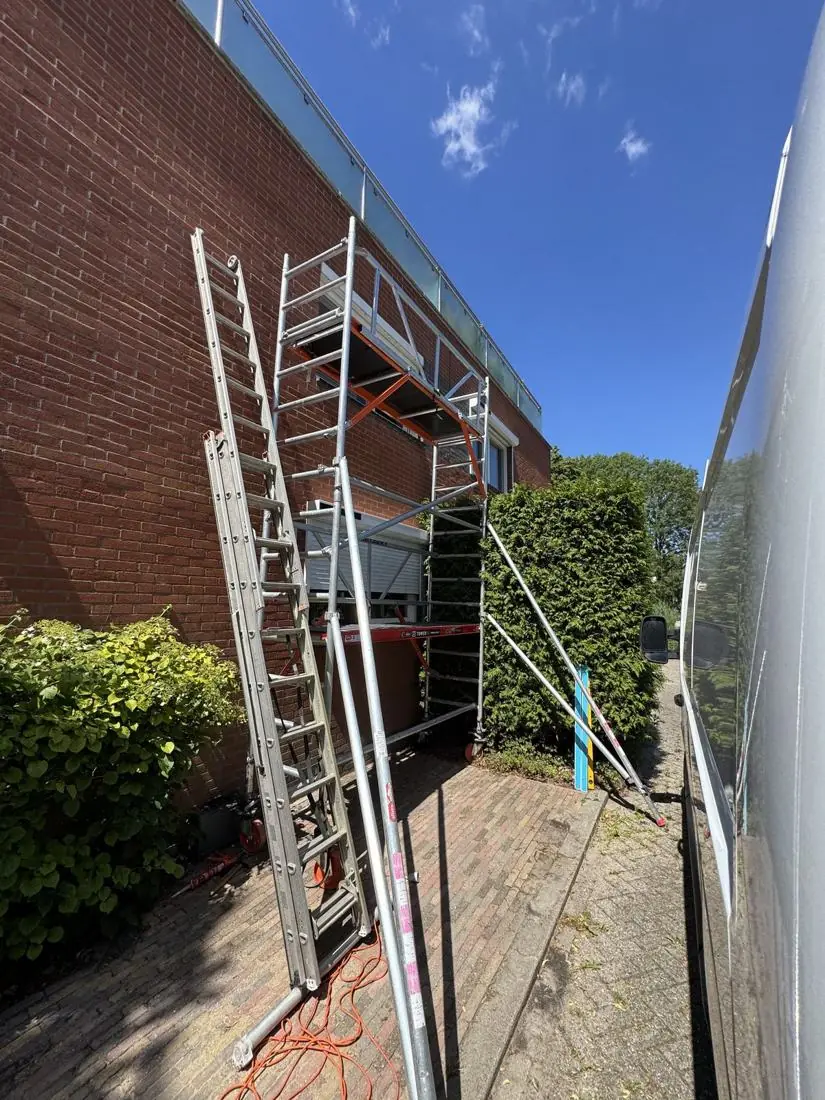
Built tower in a narrow passage, boards railed at two levels, with a ladder leaning free against the brick wall.

The real danger on this job travels downwards. Chiselling sends chips flying and drops lumps of old bedding exactly where people walk along the wall. Cordon that strip off with tape or a few crates and keep children out of the zone beneath you. Wear safety glasses yourself, because a splinter off a weathered stone carries further than you expect. Everything else that applies is gathered on the page with rules for working at height.

In 5 steps

How hiring a mobile scaffold works

1
Choose working height

Pick the height that suits your job.

2
Book online

Sorted in 60 seconds, price shown instantly.

3
We deliver

At the agreed spot the next working day.

4
Assemble safely

Assembled by you, with a manual.

5
We collect

One call and we collect the scaffold.

Good to know

Practical tips for replacing a window sill

1

Measure every sill before you order and check whether they are all the same length. Where they differ you are replacing a window sill one at a time, and you shift the build more often than you allowed for.

2

Cut the sealant round the old stones on the day you assemble the tower rather than the day you start. The following morning you climb up and go straight in with the chisel instead of reaching for a blade first.

3

Lay a board or a tarpaulin over the border before you start replacing a window sill. Debris then lands on timber rather than among the perennials, and comes off again in five minutes.

4

Take two levels up with you: a short one for the fall on a single stone and a long one that spans several. That keeps the whole row on one line instead of varying window by window.

5

Chalk on the paving where the castors belong at each opening. After lunch or a shower you roll the tower straight back into the same stance without measuring and levelling afresh.

6

Run the sealant on your second to last hire day, not on the morning the van arrives. Beads that have not cured pull straight back out of the joint while you dismantle, and you are waiting all over again.

Frequently asked questions

Frequently asked questions about replacing a window sill

Which scaffold should I hire for replacing a window sill?+

The MiTower is the obvious model here: narrow, light and meant for one person at a time. You only pause briefly at each opening before rolling on a window width, and that goes far more pleasantly with a tower you shift by yourself than with something heavy. Its 75 cm width also slips between a hedge and the brickwork. Where the stones sit higher than a first floor, pick a model with more reach when you book.

How does hiring a tower for sill work go from start to finish?+

Online you fix the model and the build height, set the day the components arrive and the day they go again, and settle a fixed sum with VAT already in it. The parts land on your pavement, you turn them into a scaffold and start on the first stone. On your closing day you strike everything and it goes back in the van. The only truly immovable thing in the plan is the mortar setting.

How many days do people usually hire for this kind of stone work?+

For four to six stones in one elevation you come out at two to three days. Cutting out and bedding fits inside a working day, but you need the day after to seal once the mortar has gone off. Take the rear elevation on as well and you add at least another day. Since you choose how long the scaffold stays, that margin is built in at the moment you reserve.

What is the rental price for a few days of sill work?+

The rental price follows from the model, the height you build to and the run out to your province. All of it appears with VAT included on the page listing what each build costs, so no arithmetic falls to you. On this job the opening day carries most of the weight, while days tacked on afterwards to let mortar cure barely register. Generous booking therefore works out cheaper rather than dearer here.

What working height do I hire for sills on the first floor?+

A build between 4 and 6 metres serves nearly every mid terrace. Measure from the paving the castors will sit on up to the bottom of the frame and add half a metre, so that you finish beside the stone instead of over it. Where the scaffold will stand in a garden lower than the footway, start the tape down in that garden. The overview of reaches shows which build suits which model.

Is delivery part of the hire, or do I fetch the scaffold myself?+

Delivery is the usual choice, though not the only one. Book bringing and fetching and the set stands at your door on the morning you picked, and we return once the last stone is in, for a sum that varies by province. With a van of your own, the parts can be picked up free of charge by prior arrangement at Zeeburgerpad 89 in Amsterdam. Most people hiring a tower for stone work still have it brought, since their trailer leaves the other way loaded with rubble.

Do I have to build it myself when I hire a tower for this?+

Yes, assembly is your share of the job. We make sure the components lie ready in time and that they disappear again afterwards. Erecting, nudging along and dismantling stay with you, and on this low build two people spend roughly an hour on it the first morning. You will find no cherry picker or system scaffold in our fleet, so for replacing a window sill at this height a rolling tower is the sensible answer.

What if the stone work overruns and I want to rent the tower longer?+

Say so as soon as you can see the plan slipping and the collection day can move, unless the tower has already been booked by someone else for those dates. Sills often behave differently from the plan: one seized solid costs an extra hour and a night of frost writes off a working day. So reserve a day more than you think rather than a day less. Returning it ahead of your end date is never a problem.

How much clear space does the build need beneath a window?+

Allow for the tower's own footprint together with the spread of the four stabilisers around it. On top of that you want room for debris, a barrow and the replacement stone waiting against the wall. In practice that means a flat run of a few metres under the opening with no planters, bicycles or water butt in it. Clear it before the hired scaffold arrives, since shuffling things aside mid job easily costs half an hour.

Can I keep the scaffold on hire when the weather stops the mortar?+

The tower can stay exactly where it is, only the wet trades slide. In a frost the mortar under a stone will not bind, and on a soaked wall sealant grips poorly, so fill such a day with cutting joints open, raking out old pointing or measuring up the next openings along the elevation. Because you set the closing date of the hire yourself and each further day counts for so little, a delay of this kind mostly costs patience.

How is the deposit handled when I rent a tower for this work?+

A deposit goes with the reservation and that sum returns to your account within 1 working day of the tower being counted back in. For sill work that mainly means two things: every component travels back in the van, and you wipe mortar off the decks before it can harden. Caked on bedding is nearly impossible to shift later, and a missing brace shows up straight away in the count.

Does the new stone go up the tower or can that stay on the ground?+

The stone travels up with you, which is precisely why you hire something sturdier than a ladder for this. Lift it between two of you, lay it crossways against an upright so that it cannot topple, and only then mix the bed. A long natural stone is far better passed up to you from ground level than carried up under your own arm on the steps. Never leave one propped loose against the guard rail.

Hire a mobile scaffold for replacing a window sill today?

Calculate your rental price now or ask for free advice.

Rolsteiger van SteigerTaxi geleverd op locatie
Book it online

Your scaffold sorted in 2 minutes.

Choose your scaffold and working height, see the price instantly and book online.