
See your price
Application

Wallpapering a stairwell? Choose the right scaffold.

Wallpapering a stairwell is measuring work above all else. The flight drops away beneath you, so almost every drop ends up with a length of its own, and the place where you cut those drops to size is the landing rather than the room downstairs. Over the void you stand an Altrex RS44 room scaffold on adjustable legs, with a stair support bearing on the string, so your floor sits level above a sloping surface. Below you can read which build up to four metres you hire and how many hire days it asks for.

  • Order before 3 pm, delivered tomorrow
  • Professional Altrex scaffolds
  • Up to 14.2 metres working height
  • Easy to assemble yourself
4,2 tot 14,2 mWorking heights available
12Provinces served
7Days a week
200 kg/m²Load class 3
In short
  • For wallpapering a stairwell we recommend the Room scaffold.
  • Wallpapering a stairwell calls for the Altrex RS44 room scaffold, set on adjustable legs directly above the open stairwell void.
  • Every drop takes a length of its own because the flight falls away, so you measure and cut up on the landing.
  • A stair support against the string carries the side with no floor beneath it, so nothing at all leans on the void.
  • First 24 hours from €50 incl. VAT and delivery; every day after that 95% off.
Key facts for this job
FeatureValue
Recommended scaffoldRoom scaffold (Altrex RS44)
Working height for this job3 to 4 metres
Available working heights4.2 to 14.2 metres
StandardEN 1004, load class 3 (200 kg per m²)
DeliveryOrdered before 3 pm, delivered next working day
Each extra day95% off, from €2.50 a day
Why a mobile scaffold for wallpapering a stairwell?

Safe, stable and professional work at height

Paper in a stairwell rarely fails on the paste and almost always on the measurement. The flight sinks away under you, so the drop to your left is soon half a metre longer than the one beside it, and that difference has to be taken again for every single length. Meanwhile there is no floor under your boots but a hole, which rules out a stepladder or a plank across two treads at once. Hiring a room scaffold for wallpapering a stairwell means building a level working floor above a sloping surface, using adjustable legs of unequal length and a stair support taking the open side. Only when you stand square on that do you lay a pasted length tight to the wall.

  • Every drop a different length as the flight falls
  • Measuring and cutting both happen up on the landing
  • Adjustable legs of unequal length above the open void
  • A stair support carries the side without floor
Read more about working safely →

Which room scaffold to hire for wallpapering a stairwell

The model you take out of the hire fleet for this is the Altrex RS44 room scaffold, together with adjustable legs and a stair support. Without those two extras you will never get a level floor above a flight, because the four corners of your set-up simply land on four different levels. Ask for them at the moment you reserve rather than on the morning you start, since a fully built tower with nowhere to sit is of no use to anybody at all.

That this is an indoor model shows itself in the doorways. The longest components pass through an opening from roughly seventy centimetres, which means you can bring them along the hall and in at the front door as far as the foot of the flight. From there you carry them up to the landing in armfuls, because that is where the build begins. Measure the bend if your stairs turn a quarter, since a component that jams there has to be left downstairs after all.
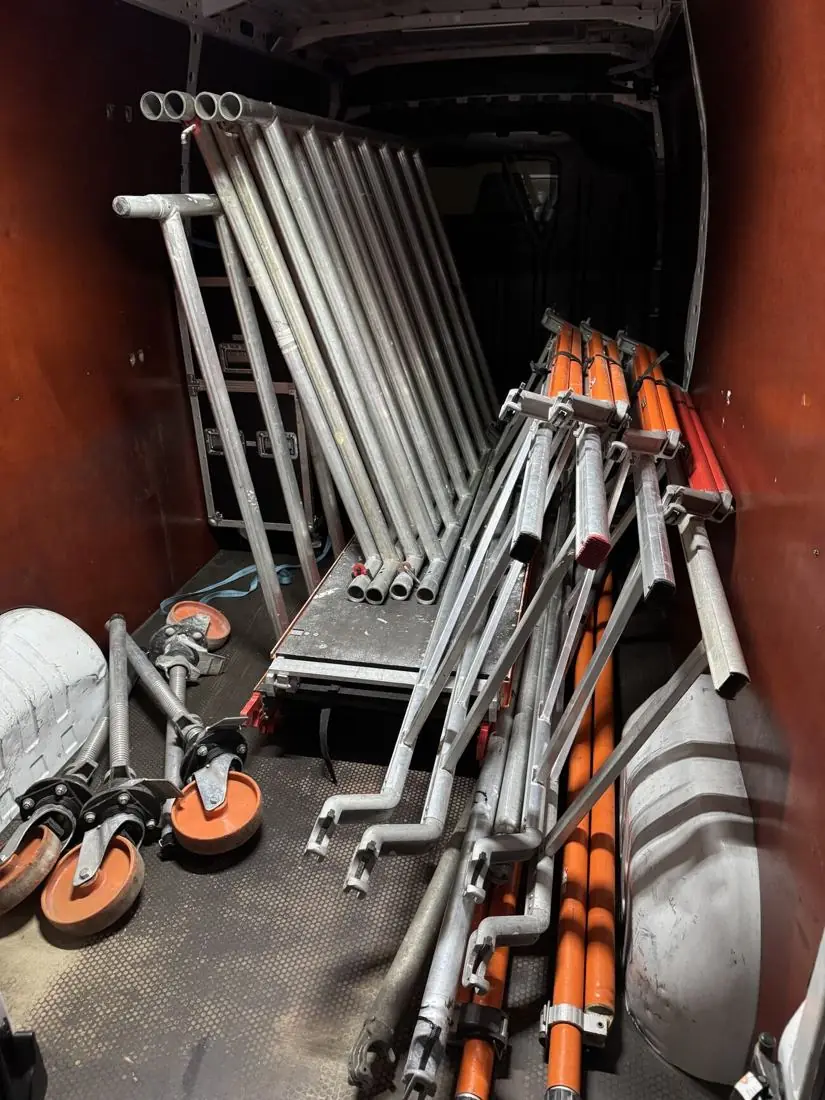
Van load space packed with scaffold frames, orange tubes, spare castors and a platform deck ready to travel

Hanging paper takes two hands and often two people, so you want a closed floor around you up there. Loose climbing gear on a tread is out, and you would hire a mobile scaffold for the outside of the house rather than for a landing. What the fleet holds and which model suits which job is set out on the page about the indoor room scaffolds we hire out, while this comparison of the two indoor builds covers the difference between them, width included.
Which working height to hire above the stairwell void

The commonest mistake when wallpapering a stairwell is measuring from the half landing below. You will not be standing on that floor at all: your adjustable legs rest on the landing and on a couple of treads beneath it, and that plane is your starting point. So measure from the lowest point at which a foot lands, straight up to the top edge of your highest drop, and use that figure when you book the build you want. Write it on the wall in pencil so it is still there on delivery day.

Working height in our fleet means the height of the deck with about two metres of reach added on top, or in plain terms how high you can still smooth a length of paper with a straight arm. For a stairwell in an ordinary house that lands you between three and four metres, exactly the span of this indoor model. If you are torn between two stages, let the top edge of your highest drop settle it, and compare the figures against a build reaching four metres. One frame changes little in the build itself.

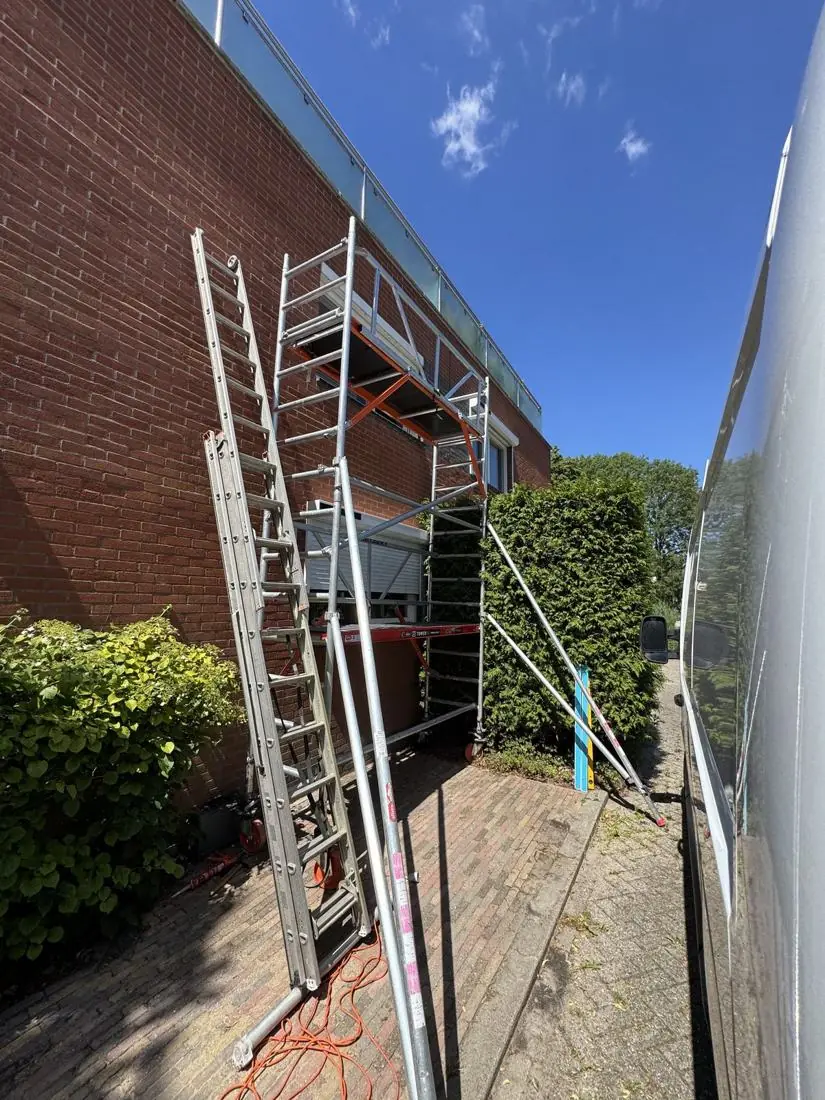
Mobile tower erected beside a brick wall, a long extension ladder standing against the same wall alongside it

Stand too low and you are reaching over your head with a wet length towards a line you cannot see. Paper pressed home in that position hangs out of true, and the seam carries that error the whole way up the wall. You notice it once the drop is on and by then correcting it is barely possible. A build one stage taller costs almost nothing more to hire and saves you cutting a fresh length, which on a stairwell wall is never a quick job.

Wallpapering a stairwell: the hired set-up over the void

Your set-up ends up half on the landing and half over the stairwell void, and that is exactly why the adjustable legs matter. Each leg takes a length of its own so the floor lies level while the feet stand on different treads. Put a spirit level on it before you carry anything up and correct in small turns. Check the levelling again once the deck sections are lying on it, because that weight presses the legs down a fraction further.

The side with nothing underneath it is taken by the stair support. That goes against the string, so the load comes onto the timber of the flight rather than onto the hole beneath. Look at what the treads themselves will take: old softwood treads with a newel in the middle are not equally sound at every point. Lay a small board under each foot to spread the pressure, and you leave no marks in the timber or in the stair runner.

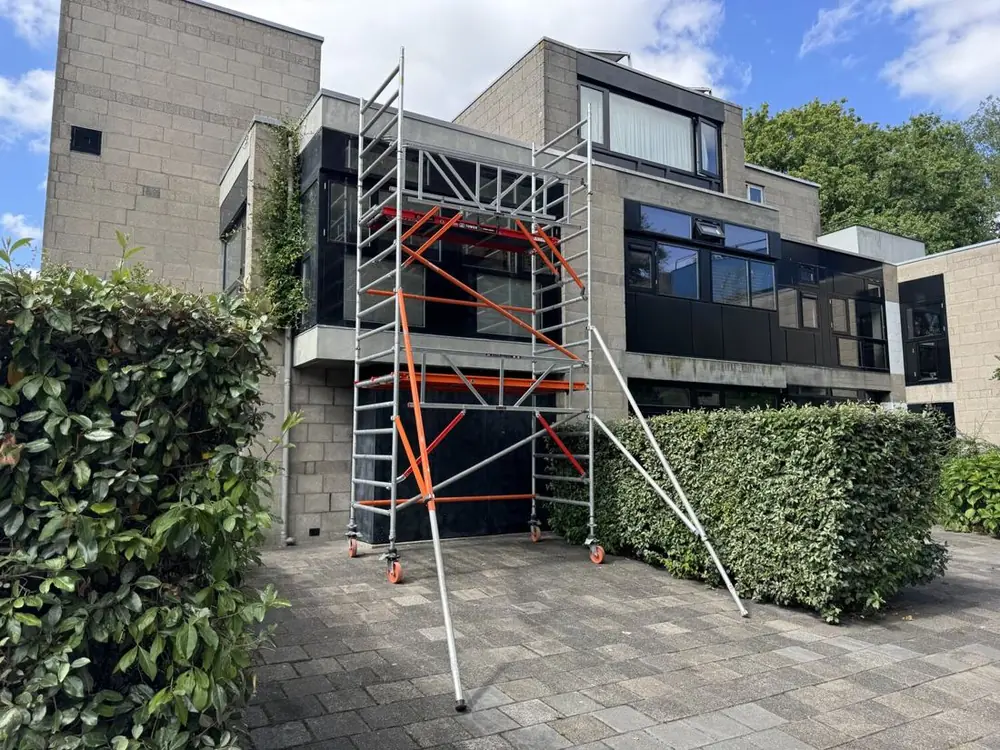
Foot of an erected tower with four stabiliser legs splayed onto block paving, red castors under the frames

Empty the landing before anything comes indoors. A laundry basket, a cupboard and the bedroom doors are all in the way once the set-up is standing. Remember the light fitting that so often hangs right in the void: take it down before you begin. Wedge the doors that open onto the landing so nobody swings one into your tower. Have a look at the guidance on towers over an open stair void before the build starts, because a landing gives you less room to correct a mistake than any bedroom would.

How many hire days wallpapering a stairwell asks for

Reckon on three hire days for an average stairwell, and four if the walls have to be filled and primed first. The opening day goes largely on building, on measuring out and on preparing the wall. Only on the second day does paper start going up, and you need the third for the last lengths, for running down the seams and for taking the tower apart. That split also leaves room for a drop you have to cut a second time.

The measuring is what eats the hours here. Every length is marked and cut separately because its bottom edge follows the flight, and between one length and the next you walk back to the cutting table on the landing. That costs a few minutes each time, and over twenty lengths it mounts up nicely. Allow for walking down the flight once per drop as well, to check the bottom edge against the treads. A lining coat that has to dry adds half a day on top.

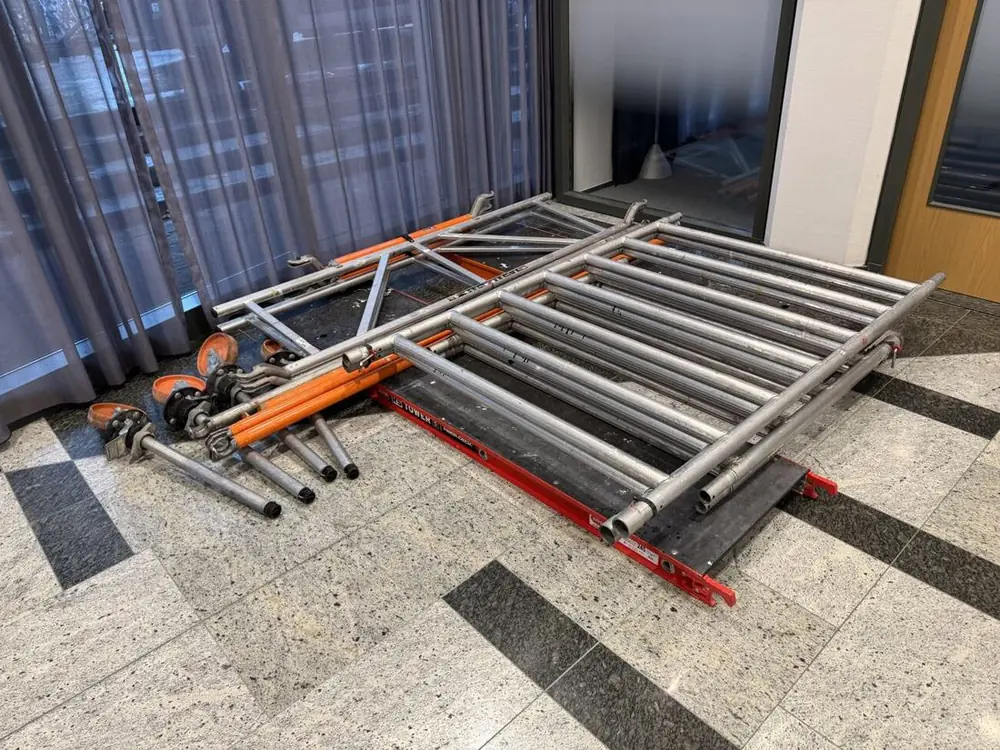
Counted scaffold set lying indoors on a tiled floor: frames, orange braces, loose castors and one platform deck

Happily an extra day weighs almost nothing. Every hire day after the opening twenty four hours carries 95 per cent off, so keeping the tower a day longer costs very little. That suits paper hanging, where you would rather wait until a lining coat is properly dry than press a length onto a clammy wall. Book too tightly and you are pressing the last seams home while the van waits at the kerb, the one situation this job cannot take. There is more on judging that in the guide to picking a hire period.

Which mobile scaffold suits wallpapering a stairwell?

Most chosen
Kamersteiger RS44
  • Working height up to 4 metres
  • Compact and narrow
  • Great for indoor and small jobs
View and calculate →
Smalle rolsteiger RS51
  • Working height up to 14.2 metres
  • Narrow (75 cm)
  • Ideal for narrow passages
View and calculate →
Brede rolsteiger RS52
  • Working height up to 14.2 metres
  • Wide platform (135 cm)
  • Extra stability and workspace
View and calculate →
1-persoons steiger MiTower
  • Working height up to 6.2 metres
  • Very compact
  • Quick and easy to assemble
View and calculate →

Hanging drops from a 245 cm platform above the stairs

Your working floor measures 245 cm, and that settles how many lengths you can hang from a single position. In practice it is two to three before the set-up has to shift along. Fix the order beforehand and start at the wall furthest from the flight, so you never have to slide past a fresh length. Number the drops on the back and you will never pick up the wrong one in half darkness with your hands full, which happens more than you would like on a stairwell landing.

The lengths all differ, because the bottom of each one follows the flight downwards. So strike your top line first, then measure the longest side of every drop and add generous extra. Cutting happens on the landing, on a table or a board across two trestles, and not down in the hall: that extra journey up the stairs with a pasted length under your arm is the last thing you want on this job. Keep the offcuts until the whole wall is up, because a short piece above a door often comes out of one.

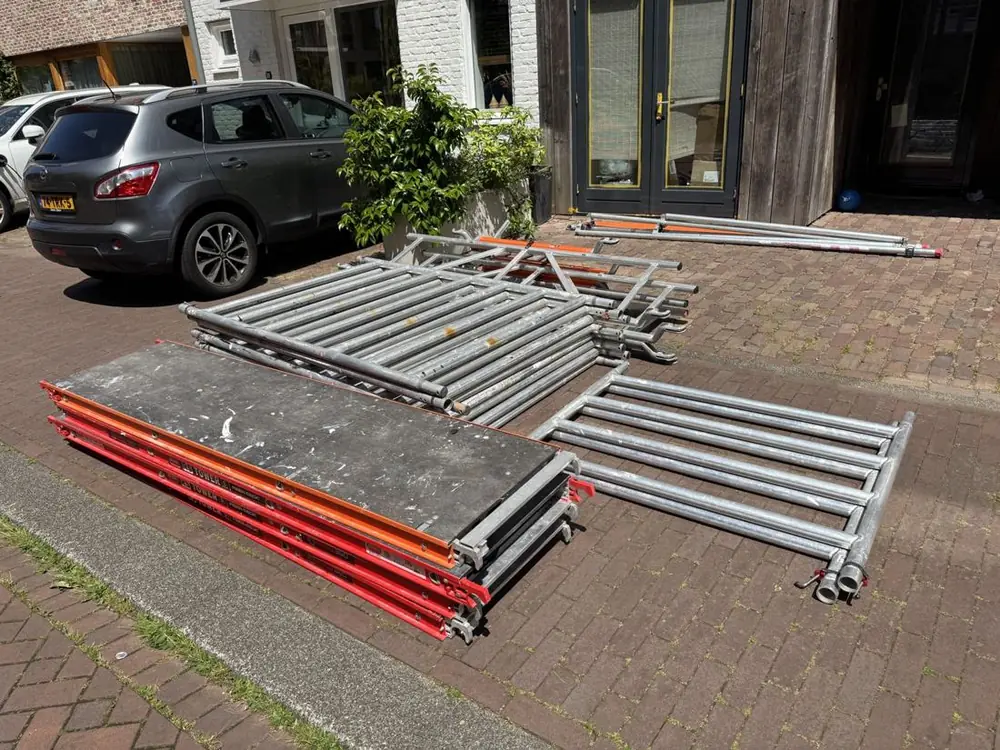
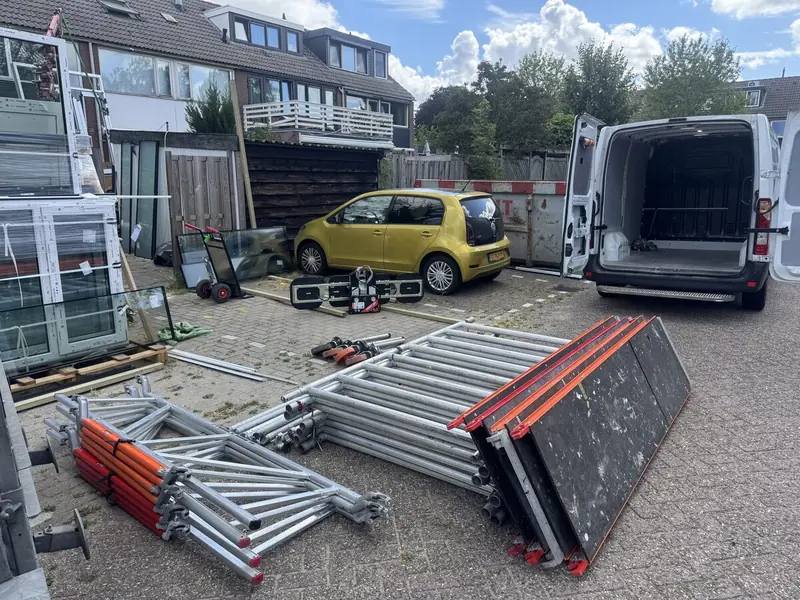
Two sorted stacks of scaffold parts on block paving outside a house, red edged decks beside grey frames

Take everything you need up for each position: the cut lengths in order, your paste bucket, a brush, a sharp knife and a damp sponge. Walking down underneath a hanging drop because you forgot something goes wrong nearly every time. Work in pairs once the lengths run beyond two metres, with one keeping the bottom clear of the treads while the other presses the top home. Share those roles out before you begin, since swapping over with a wet length between you goes wrong without fail.

Hiring a room scaffold delivered to a narrow stairwell

What gets delivered is a counted set of loose components and not a standing tower. So clear a spot first where that stack can lie without blocking the flight; a hallway is usually too tight for it, which points you to the sitting room or the garage. After that you carry everything up to the landing in two or three trips, and that will keep you busy for half an hour. Book before 15:00 on a working day and your components are loaded for the following working day.

The arrival day and the day everything may travel back are both yours to pick. Take the day before your first paper hanging day as the arrival day, because building above a void takes time: every adjustable leg has to be set separately and the stair support has to bear tight against the string. Assembling the tower stays your task; keep the manual to hand and put the instruction video on beside you. The same order appears in this stage by stage account of the build.

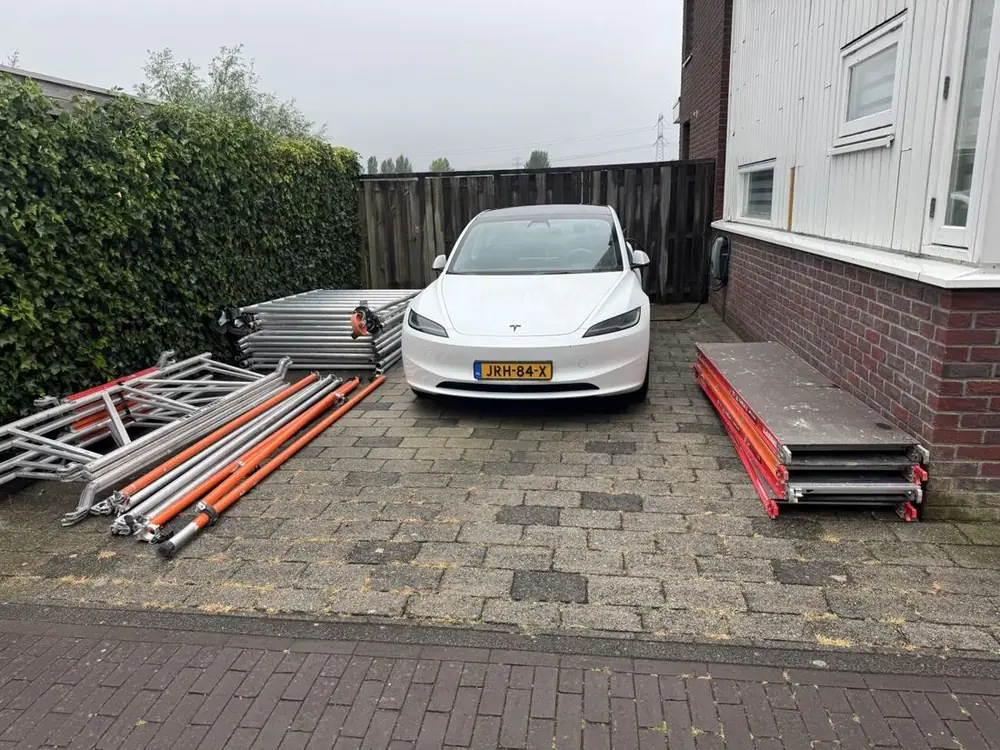
Scaffold parts set down in two rows along a paved drive on either side of a parked car

Once the paper is hanging you break the set-up down and stand the complete set ready on the ground floor, after which we come by to take it away. If you own a trailer you may also collect the components yourself, free of charge and by appointment, in Amsterdam at Zeeburgerpad 89, 1019 AD. Bringing the set and fetching it again is charged at one fixed amount for your province, and you can look that up in advance under the delivery charges by region.

Safe wallpapering over a stairwell void on a hired tower

Each square metre of the platform beneath your boots takes 200 kilos, the figure that EN 1004 sets down as load class 3. When wallpapering a stairwell you genuinely need that margin, because there are often two of you on it, plus a paste bucket and a stack of cut lengths. Add it up once before you begin, stand the bucket in the middle of the floor rather than on the edge, and lay the drops on the side you reach for them.

On this set-up the castors are not free to roll but sitting on adjustable legs, and where castors do bear they go on the brake the moment anybody climbs on. Moving happens with an empty floor only, and above a void moving means levelling again, checking again and fixing the stair support again. Never skip those steps because it is only half a metre; that is exactly when a leg ends up on the wrong tread and the floor stops being level. Shifting along is a quarter of an hour of work here.

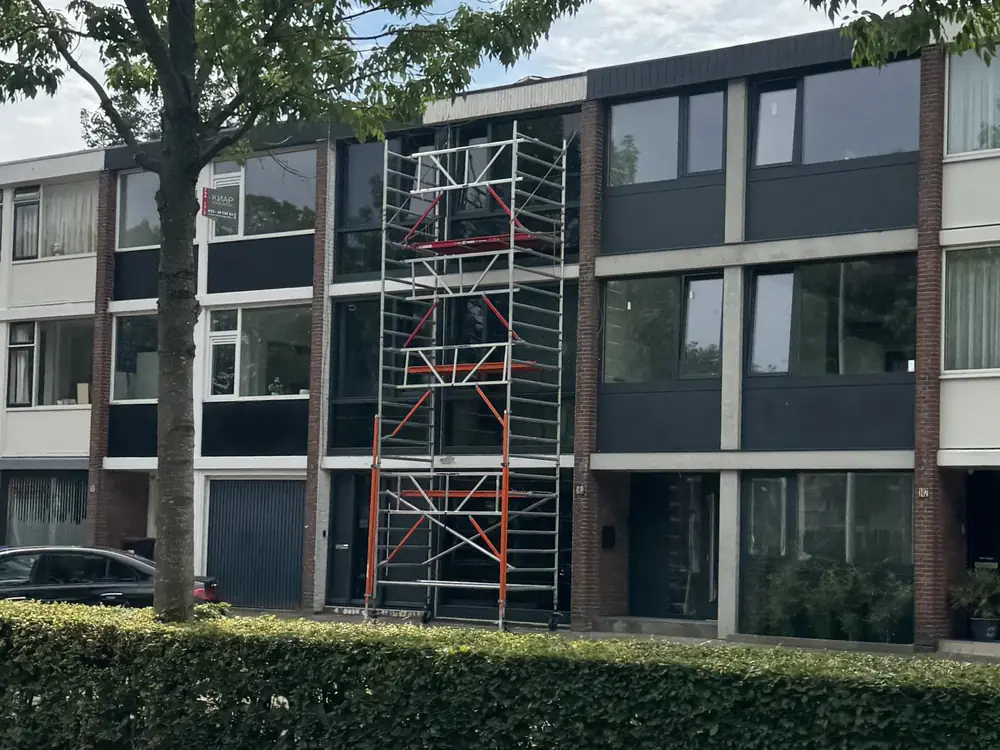
Mobile scaffold standing fully built against a block of flats, guardrails and decks fitted at every level

The hazard that outranks every other one on this job is the open void itself. Anything sliding off your working floor falls all the way to the hall below, and a paperhanging knife or a pair of scissors lands hard. Keep tools in a tray rather than loose, and keep the flight beneath you empty while you are up there. Paste on a tread makes the timber greasy as well. The rest is set out under the rules that apply to work at height.

In 5 steps

How hiring a mobile scaffold works

1
Choose working height

Pick the height that suits your job.

2
Book online

Sorted in 60 seconds, price shown instantly.

3
We deliver

At the agreed spot the next working day.

4
Assemble safely

Assembled by you, with a manual.

5
We collect

One call and we collect the scaffold.

Good to know

Practical tips for wallpapering a stairwell

1

Measure every drop along its longest side and add ten centimetres to that figure. On a flight that falls away, a length cut exactly to size always ends up just short at the bottom of the wall.

2

Set your cutting table on the landing, across a bedroom door you are not using anyway. The route to the set-up then stays clear and you never have to carry a pasted length around the table.

3

Mark the adjustable legs with tape at the length you measured out. If the set-up has to be levelled a second time later on, you will not be starting again from scratch with a spirit level.

4

Hang the first length on the landing side and work towards the flight. The drops then grow steadily longer while wallpapering a stairwell, which is far easier to judge than working from long back to short.

5

Stand a bucket of lukewarm water with a sponge beside your paste bucket. Paste landing on the handrail or on a tread has to come off at once, or it will have dried on hard by the next day.

6

Leave the set-up standing while the paper dries and break it down only on your last hire day. Levelling a second time above a void costs you more hours than that day of hire would save.

Frequently asked questions

Frequently asked questions about wallpapering a stairwell

Which room scaffold do you hire for wallpapering a stairwell?+

The Altrex RS44 room scaffold is the model for this, provided you hire it with adjustable legs and a stair support alongside. Those parts make the difference: the legs give each corner a length of its own so your floor comes up level, and the support carries the side with no tread beneath it. Without the pair of them you end up with a built tower you cannot place anywhere above an open void. Say when you reserve that the job is a stairwell.

How do you arrange the hire of a room scaffold for this job?+

You choose the model and the build height on the website, name the day the components should arrive and the day they may leave, then pay a fixed rate that already carries VAT. Our driver puts the components down at your door, you carry them through to the landing and build up there. Once the paper is on the wall the tower comes apart again and you bring the parts down for the collection run. The hire itself asks for planning rather than paperwork.

How many hire days does a stairwell full of drops take?+

Three days is a realistic hire period, and four if the walls still need preparing. On day one you build the room scaffold and measure out every length, on day two most of the paper goes up, and on day three you finish the rest, check the seams and take the tower down. Because you name your own collection date, that third day can just as easily be planned as a fourth without costing you much.

What decides the rental price for a room scaffold indoors?+

Your rental price is built from the model you choose with its build height, plus a fixed amount for the run out to your province and back. Both appear, VAT included, on the page listing our indoor hire rates. What stands out on this job is how heavily the opening day counts and how little each day after it does. Anyone planning two spare days for drying and measuring pays only a fraction more for them.

Which working height do you hire if the void runs over two storeys?+

Even then you measure not from the floor below but from the level your adjustable legs come to rest on. From the landing and the top few treads, a room scaffold at three to four metres brings you to the top edge of your highest drop. If the void carries on past what you reach from that level, split the work between two set-ups at different heights. The overview of working heights shows how those builds compare.

Can the room scaffold be delivered, or is collection part of the hire?+

Both are open to you, and on this job delivery is usually the easier call. The van drops the room scaffold off on the date you picked and returns for the components once you have finished. Collecting the set yourself is free by appointment, but remember that you then load and unload twice. Anyone wallpapering a stairwell would rather put those hours into measuring and cutting than into lifting parts in and out beside the road.

Do you put the hired scaffold up over the void yourselves?+

No, the building belongs to your side of the job. We deliver the complete scaffold set and take it away again later, but setting the legs, getting the floor level and fixing the stair support are all yours to do. The manual and the instruction video run through that order step by step. Allow a good hour, because levelling above a flight of stairs is simply slower than levelling on a flat bedroom floor.

Can you hire for longer if wallpapering a stairwell runs over?+

That rarely causes any trouble. Tell us the tower has to stay and we move the collection run back, as long as that particular set has not already been promised to somebody else for those dates. In stairwells the job runs over regularly, either because a badly cut length has to be replaced or because the wall stays damp longer than you reckoned. Booking a day extra straight away is seldom money thrown away, given how little a following day adds.

How much of the landing has to be clear before the hire starts?+

Count on the footprint of the set-up plus walking room around it, and on top of that a place for your cutting table and your buckets. In practice that means an empty landing: cupboards out, laundry basket out and the doors that swing onto it shut. Do not forget the light fitting in the void, which hangs at exactly the height the platform of your hired room scaffold reaches. Measure that space before the set arrives.

Does the hire keep running while the lining coat dries?+

Yes, and that is precisely why you count the drying day into your booking. The hired tower stays exactly where it stands in the meantime, legs set and stair support fixed, so next morning you carry straight on from where you stopped. Taking it down and levelling it again later costs you considerably more time than the day of hire you would save. Plan drying time in as a working day rather than a lost one.

What happens to the deposit if paste dries on the hired parts?+

Your deposit goes back within one working day of the complete set returning and being counted. Wallpaper paste wiped off straight away with a wet sponge causes no difficulty at all; paste that has stood drying on a tube for days certainly does. So take clean water and a sponge onto the deck whenever you hire a room scaffold, and wipe the platform down each evening. The guardrails collect just as much as the deck.

Can two of you stand on the hired scaffold at the same time?+

Yes, the room scaffold is built for it, and with long lengths that is also the sensible way to work. One of you keeps the bottom clear of the treads while the other lines the top up and presses it home. Do watch that the pair of you, plus the bucket and the stack of cut drops, stay inside the load the deck carries, and spread that weight across the full floor rather than piling it into one corner.

Hire a mobile scaffold for wallpapering a stairwell today?

Calculate your rental price now or ask for free advice.

Rolsteiger van SteigerTaxi geleverd op locatie
Book it online

Your scaffold sorted in 2 minutes.

Choose your scaffold and working height, see the price instantly and book online.