
See your price
Application

Removing a dormer? Choose the right scaffold.

Removing a dormer is demolition work at height, and everything you take out has to come down again. Glass, frame timber, zinc and the side cheeks go over the edge piece by piece, and once the top is off your roof slope lies open. Hiring a scaffold for this job means wide enough to carry on and high enough to reach the top edge of the dormer. The wide RS52 is ready for that, 135 cm across, built here to 8 or 12 metres.

  • Order before 3 pm, delivered tomorrow
  • Professional Altrex scaffolds
  • Up to 14.2 metres working height
  • Easy to assemble yourself
4,2 tot 14,2 mWorking heights available
12Provinces served
7Days a week
200 kg/m²Load class 3
In short
  • For removing a dormer we recommend the Wide mobile scaffold.
  • To take a dormer apart you hire the RS52 at 135 cm wide, in a build reaching 8 or 12 metres.
  • Put the skip within walking distance of the tower, so timber and glass never cross the pavement twice.
  • Book three to four rental days, because the hole in the roof slope has to be watertight by the end of the day.
  • First 24 hours from €175 incl. VAT and delivery; every day after that 95% off.
Key facts for this job
FeatureValue
Recommended scaffoldWide mobile scaffold (Altrex RS TOWER 52)
Working height for this job8 to 12 metres
Available working heights4.2 to 14.2 metres
StandardEN 1004, load class 3 (200 kg per m²)
DeliveryOrdered before 3 pm, delivered next working day
Each extra day95% off, from €8.75 a day
Why a mobile scaffold for removing a dormer?

Safe, stable and professional work at height

When you take a dormer apart the scaffold is above all your route down. You are pulling a structure to bits that has to leave in sections, and that will not happen with one hand on a ladder. You want to stand on a deck holding a wrecking bar and a cut out frame at the same time, and you want to put material down for a moment before you lower it. On top of that the job carries its own deadline: from the moment the top comes off, your house is open. So hiring a tower that stands high enough and wide enough saves you time and water damage in the bedroom below.

  • Demolition material brought down under full control
  • Working height of 8 to 12 metres
  • Wide 135 cm tower for carrying heavy sections
  • Skip standing within reach of the base
Read more about working safely →

Which mobile scaffold to hire for removing a dormer

For taking a dormer apart you hire the wide Altrex RS52, a mobile scaffold measuring 135 cm between the uprights. That extra width is no luxury on demolition work, because you are never standing still: you carry panels, lengths of frame and sheets of zinc across the deck to the edge and set them down for a moment before they go over. With two people side by side and a sawn out window between them, a slim deck is full straight away. All the models stand together in the mobile scaffold hire range.

The slim RS51 at 75 cm is usually too tight here. You can stand on it perfectly well to paint or to drive screws, but steering demolition parts between your feet gets awkward as soon as something of any size comes away. Count in that your tools lie there all day too: a reciprocating saw, a wrecking bar, a bucket for screws and nails, and a roll of sheeting for when the weather turns. At 135 cm you also keep a walkway clear, and that walkway is what keeps this work safe.
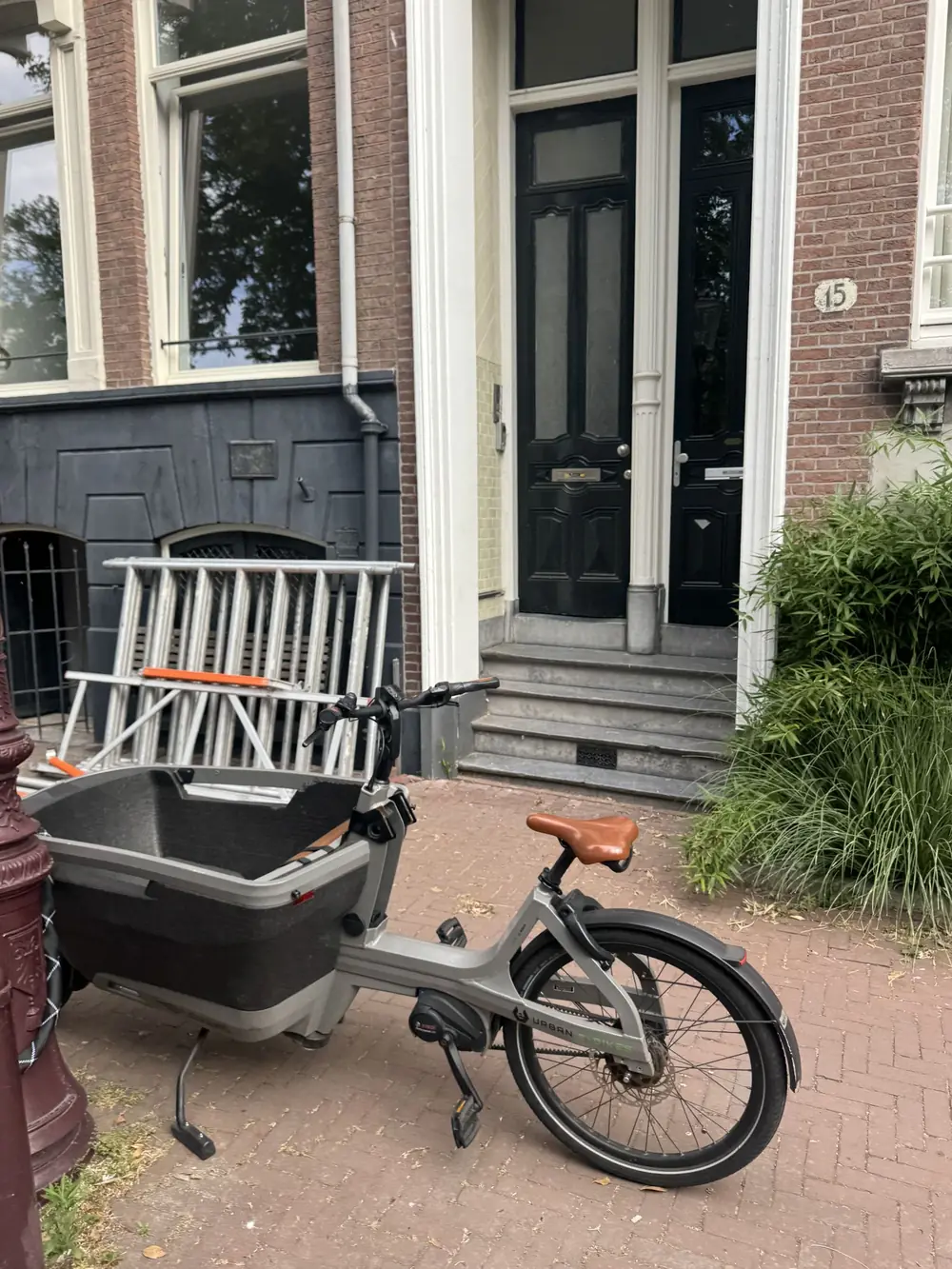
Wide model frames by a house front, the 135 cm hire set delivered in parts for taking a dormer apart

If a wide tower will not get round the back, that is the one real reason to rent slim after all. So before you book, measure the passage through to the spot where the dormer sits: a 90 cm gate, a path along the boundary, an alley between two houses. If the wide set will not fit, you carry the parts round in armfuls and build it there instead. The explanation of choosing a scaffold for a dormer puts the models next to each other.
Working height to hire when you strip a dormer

On a dormer you do not measure up to the gutter but to the top of the dormer itself, because that is where the lead sits and that is where you start. On an ordinary two storey terraced house that point is soon 7 to 9 metres above the garden, and on a property with an extra floor it runs towards 11 metres. That is why you hire a working height of between 8 and 12 metres for this job and choose inside that band on the strength of your own measurement.

Those two figures are far apart, so measure before you book. What you state when you hire is the working height, and that already has roughly 2 metres of reach built into it: you stand on the deck and your arms come out above it. If you want your hip level with the roof edge you have to work backwards, since a deck at 7 metres amounts to a working height of about 9. What such a build looks like in practice is shown at ten metres of working height.

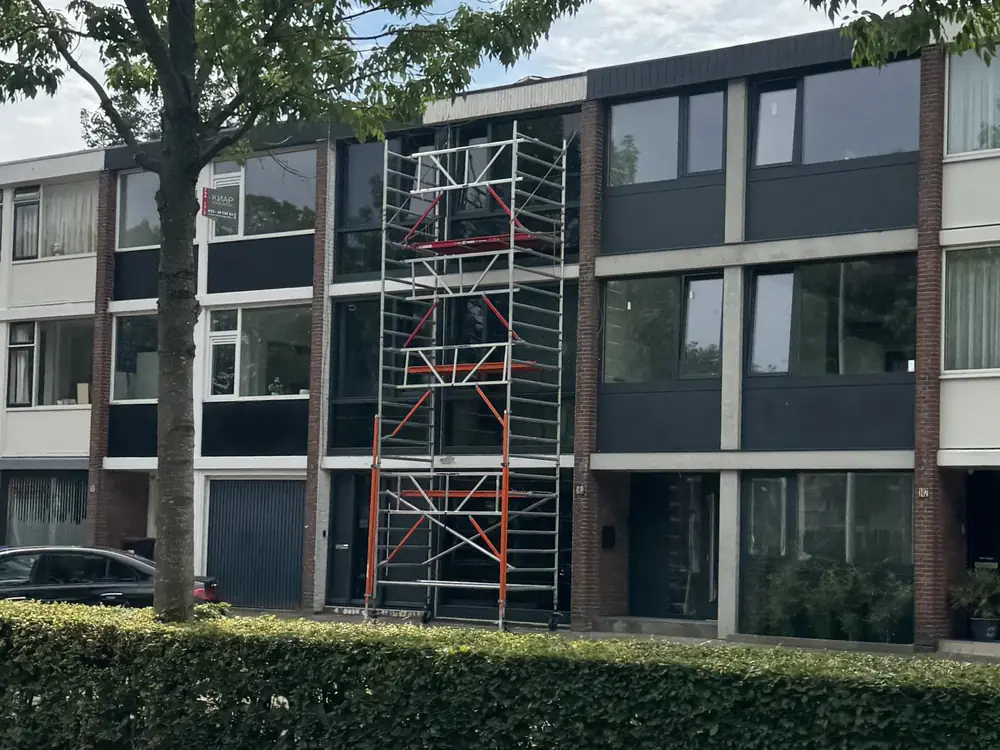
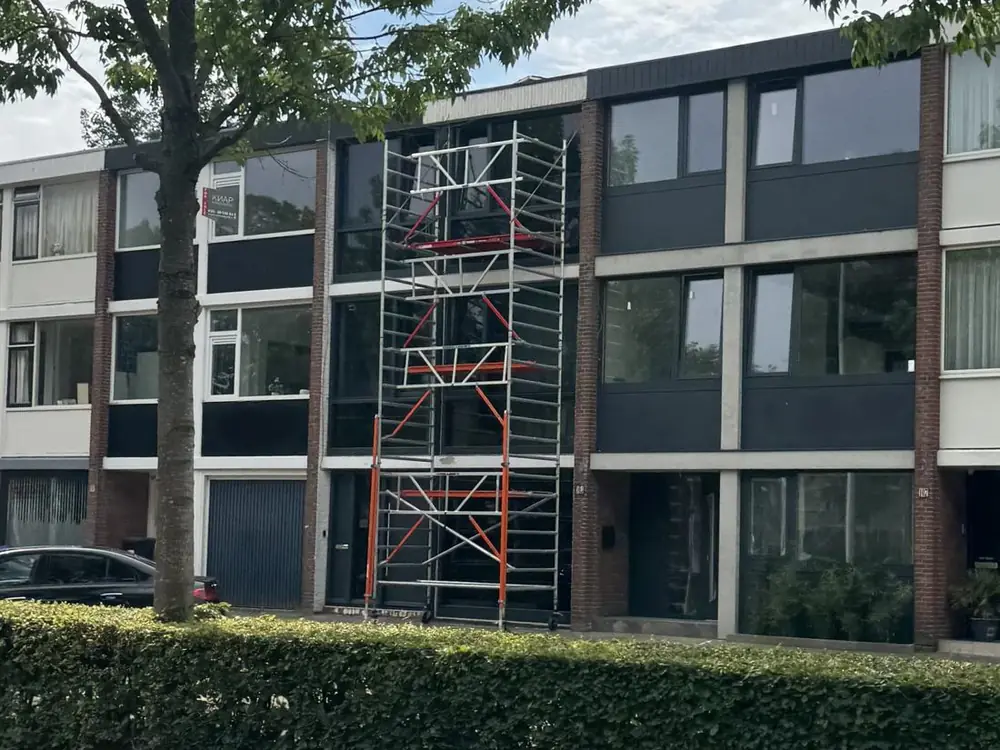
Mobile scaffold erected along a front elevation up to the roof edge, the height a dormer job asks for

Renting too low punishes you immediately on demolition work. With the deck below the floor of the dormer, you lift every part you have freed before you can lower it, and that is exactly the movement in which people lose their back or their balance. You want the deck roughly level with the bottom rail of the dormer, so that everything comes towards you horizontally. Half a metre extra is one click at the booking stage; the wrong build costs you half a working day.

Where a hired tower stands during a dormer strip out

The tower goes directly under the dormer, and on most houses that means the pavement at the front or the terrace at the back. Look first at what lies under the four wheels: paving and tarmac are fine, a border or fresh turf sinks away the moment weight goes on it. Put spreader plates or thick slabs under the feet where you need to. The four stabilisers angle outwards and therefore reach further than the build itself is wide, so that spread belongs in your free space as well.

On this job a second object shares your pavement: the skip. You want it as close to the base as you can get it, but not so close that the stabilisers foul it or that you lose the way to the ladder hatch. Allow about a metre in between. If the skip has to stand in a parking bay, ask the council what that takes and arrange it in the same week that you book the tower, because those two applications rarely move at the same speed.

Stabilisers angled out from the foot of a tower, the strip of pavement you keep clear beside a skip

Then look at what stands between you and the elevation. An extension or conservatory under the dormer means you cannot bring the scaffold up to the wall and have to sit further back, which immediately costs you extra height. The same goes for a bay, a shed against the side wall or a low carport. If your terrace falls away or there is a threshold in it, read the guidance on uneven ground before the parts arrive.

How many days to hire a scaffold for demolition

The stripping out itself is a day's work with two of you and a timber dormer of normal size. But that day does not stand alone. Before it you lift tiles, tape up sheeting and seal the loft off against dust; after it the roof slope has to be closed, the battens have to line up and everything lying on the deck has to come down. In practice you therefore hire a mobile scaffold for three to four days, and no setback is priced into that yet.

The waiting sits in the weather and in the people who follow you. An open roof slope and a downpour do not go together, so you only start on the demolition on a day the forecast keeps dry into the evening. If a roofer or joiner comes behind you to close the hole, his diary partly decides how long the tower stays up. Plan your rental period around the day the roof has to be shut, not around the day you begin.

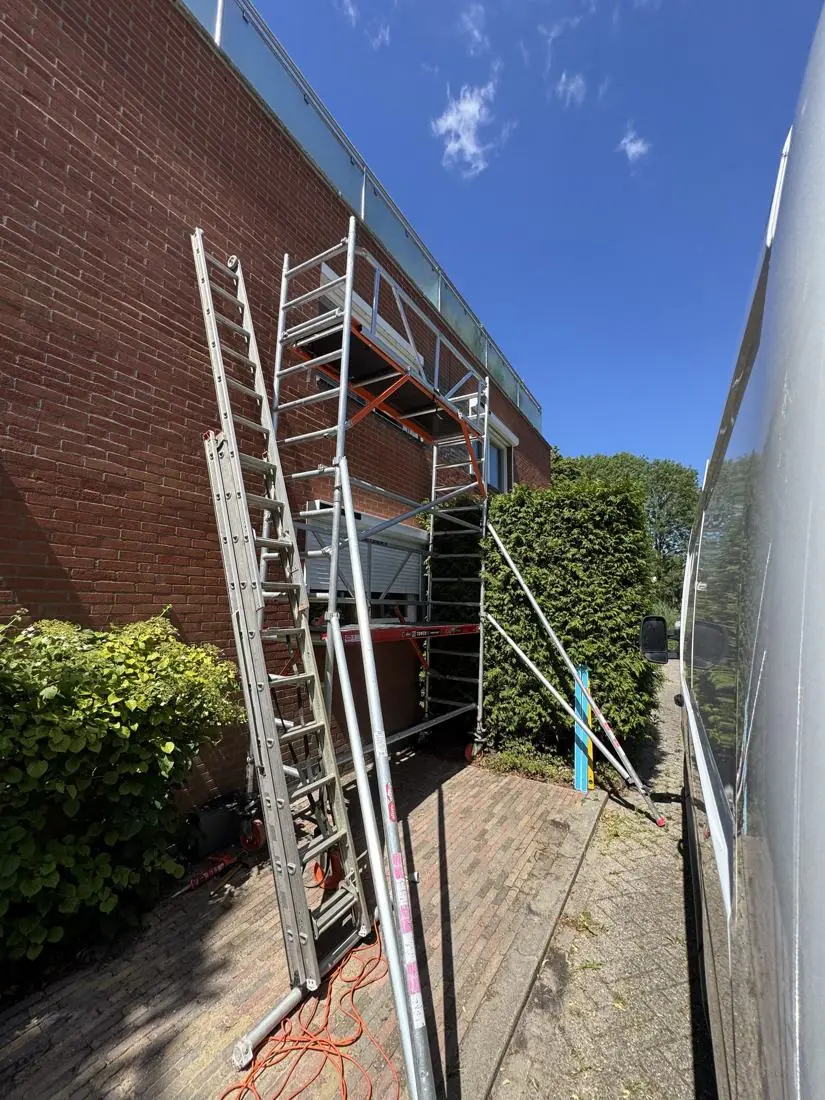
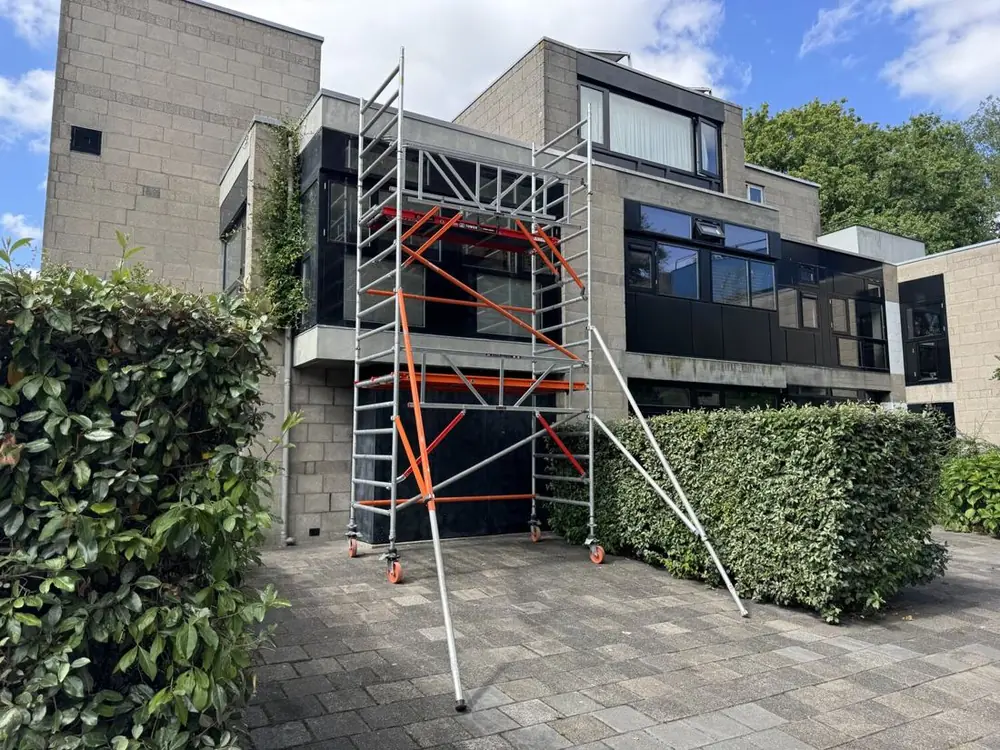
Scaffold standing along the side wall of a house, the build that stays up until the roof is closed

Booking generously is cheaper here than planning tight. Only the first 24 hours are charged at the full rate, and every day you hang on the back of that carries 95 per cent off. Two spare days therefore cost barely more than that first day alone, while they keep you out of the situation where the van is at the door and your roof slope is still open. Estimating a period like that is easier with the guidance on the number of rental days beside you.

Which mobile scaffold suits removing a dormer?

Kamersteiger RS44
  • Working height up to 4 metres
  • Compact and narrow
  • Great for indoor and small jobs
View and calculate →
Smalle rolsteiger RS51
  • Working height up to 14.2 metres
  • Narrow (75 cm)
  • Ideal for narrow passages
View and calculate →
Most chosen
Brede rolsteiger RS52
  • Working height up to 14.2 metres
  • Wide platform (135 cm)
  • Extra stability and workspace
View and calculate →
1-persoons steiger MiTower
  • Working height up to 6.2 metres
  • Very compact
  • Quick and easy to assemble
View and calculate →

Taking the dormer apart from a 245 cm platform

A platform is 245 cm long and a dormer is often the same, or a shade wider. On a dormer of two and a half metres you stand in front of the whole front from one position; on a wide one of four metres or more you move the tower halfway through. Think that out first, because you want the second position on ground as level as the first. So measure the width of the dormer before you rent, and not once the scaffold is already up.

The order runs from light to heavy and from loose to load bearing. Glass out first, because you do not want it anywhere near you when things start being pulled; then the frames, the boarding on the cheeks and only last of all the roof structure. Everything that comes free travels down by way of the deck, in a bucket on a rope or hand to hand. Throwing is not an option: you never know who is walking under the tower.

Mobile scaffold with a full deck and guard rails against a wall, the position the dormer comes apart from

What people misjudge is how much rubbish stays behind on the deck. Screws, offcuts of zinc, nails from the battens and sawn ends collect faster than you expect, and a mobile scaffold only rolls with an empty platform. So sweep before you move and lower the waste bucket first. A brush on the deck is not an extravagance on this job. If you are taking the replacement of the roof boarding on as well, allow a further round of planks over precisely the same route.

Scaffold hire with delivery beside the skip and collection

The tower arrives at your address as a complete, counted set of parts: uprights, decks, braces, guard rails and the four stabilisers. Orders that reach us before 15:00 on a working day go out the next working day. Point out beforehand where those parts may lie and take the skip into account while you do, because the skip claims the most useful piece of pavement. Put the set on the drive or in a corner of the garden rather than right in front of the door you use all week.

You choose yourself which day the scaffold comes and which day it goes again. For a dormer strip out it is best delivered two days before the demolition: one day to build and check it over, and a margin in case the drop lands in the afternoon. Anyone with a van of their own may collect the parts free of charge by appointment at the Zeeburgerpad in Amsterdam, though for a 12 metre set delivery is usually the sensible route.

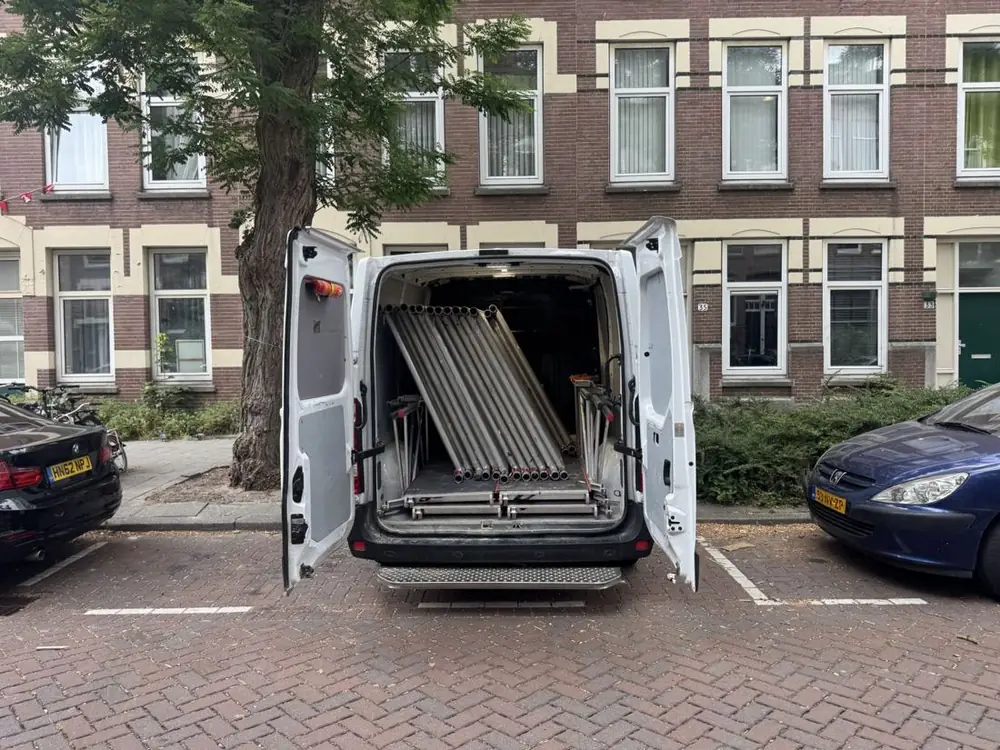
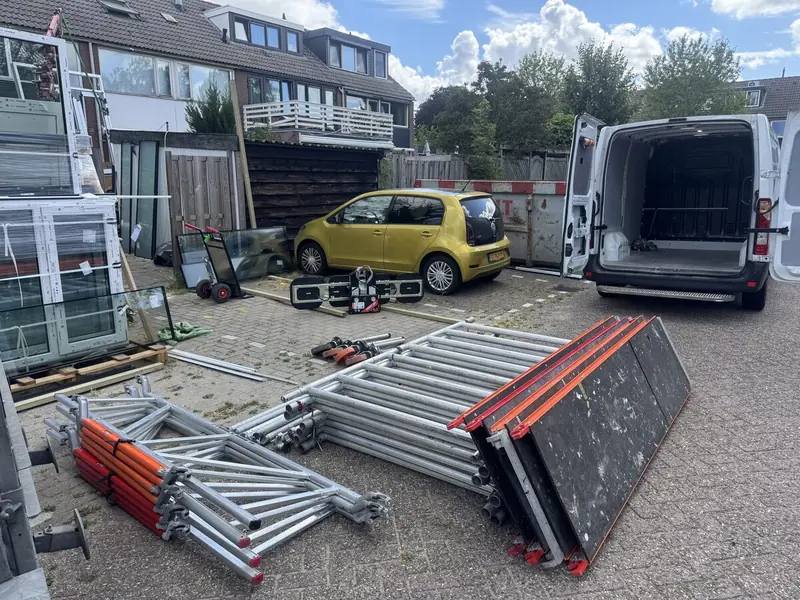
Delivery van with a complete set of scaffold parts in the street, dropped well before demolition day

Afterwards we come back for the tower; you leave it dismantled and stacked on the pavement. Wait with that until the roof slope really is closed and the last tile is down, because as long as anything remains to be done up there you want to keep your way up. Count the parts as you take it apart, so you know nothing has ended up in the skip. The charge for bringing and fetching in your region is set out in the overview of delivery costs by province.

Working safely on a hired tower when removing a dormer

The deck carries 200 kg for every square metre, which is load class 3 under the EN 1004 standard. On demolition you get near that sooner than on painting: two people together already weigh 160 kilos, and then a cut out frame has to lie there as well. So do not collect, lower each part the moment it is free, and use the platform as a hatch rather than as storage. What a deck like that may carry is worked out in the article on loading and weight.

The standing rules weigh heavily on this job. Put the wheels on the brake as soon as anyone goes up and never move the tower while someone is on it or while material is lying on it. Stop when the wind gets up, because a loose piece of roof boarding catches far more of it at ten metres than you notice on the ground. After every reposition, walk round the stabilisers, the braces and the guard rails, since on demolition you are knocking into them all day.

Tower fitted with double rails and a ladder run inside the frame, the safe way up on demolition days

The biggest risk when you remove a dormer sits under the scaffold rather than on it. All sorts of things fall: screws, slivers of glass, a sawn off batten. Fence the zone under and beside the build off with tape or cones, certainly if the tower stands on a pavement children walk along. Wear a helmet even though it feels excessive, and agree that nobody stands under the deck while sawing or pulling is going on above.

In 5 steps

How hiring a mobile scaffold works

1
Choose working height

Pick the height that suits your job.

2
Book online

Sorted in 60 seconds, price shown instantly.

3
We deliver

At the agreed spot the next working day.

4
Assemble safely

Assembled by you, with a manual.

5
We collect

One call and we collect the scaffold.

Good to know

Practical tips for removing a dormer

1

Measure the top of the dormer with a long tape from the garden before you hire the tower. Guessing from the ground can easily be a metre out on a roof slope.

2

Have the skip brought a day before the scaffold. You then see in good time how much pavement is left and can shift the position before the parts are dropped off.

3

Hang a bucket on a rope from the guard rail for small demolition waste. Carrying screws and slivers of glass down in your coat pocket works once and never again.

4

Lay a sheet of plywood or an old door over the gutter before you start. That way you do not damage the zinc trough with timber you lower from the deck.

5

Agree with your neighbours which day the top comes off. A tower on the pavement and a skip at the door sit better when people know it is a two day business.

6

Keep sheeting and a few battens ready on the deck. If the weather turns while the roof slope lies open, you want that gear up top and not in the bottom of the van.

Frequently asked questions

Frequently asked questions about removing a dormer

Which mobile scaffold should you hire for taking a dormer apart?+

Take the wide RS52 at 135 cm. On this job you are constantly carrying something across the deck: glass, frame timber, zinc and later the timbers of the structure itself. On a wide platform you can put a section down without your mate having to climb past it. You only rent the slim 75 cm tower when the passage to the back is too tight for the wide set. Measure that passage before you book, because swapping afterwards can cost you a working day.

How does hiring a scaffold work around the day you strip the dormer?+

You reserve online by model and by the working height you need, setting your dates in the same step. The set of parts arrives on the day you have chosen, you put the tower together the day before the demolition and walk round it. Then comes the strip out, after which the roof slope has to be closed. Once it is, you take the build apart and stack every piece together on the pavement. Arrange the skip in the same plan, because those two decide what your pavement looks like.

For how many days do you rent a tower when a dormer comes off?+

Allow three to four days. One day goes on building and preparing, one on the demolition itself, and after that you need time to close the roof slope and clear the waste away. If you are working alone, or the dormer is wider than three metres, add another day. Because the days after the first barely register in what you pay, hiring generously makes more sense here than planning it tight.

What does it cost to hire a tower for this job, and how does day two count?+

The rental price follows from the build you choose and from the distance for delivery. Every amount includes VAT and you see it before you book on the page with prices. What matters more for this job is how the rate runs: the first day counts in full, every following day falls well below it. Keeping a tower two days longer therefore costs barely more than squeezing the work into a single day, and it buys calm.

What working height should you hire if the dormer is on the second floor?+

Then you are at the top end of the 8 to 12 metre band. Measure from the spot where the wheels of the scaffold will stand up to the top edge of the dormer, so to the point where you take the lead off. If you are standing on a terrace lower than the street, that difference counts too. If you are torn between two builds, look at the page on choosing a working height and take the roomier one for this work.

Can the scaffold be delivered on the day the skip arrives?+

It can, but it is not the easier route. Both the skip and the set of parts need room on the pavement, and the two drivers end up in each other's way. Better to have the skip placed a day earlier and the tower follow, or the other way round. You pick the date yourself when you book, so pulling the two drops apart is simple. Have a dry spot ready for the parts as well.

Do you have to build the tower yourself when you rent it for demolition?+

Yes, the building is down to you. We supply the mobile scaffold as a set of parts; you put it up following the manual and the instruction video, and take it down again once the work is done. With two people a ten metre build takes half a day. Plan that half day separately, because on the day the dormer comes out you want a tower that already stands and only needs checking over.

What if the roof slope is still open and I want to hire the scaffold longer?+

Let us know and the collection date moves with you, as long as the tower is not already booked for someone else. On demolition that happens regularly: the weather turns, the loft proves damp, or the joiner closing the hole can only come a day later. If you want to rule it out, book a day of slack in at the start. You choose the collection date, and finishing early simply means returning early.

How much room do you need for the scaffold next to a skip?+

Add the width of the build to the spread of the stabilisers on either side, and add a metre of walking room to the skip on top of that. In practice you want four to five metres of clear pavement or garden under the dormer. A car, a bike rack or a tall hedge goes before the tower arrives. Think about where the loose parts will lie as well, because shuffling a finished build between obstacles costs more time than clearing up first.

Can I carry on in the rain or do I have to rent the tower for longer?+

Standing on the scaffold in the rain is allowed, but stripping a dormer out is not something you add to it. The moment the top is off your loft lies open, so you plan that step for a dry day. Use a wet day to empty the loft, stack tiles or start filling the skip. You set the date the tower stays until yourself, so shifting a day mainly touches your planning and hardly your wallet.

When is the deposit back after hiring the scaffold?+

You pay the deposit when you book and it returns within one working day of the set coming back, once it has been found complete. On demolition that counting matters: a brace or a guard rail that ends up among the timber in the skip shows up straight away. So keep everything belonging to the tower well apart from your waste. The article on the deposit explains how the rest of it runs.

Can I keep the same mobile scaffold on hire for the new dormer?+

Yes, and that is usually the smartest route. Simply leave the build standing between the strip out and the installation of the new dormer, because neither the working height nor the position changes. You simply extend the rental period by the number of days you still need it for. Only if a crane is involved do you check in advance whether the tower has to move aside or come down for that morning.

Hire a mobile scaffold for removing a dormer today?

Calculate your rental price now or ask for free advice.

Rolsteiger van SteigerTaxi geleverd op locatie
Book it online

Your scaffold sorted in 2 minutes.

Choose your scaffold and working height, see the price instantly and book online.