
See your price
Application

Painting facade cladding? Choose the right scaffold.

A whole run of facade cladding gets an opaque finish, and opaque work is seldom done in one coat. Usually it is a primer with two finishing coats over it, and each coat is a complete circuit past exactly the same stand positions. That is what makes this job expensive in days rather than in square metres. For a timber elevation across two storeys you therefore reserve an RS51 of 75 cm, built up to somewhere between 6 and 8 metres of reach. What that means for your rental period follows below.

  • Order before 3 pm, delivered tomorrow
  • Professional Altrex scaffolds
  • Up to 14.2 metres working height
  • Easy to assemble yourself
4,2 tot 14,2 mWorking heights available
12Provinces served
7Days a week
200 kg/m²Load class 3
In short
  • For painting facade cladding we recommend the Narrow mobile scaffold.
  • Painting facade cladding is done from the narrow RS51, 75 cm wide, hired in a build reaching 8 metres.
  • Three opaque circuits mean you visit every stand position three times, and that is what sets your number of rental days.
  • Allow six to eight days for two elevations, including the drying time the paint system asks between coats.
  • First 24 hours from €150 incl. VAT and delivery; every day after that 95% off.
Key facts for this job
FeatureValue
Recommended scaffoldNarrow mobile scaffold (Altrex RS TOWER 51)
Working height for this job6 to 8 metres
Available working heights4.2 to 14.2 metres
StandardEN 1004, load class 3 (200 kg per m²)
DeliveryOrdered before 3 pm, delivered next working day
Each extra day95% off, from €7.50 a day
Why a mobile scaffold for painting facade cladding?

Safe, stable and professional work at height

With opaque paintwork it is not so much the height that counts as the number of times you go back up to it. You cut in the seams and the end grain first, lay the face off with a roller after that, and repeat the lot per coat over the full length of the elevation. Every circuit runs past the same positions, so every position you chose badly costs you time three times over. On top of that you work with a tin, a tray and two kinds of tool at once, so you need somewhere to put things down. Hiring a scaffold for facade cladding is therefore about stand positions, about circuits and about the days those add up to.

  • A primer and two opaque coats in succession
  • Every stand position comes round three times
  • Tin, roller tray and brush within reach at once
  • Reach up to 8 metres along the whole elevation
Read more about working safely →

Hiring the right mobile scaffold to paint a clad elevation

For a timber elevation of two storeys the model is the Altrex RS51, 75 cm across. What decides it is not the room on the platform but the weight you shift about, because you move this tower dozens of times during the job: every coat sends you past all the positions again. A narrow build rolls on under one pair of hands and still fits through a gate to the rear elevation. You can weigh the models against each other on the page of mobile scaffolds in the hire fleet.

What travels up with you weighs more here than on staining work: a tin of paint, a roller tray, a roller with a handle, a brush for cutting in and a cloth. On a deck 245 cm long you can put all of that down without treading in it, provided you keep the tray at one end. That length also sets how many metres of cladding you cut in and roll out from one position before the edge pulls.
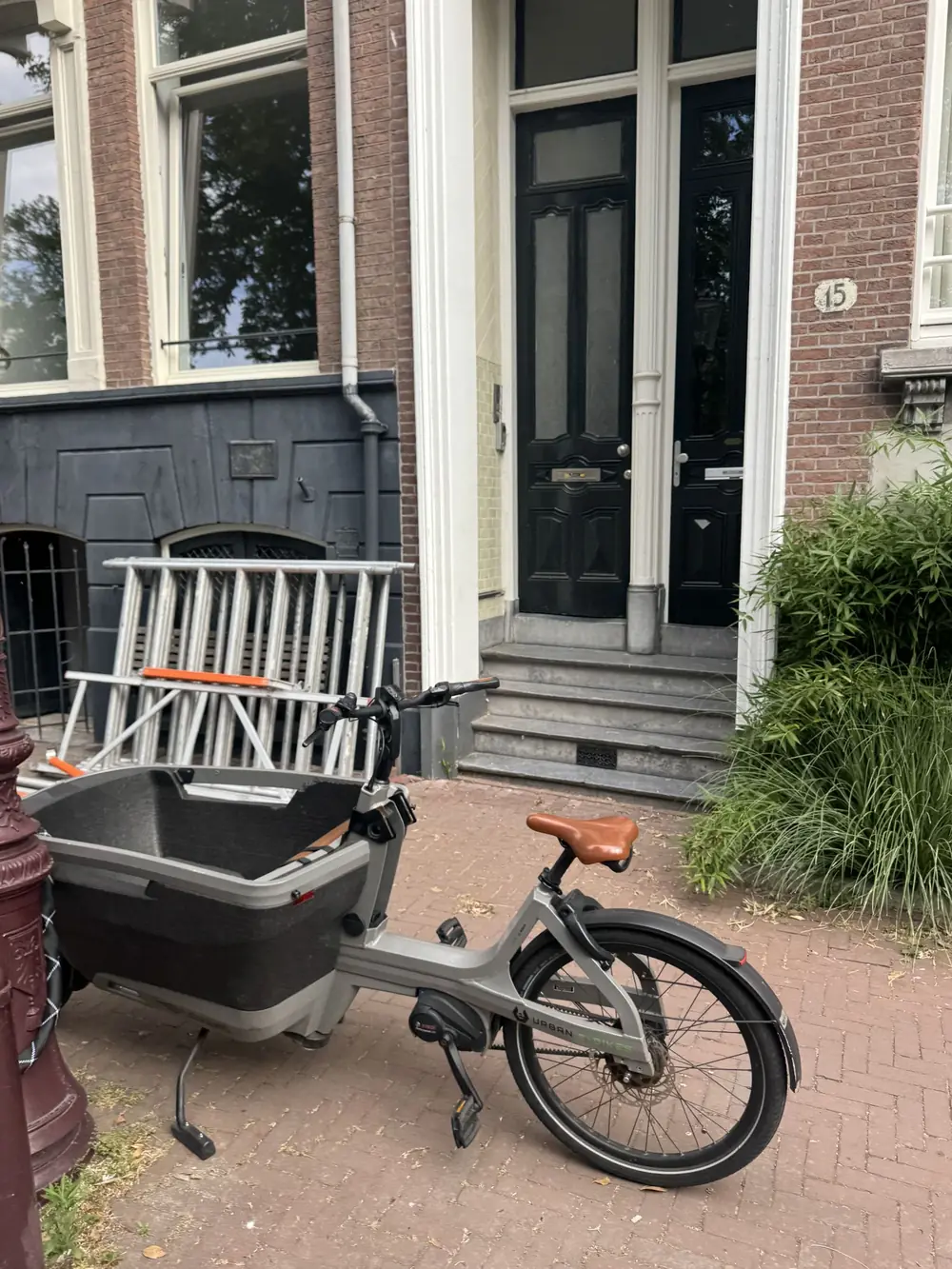
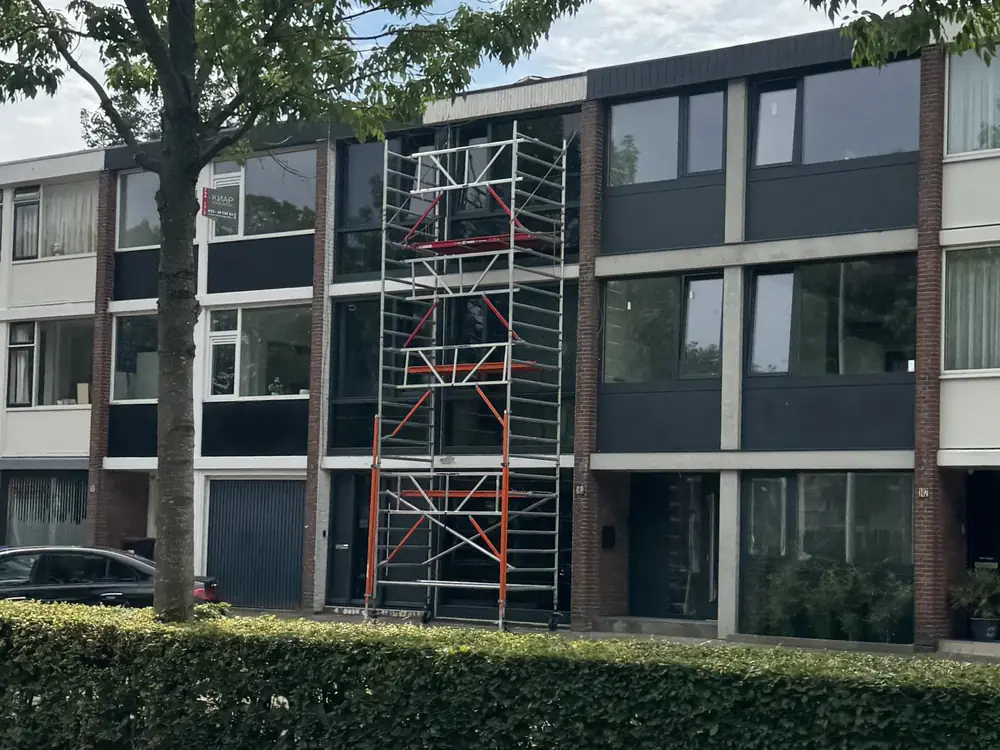
Guard rail frames against a house wall on the pavement, the light 75 cm Altrex RS51 kit one person moves alone

If two of you are working, the wide RS52 of 135 cm becomes interesting: one cuts in the seams, the other rolls along behind, and then you do not want to be squeezing round each other on a single deck. For a smaller run of boarding, or for cladding that sits indoors, the choice runs differently again; the page about painting interior boarding covers that case, where a shorter build and a lower stand usually do.
Hiring a working height for a whole clad elevation

Your measuring point is the top board of the cladding, usually just under a fascia or behind a bargeboard. If a strip of fascia board sits above it that you are taking in the same go, count that into your height. Two storeys bring you to 6 to 8 metres of reach. That is the figure you give when you hire, and it holds for all three circuits you are going to make, because a second build halfway through the job is the last thing you want.

The deck itself hangs lower than the reach suggests, somewhere between four and six metres. The difference is what you cover standing, roughly 2 metres of reach with a roller on a short handle. Worth keeping apart: the RS51 goes to 14.2 metres as a model, but that is the limit of the structure and not the build you order. On this elevation you stay well under it and work from a low, solid stand you move quickly, as shown at a working height of 8 metres.

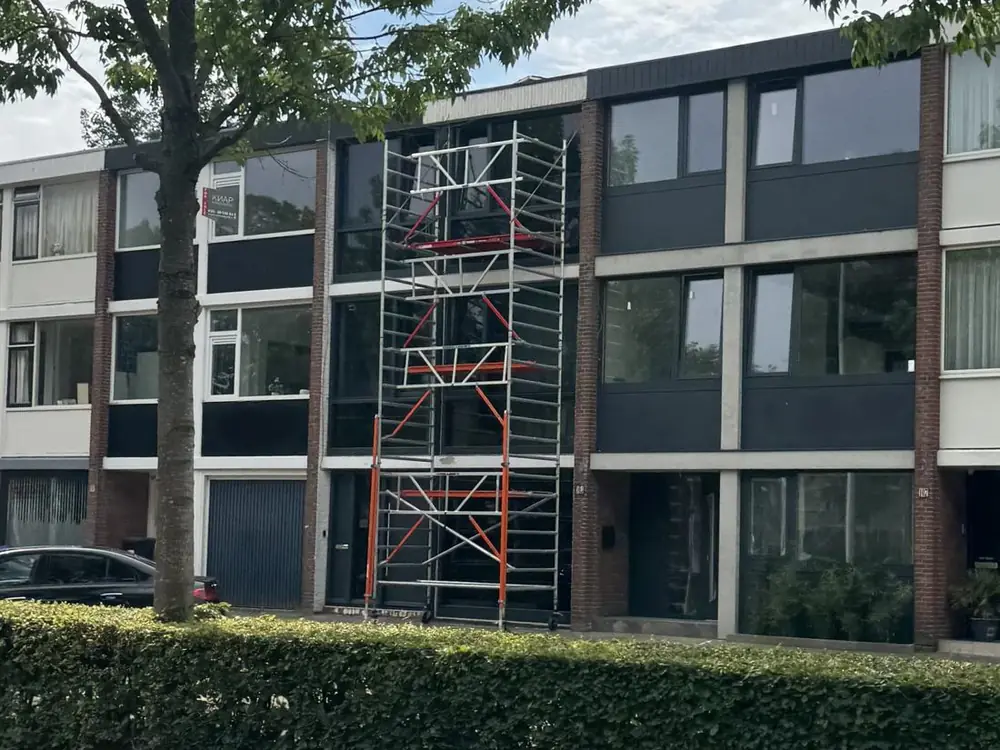
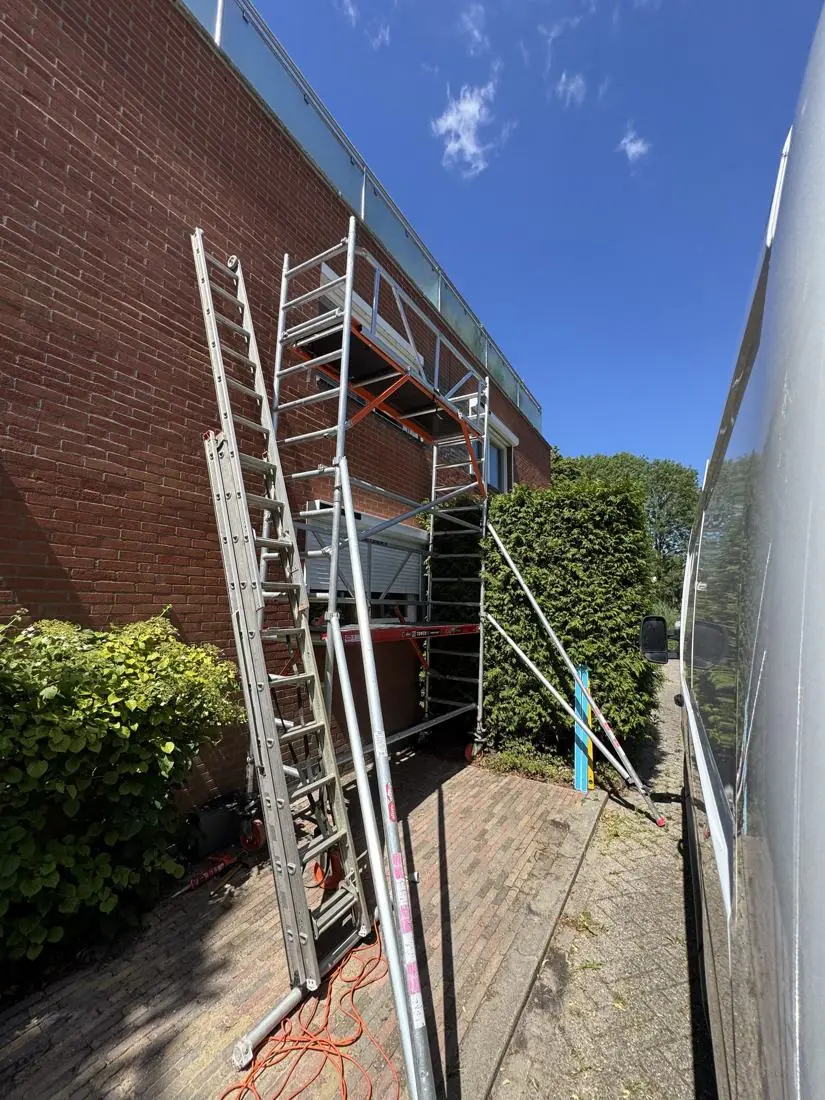
Mobile scaffold built along a side elevation up to the fascia, the reach that lets you roll the top boards fully

Half a metre too low punishes you three times here, because you make three circuits. Fall short of the top board and you roll it at full stretch, so the coat goes on thinner; with opaque paint that shows up later as a lighter band under the fascia. Measure from the level the wheels will stand on and not from the terrace, because gardens fall away more often than you think. For an elevation of two storeys, check what working at first floor level demands.

Where the hired tower stands along a long clad elevation

The stand position is not a one off choice on this job. You come back to every spot three times, so a position that stands crooked or falls just short of the corner costs you shuffling on every circuit. Walk the whole elevation before the first coat and divide it into positions that join up neatly, with the changeovers at a butt joint or a downpipe. Write that division down, because by the third circuit you will not remember where you stopped.

The ground has to last the whole period, and that asks more of it than a one day job does. Paving and a driveway carry well; grass and borders sink under the wheels after a few showers. The four stabilisers splay outwards and all four should bear, including after the tower has been trundled to and fro for a week. What you can do to keep it steady is set out in the explanation of anchoring a tower.

Four stabilisers set out under a mobile scaffold, the bearing points that have to hold the same spot for a week

Keep the strip under the cladding free for your covering as well. With opaque paint you lay sheeting or dust sheets out past the drip line, and it stays there as long as you are working. So before the first circuit, clear away whatever need not stand there for the coming days: planters, the water butt, furniture and bikes. If part of the build stands on the pavement, leave room to walk past and tell the neighbours, because you are sharing that footway all week.

How many rental days three opaque circuits ask of you

Count your rental days in circuits, not in square metres. On bare or patched timber you start with sanding and a primer, and two opaque coats go over that. That is three or four runs along the same route past the same positions, with the same climb each time. For a front and a rear elevation over two storeys that brings you to six to eight days of hire, and that is a realistic estimate rather than a generous one. So measure your elevation out in positions before you fix a period.

Between two coats there is waiting time you cannot shorten. How long you have to leave it is written on the tin of your paint system and depends on the temperature and the humidity that day. Two coats in one day is therefore rare with opaque work. The weather adds to it: an elevation in the morning sun is wet with dew, and on a cold evening nothing dries at all. Let your period run from the build day to the morning you take everything apart dry.

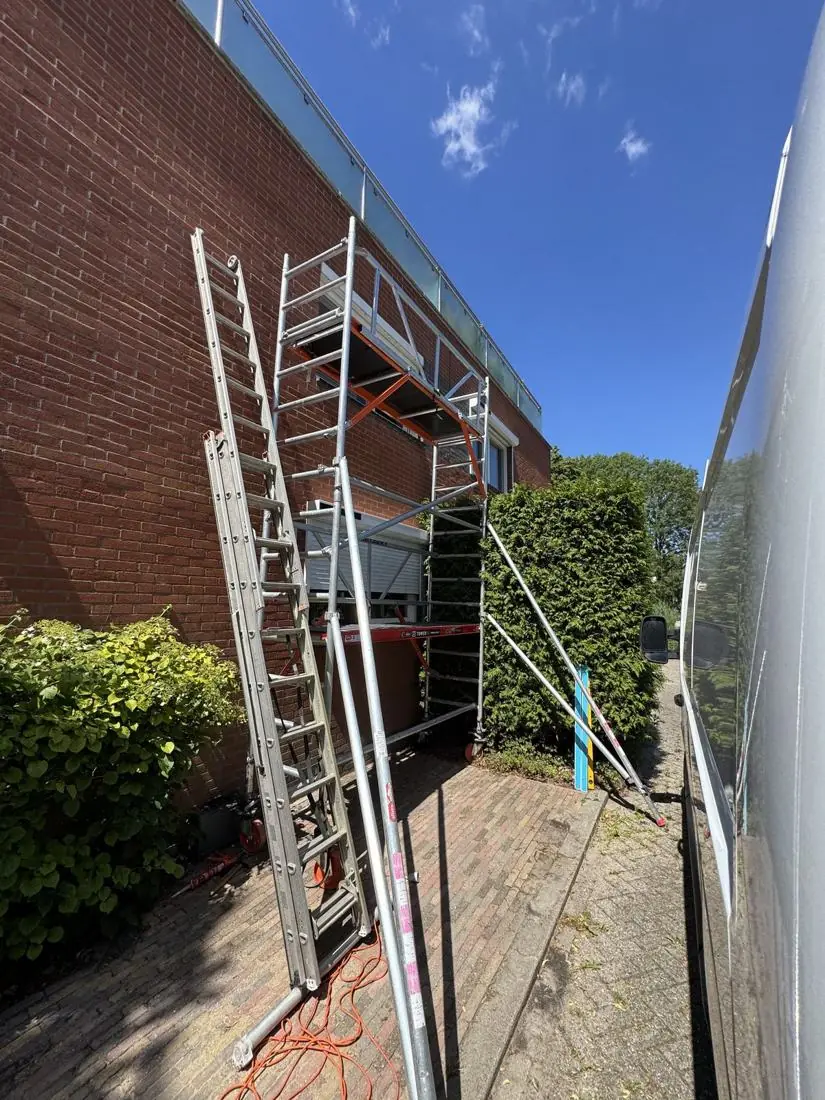
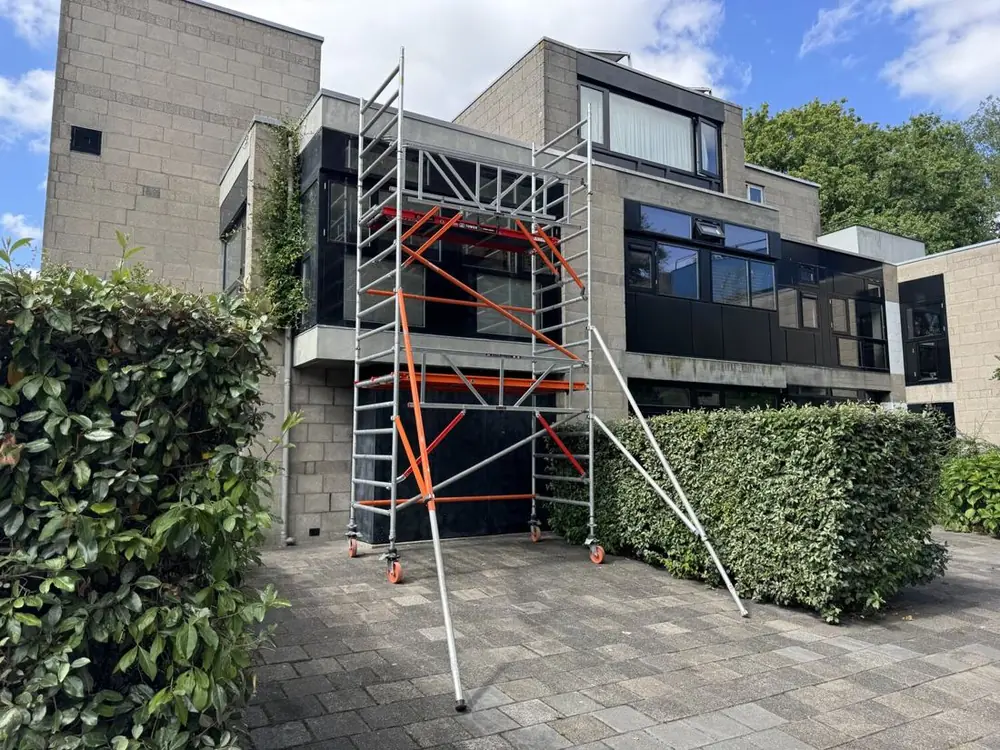
Mobile scaffold built up beside a house and untouched, exactly the stand you wait on between two opaque coats

Over a long period like that, the way the rental price is built up works in your favour. The opening day is charged in full; after it 95 per cent of that rate falls away, so the ninth day costs barely more than the eighth. Two spare days behind your planning are the rule here rather than the exception, and they rescue the schedule if a wet week lands in it. The difference between reckoning by the day and by the week is set out in the piece on daily and weekly periods.

Which mobile scaffold suits painting facade cladding?

Kamersteiger RS44
  • Working height up to 4 metres
  • Compact and narrow
  • Great for indoor and small jobs
View and calculate →
Most chosen
Smalle rolsteiger RS51
  • Working height up to 14.2 metres
  • Narrow (75 cm)
  • Ideal for narrow passages
View and calculate →
Brede rolsteiger RS52
  • Working height up to 14.2 metres
  • Wide platform (135 cm)
  • Extra stability and workspace
View and calculate →
1-persoons steiger MiTower
  • Working height up to 6.2 metres
  • Very compact
  • Quick and easy to assemble
View and calculate →

Painting facade cladding from the platform, coat after coat

Each position gives you 245 cm of cladding, and you finish that completely before you roll on. Start at the top, cut in the seams, bottom edges and end grain with the brush, then lay the face off while that edge is still wet. Do it the other way round and you drag the brush through a rolled coat, and the brush marks sit in it as a different texture once it dries. More about tackling a whole elevation is in the article on painting elevations.

Number your positions and keep track of which coat sits where. That sounds excessive until you are halfway through the second circuit looking at an elevation where everything appears the same: one skipped position only shows once the paint is dry, and then you are facing a fourth circuit. Work every circuit in the same direction as well, always left to right for instance, so your overlaps keep falling on the same vertical lines and thin patches do not pile up in changing places.

Mobile scaffold with the deck at height against a front elevation, the position you cut in and roll 245 cm from

Take up what you need for that position and no more: the tray filled halfway, a roller, a brush and a cloth. The rest stays below under a lid. The number of moves on this job is systematically underestimated. Eight metres of elevation counts three to four positions, so with three coats you trundle that tower back and forth a good ten times, quite apart from the second elevation at the back. Allow five to ten minutes per move and you can see where your rental days go.

Scaffold hire and delivery for a job of several coats

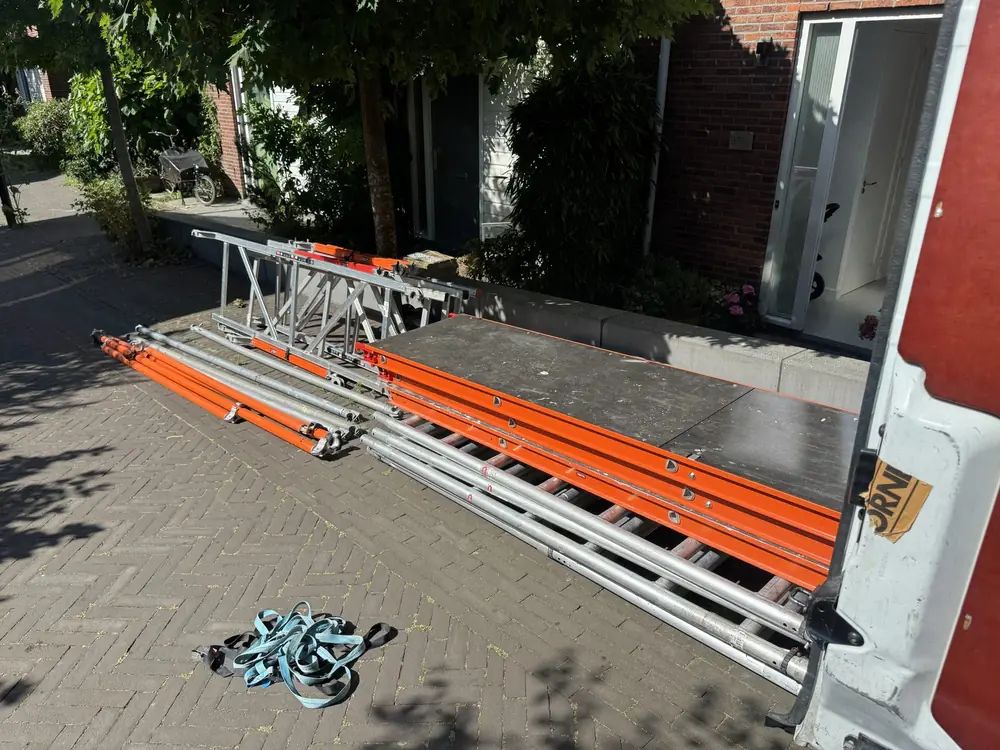
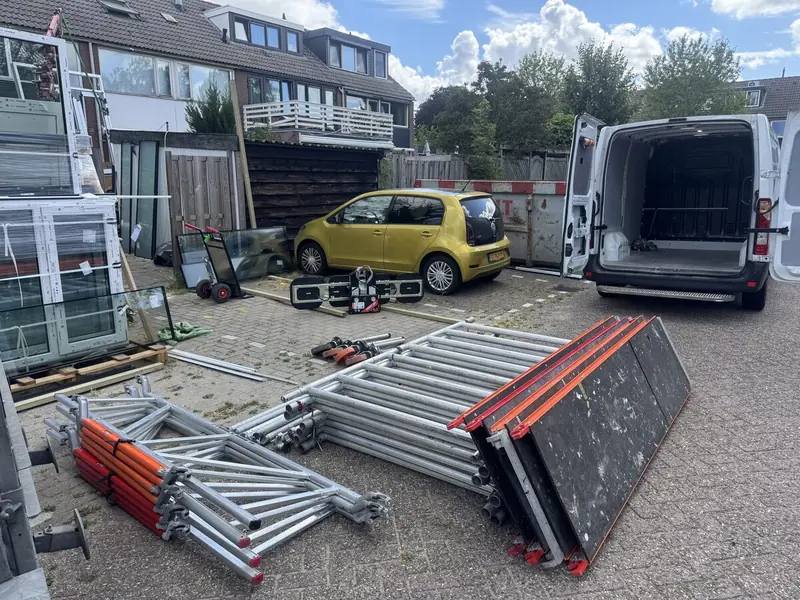
You receive the tower as a complete set of loose parts, counted piece by piece. Pick a place for that stack in advance where you can do without it for a week, and that is not the band under the elevation where your sheeting will lie. A driveway, a garage path or the corner of a front garden does better. An order placed on a working day, before 15:00, puts the set at your address the next working day.

Both dates, the one it comes and the one it goes, are yours to pick, and here they hang on a forecast for a whole week rather than a single day. Have the tower brought a day earlier than your first coat, then building does not eat your dry hours. You build it yourself, with a manual in the set and an instruction video showing the steps; two people need half a day for it. The step by step guide to assembly runs through the order.

Scaffold parts loaded in a delivery van, the complete set you have brought a day before your first coat

When you have finished, you dismantle it yourself and we come and take it away. Only do that once your last coat has properly hardened: a frame brushing a fresh board leaves a mark you can only remove with a fourth circuit. Simply count off what you have in your hands while you take it apart and put everything down where the van can get to it. The cost of the run to your province is listed at the delivery charges per province.

Painting safely at height along timber facade cladding

Two hundred kilos per square metre is what your deck is made for, and that is load class 3 within EN 1004. On opaque paintwork you get closer to that than most people expect: a full tin, a filled roller tray, two people and a box of sanding gear add up faster than one tin does. So leave the stock on the ground and take up only what you will use at that one position. More about the standard is in the explanation of loading and weight.

Because you reposition dozens of times, the fixed rules come round often here. Lock the wheels before you climb on, never move the tower with a person or a filled tray aboard, and check after every move that the four supports bear again. If the wind picks up, stop: paint carries as a fine mist over the neighbour's car, and with a roller handle in one hand you have only the other left to hold on with.

Built up tower with the internal climb and guard rails, the route you take up again on every circuit

What plays an extra part on this job is time. The tower stands at your house for a week or more, so people get used to it and walk underneath without thinking. Fence off the zone under your deck while you work, even in your own garden, and clear the platform at the end of every day. A tray knocked over on a slippery deck is the hazard you make yourself. The rules in one place are at working at height.

In 5 steps

How hiring a mobile scaffold works

1
Choose working height

Pick the height that suits your job.

2
Book online

Sorted in 60 seconds, price shown instantly.

3
We deliver

At the agreed spot the next working day.

4
Assemble safely

Assembled by you, with a manual.

5
We collect

One call and we collect the scaffold.

Good to know

Practical tips for painting facade cladding

1

Draw the elevation on a sheet of paper and number your positions. Tick off per circuit which position has had which coat, and in round two or three you will not accidentally skip a single spot.

2

Cut in the seams, the bottom edges and the end grain with a brush first and roll the face afterwards. The other way round you drag the brush through fresh roller work and end up with two textures.

3

Never fill your roller tray past halfway before you climb up. A full tray slops over the rim the moment you set it down on the platform, and opaque paint does not come off a scrubbed deck.

4

Keep the same walking direction along the elevation on every circuit, left to right or the other way about. Your overlaps then fall on the same vertical lines each time and thin patches build up nowhere.

5

Leave your covering down for the whole period instead of clearing it away daily. You save half an hour per circuit and the tower does not have to be shifted specially for it.

6

Before you book, count the number of positions and multiply that by the number of coats. That figure tells you more about your rental days than the surface area of the elevation in square metres.

Frequently asked questions

Frequently asked questions about painting facade cladding

Which mobile scaffold is best to hire for timber facade cladding?+

The RS51 at 75 cm wide, in a build to 6 to 8 metres. With opaque work it is not about room on the deck but about how briskly you move on, because every coat sends you past all the positions again. A narrow tower you push on alone and can still get round to the rear elevation. If two of you cut in and roll at the same time, the wider RS52 at 135 cm earns its keep in the hire.

How does hiring a scaffold work if I am painting in several coats?+

You hire a mobile scaffold online on model and reach, mark the day the set turns up and the day it leaves again, and settle up in advance including VAT. We put the counted parts down for you; building the tower and working your circuits are yours to do. On the final day you take it apart and lay everything out complete for the van. With three coats it pays to book that whole run as one continuous period rather than in separate blocks.

How many days do I hire for a primer and two opaque coats?+

A front and a rear elevation with cladding over two storeys ask for six to eight rental days together. Every coat is a full circuit past all the positions, and between the coats sits drying time you cannot skip. If sanding or timber repair comes first, add a day for that. Rather book the mobile scaffold a day too long than a day too short, because a last coat laid on in a hurry shows on an elevation.

Does the hire get much dearer if I stay up for three circuits?+

Hardly, and that is why this job plans so well. The rental price sits mostly in the first 24 hours; every day you stick behind it adds only very lightly. Keeping a mobile scaffold for a week therefore costs nowhere near seven times one day, which makes three circuits easy to schedule. The rates per model and per build stand with VAT included on the page of tariffs, so you can work the period out in advance.

What height do I hire if the top board sits under the overhang?+

Then that board sets your height, not the roof edge above it. Two storeys come out around 6 to 8 metres, with the deck hanging at four to six metres. If you are taking in the bargeboards and the fascia at the same time, add a stretch to that. Which build of the tower belongs with it, and how many frames that means, is shown in the overview of working heights before you book for good.

Can the mobile scaffold be delivered onto the pavement out front?+

Yes, we unload the parts at a reachable spot along the road. From there you carry them yourself to where the tower has to stand, and that is exactly what makes those 75 cm so pleasant. Picking it up yourself is free by arrangement at our Amsterdam address on Zeeburgerpad. Keep a walkway clear while unloading, and check with the council which rules cover your street if the stand is there a week.

Is the tower put up for me, or does that come with the hire?+

The latter. We drive the tower out to you and take it back at the end, but putting it up, moving it and dismantling it remain your work, with the supplied instructions and a video to help. Two people are at it for half a day. Plan those hours for the day before your first coat, because building and painting on the same morning does not work. Our fleet holds no system scaffolds, no facade scaffolds and no cherry pickers at all.

What if the last coat is not dry and I have to rent for longer?+

Pass it on and we shift the collection day back, unless that tower is already down to the next customer in the diary. With opaque work that happens regularly, because every coat wants its own time and cold weather stretches that time. Anyone who would rather not depend on it simply hangs two days on the end when booking. You set the final date yourself and handing back a day early is no trouble, so booking with room always pays here.

How much clear space does the stand ask along a long elevation?+

Take the width of the stand, add the four splayed supports and keep a further strip open for your sheeting, your tin and your tray. Because the tower stays put here for a week, you do not want to clear that space afresh every morning. Move garden furniture, bikes and planters away before the first circuit and lay your covering down in one go for the whole period. That saves you a quarter of an hour on every coat.

Can I keep the tower on hire if it turns too cold to paint?+

The scaffold can stay standing; only your coats shift back. Below a certain temperature opaque paint no longer bonds and dries as it should, and you read that on the tin of your system. Use a day like that for sanding, degreasing or masking. Because you decide the end date, it stays at one or two extra days of hire and you do not have to set out a single position again. The stand simply stays where it is.

How does the deposit work in the hire if paint gets on the parts?+

Once the set is back and properly counted, we transfer the deposit to you within one working day. Dried topcoat on tubes and platforms counts just as heavily as a missing part, so wipe any splash off before it sets. Lay cardboard on the platform of the tower and keep a damp cloth within reach; that saves you cleaning on the day you hand back and keeps the settlement short.

Can I take in the bargeboards and gutter without hiring again?+

You can, and it is usually clever too. You are standing right under those parts on the same mobile scaffold anyway, and one extra day weighs lightly in the total rental period. Do pick your reach on the highest part you are taking in, though, and not on the top board of the cladding. If you want to do the gutter from the inside as well, plan that circuit before your last opaque coat so you are not working over anything.

Hire a mobile scaffold for painting facade cladding today?

Calculate your rental price now or ask for free advice.

Rolsteiger van SteigerTaxi geleverd op locatie
Book it online

Your scaffold sorted in 2 minutes.

Choose your scaffold and working height, see the price instantly and book online.