
See your price
Application

Staining a pergola? Choose the right scaffold.

A pergola is an open frame of posts, beams and rafters over a terrace, and that makes staining a pergola a different proposition from a solid wall. Every beam carries four faces that each take their turn with the brush, and most of them sit above your head. A ladder wedged between the garden chairs will not do, because you need both hands free and a deck to turn on. So the tower to hire here is a one-person MiTower, in a build landing between 4 and 6 metres of working height.

  • Order before 3 pm, delivered tomorrow
  • Professional Altrex scaffolds
  • Up to 14.2 metres working height
  • Easy to assemble yourself
4,2 tot 14,2 mWorking heights available
12Provinces served
7Days a week
200 kg/m²Load class 3
In short
  • For staining a pergola we recommend the 1-person scaffold.
  • For staining a pergola over a terrace you hire the MiTower: 75 cm wide, light in weight and rated for one person.
  • Every beam has four sides, and the top face only becomes visible once your eyes clear the timber above you.
  • Reckon on three to four hire days, since two coats of stain go on and the tower shifts per bay of beams.
  • First 24 hours from €100 incl. VAT and delivery; every day after that 95% off.
Key facts for this job
FeatureValue
Recommended scaffold1-person scaffold (Altrex Mi Tower)
Working height for this job4 to 6 metres
Available working heights4.2 to 14.2 metres
StandardEN 1004, load class 3 (200 kg per m²)
DeliveryOrdered before 3 pm, delivered next working day
Each extra day95% off, from €5 a day
Why a mobile scaffold for staining a pergola?

Safe, stable and professional work at height

Staining a pergola has you looking upward for nearly the whole day. Your arm hangs above your head, the brush stands vertical and the stain finds its way down your sleeve. That is only bearable if your footing is firm and the tin is within arm's reach, and not while you teeter on a ladder among the garden furniture. Add to that the open nature of the frame: every side of every beam has to come within reach, so you shift position constantly. Hiring a light tower you can roll single-handed saves you more time on this job than a broad platform two people barely fit on. Speed of repositioning is what you are really paying for here.

  • Staining a pergola means four faces per beam
  • The upper side of the rafters greys first
  • A light tower you shift alone between posts
  • Terrace with chairs, borders and loose slabs below
Read more about working safely →

Which scaffold to hire for staining a pergola: the MiTower

A pergola seldom stands free in the middle of a lawn. There is a table beneath it, a border down one side and the house wall on the other. For this you want the Altrex Mi Tower, 75 centimetres across and designed around a single user. It is light enough to push between the uprights on your own, and you do that all day, because every bay of beams puts you somewhere new. As a model it builds to working heights of 4.2 to 6.2 metres, and you use the lower part.

Very little travels up with you on stain work: a tin, two brushes, a rag and an abrasive sponge for the rough patches. Much more would not fit anyway, since a tower meant for one person is not built to be crowded. On a pergola that suits the rhythm, because you move so often that every extra container sends you down the ladder once more. Hook your tin under the guardrail or wedge it against an upright, never loose on the edge of the deck.
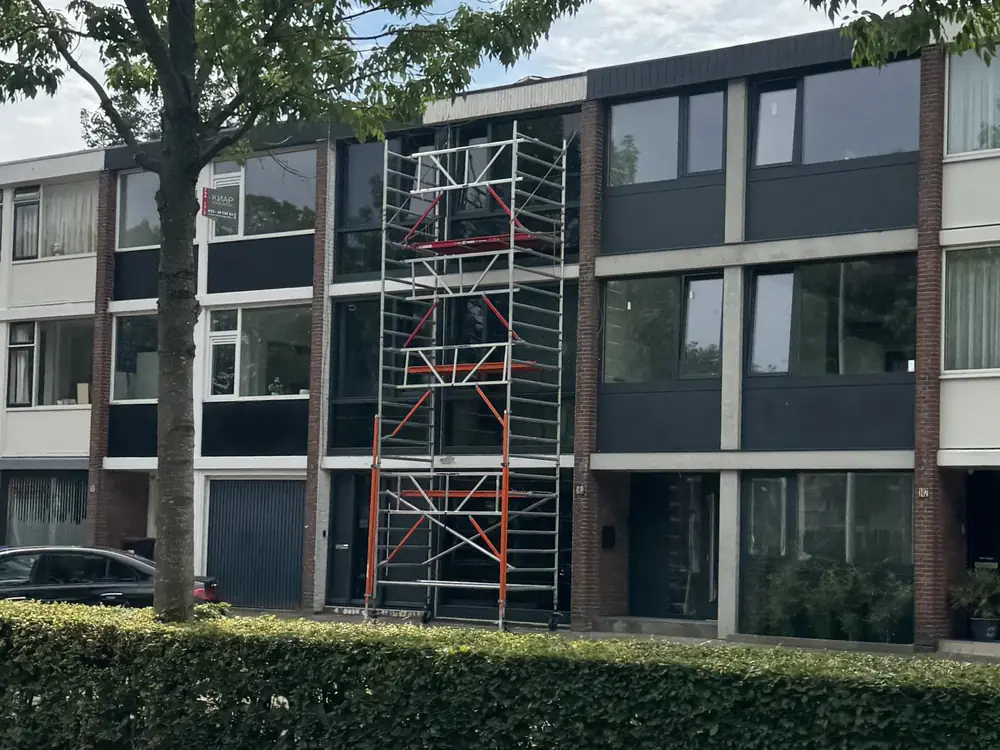
Compact erected tower 75 cm wide, the type you shift bay by bay while staining a pergola

Where the frame hangs off a rear extension or carries on under a balcony, this reach runs out, and what you want then is an RS51 mobile scaffold on hire instead, since that model carries on well past ten metres. With two of you at a long pergola a wider deck works more comfortably, paid for in extra carrying across the terrace. Which parts sit in the set is listed on the page where you can hire a Mi Tower.
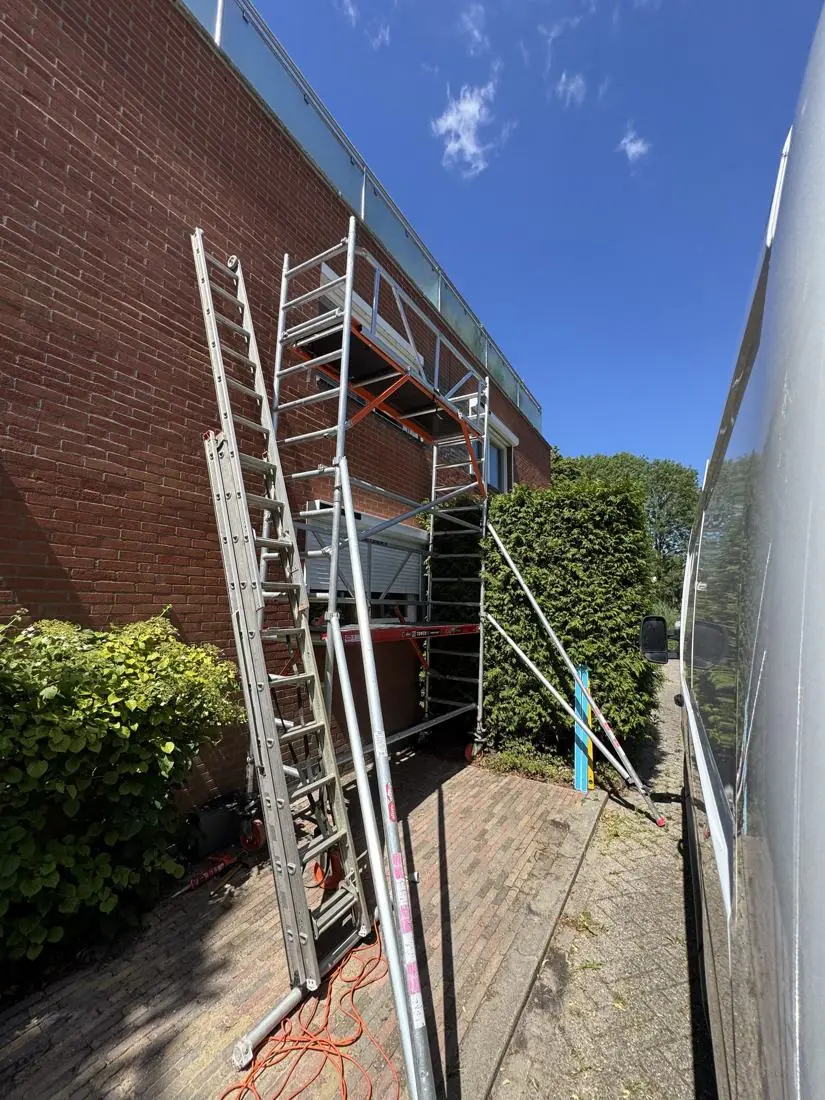
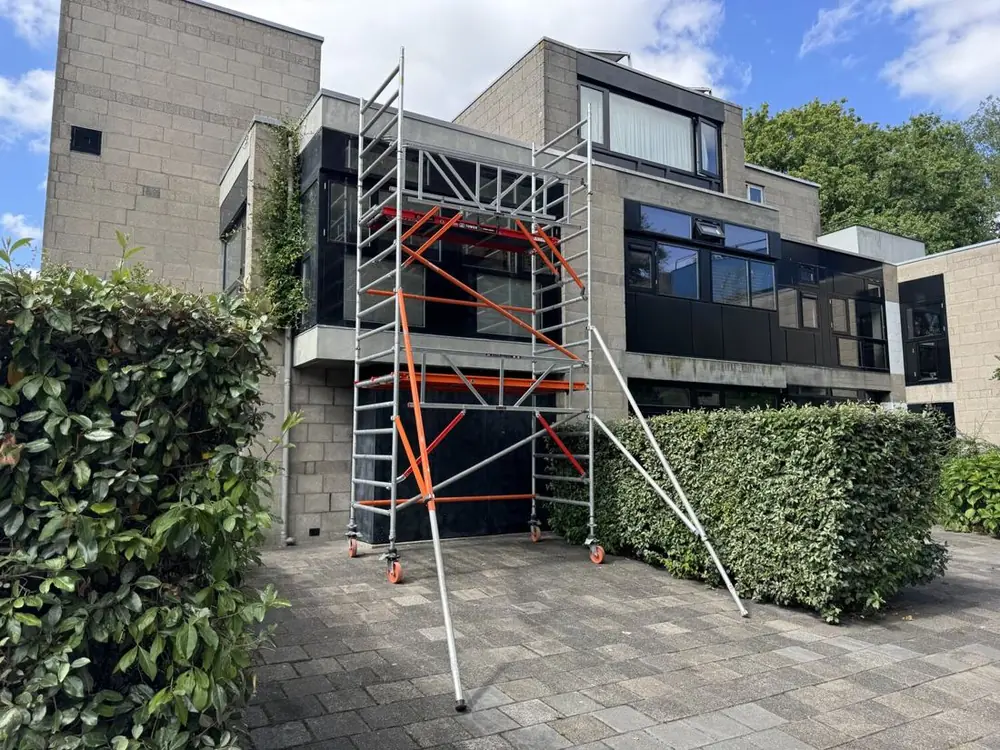
Hiring the working height that staining a pergola really needs

What you have to reach on a pergola is not the rafters themselves but the air just above them. A pergola is only properly stained once you can look down onto the top of every beam, since that is the face collecting rain and the first to turn grey. So measure from the slabs to half a metre above the topmost timber, and an ordinary terrace pergola lands you at 4 to 6 metres. Your deck hangs between two and four, because roughly two metres of reach is counted above the platform.

Take that measurement on the terrace itself rather than the lawn alongside, since a terrace commonly sits a step higher than the rest of the garden. Where the frame stands half on paving and half in a border, the lowest adjustable foot decides which build you fix. Look as well at the clearance beneath the rafters: on a good many pergolas there is barely more than two metres between deck and timber, and one setting too tall puts your shoulders straight into the beams.

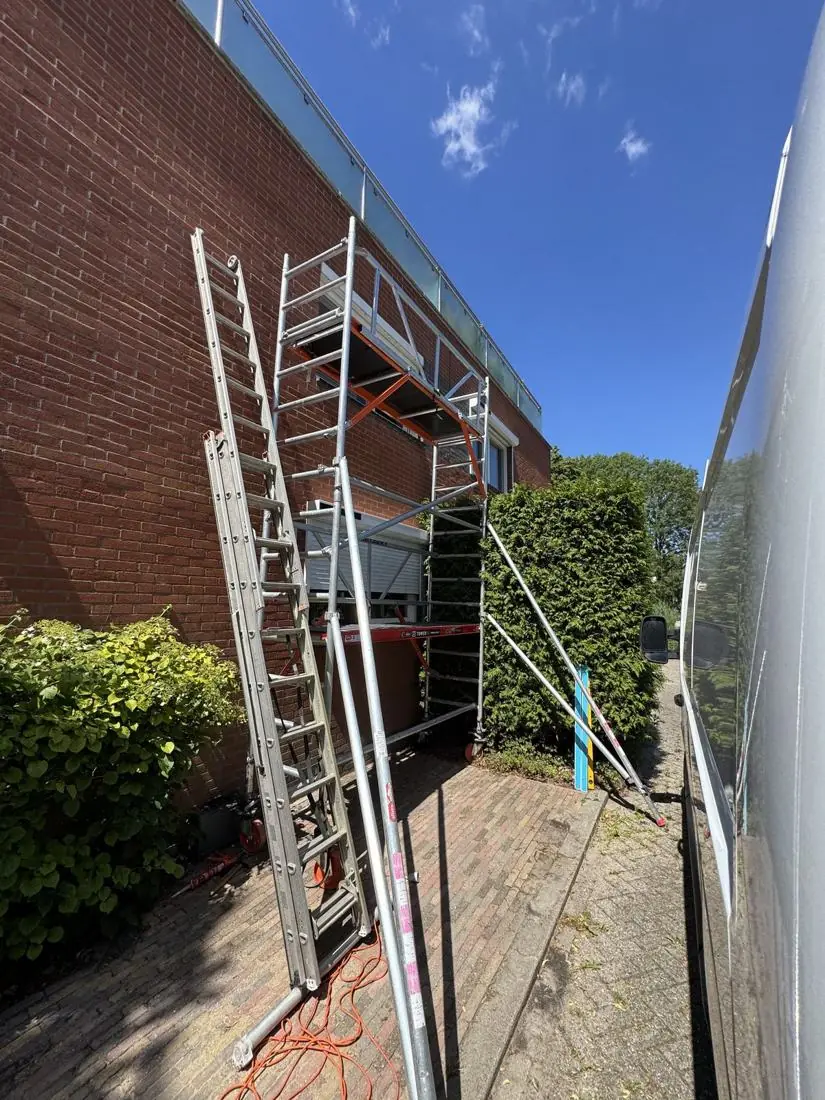
Tower erected beside a house, showing the deck height at which you end up above the timbers you are treating

Go too low and you stain the upper faces by feel alone. That returns half a year later, when precisely those surfaces stand grey while the sides still look sound, and you get to hire a scaffold a second time in a taller build for the very same timber. Go too high and your head meets the rafters, so you work bent over and feel it in your back within the hour. Which setting matches a reach of six metres is shown per model.

MiTower hire for staining a pergola: where it stands

The surface this tower has to stand on is usually a terrace, and a terrace is rarely as level as it appears. Slabs are laid with a fall away from the house, the odd paver has sunk and a band of gravel often runs along the edge. Set all four stabilisers on solid paving rather than on that gravel, and adjust the legs until nothing rocks as you step aboard. Check a timber deck for soft boards first, because they give way under a point load.

Then empty the terrace. Chairs, the table, a barbecue, planters and the cable feeding your outdoor lights all sit exactly where the wheels need to travel. Count on the stabilisers not quite fitting between two uprights; in that case you place the tower slightly outside the bay and work up at an angle instead. That costs you a few centimetres of reach, so allow for it when choosing your build and measure the clear gap between the posts before booking.

Extended stabilisers at the base of a tower, exactly the part that has to fit between the uprights on a terrace

All round the base you want a free strip, including on the border side. With a pergola built against the house that generally means the entire first row of slabs along the wall has to clear, planters and hosepipe included. If your terrace falls away steeply toward the lawn, the article on sloping ground sets out how to take that up without piling offcuts and spare slabs beneath a leg. Remember that same strip carries the barrow of parts on delivery day, so keep the route from the gate open.

How many hire days staining a pergola really needs

The brushing itself moves along nicely; the preparation and the repositioning are what eat time. First you sweep the timber down and rub back the greyed patches, then the first coat goes on and after the drying time the second follows. Because each position reaches only a small slice of the frame, both rounds are done in eight to twelve moves apiece. For a terrace pergola of four metres or so that works out at three to four hire days.

Stain also demands patience between coats. How much is printed on the tin and varies enormously by brand and by type, so schedule that pause instead of wishing it shorter. Out in a garden the weather joins in as well: dew on a terrace does not lift until around midday, and under trees something keeps dropping all afternoon. Anyone doing this in spring therefore rarely starts before ten and packs up well before evening. A settled dry spell matters more to the finish than any brand claim.

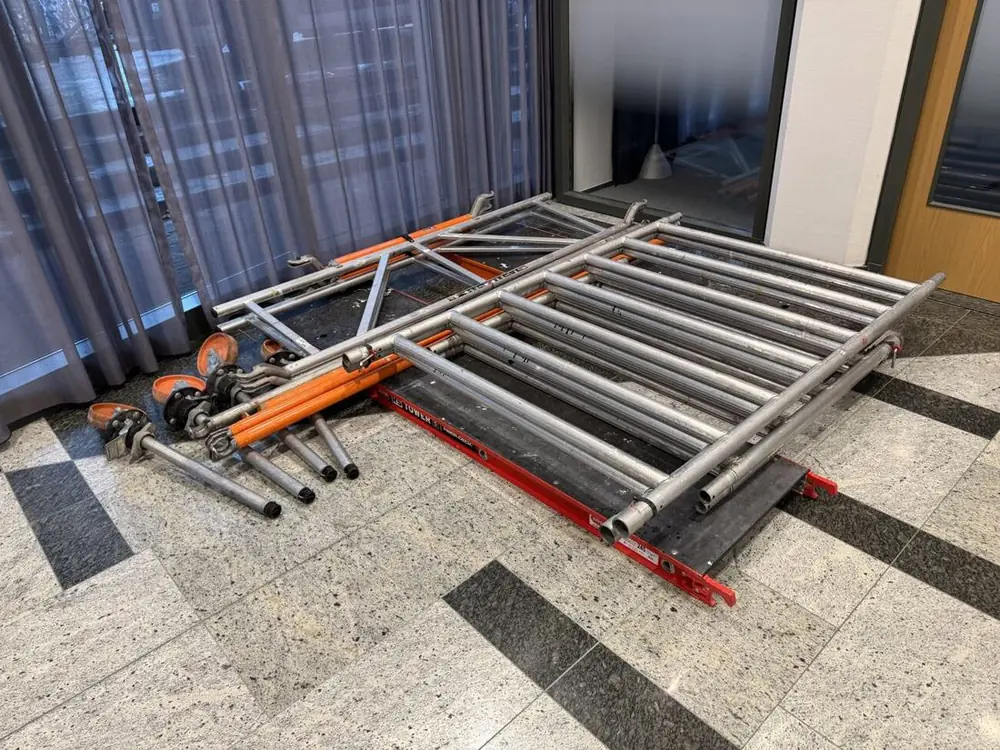
Complete set of scaffold parts checked and laid out, as it stays in the garden through your hire days

Generous booking is cheap cover on a job like this. The full amount applies only while that opening twenty-four hours is running; each following day is added with ninety-five per cent off it, so a spare day held back for rain hardly touches your rental price. Cut it fine and lose a day and you stand at a half stained pergola waiting for another tower to become free. For a bigger frame, this piece on hire duration gives a guide.

Which mobile scaffold suits staining a pergola?

Kamersteiger RS44
  • Working height up to 4 metres
  • Compact and narrow
  • Great for indoor and small jobs
View and calculate →
Smalle rolsteiger RS51
  • Working height up to 14.2 metres
  • Narrow (75 cm)
  • Ideal for narrow passages
View and calculate →
Brede rolsteiger RS52
  • Working height up to 14.2 metres
  • Wide platform (135 cm)
  • Extra stability and workspace
View and calculate →
Most chosen
1-persoons steiger MiTower
  • Working height up to 6.2 metres
  • Very compact
  • Quick and easy to assemble
View and calculate →

Staining a pergola from a 245 cm platform

A deck measuring 245 centimetres covers roughly one bay of beams. Per position you take on everything falling inside that bay: the underside of the rafter above you, both flanks and the upper face. Keep to that order, because stain running down from the top is brushed out along the sides while it is still wet. Then you move along to the following bay. Skip a face meaning to catch it later and that entire position has to be set up a second time.

Here lies the difference with work that looks similar. When spraying slatted timber the mist does the reaching for you and no face has to be physically touched; here every side has to meet a brush. And unlike staining a carport, where a closed roof sits over you and the work concentrates along the edge and the posts, on a pergola you look straight through the frame and most of the timber hangs above eye level. The number of positions you set up differs sharply between the three as a result.

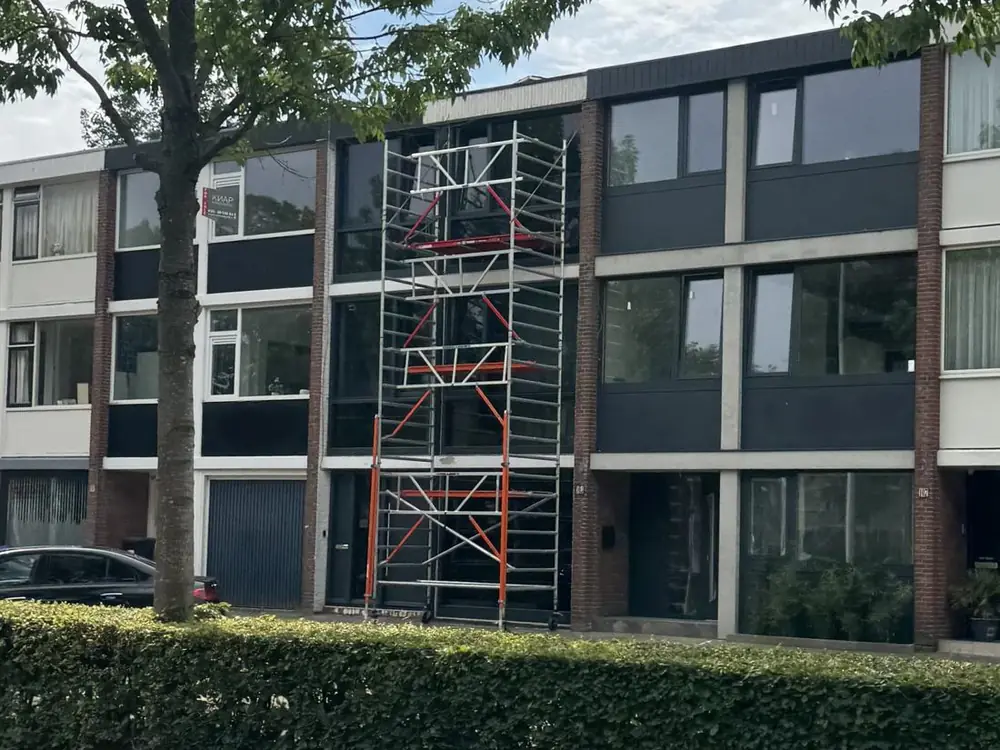
Erected tower alongside a front elevation, comparable to the position you take under each bay of pergola beams

Expect a great many short moves, then. A pergola of four by three metres carrying five rafters soon runs to eight or twelve positions per coat, and that already counts the uprights you do standing on the paving. Working above your head is slower than working at eye level too: the arm grows heavy, the brush goes down more often and you keep wiping runs off your forearm. Build room for that into your planning and your hire days.

MiTower hire with delivery to the garden behind the house

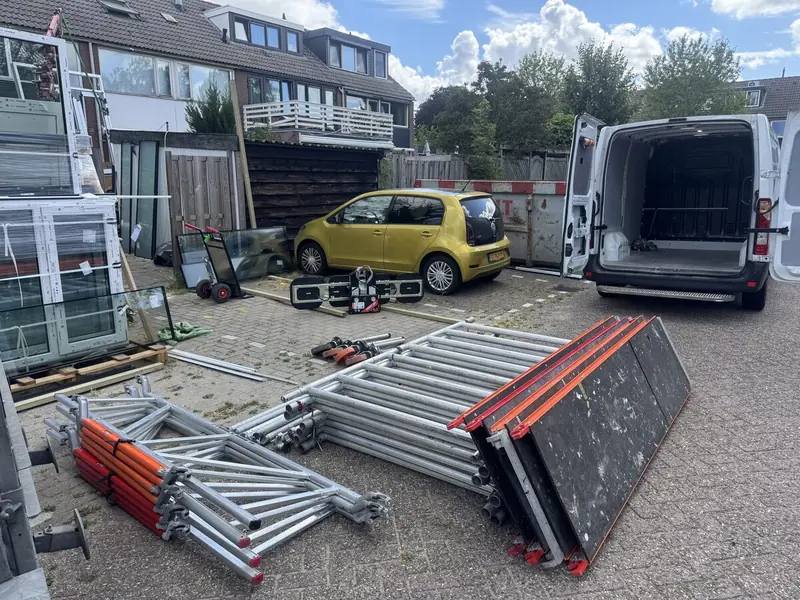
The scaffold reaches you as a bundle of loose parts, counted and complete, which you assemble into a tower yourself. Work out beforehand where those parts are allowed to lie, because the terrace under the pergola is ruled out: the build goes there and you will be walking about with a tin of stain. Grass beside the terrace or a length of drive suits better, provided a barrow can pass. Reserve on a weekday before 15:00 and the parts lie in your garden the next working day.

Both the delivery day and the return day are yours to pin, and on stain work you let the forecast decide them. A run of dry days counts for more here than an early start, since stain drawn into damp timber dries patchy. Putting it together is down to you: the instructions come with the set and the film takes you through the steps in order. Building alone is perfectly possible, though a second pair of hands passing parts up makes it noticeably faster.

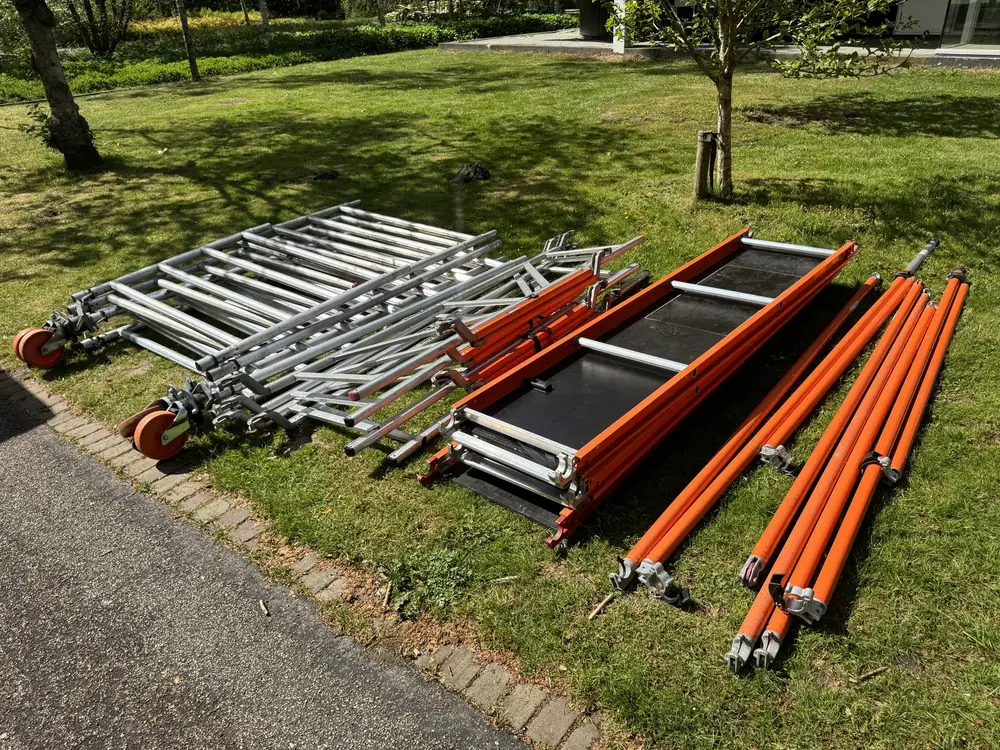
Scaffold parts laid out on the lawn in a garden, next to the spot where the tower will be built

Once the final rafter has had its coat you take the tower apart and our van comes round for the parts. Stack them somewhere a trolley can reach rather than behind a bolted gate. Let the stain harden before you handle the tubes, or fresh marks transfer onto the material and prove awkward to polish off later. Count the pieces back into the bundle as you stack them, and nothing has to be chased afterwards. What the run to your province comes to is listed under the cost of delivery.

Working safely overhead on a hired one-person tower

The platform is proved at 200 kilos per square metre, which EN 1004 records as load class 3. On a tower intended for one user that weight is seldom the limiting factor; the chassis is what governs. A narrow base asks for four stabilisers wound properly out, even though you stand no more than half a metre above the paving. Set them again after every move and look them over the moment somebody on the terrace has caught one with a shoe.

The trap on a pergola is the frame itself. It is tempting to haul yourself up on a rafter, or push off one to travel a little further along, but then the tower rolls out from under you and your weight hangs on the timber. Always move with both feet on the slabs, the deck cleared and the brakes released, then lock the wheels again before climbing. Stop altogether as soon as it starts to blow hard. Rolling with a full tin aboard is how stain ends up across the paving.

Tower with a guardrail around the platform and an internal step, the route down between one bay and the next

Beyond that this is drip work. Stain laid on overhead runs down the handle to your sleeve and then onto the boards, where it leaves a slippery patch behind. Put card down and swap it once it soaks through, wear glasses against splashes, and never carry on while children or guests are sitting under the frame. A tower left standing overnight in a garden also wants its brakes on and its deck cleared. The rest of what applies while hiring a tower is gathered in the safety rules overview.

In 5 steps

How hiring a mobile scaffold works

1
Choose working height

Pick the height that suits your job.

2
Book online

Sorted in 60 seconds, price shown instantly.

3
We deliver

At the agreed spot the next working day.

4
Assemble safely

Assembled by you, with a manual.

5
We collect

One call and we collect the scaffold.

Good to know

Practical tips for staining a pergola

1

Stain the upper faces of all the rafters first and only afterwards the sides. Anything running down then gets brushed out immediately, rather than settling across work that has already dried hard.

2

Chalk a small mark on the slabs at each position. Once the drying time has passed you roll the tower back to precisely that spot and know for certain no bay of beams was skipped.

3

Hook your tin of stain under the guardrail instead of standing it on the boards by your feet. You then cannot kick it over as you turn towards the next side of a beam.

4

Do the uprights standing on the paving and the rafters from the tower. That gains a few minutes per bay and spares you lowering the build simply to reach the bottom of a post.

5

Check before booking whether the longest parts pass through your garden gate. If they must come through the house instead, you want to know that before the van is standing at the kerb.

6

Put your collection day one clear day after the final coat. That leaves the timber time to dry and gives you room to dismantle cleanly without printing marks onto the tubes.

Frequently asked questions

Frequently asked questions about staining a pergola

Which scaffold should you hire for staining a pergola?+

Over a terrace the MiTower is the obvious pick: 75 centimetres wide, intended for a single user and light enough to slide between the uprights on your own. That last point weighs heavily, since you reposition per bay of beams. Where the structure sits higher, against a two-storey extension for instance, the answer is to hire a mobile scaffold, an RS51 in a narrow build, because it reaches far above this. For a plain terrace frame such a model only means more parts to lug about.

How do you arrange MiTower hire for a pergola in the back garden?+

You choose the model online, choose the build that suits your frame, pin a delivery day and a day of return, and the amount including VAT appears at once. We drop the package at the point you indicate, you build the scaffold on the terrace and stain your pergola, and at the end everything goes back complete and taken apart. Nothing else needs organising beyond clearing the terrace and timing the drying interval between your two coats yourself. The van brings loose parts, never a finished tower.

How many hire days does staining a pergola take?+

Three to four hire days covers an average terrace pergola: one day for brushing down, sanding and assembly, then two rounds of stain with the drying interval between them. Where the structure is long or turns a corner of the terrace, add a further day. Because the tower is shifted per bay of beams, a larger pergola costs you mainly in the number of positions rather than in the brushwork itself. Working single-handed pushes you towards the upper end of that range.

What is the rental price for a MiTower on pergola work and how does the discount run?+

What you pay follows from the model, the height the tower is built to and the run out to your province. Amounts include VAT and sit together in the current price list. For stain work the structure is kind: the opening day is by far the dearest and each day hung on the back barely registers. Anyone allowing for drying time and a passing shower therefore books the spare day at the outset rather than adding it afterwards. Booking one setting taller costs little and removes the guesswork.

What working height should I hire for a pergola over a terrace?+

Usually you land between 4 and 6 metres, measured from the paving to half a metre above the topmost horizontal timber. That half metre is what lets you see over the top of the wood and lay the stain on tidily. Where your terrace is raised or the frame stands against a bank, measure from the lowest point the wheels reach. The page listing the working heights shows what each scaffold manages.

Can you deliver the hired parts into the back garden or must I collect them?+

The driver sets the scaffold down wherever a trolley can reach, so for a back garden that means the gate or the path leading to it. If the garden opens only through the house, mention it when you reserve. Prefer to drive yourself and you take the set by appointment from Zeeburgerpad in Amsterdam, where collecting it costs you nothing. Carrying the parts through to the terrace remains your share of the work either way.

Is assembly part of hiring the MiTower?+

No, the tower turns up as loose parts and putting them together falls to you. On this model that is manageable single-handed, although a second pair of hands helps when the first deck goes up to height. The written steps and the film show the way and an hour or so sees it done, far less than a full mobile scaffold takes. We do not deliver anything assembled, and cherry pickers or facade scaffolding are not in the hire range at all.

Can I hire the tower for longer if staining a pergola overruns?+

Ring or email the moment it becomes obvious, and the collection date is moved for you, unless that scaffold is already booked out to somebody else in the same week. Stain work often runs differently from the plan, because the timber has to be dry and a shower at midday upsets the whole schedule. Reserving generously from the start is therefore the smarter route: giving the set back early is always allowed and those extra days weigh very little.

How much room does hiring a scaffold need on a small terrace?+

Work from the footprint of the chassis plus the space the four stabilisers occupy all round, and remember you also want to walk past the tower carrying a tin. On a cramped terrace that generally means the table and chairs spend the week in the shed. The route the parts travel in by counts too. Measure the narrowest passage before you hire, and you know for certain the bundle will pass through. Check the gate as carefully as the terrace before settling on a delivery date.

Does my rental simply run on when it is too wet for staining a pergola?+

Yes, the tower stays put in the garden until you need it again. Brushing stain onto damp timber achieves nothing, so use such a day for sweeping down, sanding or clearing the terrace and pick the brush up once things dry. Do take your tin and brushes off the boards if wind gets up. Because the closing date of the hire is set by you, a postponed day costs remarkably little in practice.

How quickly is the deposit returned after a pergola hire?+

As soon as the parts are back and counted through, the deposit heads your way again within one working day. On stain work it comes down to handing things over clean: droplets on the tubes go hard and are then difficult to shift. Wipe spatters away while they are still wet, lay card on the deck under your tin and keep a cloth in your pocket. Missing parts count at the final tally of your hire as heavily as damage to a tube.

Can I roll the hired tower between the posts of the pergola?+

That depends on the clear dimension between two uprights. At 75 centimetres the chassis normally passes, but the stabilisers project further and have to be drawn in for the moment. Only do that with an empty deck and wind them out again before you climb. If it will not go through at all, stand the scaffold outside the bay and work up at an angle; allow slightly more working height in that case.

Hire a mobile scaffold for staining a pergola today?

Calculate your rental price now or ask for free advice.

Rolsteiger van SteigerTaxi geleverd op locatie
Book it online

Your scaffold sorted in 2 minutes.

Choose your scaffold and working height, see the price instantly and book online.