
See your price
Application

Painting pillars? Choose the right scaffold.

Painting pillars looks like ordinary exterior work right up to the moment you stand at the first column with a brush. A pillar has no back you are allowed to skip: round or square, you have to go the whole way round it. A scaffold will not wrap itself around a column, so you work a quarter at a time and reposition four times before one pillar is finished. For columns under a canopy, a porch or a gallery you hire the RS51, a narrow 75 cm tower built to six or eight metres.

  • Order before 3 pm, delivered tomorrow
  • Professional Altrex scaffolds
  • Up to 14.2 metres working height
  • Easy to assemble yourself
4,2 tot 14,2 mWorking heights available
12Provinces served
7Days a week
200 kg/m²Load class 3
In short
  • For painting pillars we recommend the Narrow mobile scaffold.
  • For painting pillars up to eight metres you hire the RS51: 75 cm wide and slim enough to pass close by a column.
  • A scaffold cannot go around a pillar, so you set it down again per quarter: four stand positions to every column.
  • Allow three to five hire days, because shifting the tower costs more hours than painting pillars itself does.
  • First 24 hours from €150 incl. VAT and delivery; every day after that 95% off.
Key facts for this job
FeatureValue
Recommended scaffoldNarrow mobile scaffold (Altrex RS TOWER 51)
Working height for this job6 to 8 metres
Available working heights4.2 to 14.2 metres
StandardEN 1004, load class 3 (200 kg per m²)
DeliveryOrdered before 3 pm, delivered next working day
Each extra day95% off, from €7.50 a day
Why a mobile scaffold for painting pillars?

Safe, stable and professional work at height

Along a facade you shuffle sideways; around a pillar you turn. That single difference governs everything about the job. Each column asks for four stand positions, and between those positions sits a wet edge that must not dry before the next quarter begins. So you want a scaffold you can release, roll and lock again inside a couple of minutes, rather than a heavy set-up that takes two people to shift. Anyone renting a mobile scaffold for painting pillars is therefore looking less at the maximum height than at how quickly the thing goes from quarter to quarter, and at how much floor can be cleared around each pillar.

  • Four stand positions per column, right around the shaft
  • Holding a wet edge between two quarter turns
  • Narrow chassis between column and parapet or wall
  • Painting pillars that run to eight metres tall
Read more about working safely →

Which mobile scaffold to hire for painting pillars at a porch

For columns you pick the Altrex RS51 at 75 centimetres wide, and here the choice turns on manoeuvrability rather than working room. This chassis gets set down four times per column, and anything broader or heavier converts that into an afternoon of hauling. Pillars seldom stand in the open either: between the shaft and the wall or the parapet there is often no more than a metre to play with. The model itself runs from a working height of 4.2 metres up to 14.2, so entrance columns keep you well down that scale.

The 245 centimetre deck is only half used on this sort of work. You stand facing a shaft half a metre wide at most, with a tin, a brush and a small roller by your boots. That length is not wasted, though: where columns in a gallery stand close together, one position lets you take two half pillars and saves a whole round of shifting. Measure the centre to centre spacing between the columns before anything gets booked, because that single figure decides whether the row costs you one circuit or two.
Narrow erected mobile scaffold 75 cm wide, the size you move four separate times while painting pillars

A broader chassis rarely pays off here, because the extra deck stands empty on one side while you still have to steer the thing around every column. Where the pillars are indoors, in a hall or beneath a void, you end up at the lower room scaffold instead, which rolls over a timber floor without scoring it and passes through an ordinary internal door. Height alone should not settle it. Compare what is on offer in the range of mobile scaffolds for hire before committing to a build.
What working height to hire for a six metre pillar

The point you have to reach is not the top of the shaft but the joint where the column disappears into the beam, the canopy edge or the ceiling. There is frequently a widening or a bracket at that joint, projecting slightly further than the pillar itself and needing the same colour. Measure up to it and add half a metre for comfortable access. On entrance columns of six metres or thereabouts, your reach lands between 6 and 8 metres.

What gets booked is the working height, which is nothing more than deck height plus about two metres of reach. The platform on this job therefore comes to rest somewhere between four and six metres. Start the tape on the paving the wheels will stand on rather than on the landing alongside, because an entrance almost always sits a few treads above street level. Where a ramp runs past the row, the starting point differs from one stand position to the next.

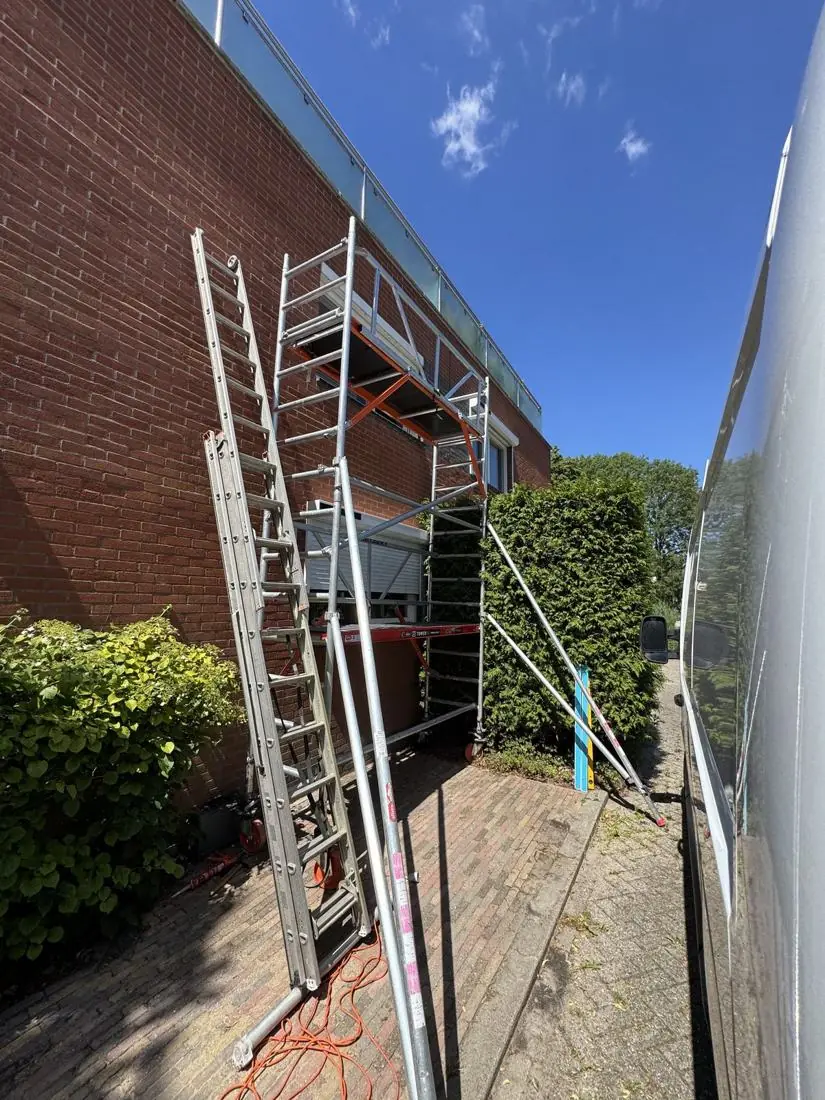
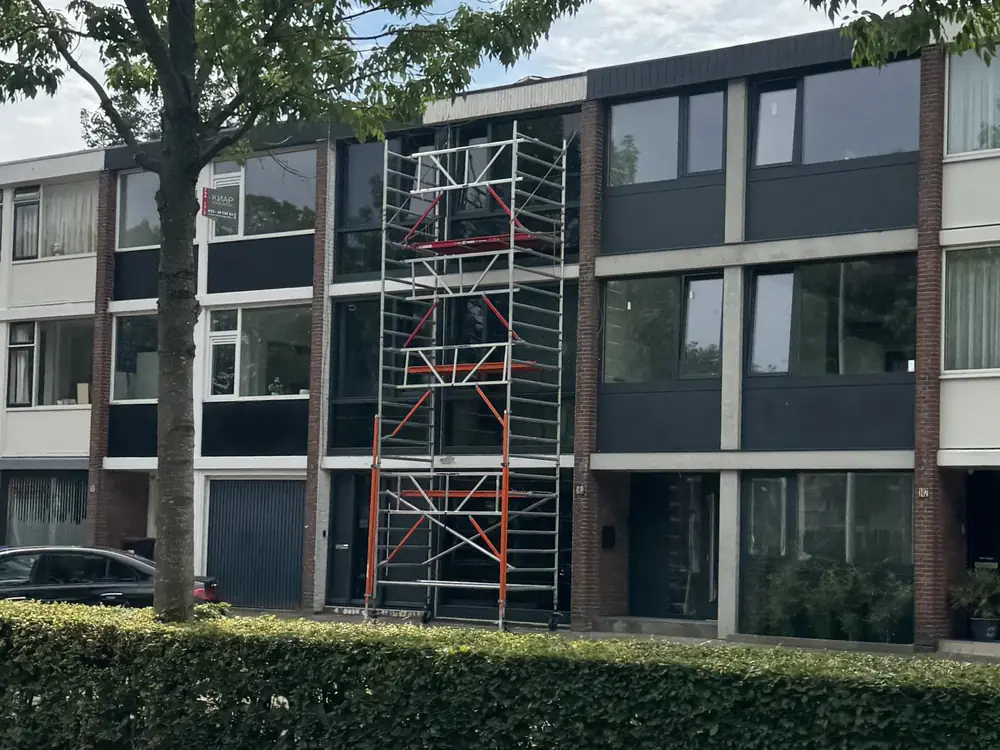
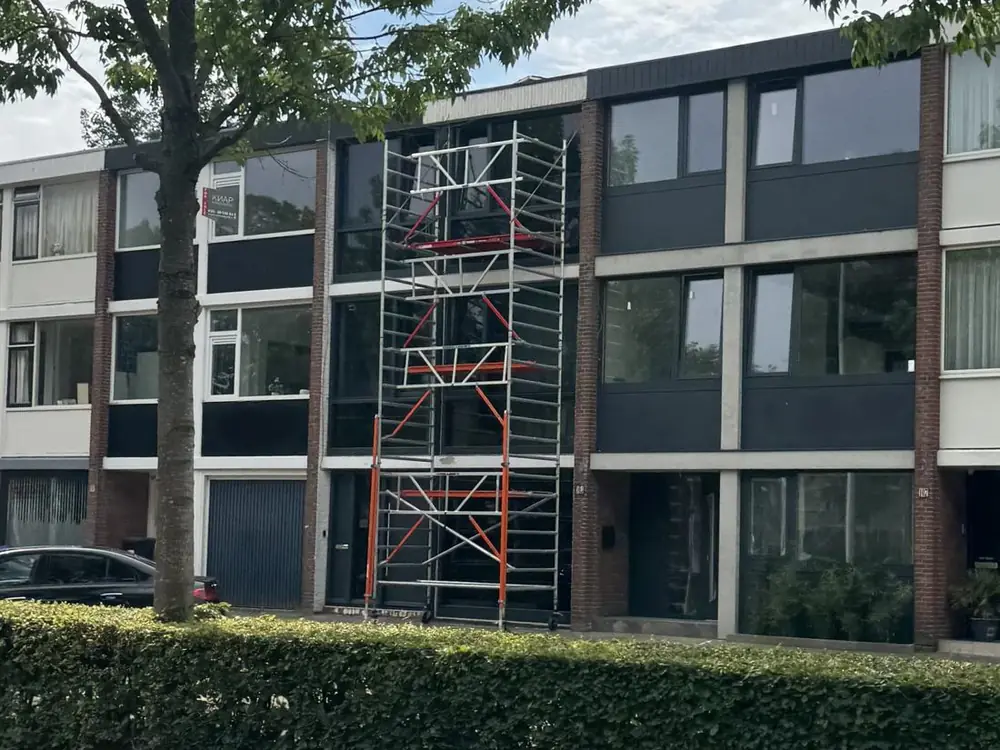
Mobile scaffold erected against the front of a building, at roughly the build height an entrance column asks for

Choose too low and precisely the top band goes untreated, which is where water runs down the column and the coat lets go first. Touching that in from a step ladder under a canopy is not on, so you get to hire a second time for a strip thirty centimetres deep. One setting higher costs very little at the booking and removes the risk outright. Which build belongs to which reach is set out clearly at the settings up to eight metres.

Hiring a mobile scaffold for painting pillars: where it stands

Around every column you need four places where the chassis will actually fit, and at a porch that is generally the sticking point. The stabilisers project outward at an angle and run straight into the steps, the planter, the landing or the neighbouring column. Do not draw them in to make it work; slide the set-up half a metre and take the face from an angle instead. Walk all four stand positions round the first pillar before you start, and the rest of the row becomes predictable.

The surface at an entrance deserves attention. Bluestone and polished slabs turn slippery after rain, an inspection cover rarely sits quite flush, and a drive often has a threshold or a drainage channel across it. Place the wheels so that not one of them rests on an edge, and after every quarter turn confirm that all four feet are carrying evenly again. A sunken paver announces itself only when you are already up there stretching for the top of the shaft.

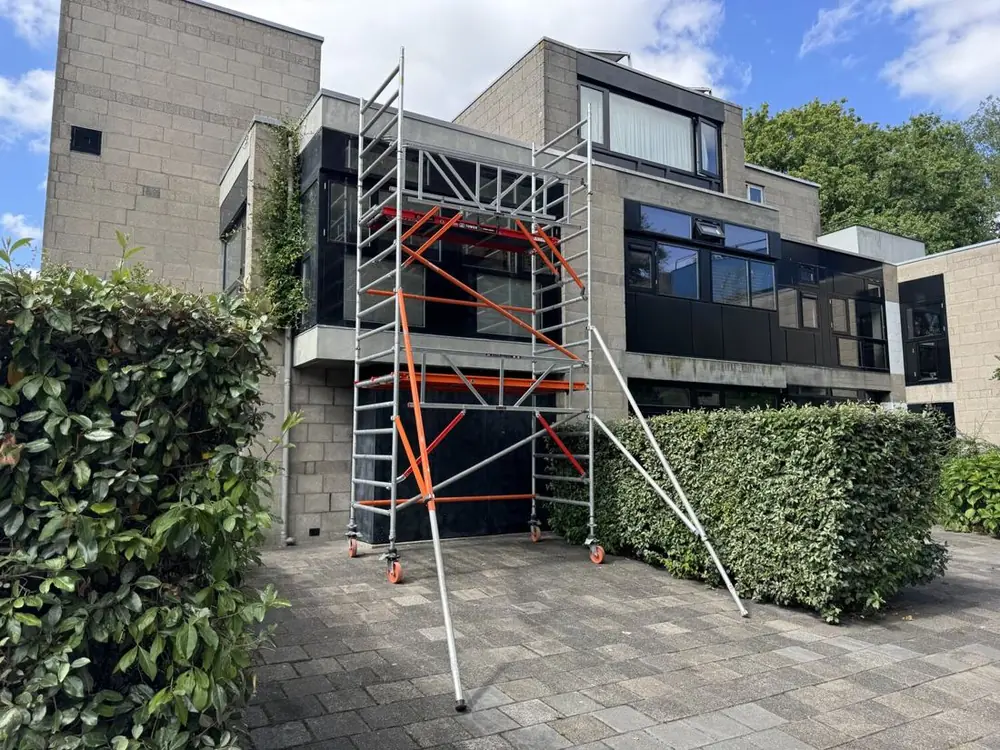
Folded out stabilisers under a mobile scaffold, the part that fouls steps and landings when working at columns

Bear in mind as well that columns nearly always stand on a route people use. At a gallery, a porch or a company entrance there are people going past all day who are not expecting your scaffold. Arrange the set-up so a walking route stays open, hang tape or a sign, and agree with the building manager when the quiet hours fall. Where the set-up ends up on the pavement, ask what your council makes of that, since a porch on a public footway often falls under its own local rules.

How many days to hire the tower for painting pillars

The arithmetic here is straightforward: number of columns, times four stand positions, times two coats. Six pillars under a canopy therefore come to forty-eight set-ups, and each one costs a few minutes of brakes, stabilisers, rolling and locking down again. Together that mounts up faster than the brushwork does. For a row of four to six columns you hire for three to five days, sanding and degreasing before the first coat included in that figure. Working alone rather than in a pair pushes you towards the upper end.

Between two coats sits waiting time that will not compress, and outdoors the weather comes on top of it. Where the pillars stand under a canopy or in a porch you suffer less than at an open wall, though damp drawing up a column still causes delay. Indoors the weather plays no part, but the question of when the passage may be blocked by your set-up certainly does; in a shopping gallery that is seldom the moment that suits you.

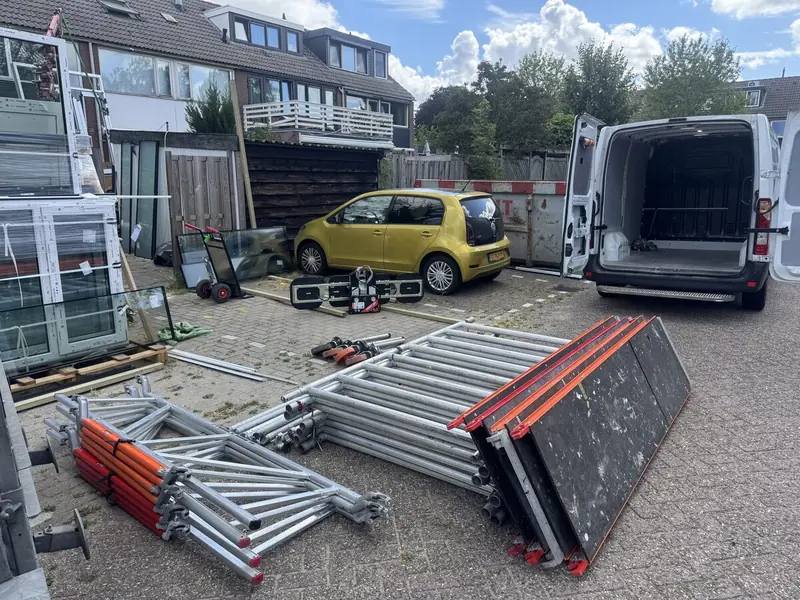
Scaffold parts bundled ready for transport, the set you move from column to column through your hire period

Booking generously works out well against a sum like this, because the rate leans heavily on the opening period. One day is charged in full, the first one; every day beyond it is reduced by ninety-five per cent against what it would otherwise have been, so a spare day for a forgotten quarter turn barely registers. Come up a day short and the van arrives while half a column still stands in primer. Work your period out with the explanation of hire periods beside you.

Which mobile scaffold suits painting pillars?

Kamersteiger RS44
  • Working height up to 4 metres
  • Compact and narrow
  • Great for indoor and small jobs
View and calculate →
Most chosen
Smalle rolsteiger RS51
  • Working height up to 14.2 metres
  • Narrow (75 cm)
  • Ideal for narrow passages
View and calculate →
Brede rolsteiger RS52
  • Working height up to 14.2 metres
  • Wide platform (135 cm)
  • Extra stability and workspace
View and calculate →
1-persoons steiger MiTower
  • Working height up to 6.2 metres
  • Very compact
  • Quick and easy to assemble
View and calculate →

Painting pillars a quarter at a time from the platform

Per stand position you take one quarter of the circumference, and that quarter you do in a single pass over the full height. On a round column you work in narrow vertical bands that have to meet along a wet edge; let such an edge dry before the following quarter begins and the join shows later as a stripe in low light. Put those transitions on the side of the column nobody sees from the path, and the finish reads as one continuous surface.

The top two metres come off the platform and the rest from the ground, which sounds like a compromise and is not. It works out genuinely handy: the tower serves only the stretch where you would otherwise be leaning a ladder against a round shaft, while the foot of each pillar gets walked round at the end. Carry up everything a whole quarter needs, because descending for a second brush costs you four times over on every single column.

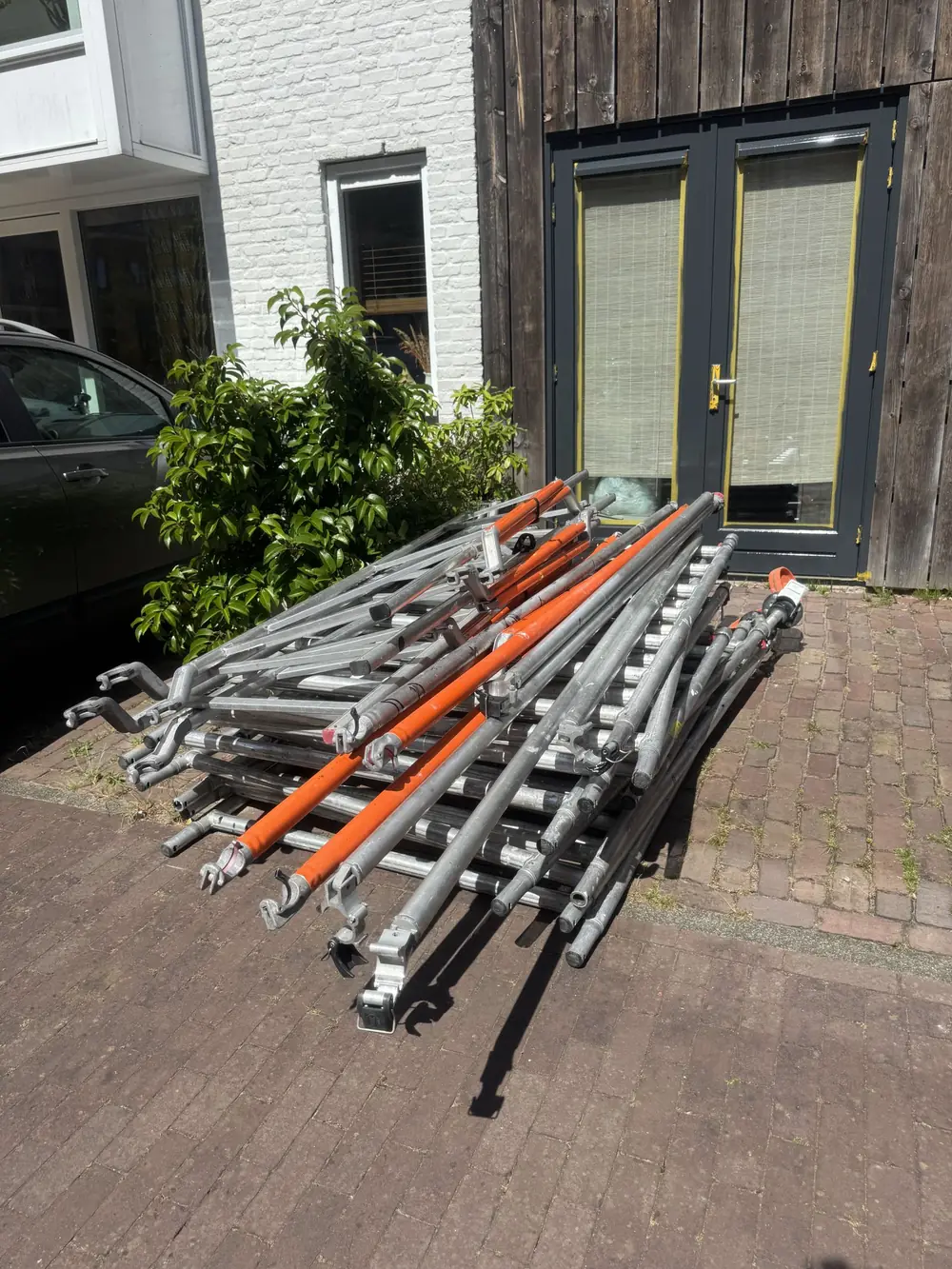
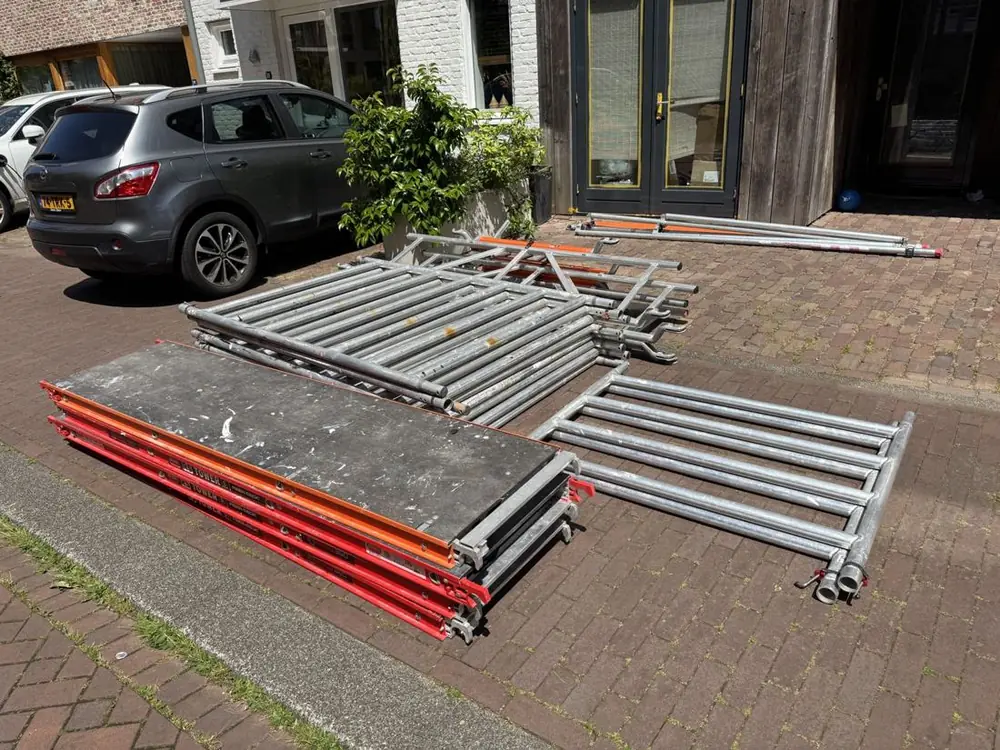
Frames, braces and tubes on a drive beside a parked car, the hire set built up before working around a column.

What people underestimate is the shifting itself. Brakes off, stabilisers in, roll, line up, stabilisers out, brakes on: taken one by one these are nothing, yet at twenty-four stand positions per coat half a day vanishes into them. That is exactly why a row of columns wants an extra hire day sooner than a plain wall would. Combine anything due in the same place anyway, such as cleaning the canopy above the columns, so each of those positions earns its keep twice over.

Scaffold hire with delivery at an entrance or gallery

The parts arrive complete and counted, and you decide where the driver puts them down. At an entrance that is harder than it sounds, because the space in front of the door is exactly the space everybody has to pass through. Nominate a corner of the car park or a strip beside the landing instead, and remember that the longest tubes will not come round a sharp bend. Reserve on a working day and get in before 15:00, and the set is with you one working day later.

Both the delivery day and the day everything leaves again are yours to schedule, and with a row of columns you would rather assemble outside the busy hour at the entrance. Nothing is driven out ready made: putting it together is your part, with the manual to hand and the instruction film there for whenever the order of parts is unclear. Allow half a day for that and put the sanding of the first column on a different morning.

Scaffold parts stacked on the street outside a building, the pile you keep clear of the walking route

Once the last column stands in its finishing coat you break everything down and we come for the parts. Stack them where a trolley can reach and count them as you pile them, so nothing has to be hunted for afterwards. Live nearby with room in your van and you may take the parts away at no charge, by appointment, at Zeeburgerpad 89 in Amsterdam. What the delivery costs per province is listed under the rates for the run.

Working safely around a column on a hired mobile scaffold

The platform will carry 200 kilos on each square metre, the figure EN 1004 calls load class 3. At a column you never come close to that limit, because you work with no more than a tin, a brush and a small roller. Load is not what troubles you here; the set-up is, since you shift so often that the temptation grows to leave one stabiliser tucked in. Resist it, even for a quarter turn that lasts five minutes.

Brakes go on before you climb, nobody stands on the deck while the chassis rolls, and strong wind stops outdoor work. With columns one more rule joins the list: never use the pillar as a handhold. Hauling yourself up on a shaft, or pushing off it to travel half a metre along, sends the scaffold rolling out from under you. Leaning over the guardrail to just catch the far side belongs in exactly the same category, and it is the commonest way people come unstuck on a column.

Mobile scaffold with guardrails all round and a built-in step, climbed afresh at every new position around a column

Keep an eye as well on who is walking underneath. Columns stand by doors, stairs and passageways, and a brush dropped from five metres lands on somebody's shoulder there. Keep tools in the middle of the deck, hang the tin from a hook rather than balancing it on the edge, and tape the set-up off while you are up top. The remaining agreements around hiring a scaffold are summarised in the rules covering work at height.

In 5 steps

How hiring a mobile scaffold works

1
Choose working height

Pick the height that suits your job.

2
Book online

Sorted in 60 seconds, price shown instantly.

3
We deliver

At the agreed spot the next working day.

4
Assemble safely

Assembled by you, with a manual.

5
We collect

One call and we collect the scaffold.

Good to know

Practical tips for painting pillars

1

Chalk a number for each quarter of every column onto the paving. After the drying time you know precisely where the tower has to stand for the second coat, and you skip no side.

2

Always start on the face that is least on show. The final wet edge then finishes on the back of the pillar, where nobody stands looking at it in raking light.

3

Do the upper sections of the entire row of columns first and only afterwards the lower part from the ground. The tower then makes a single circuit past the pillars instead of two.

4

Measure the centre to centre spacing between two columns before you reserve anything. Where they stand close together, one position reaches two half pillars and saves you a complete round of shifting.

5

Stand a bucket of water and a sponge ready on the ground. Gloss on a polished bluestone floor comes away only while it is still wet, and you generally notice a quarter of an hour too late.

6

At a gallery or porch, ask in advance when the quiet hours fall. Shifting between passing residents costs you more time per column than painting that same column does, mornings above all.

Frequently asked questions

Frequently asked questions about painting pillars

Which mobile scaffold is the right one to hire for painting pillars?+

The RS51 at 75 centimetres is the sensible pick here, not for the room on the deck but because of how often you move it. A column wants four stand positions, and a narrow chassis slides between the shaft and the wall without anything having to come apart first. Where the pillars stand indoors, you hire a room scaffold instead, one that passes an internal doorway and leaves the floor covering unmarked. That is a different reservation, though it can fall in the same week.

How do you go about hiring a tower for a whole row of columns?+

Online you settle a model and a height, pin the delivery day and the return day, and see a fixed amount including VAT. We drop the parts off, you build the scaffold and work the columns quarter by quarter, and on the closing date everything stands dismantled and ready. With a long row of pillars it pays to take a hire period slightly wider than your first calculation suggests, since stand positions always outnumber the estimate.

Six pillars in gloss: how many hire days is that?+

For six columns in two coats of gloss you land at three to five days of scaffold hire. That is not down to the painting but to the forty-eight stand positions you make in total and the drying time between rounds. Where the pillars are bare or carry old paint that has to come off, add at least a day of preparation. Working single-handed puts you at the top end of that margin.

What is the rental price for painting pillars and how does the rate work after day one?+

The deciding factors are the model, the build you choose and the run out to your province; all amounts appear with VAT already included on the tariff page per scaffold. The shape of the rental price works in your favour on this job, since the opening period carries the weight and the days behind it cost a fraction. For work full of stand positions, waiting and a second coat, that is precisely the split you want, and it is the reason a long booking beats two short ones.

What working height should you hire for pillars under a canopy?+

Usually 6 to 8 metres, measured from the paving under the wheels to the joint where the column vanishes into the canopy, plus half a metre for proper access. Where the entrance sits on a landing with steps, measure from the level the scaffold genuinely stands on. In the explanation of working height you can see per model which builds are achievable, so nothing gets reserved too tight. Booking one setting taller than the tape suggests is cheap insurance against a bracket you had not spotted.

Can you deliver a hired scaffold at a porch with no driveway?+

Yes, the driver puts the parts down as close as possible to the spot you indicate, provided a trolley can get there. At a porch without a drive that often means the parking bay or the pavement beside it, and you carry the scaffold the last stretch in yourself. Say at the booking that this is a gallery or an entrance and the driver allows for it when unloading. Collecting the parts yourself is fine too, if your transport takes the long tubes.

Is assembly covered by the hire or do I sort that out myself?+

The latter. We supply a complete set and fetch it back afterwards; the assembling, the rolling about and the taking apart are yours. Allow half a day before the first column gets its turn and keep the film as a reference. Delivering anything erected is not part of what we do, and neither cherry pickers nor facade scaffolding appear in the range. For painting pillars up to eight metres a mobile tower is in any case the most practical tool available.

Can I hire on if the finishing coat on the columns overruns?+

You can, so long as we hear from you ahead of the collection day. Provided the scaffold has not been pledged elsewhere, that date shifts with you. On pillars things overrun regularly, either because the count of stand positions disappoints or because a coat stays wet for longer than expected. Anyone wanting to head that off adds a day at the reservation; giving the set back early is still allowed and stopping halfway up a column never becomes necessary.

How much space has to be clear around a pillar for the hired scaffold?+

Per stand position, reckon on the width of the chassis with the stabilisers added, and then on all four sides of the column. In practice you want roughly a metre and a half of clear floor round a pillar, free of planters, parked bicycles and loose slabs that tip. Where a stair abuts the shaft, you take that face from an angle and need slightly more reach. Walk that circuit with a tape before you hire a mobile scaffold, and every stand position is settled in advance.

Does the hire keep running when the columns are too damp to gloss?+

The set-up simply stays standing for as long as your period runs. Gloss on damp columns bonds poorly and dries patchy, so spend such a day sanding, degreasing or masking instead. Where the pillars stand under a canopy or in a porch you can often carry on regardless while it pours outside. Because the closing date of the hire is yours to set, a day of postponement usually stays the only consequence for your schedule.

How quickly does the deposit come back after hiring for gloss work?+

There is a deposit attached to every reservation. Once the parts are back and counted, we transfer it to your account within one working day. On gloss work watch the spatter above all: paint that dries onto the tubes is virtually impossible to shift afterwards. Lay a cloth over the guardrail where your tin sits, wipe drips away at once and check the deck before descending. Missing components weigh as heavily at the final check of the hire as damage to a tube.

Do I really have to shift the scaffold I hire four times per pillar?+

In practice yes, unless the column stands against a wall and the back stays out of sight. On a free-standing pillar one position gets you halfway along the sides at best, and hanging over the guardrail for the remainder is exactly what you must not do on a hired tower. Where several columns stand close together you sometimes combine two half shafts and keep it to three rounds per pillar. Nobody gains more than that on a free-standing column.

Hire a mobile scaffold for painting pillars today?

Calculate your rental price now or ask for free advice.

Rolsteiger van SteigerTaxi geleverd op locatie
Book it online

Your scaffold sorted in 2 minutes.

Choose your scaffold and working height, see the price instantly and book online.