
See your price
Application

Cleaning cladding? Choose the right scaffold.

Timber or plastic cladding asks for a gentle hand. You want the growth off and the coating left on, so a pressure washer is out and you work with a brush and very little force. That means standing close, following every joint calmly and never driving water in behind the boards. For a wall of two storeys you hire the narrow RS51 at 75 cm, built to a working height of 6 to 8 metres. Below: where it stands, how many days you need it and how delivery works.

  • Order before 3 pm, delivered tomorrow
  • Professional Altrex scaffolds
  • Up to 14.2 metres working height
  • Easy to assemble yourself
4,2 tot 14,2 mWorking heights available
12Provinces served
7Days a week
200 kg/m²Load class 3
In short
  • For cleaning cladding we recommend the Narrow mobile scaffold.
  • For cleaning cladding over two storeys you hire the RS51: narrow, 75 cm, built to a reach of 8 metres.
  • A narrow tower stands close in against the boards, so you can work at low pressure with a soft brush.
  • Reckon on one to two rental days, because per set up you follow every joint downward without hurrying.
  • First 24 hours from €150 incl. VAT and delivery; every day after that 95% off.
Key facts for this job
FeatureValue
Recommended scaffoldNarrow mobile scaffold (Altrex RS TOWER 51)
Working height for this job6 to 8 metres
Available working heights4.2 to 14.2 metres
StandardEN 1004, load class 3 (200 kg per m²)
DeliveryOrdered before 3 pm, delivered next working day
Each extra day95% off, from €7.50 a day
Why a mobile scaffold for cleaning cladding?

Safe, stable and professional work at height

Cladding is not masonry. There is air behind the boards, and on shiplap or feather edge each plank laps a little over the next. Spray upwards and the water goes exactly where it should not: behind the cladding, into the structure, where it dries slowly. So you work from the top down, at low pressure, with a soft brush, in short runs. That takes time, and it demands that you reach everything without stretching, because an outstretched arm leans harder than you intend. Hiring a scaffold for cleaning cladding is therefore about closeness and calm. That difference from a brick wall shapes the whole approach.

  • Narrow mobile scaffold close in along the cladding
  • Reach to the top row under the fascia
  • Low pressure, soft brush, no pressure washer
  • No water allowed behind the boards
Read more about working safely →

Which 75 cm mobile scaffold to hire for cleaning cladding

Surprisingly little travels up for this job: a bucket of tepid water, a soft brush or a wash brush, a hose running at low pressure and a couple of cloths. Any more than that and you start catching the boards with something hard. Which is why the Altrex RS TOWER 51 belongs here, narrow at 75 cm across. It fits the path along a side elevation, where cladding tends to sit in the first place. The whole selection is set out under mobile scaffolds available to hire.

There is a second argument for going narrow. A light frame is one you shift single handed, and on this job you shift constantly, because only a limited face can be finished properly at a time. Should a second person need to come up, or should you want buckets and a container of cleaning product beside you, then it becomes the wide RS52 at 135 cm, and you accept that the way through to the back has to be roomier.
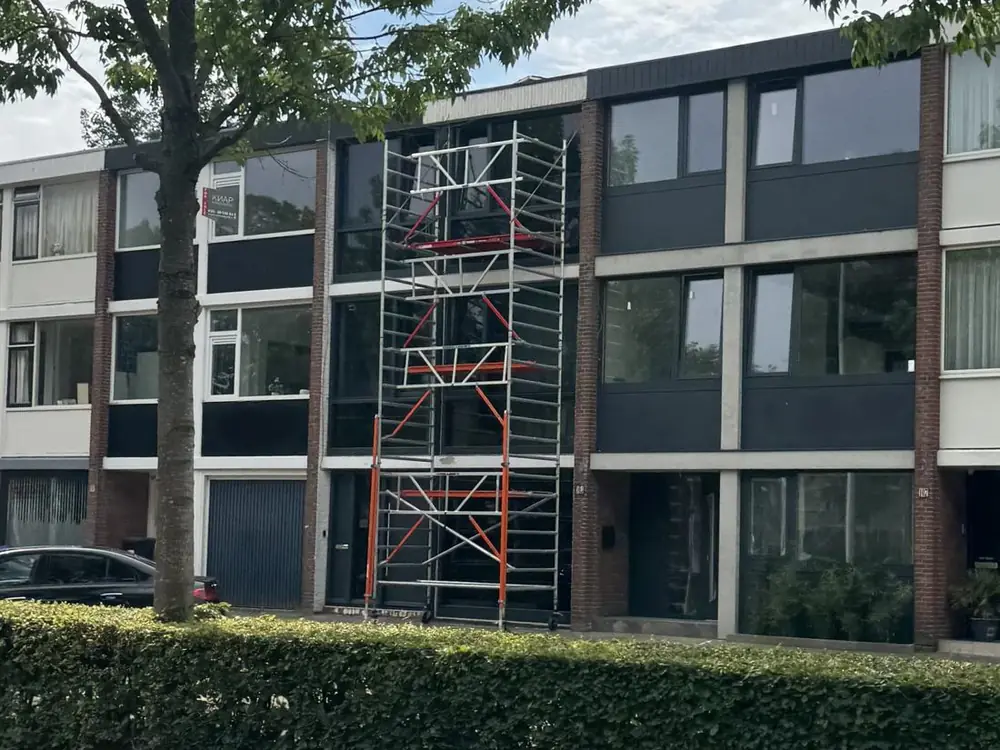
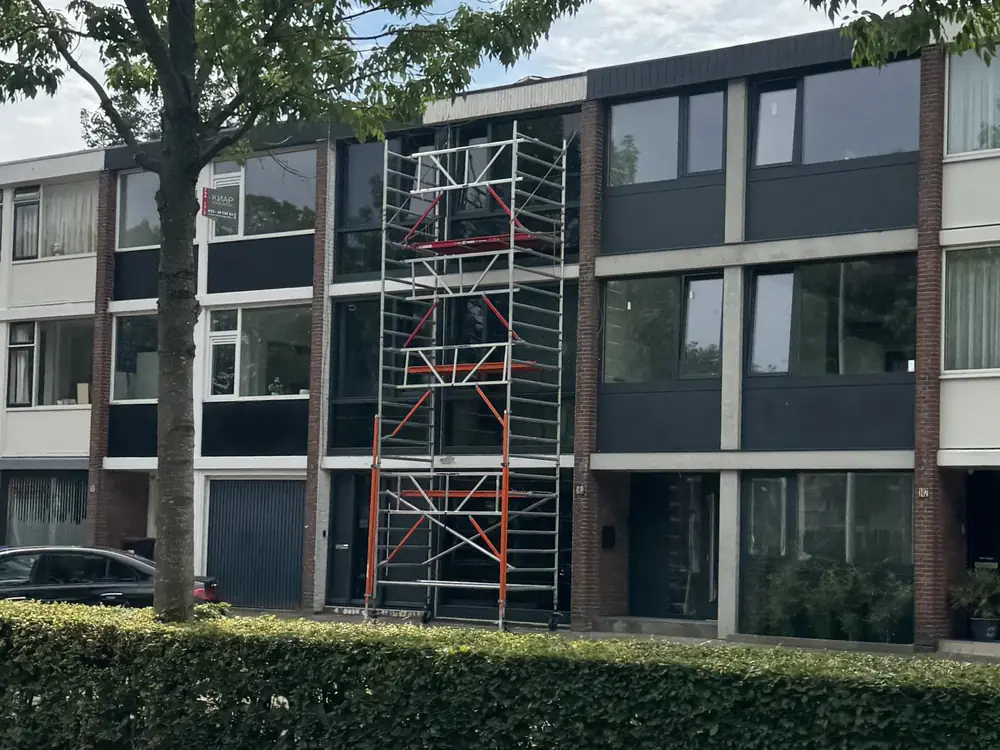
Slim mobile scaffold pitched at a dwelling front, close enough in to let you work flat along the boards

The deck is 245 cm long, and that length settles the strip of cladding you treat per set up. On horizontal boards it means finishing every plank across that width, from the top row to the bottom one, and only then rolling on. On vertical boards it runs differently, since you take plank by plank over the full height. You work in smaller units than on a solid wall, and the number of moves shows it. Sizes are compared in the overview of scaffold sizes.
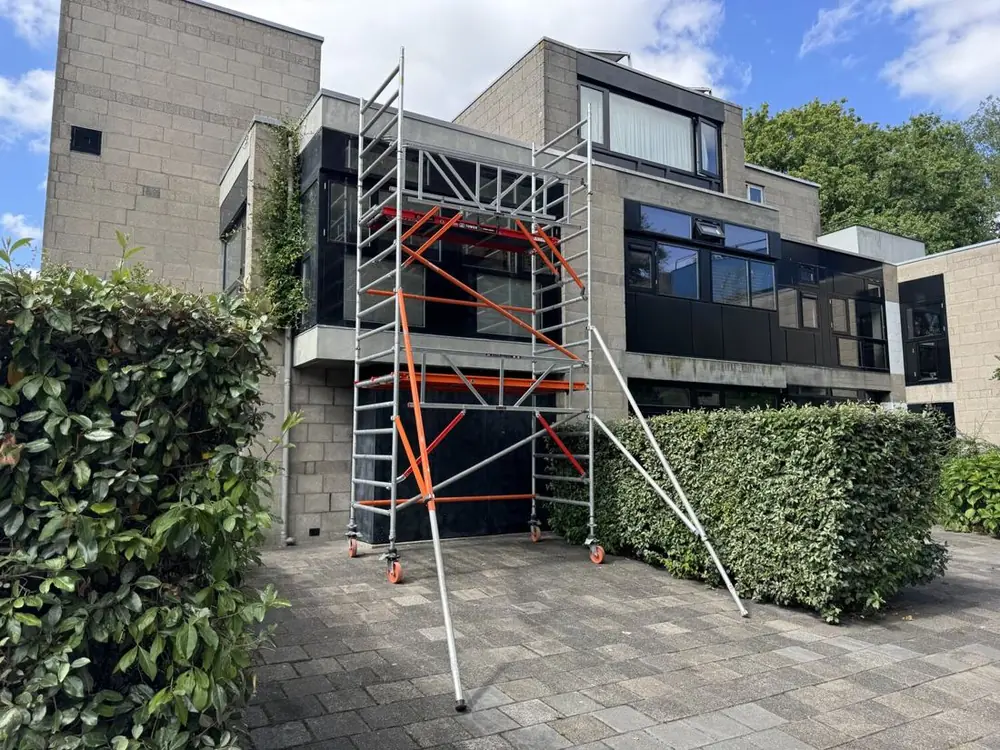
Working height to hire for cleaning timber cladding on two storeys

The highest point in this work is the top row of boards, tucked just under the fascia or the overhang. Over two living storeys that puts you on a working height of 6 to 8 metres. The platform then stands at 4 to 6 metres, because on top of the platform there is roughly 2 metres of reach to add. That number is what you pass on when you reserve. The build that belongs with it is shown at eight metres of working height.

When measuring, note where the cladding actually starts. Plenty of walls carry a brick plinth at the bottom with timber or plastic boards only above it, and sometimes the cladding is confined to the gable end. That changes nothing about the height you have to make, but it changes how you build up: you need reach to the top edge, not to somewhere halfway. Measure from the path the wheels will sit on, not from a terrace that lies a step higher.

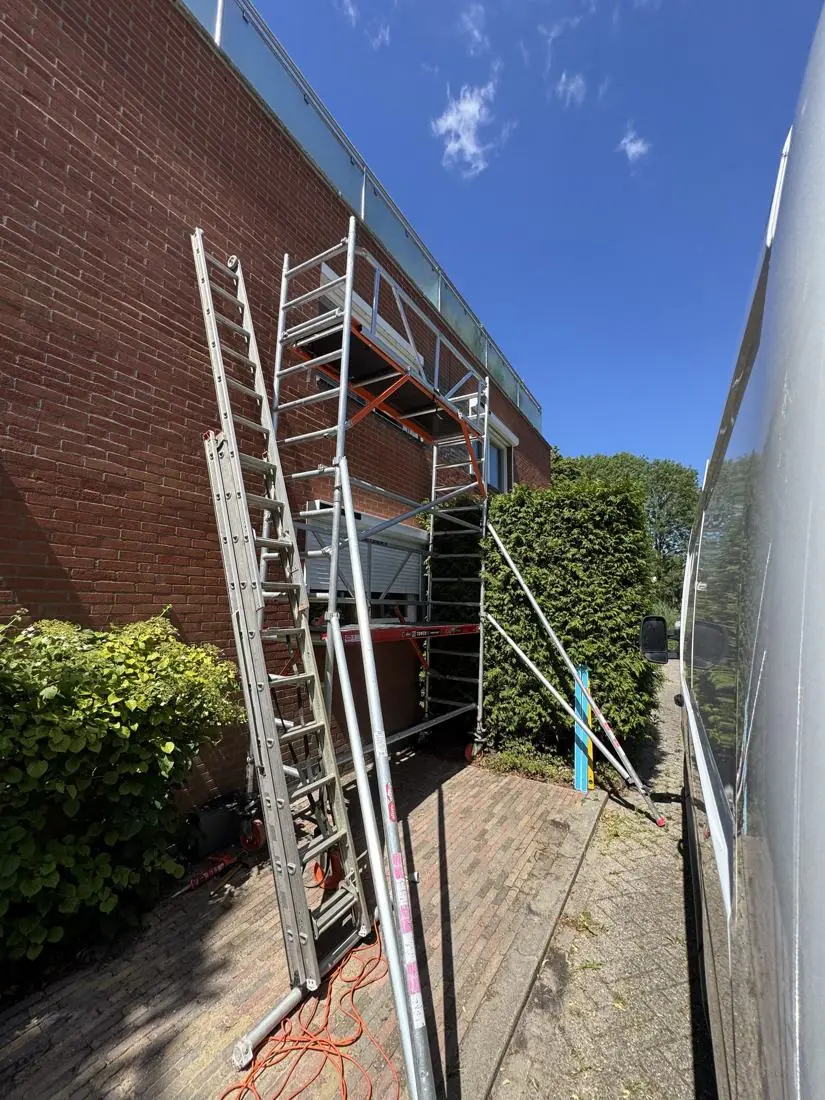
Mobile scaffold pitched along a house wall with reach up to the roof edge where the top boards sit

Reserving too low goes badly here, and not only because you miss a strip. The moment you begin stretching you put more force on the brush than you meant to, and on a coating that shows up afterwards as a dull band. That is precisely the damage you set out to avoid. So choose the roomier reach. On a wall of two living storeys that means getting above the roof edge. Half a metre of extra reach costs you next to nothing at booking.

Hiring a mobile scaffold and standing it beside fragile cladding

Cladding usually sits on the side or the back of a house, and there is rarely a broad terrace there. Your pitch therefore lands on a path, a strip of gravel or a patch of grass, with the wall an arm's length away. Deliberately keep a few centimetres between the frame and the boards. A tube that taps a plastic panel or a timber plank leaves a dent or a streak that no amount of cleaning will take out again.

Stabilisers angle outward at all four corners and each of them claims its own place. Along a narrow path that puts you into the border or up against the boundary fence surprisingly quickly. Look too at what protrudes from the wall lower down, since an outside tap, a vent grille, the gutter outlet or a crawl hatch all get in the way. On soft or falling ground, lay plates under the foot points; the guidance on uneven ground covers that.

Stabilisers at the base of a mobile scaffold on hard standing, the only footing this work may lean on

One more thing that often goes wrong at these walls: the cladding is not a support. The boards are fixed to battens and carry nothing themselves, so you do not lean the tower against them, you tie nothing to them, and you do not push off the wall while rolling. All the stability comes from the stabilisers and from level ground. Get those two right before you carry the first bucket up. A pitch that only stays upright thanks to the wall is no pitch at all.

How many rental days does cleaning cladding from a scaffold take

This work refuses to be hurried. Per set up you spend roughly three quarters of an hour soaping, brushing and rinsing off, because you go through each row of boards separately instead of sweeping across the face in long strokes. A single side elevation of two storeys is therefore a day of work. Go right round the house and you are at two days, and with a gable end or a bay window added it runs on further than you judge from the ground.

The build day comes on top of that, done in half a day but with little else achieved on it. Weather steers your planning as well. In full sun the product dries on the boards before you have rinsed, which leaves marks on exactly the face you meant to improve. In frost you do not start at all, because water stands in the joints. Overcast and dry is the best combination there is for cleaning cladding.

Built up mobile scaffold along a modern facade with flat panels, pitched for several days in a row

So do not set your rental period tight against your own estimate. You pay the full rate for the first twenty four hours; every day beyond it goes at 95 per cent off, so a day of slack costs you next to nothing. And if the cleaning reveals boards ready for replacement, that spare day is your inspection day with the tower still standing. Judging such a period in advance is covered in the note on rental days.

Which mobile scaffold suits cleaning cladding?

Kamersteiger RS44
  • Working height up to 4 metres
  • Compact and narrow
  • Great for indoor and small jobs
View and calculate →
Most chosen
Smalle rolsteiger RS51
  • Working height up to 14.2 metres
  • Narrow (75 cm)
  • Ideal for narrow passages
View and calculate →
Brede rolsteiger RS52
  • Working height up to 14.2 metres
  • Wide platform (135 cm)
  • Extra stability and workspace
View and calculate →
1-persoons steiger MiTower
  • Working height up to 6.2 metres
  • Very compact
  • Quick and easy to assemble
View and calculate →

Cleaning cladding from the platform without water behind the boards

Per set up you take on a face 245 cm wide, and within it you work strictly downwards. Begin at the top row, brush along the length of the boards and rinse that row before you drop to the next. Keep the jet pointed at a downward angle at all times. Aim it upward against the lap and the water travels behind the cladding, where you only find out months later what it has done in there.

Move on with the hose in your hand and not with the hose under the wheels. Close the tap before you climb down, lay the line in a generous curve along your direction of travel, then roll the tower through to the next strip in one go. Brake the wheels, set the stabilisers out again and check that you still have those few centimetres of clearance to the boards. Two minutes, and no crushed hose or dented panel.

Tower positioned along a side wall of a home, from which you work down one row of boards at a time

What people misjudge is the number of joints. A wall that reads as one smooth face from below turns out at close range to be dozens of planks, each with its own edge of dirt. Tape the vent grilles before you start. Bear in mind too that a face gleaming wet looks cleaner than it is; only once dry do you see where you still have to go. If rot or a split panel shows under the grime, see replacing cladding.

Hire a mobile scaffold with delivery at a clad facade

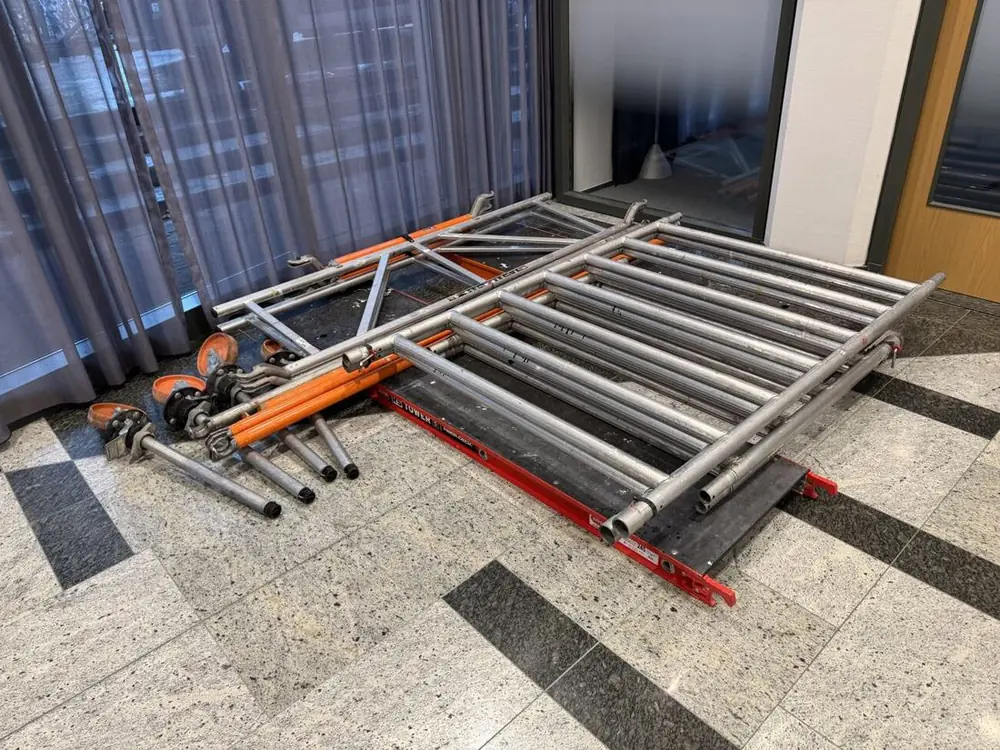
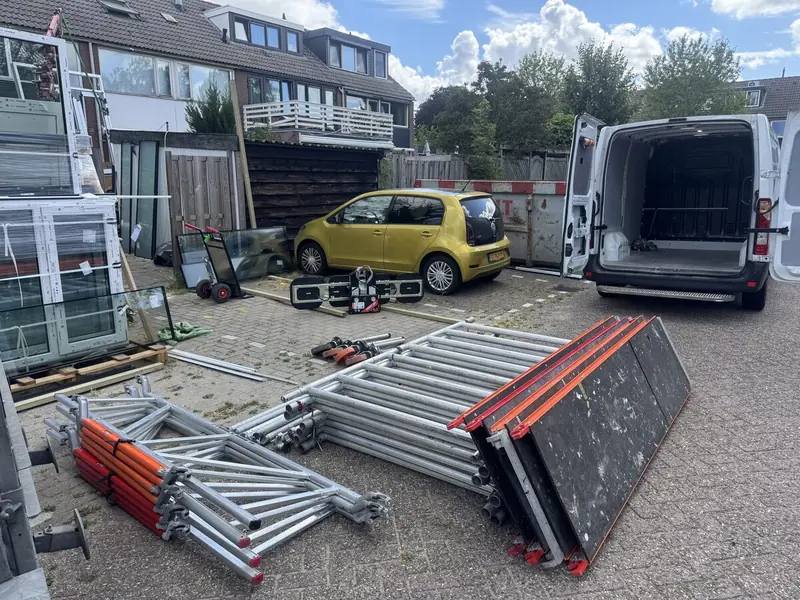
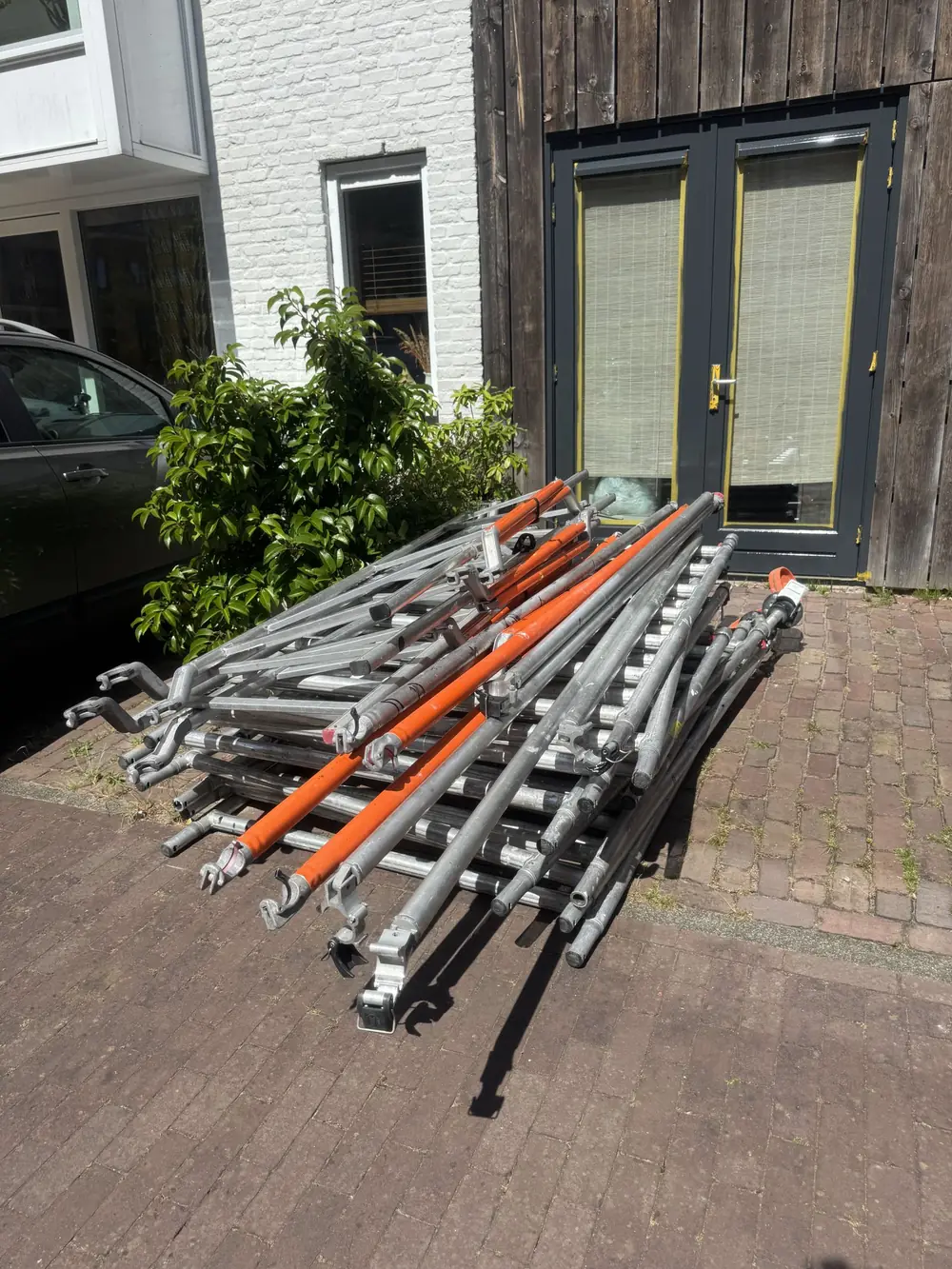
The tower is delivered in loose, counted components: standards, braces, deck boards, guard rails and wheels. Decide beforehand where that pile ends up, and do not lean it against the wall, because a tube sliding along plastic or timber makes precisely the scratch you were trying to avoid. A drive or a piece of terrace suits better. Delivery follows a simple rule: order on a working day, before 15:00 has passed, and we drive out to you the next working day.

The date the delivery happens and the date everything is fetched again are yours to set when you hire. For this job you want a dry, overcast run of days with no night frost, so look further ahead than tomorrow. Put the delivery a day before your first working day and you can build in peace. That build is laid out step by step in the guide to erecting a tower. Schedule it on a day you could not clean anyway and you lose no working time.

Complete inspected set of scaffold components ready for use, as it is dropped off at your address

Once your last working day is behind you the van comes back for the tower. Taking it apart and laying every component together is your part, preferably on the same spot it arrived. Let the deck boards dry off before you stack them and rinse traces of product from the tubes. Counting as you strip down saves searching afterwards, because a single loose brace in the grass is not something you find later. What the trip to your province costs, out and back, is listed at delivery costs.

Cleaning safely on a rented tower alongside timber boards

These decks sit in load class 3 and carry 200 kg per square metre, a figure EN 1004 fixes for towers of this sort. For cleaning cladding that is generous, since you take little up with you. It still mounts up the moment a second person joins you with a bucket in each hand, and a bucket of tepid water is ten kilos in itself. Spread the weight over the deck. What the class actually says is unpacked in the note on this scaffold standard.

The same standing agreements apply to this wet work. Wheels go on the brake before anybody climbs up, the pitch is never moved with a person or with kit on it, and you stop as soon as it blows hard. Wind is extra unwelcome here because the mist off your hose drifts everywhere and settles on windows and on the car. Walk the four stabilisers at every new strip before you start again, and check the wheels really are locked.

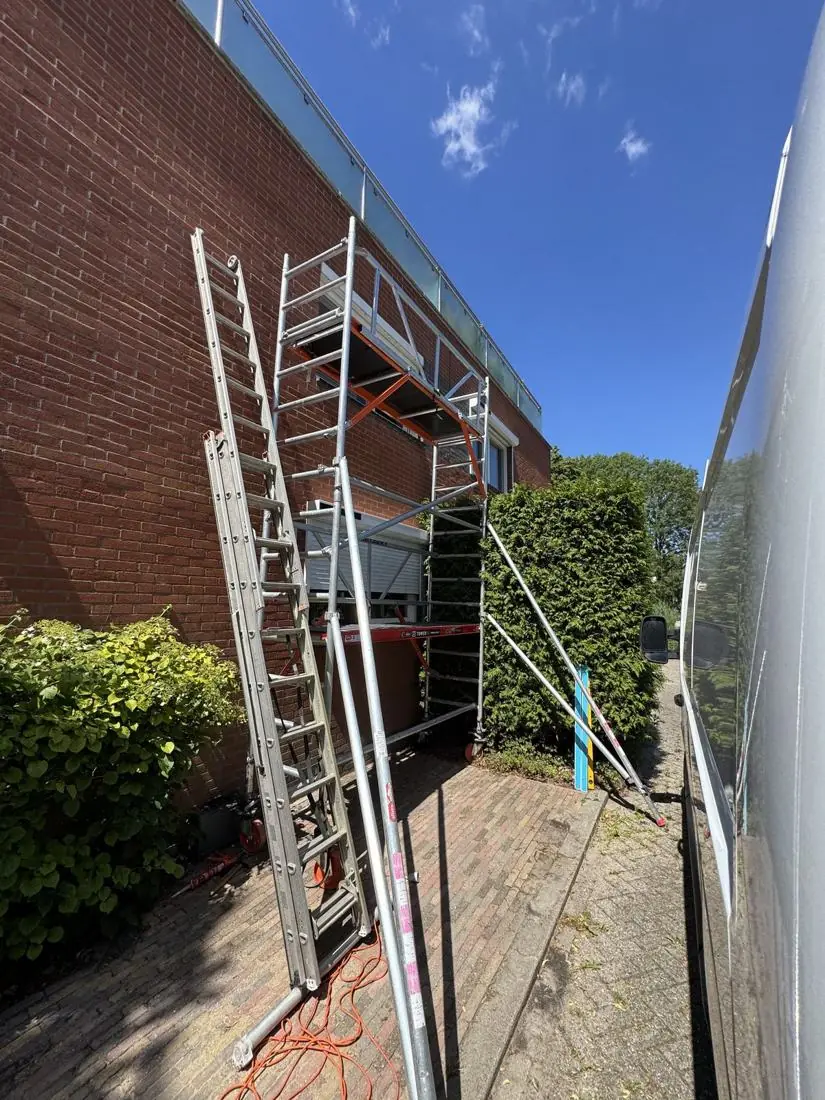
Mobile scaffold with guard railing and a ladder on the inside, the safe way up during wet cleaning work

The particular risk on this job is the water. A deck with cleaning product spilled on it turns lethally slippery, so rinse the platform between runs and wipe it afterwards. Keep the strip beneath the pitch empty, because a brush or a bucket that falls arrives below at speed. Watch for sockets and outside lights before you turn the hose on, since on this kind of wall they often sit in a routed out board. The rest is in the rules for working at height.

In 5 steps

How hiring a mobile scaffold works

1
Choose working height

Pick the height that suits your job.

2
Book online

Sorted in 60 seconds, price shown instantly.

3
We deliver

At the agreed spot the next working day.

4
Assemble safely

Assembled by you, with a manual.

5
We collect

One call and we collect the scaffold.

Good to know

Practical tips for cleaning cladding

1

Start with a test patch half a metre across in an inconspicuous place, behind the downpipe for instance. That shows you what the product does to the coating before you treat a whole wall from the tower.

2

Put a wide, soft spray head on the hose instead of a jet nozzle. A jet creeps in under the lap of the boards, and that is exactly the thing this job is meant to avoid.

3

Tape off the vent grilles and the letter plate before you pitch the mobile scaffold. From the deck you can no longer reach those openings to close them, and water that gets in ends up in the cavity.

4

Work with two buckets up top: one with suds and one with clean water for rinsing your brush out. Dirt left sitting in the bristles scours across the coating on your next stroke.

5

Keep a thumb's width of air between the scaffold tubes and the cladding and check it after every move. On a slightly falling path the pitch drifts towards the wall unnoticed, and then it taps against it.

6

Walk the wall once more after it has dried, before your collection day arrives. Marks you cannot see when it is wet stand out when dry, and the tower is still there to put them right.

Frequently asked questions

Frequently asked questions about cleaning cladding

Which mobile scaffold should you hire to clean cladding?+

Over two storeys the choice lands on the RS51, a narrow mobile scaffold 75 cm wide. You carry little material, you want to stand close in along the boards and you have to move often, and a narrow pitch suits all three. On top of that it passes the way through to the back or side elevation where cladding normally sits. Working in a pair, or taking more up with you, brings the wider 135 cm version into play.

How does hiring a scaffold work for cleaning timber boards?+

You pick a model and a working height online, say when the tower may be delivered and when it gets collected, and settle a fixed amount including VAT beforehand. We bring the components, you put them up and clean the cladding, and afterwards you stand it all dismantled ready. We come to fetch it. Plan your test patch on the first day, so you know product and method are right before the whole wall is due.

How many rental days does it take to clean the cladding?+

For a single side elevation of two storeys, one day is realistic, provided the mobile scaffold was delivered and erected the day before. Take the whole house and it becomes two days, and a gable end or a lot of small areas around frames adds another half. This work goes row of boards by row of boards and that simply takes time. So book with a day of slack rather than exactly on your own estimate.

What are you out of pocket to hire a scaffold for this cleaning work?+

The model and the chosen working height set the amount, and bringing and fetching carries a fixed price per province. The rental price including VAT is on the rates page, so there are no surprises at booking. One pleasant feature of the structure: the opening day weighs heavily and every day after it fades beside that. Keeping a tower on a little longer is no costly move, which is reassuring on a job that creeps forward row by row.

Which working height should you hire for cladding on two storeys?+

Hold to 6 to 8 metres of working height, which puts the deck at 4 to 6 metres. You start measuring where the wheels are going to rest and work up to the top row of boards, usually just below the fascia. If only the gable end is clad, you still measure through to that upper edge. Which mobile scaffold you need for which reach is on the working height pages, including the build involved.

Do you deliver the scaffold, or can you collect it yourself when hiring?+

That choice is yours at booking. With delivery we set the set down on the day you picked and take it back after your last working day, at a fixed rate per province. Prefer to fetch it, and that is possible by appointment and at no charge from Zeeburgerpad 89 in Amsterdam, so long as your van or trailer can hold the tower in parts. For a job of two days at most, having it brought is generally the calmest.

Is the tower standing when it arrives, or do you build it yourself on hire?+

No, erecting falls to your side. We drop the components with you and take them back afterwards; putting up, rolling and dismantling is your work, with the manual and the film beside you. Two people spend half a day on it. We hire out mobile scaffolds only, so no system scaffold, no facade scaffold and certainly no cherry picker; cladding at this height wants a tower anyway. Count that build time in, because you clean nothing on that day.

Can you hire an extra day if the cleaning takes longer?+

You can, only tell us in time and we move the collection day; the one case where it fails is a mobile scaffold already committed elsewhere. On this job it usually runs over because there prove to be more joints than expected, or because you decide halfway through to take the gable end as well. Finish sooner and it may go sooner. You fix the end date at booking and it can still be changed after that.

How much room do you need along a wall with cladding?+

Count the width of the mobile scaffold itself, what the stabilisers stick out left and right, and a strip for your buckets and the hose. On top of that you keep a few centimetres of air between the tubes and the boards so nothing taps against the cladding. On a narrow path beside a side elevation that gets tight quickly. Measure it before you order, because a pitch that cannot stand level is extra unwelcome here.

Can you keep the hire running while it rains during the cleaning?+

The tower may stay standing; it is your work you postpone. Rain in itself gets in the way less here than with painting, but you cannot judge whether a face is clean while it stays wet, and the product washes off before it does anything. Wet timber and wet panels are slippery besides. Wait a day and carry on; your rental period simply shifts, which costs little because you move the collection day yourself.

How do you get the deposit back after a wet job?+

A deposit belongs to the booking. Once the mobile scaffold is back and the set proves complete, we credit the amount to you again within one working day. So make sure every component is there and that no dried cleaning product is left on the deck boards and the tubes. A quick rinse on your last working day is enough. What else is involved is in the explanation of the deposit.

May you use a pressure washer from the scaffold?+

On cladding that is a poor idea, for two reasons. A hard jet blows the coating off timber or plastic boards and forces water behind the lap, where it never comes out again. On top of that the kickback from such a lance pushes you away from the wall, and you do not want that from a deck at six metres. So work at low pressure with a brush; a mobile scaffold gives you the calm and the hold to keep that up for a whole wall.

Hire a mobile scaffold for cleaning cladding today?

Calculate your rental price now or ask for free advice.

Rolsteiger van SteigerTaxi geleverd op locatie
Book it online

Your scaffold sorted in 2 minutes.

Choose your scaffold and working height, see the price instantly and book online.