
See your price
Application

Installing cavity wall insulation? Choose the right scaffold.

Installing cavity wall insulation is delivery work: the holes are already drilled, the machine sits on the ground, and you fill one opening after another from the bottom course upwards. Each shot lasts seconds, yet you have to watch the neighbouring hole while it happens and keep the hose running free of everything. Across a two storey elevation you deliberately hire the narrow RS51 at 75 cm, put up until the working height sits at 6 to 8 metres. Hire days and stands are mapped out further down this page.

  • Order before 3 pm, delivered tomorrow
  • Professional Altrex scaffolds
  • Up to 14.2 metres working height
  • Easy to assemble yourself
4,2 tot 14,2 mWorking heights available
12Provinces served
7Days a week
200 kg/m²Load class 3
In short
  • For installing cavity wall insulation we recommend the Narrow mobile scaffold.
  • This page deals with the filling itself; the survey that comes first sits on the sister page about insulating a cavity wall.
  • You hire a mobile scaffold 75 cm across, the RS51 at 6 to 8 metres, so the strip beside the wall stays walkable.
  • Keep the hired tower up after installing cavity wall insulation, until every opening is capped and the wall reads clean.
  • First 24 hours from €150 incl. VAT and delivery; every day after that 95% off.
Key facts for this job
FeatureValue
Recommended scaffoldNarrow mobile scaffold (Altrex RS TOWER 51)
Working height for this job6 to 8 metres
Available working heights4.2 to 14.2 metres
StandardEN 1004, load class 3 (200 kg per m²)
DeliveryOrdered before 3 pm, delivered next working day
Each extra day95% off, from €7.50 a day
Why a mobile scaffold for installing cavity wall insulation?

Safe, stable and professional work at height

Filling travels quickly so long as nothing interrupts it. You set the lance into an opening, hear the machine labour, and keep an eye on the hole beside it, because the instant material returns there the panel is full. Watching and listening at once only works when you stand firmly with both hands on the lance. On top of that a hose climbs with you from the plant at ground level and must never be pinched anywhere along its run. Hiring a tower for installing cavity wall insulation therefore turns on three things: a deck long enough to serve two rows of holes at once, clear ground at the foot, and days enough to cover the capping.

  • Installing cavity wall insulation bottom row upwards
  • Watching for blowback at the neighbouring opening
  • A hose left free down to the plant
  • Capping with mortar of a matching colour
Read more about working safely →

Hiring a narrow mobile scaffold for installing cavity wall insulation

For filling a cavity in a two storey house you take the 75 cm Altrex RS51, and the narrow base is a deliberate choice here. The strip along the wall is already carrying the hose, the plant and often a path through to the back garden, and a wide undercarriage swallows every bit of that. Widths and builds are gathered together on the page of towers you can hire by the day, the narrow model set out beside the wide one for comparison.

Little kit goes up with you in the first place: the lance hangs from the hose, a cloth and a stopper live in your pocket, and the sacks stay down beside the plant. Beads or fibre travel up through the hose rather than in your arms, so the deck stays clear for your feet. The wider 135 cm RS52 only earns its place when two of you work aloft together, one on the lance and one capping behind, and both need room to pass.
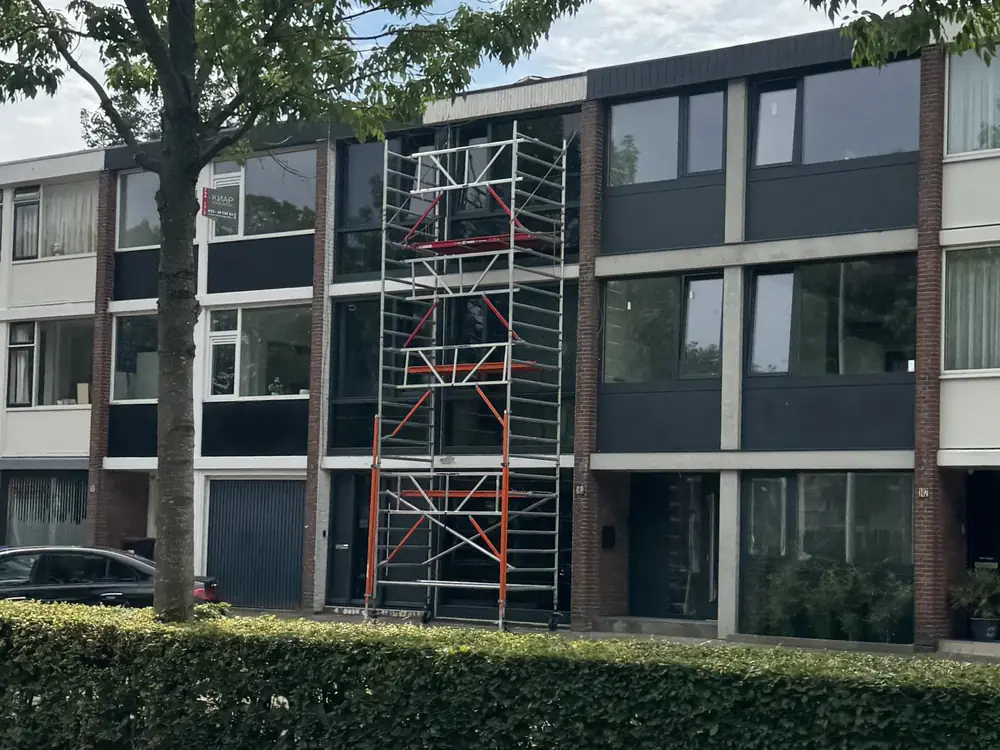
Assembled mobile scaffold standing at a modern house, the narrow stand that leaves the strip beside the wall free

The dimension that shapes how the day runs is the 245 cm deck, since it fixes how many openings one stand serves before you roll along. A broad deck buys working room rather than reach. The single-person MiTower stops at 6.2 metres and belongs on a bungalow or a garage wall, never on a two storey job of this kind. Compare the two facade builds properly in the overview of tower sizes before any dates are committed to, because a change of model later means a change of build.
What working height to hire for the topmost fill holes

The uppermost openings sit immediately beneath the roof edge, because a cavity has to come full right to the top course. Measure to that final row rather than to the gutter, and two storeys returns a working height of 6 to 8 metres. Turn the figure into a build by adding what you reach while standing, near enough two metres, to the height of the platform itself. Which assembly matches that band is worked out in full at a build reaching eight metres, part list included.

Something else counts on this job. You fill upwards, so from each stand you want two or three rows of openings within reach: the row at chest height, the row beneath it and the row just above your shoulders. Pick the build so one deck covers a broad band of elevation rather than pinning it tightly to the highest hole. That saves stripping an intermediate platform out and resetting the whole thing halfway through the afternoon, with a charged hose lying across the deck.

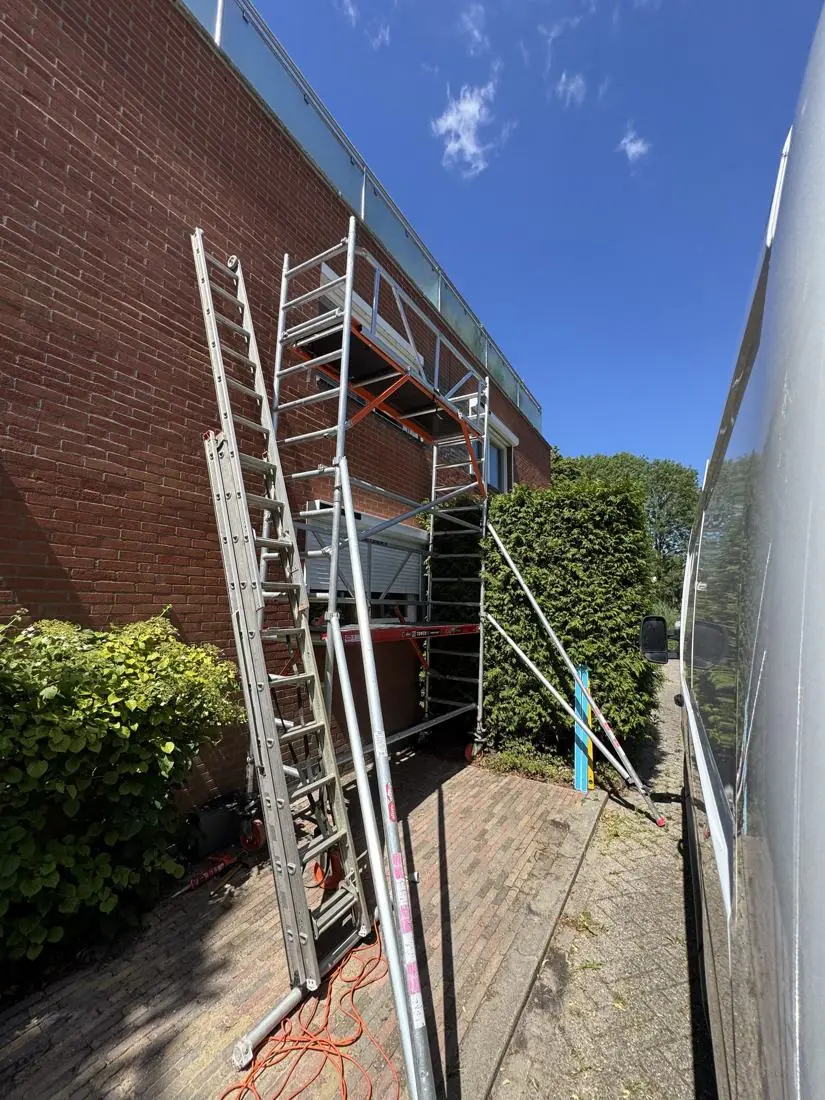
Mobile tower built along a side elevation, reaching the uppermost courses where the last row of openings is served

Your tape begins at wheel level, since a back garden seldom sits flush with the pavement out front. Come up short and the top row stays unfilled, leaving a cold strip directly under the roof where heat escapes quickest. Putting that right later means hiring a tower once more and building the whole thing a second time before installing cavity wall insulation in a single missed panel. Where the wall runs on past the windows of the first floor, take the roomier build without arguing about it.

Machine at the foot: hiring space as well as a tower

Ground beside the tower is doubly occupied on this job. The plant stands there with its sacks alongside it, and the four stabilisers reach into precisely the same area. Put the machine next to the stand rather than under it, so rolling along does not begin with shifting a loaded hopper across the path. What you want is level ground running wider than the stand on all sides, with room to slit sacks open and somewhere sensible for empty packaging to end up.

Decide exactly where you will stand before the parts are dropped off. Slabs, a drive or a raked path will do; grass that gives way under four wheels after a wet week certainly will not. Watch the run of the hose too, since it climbs from the plant and must not finish under a wheel or chafe across the sharp edge of a sole plate. For a step between terrace and garden, ground that slopes away offers practical answers.

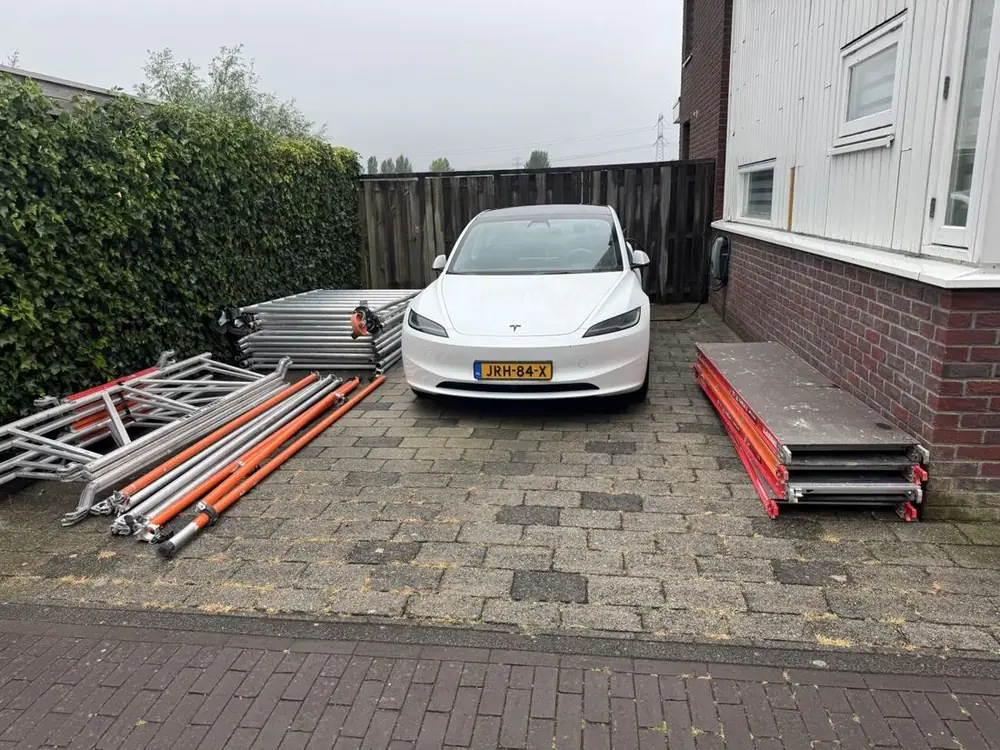
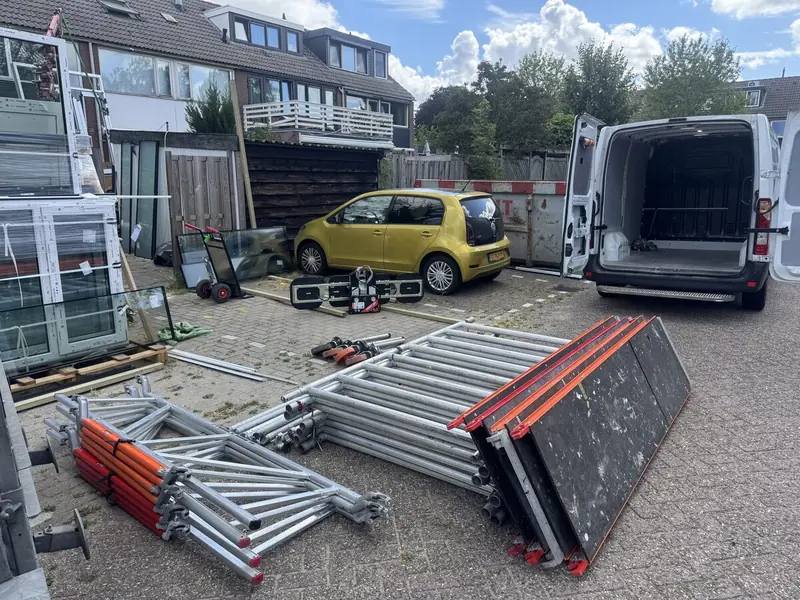
Loose scaffold frames and braces set down on a street surface, showing how much ground a single stand claims

Think about the neighbours, and think about dust. Some material always escapes around the openings while you are filling, and it carries a good deal further than people expect it to. Cover a pond, a vegetable patch or an open cellar light before you start, and avoid setting up right beside a car that has to stay parked all day. The tower is tied to nothing whatever, since nobody drills anchors into a cavity minutes after installing cavity wall insulation behind it.

Filling and capping: how many days to hire the tower

The filling itself finishes surprisingly fast. An ordinary two storey terrace is done inside a day, assuming the pattern is set out already and the cavity behind the brickwork holds no surprises. That tempts people into booking one single day, and that is exactly where it goes wrong. Time goes into everything around the filling: capping openings with mortar that matches, brushing the brickwork down, and only then checking whether the result actually holds up across the whole elevation you have filled.

Meet an obstruction and the whole plan slides. Rubble at the bottom of the cavity, mortar snots on the wall ties or a pipe blocking the flow all mean extra holes and a second attempt at another height. You discover it mid job, because the machine either empties faster than expected at that spot or refuses to feed at all. Carry a day of slack in the period you hire, even in cases where the survey beforehand was done as thoroughly as anyone could ask.

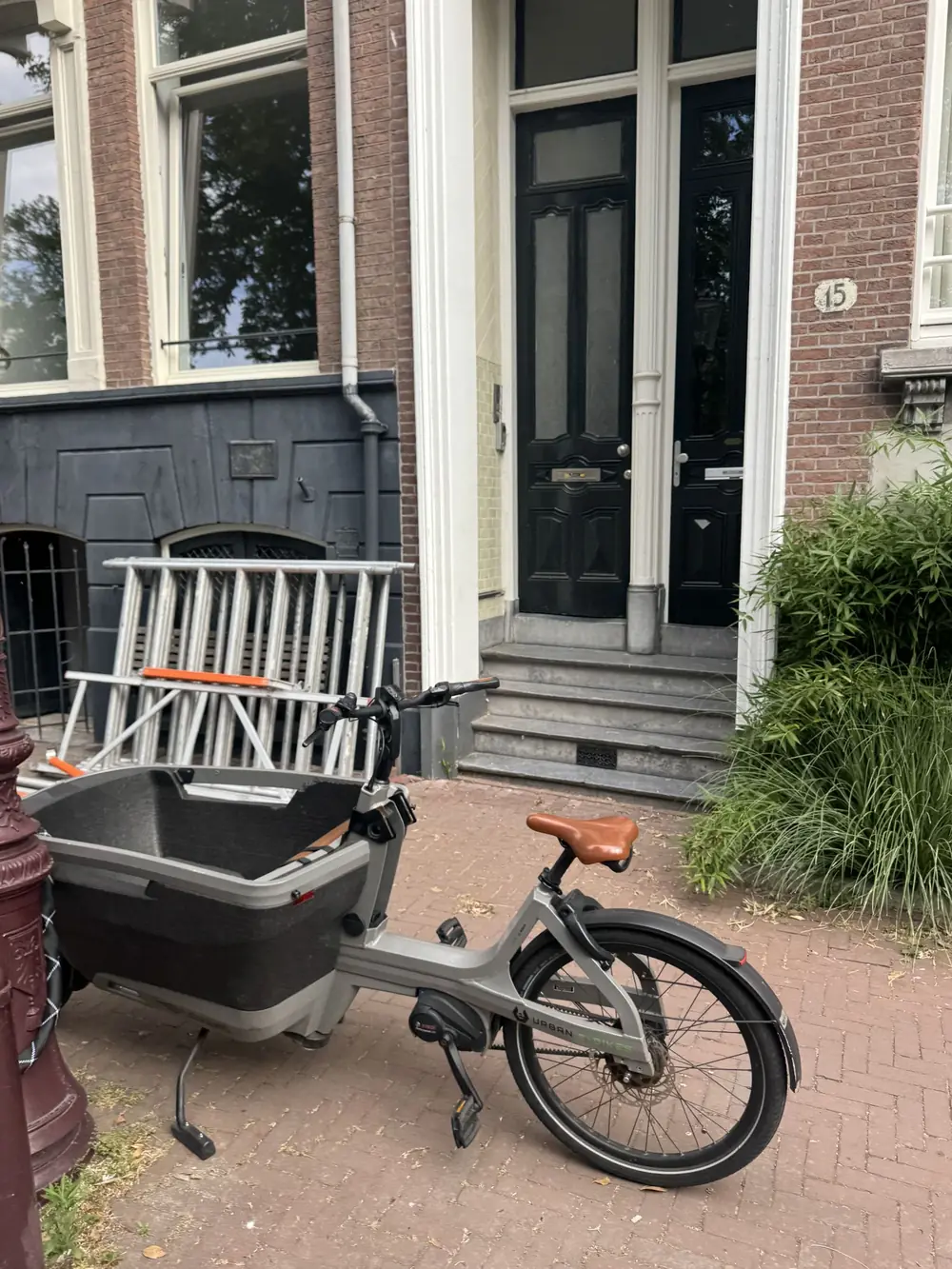
Frames leaning on a house wall behind a parked cargo bike, the hire set kept through the filling and capping days.

Your wallet copes with that easily enough. Full rate applies across the opening twenty four hours, while every day placed behind it counts with 95 per cent removed, so the slack weighs almost nothing. What does matter is this: send the tower away too early and there is nothing left to stand on when the thermal camera finds a cold patch. Every model has its own rental price, and every one of them is gathered at the rates for each tower alongside the builds they belong to.

Which mobile scaffold suits installing cavity wall insulation?

Kamersteiger RS44
  • Working height up to 4 metres
  • Compact and narrow
  • Great for indoor and small jobs
View and calculate →
Most chosen
Smalle rolsteiger RS51
  • Working height up to 14.2 metres
  • Narrow (75 cm)
  • Ideal for narrow passages
View and calculate →
Brede rolsteiger RS52
  • Working height up to 14.2 metres
  • Wide platform (135 cm)
  • Extra stability and workspace
View and calculate →
1-persoons steiger MiTower
  • Working height up to 6.2 metres
  • Very compact
  • Quick and easy to assemble
View and calculate →

Installing cavity wall insulation one 245 cm band at a time

Each stand handles a band of wall as wide as the deck, so 245 cm of brickwork. Inside that band you work from the bottom row upwards, opening by opening, so the material settles on itself and leaves no voids behind. Only once the band is full over its whole height do you roll along to the next one. Work across an elevation at random and you lose track of what has been filled, which surfaces later in the thermal images as a patchwork rather than an evenly insulated wall.

Blowback is your chief instrument while installing cavity wall insulation. When material shows at the neighbouring opening the panel is full and you stop; when it never shows, something is in the way or the material is escaping somewhere else entirely. That is why both holes want to be in view from the deck without craning around an upright. Cap each filled opening at once with a plug, or the contents run straight back out while you charge the hole beside it.

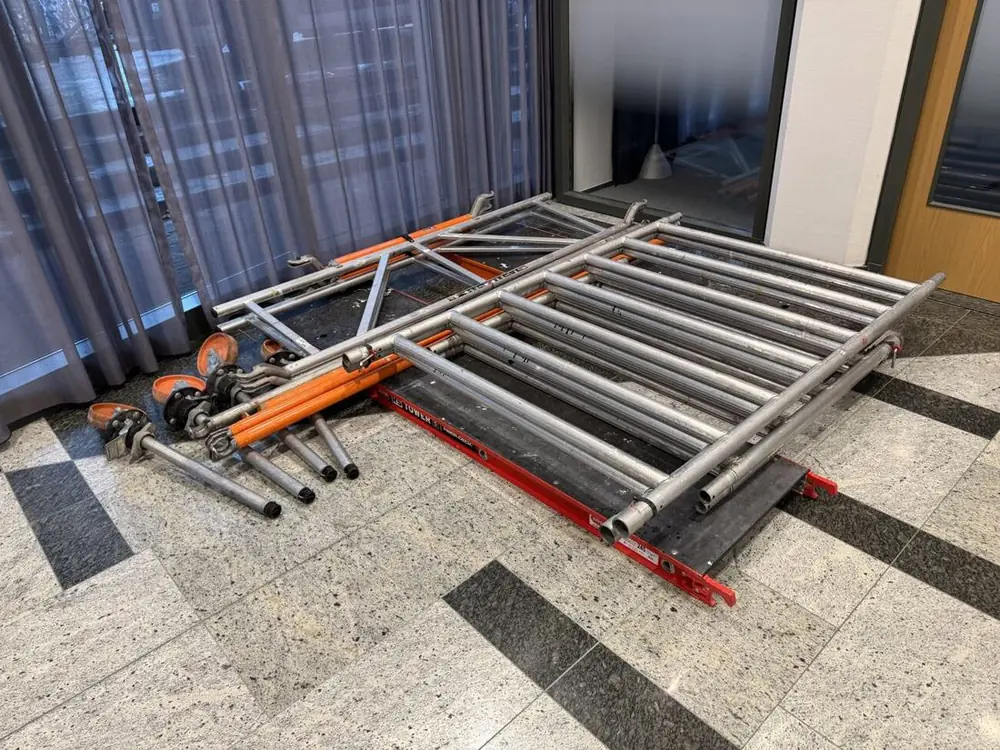
Complete checked scaffold set including its 245 cm decks, the length that fixes how wide one filling band runs

Capping belongs inside the same hire period. You close the openings with mortar matched to the colour and grain of the existing pointing, and that only works while you can still reach them from the deck. Do the round from the same stand, directly after the band is full, and no metre of wall has to be reached twice. How the pattern you are working through came about, hole by hole, sits on the sister page about judging the cavity first, which is where the survey work is described.

Delivery of parts when you hire a tower for filling

The tower reaches you in loose pieces, as a set counted through in advance. Agree beforehand where those pieces are to land, because the strip beside the wall is already promised to the plant and to the stock of sacks. A drive or a corner of the lawn beats the path along which you will be laying the hose. Place the order during working hours and finish it before 15:00, and every part of it turns up on the working day that follows.

Arrival day and departure day are both recorded when you hire. On this job let the set come the day before the filling: assembly is yours, a couple of hours with two people, the sequence set out by the manual and the video. Plant pulling up at eight while you are still levelling frames costs half a session of waiting about before installing cavity wall insulation even begins. The step by step assembly guide shows exactly what goes where and in what order.

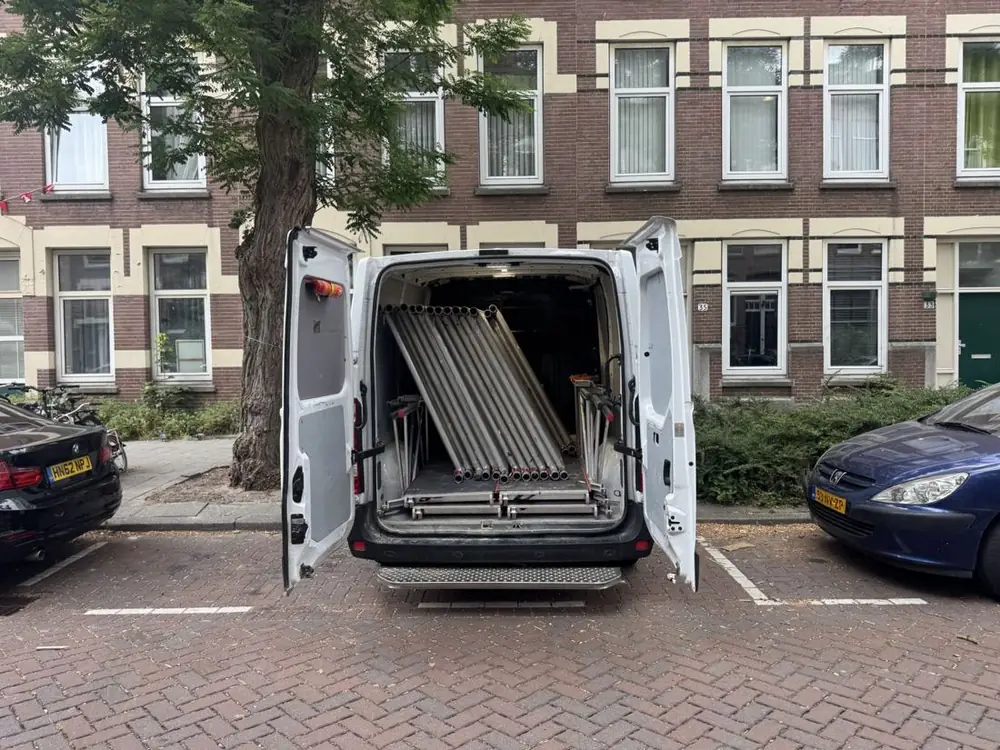
Delivery van at a house with scaffold parts, the drop off arranged a day before any filling work begins

Collection we arrange; dismantling stays yours, and the order matters a great deal here. Take nothing down before the mortar is in the openings and the elevation has been read over, or you lose the chance to fill a forgotten panel. Stack the whole set complete where the van reaches it easily, so not behind a gate that has to be locked. What your region charges for the round trip out and back is at delivery charges listed by region, so it can go into the plan early.

Working safely with a lance and hose at height

Load class 3 applies to the towers in this fleet, an EN 1004 rating that puts 200 kg on each square metre of deck. You and the lance stay well inside it, but a hose full of material weighs more than it looks and tugs steadily at your arm besides. Set the brakes before hauling that hose upwards, and lay it across the guardrail in a generous curve rather than pulled tight down an upright where it will snag on a brace.

Rolling happens with an empty deck and a hose pulled clear first, never with anybody aboard. Take the hose along in the direction of travel, drop all four stabilisers firmly afterwards, and check nothing is trapped before the plant starts again. That check costs half a minute and saves a pinched line. In strong wind you stop altogether: escaping material blows across the entire garden next door as well, and you stand unsheltered on the topmost deck while it happens.

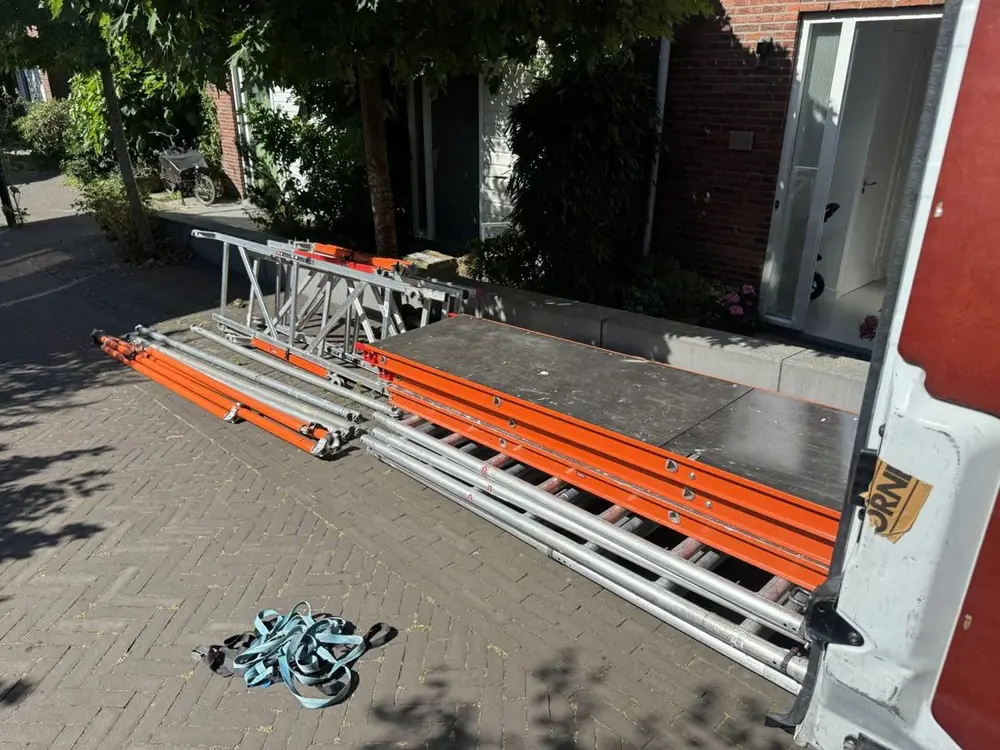
Counted set of scaffold parts standing on site, the components to check over before a first climb is made

The hazard that genuinely belongs to this job is dust and a slippery deck. Material coming back out of an opening spreads across the platform, turns greasy underfoot and gets into your eyes whenever you look upwards. Sweep between bands, wear goggles, and keep the area beneath the tower clear of people, since a lance breaking loose whips about hard. The remaining rules, including what to do when the wind turns, sit at the regulations covering work at height.

In 5 steps

How hiring a mobile scaffold works

1
Choose working height

Pick the height that suits your job.

2
Book online

Sorted in 60 seconds, price shown instantly.

3
We deliver

At the agreed spot the next working day.

4
Assemble safely

Assembled by you, with a manual.

5
We collect

One call and we collect the scaffold.

Good to know

Practical tips for installing cavity wall insulation

1

Measure the hose out before deciding where the plant will stand. Come up short at the final band and you would far rather move the machine once more than reposition and level the whole hired tower over again.

2

Cap each filled opening straight away with a plug or a stopper. Without one the material pushes back out at the next hole and you wrongly conclude that the panel behind it is already full.

3

Work each band from the bottom upwards and tick finished rows off on a printed picture of the elevation. By midday nobody recalls from memory alone which openings were done and which of them were skipped over.

4

Mix a small test of the repair mortar and let it dry on an inconspicuous stretch of pointing. Wet mortar always reads darker, and judging the colour while it is still wet leaves you with a blotchy finished wall.

5

Book the thermal camera round for a cold morning while the tower is still standing. Spot a cold band beneath the roof edge and you drill an extra opening that same day instead of hiring all over again.

6

Lay a sheet under the band you are working on. Material escaping around the openings then sweeps up in one go rather than being picked out of gravel and flower borders a handful at a time on the last afternoon.

Frequently asked questions

Frequently asked questions about installing cavity wall insulation

Which mobile scaffold do you hire for installing cavity wall insulation?+

For a two storey elevation the 75 cm RS51 is the hire that fits, because the ground beside the wall is already holding the plant, the sacks and the hose, and a wide base takes the last of it. Where two of you work aloft, one filling and one capping behind, the 135 cm RS52 buys the floor space to pass. Little goes up with you either way, since the material arrives through the hose rather than in your arms.

What is involved in hiring a tower for this filling work?+

A model and a build height are fixed online, an arrival date and a departure date chosen, and a price settled with VAT already inside it. The parts are set down on your ground, you assemble the tower and work the elevation band by band. Once everything is filled and capped, you dismantle and the return trip is arranged from our side. Allow an extra day inside the hire for the check that follows, because a thermal round needs the tower still standing.

How many hire days does filling and capping a cavity really need?+

Filling a terraced house usually takes a day, but the elevation is not finished at that point. Capping with colour-matched mortar, brushing down and inspecting want half a day at least on top. Two days of tower hire is therefore the realistic figure rather than one. Meet rubble or mortar snots in the cavity and drilling plus refilling joins the list, at which point the slack you booked into the hire earns its keep several times over.

What settles the hire cost when you fill a cavity from a tower?+

Two decisions do it: which scaffold model you take and how high it is built. Bringing the set out and collecting it again carries a fixed figure for your own province, VAT included in each. The way the rate is arranged suits this job, since the first day carries the weight and later ones barely register. Booking a day for capping and the thermal round after installing cavity wall insulation therefore costs so little that skipping it makes no sense.

Which working height do you hire for the topmost row of holes?+

Two storeys puts the build at 6 to 8 metres, measured up to the row of openings just under the roof edge. Start the tape where the wheels will end up, because a back garden often lies well below the pavement. Within that range hire generously, so one stand serves several rows. Leave the top row out of reach and a cold strip stays there that no later visit can fill without a fresh tower and a fresh assembly on the same ground.

Is the hired tower brought out, or can I fetch it myself?+

Both routes are open and you decide at the booking stage. Delivered, the set arrives on your chosen date and disappears afterwards, against a figure fixed for your province. Fetching it yourself is free by appointment from the yard on Zeeburgerpad in Amsterdam, so long as your transport handles the lengths involved. Since plant and material also have to arrive on filling day, most people have the scaffold delivered rather than adding a trip of their own to a busy morning.

Do I have to build the hired tower myself before filling starts?+

Assembly is your side of the arrangement. The set arrives complete and counted and returns the same way, but building, rolling and dismantling stay in your own hands throughout. Two people should allow a couple of hours for it, video and manual at their elbow. Anyone hiring alone and building alone takes considerably longer. Neither cherry pickers nor system scaffolds appear in this fleet, so a mobile tower is what a two storey elevation gets, and it is the right answer for filling work.

Can I hire for longer if the cavity turns out to be obstructed?+

Almost always, provided the set is not already spoken for by the next customer. Pass it on the moment you notice a panel refusing to fill, because that means extra openings drilled at other heights. Setbacks of that kind never announce themselves in advance, not even after a careful survey, so factor them in when you fix the hire period. A day added to the booking beats dismantling everything and rebuilding it a week later for one panel.

How much room do tower, machine and sacks want together?+

Besides the width of the tower itself, the stabilisers reach outwards all round, and to that you add space for the plant and the stock of sacks. In practice it comes down to a flat strip a few metres long beside the wall, plus a passage wide enough to keep feeding fresh material through. Clear bicycles, planters and garden furniture before you hire and build, rather than shuffling them about while a loaded machine is already running.

Can I keep working during my hire days if it rains?+

Filling a wet wall is a poor idea: moisture carried into the cavity stays there, and capping with mortar will not take on a soaked joint either. Wait for a dry spell and spend the wet hours staging sacks and walking the pattern through. The hired tower stays standing meanwhile, and because the collection date rests with you, that pause adds very little to what the hire finally comes to, since the tower is not being taken away and brought back.

After hiring for filling work, when is the deposit returned?+

Once the tower is back and every part has been counted through, the deposit is returned to your account inside a working day. On this job the things to watch are mortar residue and stray filling material: brush the decks and rungs before you dismantle, since dried mix on a frame does not come off easily later. Hand the hired set back as complete as it arrived, small clips and pins included in the count.

What is the difference from the page about insulating a cavity wall?+

That page covers the stage before this one: the test hole, the cavity width, the state of the brickwork, the lintels and the check for birds and bats. Here it is the execution, so filling hole by hole, the blowback at the neighbouring opening, capping with colour-matched mortar and the thermal round. Run both stages back to back and you hire the tower once for the full spread of days, which saves a second delivery and a second assembly.

Hire a mobile scaffold for installing cavity wall insulation today?

Calculate your rental price now or ask for free advice.

Rolsteiger van SteigerTaxi geleverd op locatie
Book it online

Your scaffold sorted in 2 minutes.

Choose your scaffold and working height, see the price instantly and book online.