
See your price
Application

Painting a stairwell? Choose the right scaffold.

Painting a stairwell runs in a fixed order, and that order starts at the top: first the ceiling over the void, only then the walls. While that ceiling is still to do, everything you roll throws spatter down onto finish you have already laid, and it needs the tallest set-up of the whole job anyway. For that you hire the Altrex RS44 room scaffold, made for indoor work and covering three to four metres. Below you can read which build goes with it and how many hire days a shaft like this asks for.

  • Order before 3 pm, delivered tomorrow
  • Professional Altrex scaffolds
  • Up to 14.2 metres working height
  • Easy to assemble yourself
4,2 tot 14,2 mWorking heights available
12Provinces served
7Days a week
200 kg/m²Load class 3
In short
  • For painting a stairwell we recommend the Room scaffold.
  • Painting a stairwell starts with an Altrex RS44 room scaffold, the indoor build that covers three to four metres.
  • Start at the top: the ceiling over the void comes first, then the wall panels, and the landing doors last of all.
  • Allow for the band around handrail height, which years of passing hands leave greasier than the rest of the wall.
  • First 24 hours from €50 incl. VAT and delivery; every day after that 95% off.
Key facts for this job
FeatureValue
Recommended scaffoldRoom scaffold (Altrex RS44)
Working height for this job3 to 4 metres
Available working heights4.2 to 14.2 metres
StandardEN 1004, load class 3 (200 kg per m²)
DeliveryOrdered before 3 pm, delivered next working day
Each extra day95% off, from €2.50 a day
Why a mobile scaffold for painting a stairwell?

Safe, stable and professional work at height

In a stairwell almost every wall panel has a raked bottom and a straight top, and between the two there is nowhere you can simply stand with both feet planted. That is why decorating goes wrong here so often: the cut line along the ceiling wanders, the roller passes fail to knit together, and the band at handrail height keeps grinning through. Hiring a scaffold for painting a stairwell buys you two things you cannot manage without. One is a flat working floor in the single place where there is otherwise only air. The other is enough hire days to finish the ceiling, the panels and the landing doors one after another without hurrying any of them.

  • The ceiling over the void is painted first
  • Panels run from the ceiling angle down to the string
  • A greasy band at handrail height needs extra preparation
  • Landing doors are the last thing to be coated
Read more about working safely →

Which room scaffold to hire when painting a stairwell

Waiting in the fleet for this job is the Altrex RS44 room scaffold, the model meant specifically for work indoors. What makes it right here is the pairing of a closed working floor with a guardrail around it and loose parts that pass through an opening of seventy centimetres. That second quality gets overlooked all the time: the whole set has to be worked in at the front door, along the hall and up the flight, and a part that sticks in the turn is no good to you at the top.

Width is not the deciding factor when painting a stairwell. You have a kettle, a roller on a pole and two brushes with you, and beyond that you mainly want room to turn while cutting along a raking wall. What you do want is a floor over the void that does not flex the moment you lean on the roller. A plank between two treads never gives you that feeling, whereas a properly built room scaffold does from the first step you take on it.
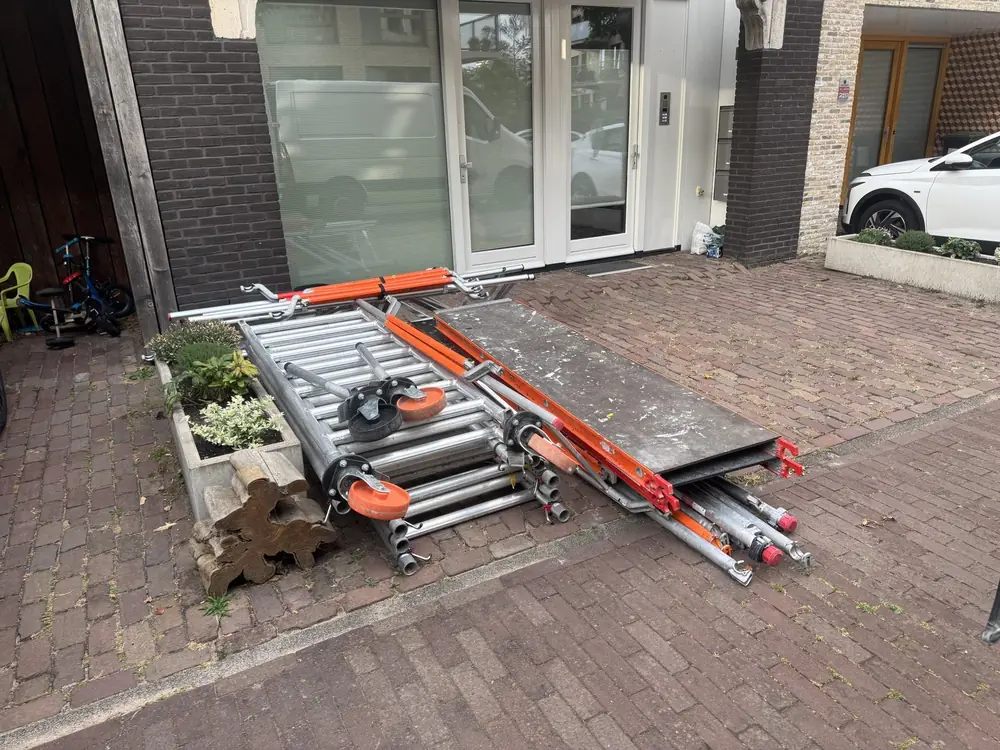
Frames, a grey deck section and orange braces set down on brick paving outside a pair of white glazed doors

Outside the house you would hire a mobile scaffold with far more build height, but indoors a model like that stops at the first door frame. The room scaffold is the sensible choice here and you need little else, though an extra adjustable leg over a falling flight is hardly a luxury. Ask for one when you reserve. Which models are available and how they differ from one another is set out on the page about hiring an indoor room scaffold, and that page is worth a look before you settle on a build.
Working height to hire for the ceiling above the void

The ceiling over the void is the highest point of the whole job, so that point decides the build you order. The misunderstanding lies in where you measure from: not from the hall floor downstairs, but from the level your set-up will come to rest on, which is normally the landing and a few treads under it. Straight up from that plane to the ceiling is the figure you fill in when you reserve. Take a tape to it properly rather than going by the height of the storey.

Our builds are quoted as working height, which adds about two metres of reach to whatever the deck stands at. For a stairwell in an ordinary house that brings you out at three to four metres, precisely the window this indoor model occupies. If you land between two stages, choose the one that lets you cut the ceiling with a bent arm rather than a straight one. A bent arm gives you a steadier line and less paint travelling down towards your elbow. More on that arithmetic sits alongside a build that reaches four metres.

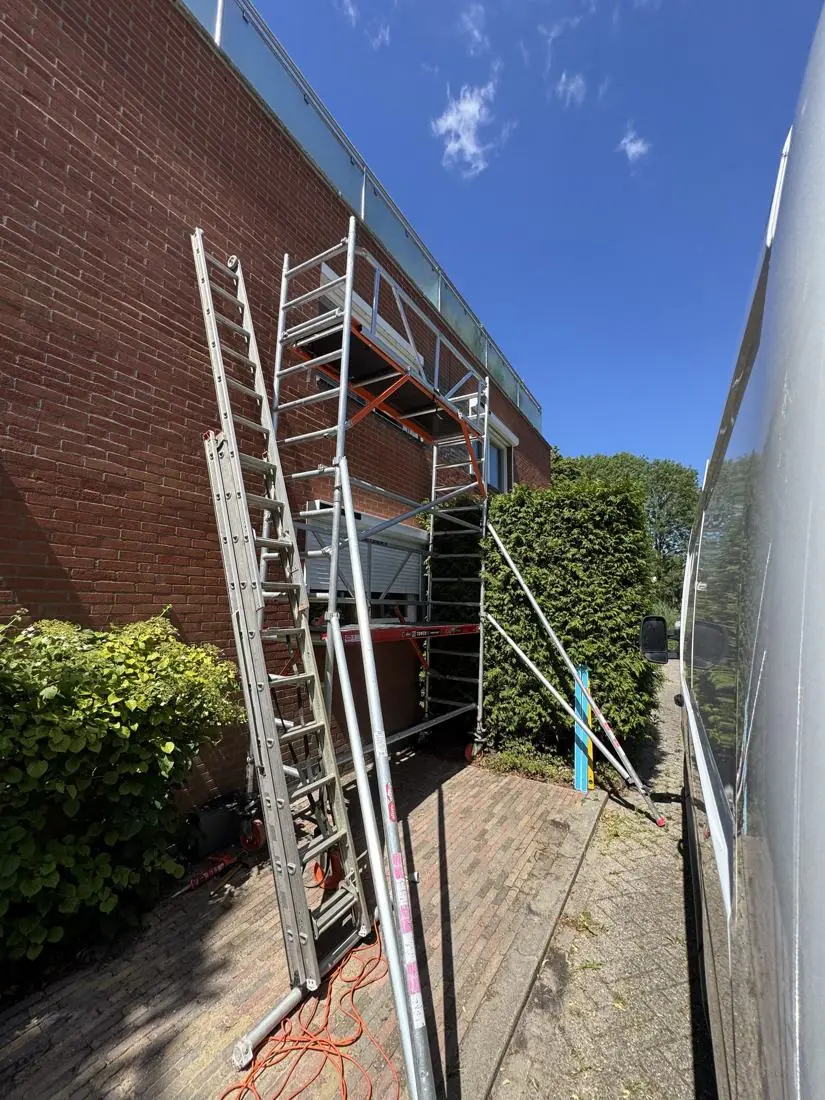
Tower assembled against a brick side wall in a narrow passage, a long ladder propped beside it on the paving

Standing too low takes its revenge on the cut line along the ceiling. With your arm straight above your head the brush shakes, you cannot see the line you are pulling and the edge comes out wavy, which in a stairwell shows up doubly because everyone looks at it from below. Paint drips down your sleeve from a raised roller as well. One stage more to hire costs little beside a line you would have to pull again, especially where the shaft carries on up to the first floor rooms.

Where the hired tower stands while painting a stairwell

While the ceiling is being coated, the set-up stands at its tallest right over the void, with its feet shared between the landing and the treads below. As soon as that ceiling is finished you drop back down a stage and move along one wall panel at a time. Each move costs you time, so divide the shaft into positions beforehand and sketch them on a sheet of paper. Then you know exactly how often you have to level up again in the course of the day.

Protect the flight before anything goes upstairs. A stair runner drinks spilt paint and timber treads take marks from feet and tools, so lay sheeting and tape it down as far as the skirting. Two things have to stand on the landing itself that will fit nowhere else: your kettle with the stock of paint, and the doors you intend to coat later on. Clear away the cupboards, the laundry basket and the loose belongings first, since none of it can stay once the tower is standing.

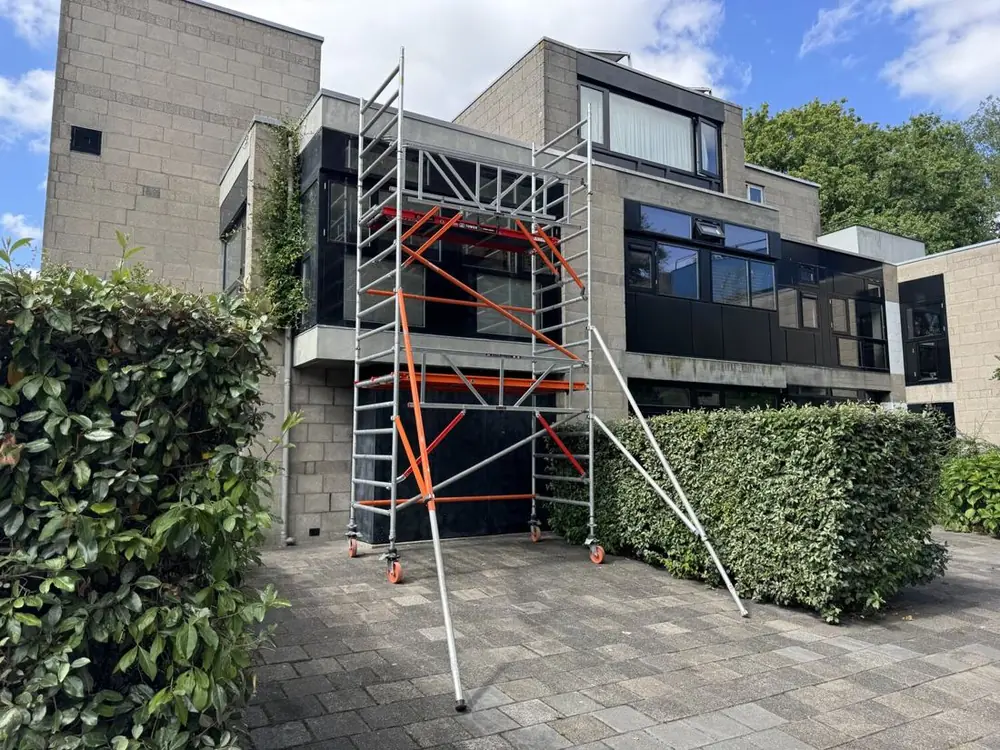
Base of an erected tower on block paving with its four stabilisers angled out onto the ground beside it

Watch the doors that open onto the landing as well. They tend to swing exactly into the space you want your set-up to occupy, so wedge them or lift them off their hinges if you are painting them anyway. How a tower is placed over an open void and what carries the load is described in this account of building above a stair opening. Read it through before the build begins, because a mistake corrected afterwards costs far more than the ten minutes of reading.

How many hire days a full stairwell repaint needs

Painting a stairwell is small in square metres and large in operations, which makes the planning deceptive. Day one goes on building, masking, degreasing the walls and finishing the ceiling in two coats. Day two is for the wall panels, two coats again, with drying time between them that you cannot hurry along. Day three covers the landing doors and touching in all the edges. Four hire days is therefore the rule rather than the exception, certainly if there is filling to do as well.

The greasy band around handrail height costs extra time that plenty of people forget. At that height years of hands have left their mark, and paint simply will not key there without thorough degreasing and sometimes a bonding coat on top. Skip that step and within a few months a shadow comes back over the full run of the flight. Allow half a day for that preparation alone, and a little more for sanding the patches that still shine afterwards.

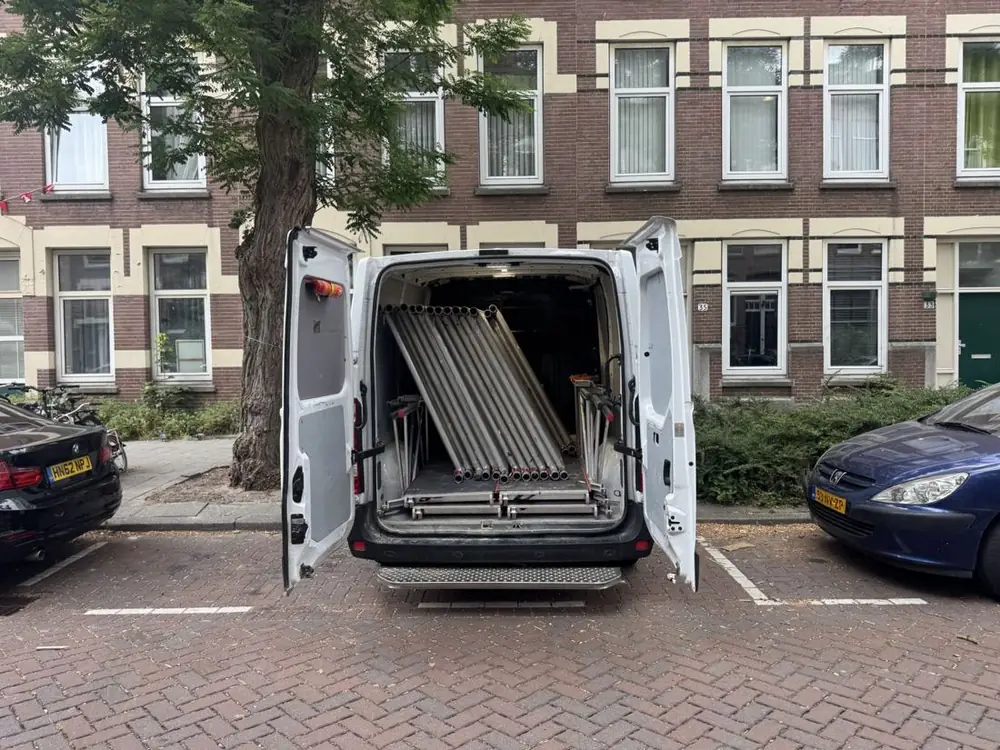
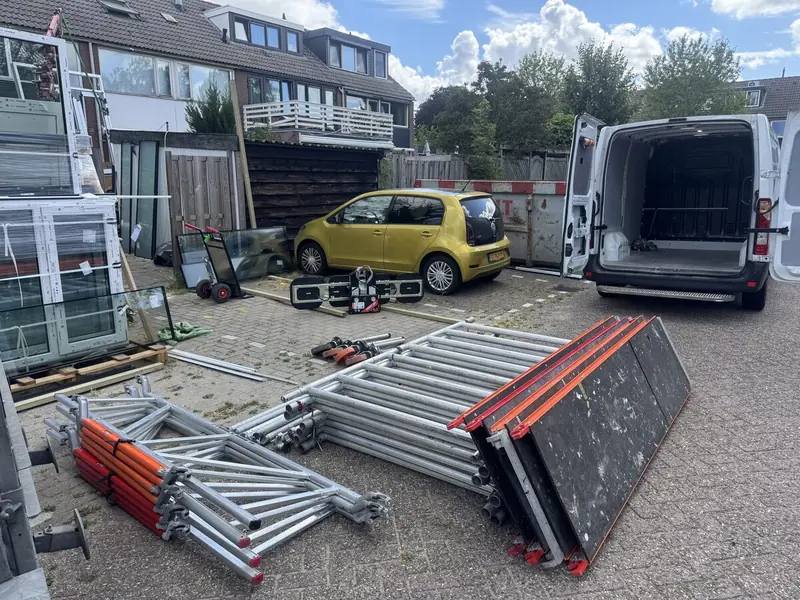
Van standing at the kerb in a terraced street with its rear doors open and scaffold frames stacked inside

Financially those extra days barely register. The full rate covers the opening twenty four hours and every day beyond that carries 95 per cent off, so a generous booking mainly buys calm in the planning. Book too keenly and you are looking at a half finished shaft while the collection round is already due, with a coat still to go and the doors still waiting. What an average indoor job asks for is explained in this note on hire periods indoors.

Which mobile scaffold suits painting a stairwell?

Most chosen
Kamersteiger RS44
  • Working height up to 4 metres
  • Compact and narrow
  • Great for indoor and small jobs
View and calculate →
Smalle rolsteiger RS51
  • Working height up to 14.2 metres
  • Narrow (75 cm)
  • Ideal for narrow passages
View and calculate →
Brede rolsteiger RS52
  • Working height up to 14.2 metres
  • Wide platform (135 cm)
  • Extra stability and workspace
View and calculate →
1-persoons steiger MiTower
  • Working height up to 6.2 metres
  • Very compact
  • Quick and easy to assemble
View and calculate →

Painting a stairwell: wall panels from a 245 cm deck

Your working floor is 245 cm long, which by chance is almost exactly the width of an average wall panel in a stairwell. So you take a whole panel from each position: first the cut edges with the brush, then the middle with the roller, and only then do you move. Anybody who shifts halfway across a panel gets a visible join where the wet edge went off, and on a flight in raking light that stands out immediately from the hall below.

When painting a stairwell the panels do not run tidily from floor to ceiling. They begin in the ceiling angle and finish at the string, so each one comes out longer or shorter than the last and the bottom is always raked. Work downwards and keep the bottom edge live until you reach the string. Cut the line along the string with a narrow brush rather than tape, because tape never follows a raking timber edge tightly enough to be worth the trouble.

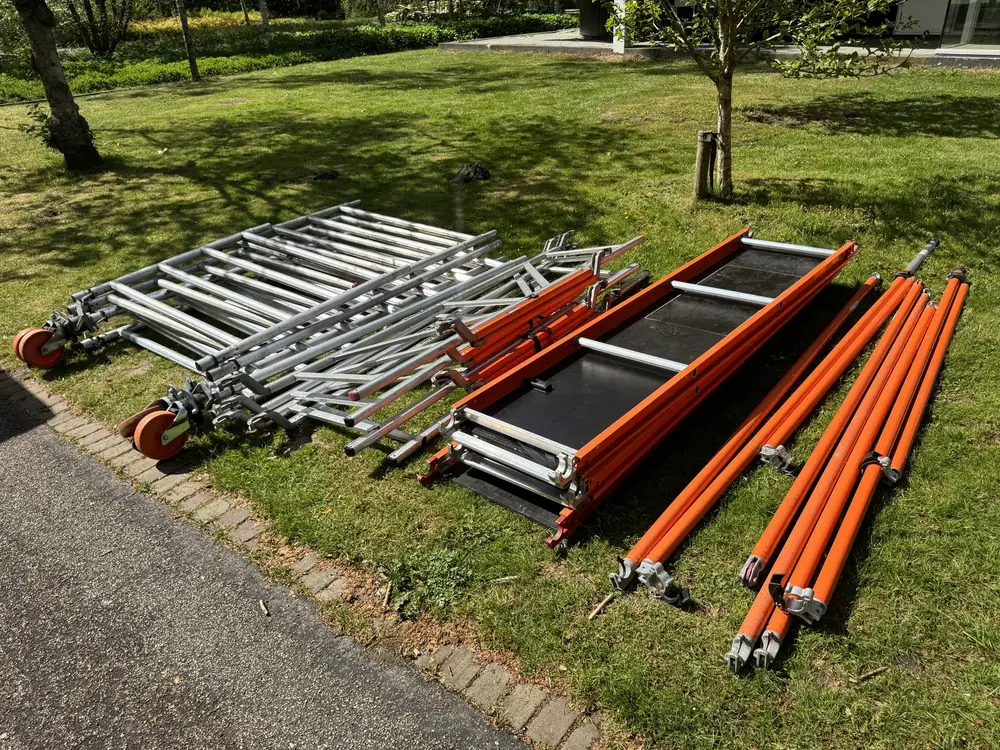
Stacked frames with red castors, a platform deck and orange tubes laid out on a lawn beside a path

The band at handrail height gets taken from the same position, but with different attention. Degrease that strip over its whole length, let it dry, and only then lay your coats on, or you will get shiny patches coming through the finish. Make sure one trip upstairs brings everything you need, because every descent means sliding down past a wet wall. Stand the kettle on the deck itself and never on the edge of the guardrail, where one careless elbow tips it over the side.

Hiring a room scaffold delivered before the first coat

A complete, counted set of loose tubes and deck sections gets dropped off at your place, and nothing more than that. Think in advance about where the pile comes to rest, because you badly need the hall and the bottom treads as your route upstairs. An empty room on the ground floor or the garage makes a better landing spot for the material. Anything confirmed on a working day before 15:00 gets loaded on the next working day and brought round to you.

When the material turns up and when it leaves again are both dates you set yourself. Set the delivery date one day ahead of your first coat, which leaves you time to build calmly, cover the flight and finish the masking. Assembly is not part of our package: that is yours to do, working from the printed manual with the instruction video running alongside. For a stairwell allow rather longer than for an ordinary room. The steps are described in this walkthrough of assembling a tower.

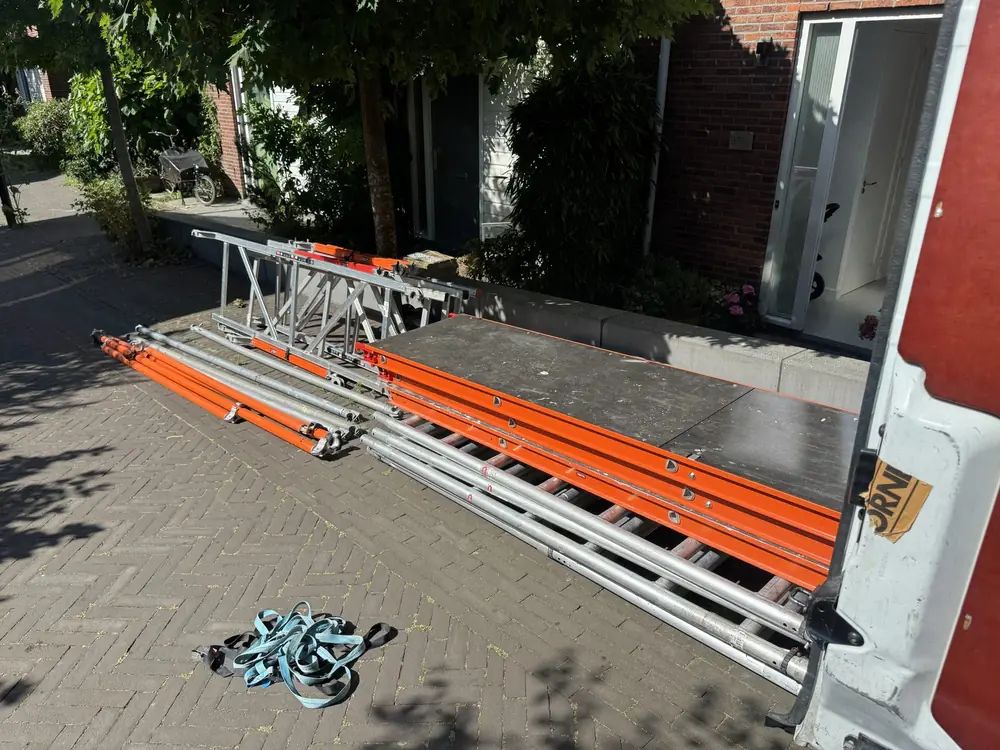
Long orange braces and grey frames stacked on herringbone paving beside the open side door of a white van

Once the last coat has dried you take the set-up apart and stand everything stacked on the ground floor, and we come to remove it from there. Collection costs nothing, by appointment, at our yard on Zeeburgerpad 89 in Amsterdam, so long as your own vehicle swallows the longest tubes without trouble. What a run per province costs is set out plainly under the rates for bringing and collecting, VAT included and settled before the tower ever arrives.

Safe brushwork above the void on a hired room scaffold

Your working floor takes 200 kg on every square metre, the load class 3 figure recorded in EN 1004. Doing paintwork in a shaft you never come close to that ceiling, even with somebody else beside you, but the number says more than weight alone: it belongs to a set-up braced at every point and with the deck sections locked down. Check those catches before you stand over an open void for the first time, and run through them again after every move you make.

If there are castors under your set-up they go on the brake before anybody climbs on, and the tower is never shifted while anybody or anything is still aboard it. In a stairwell that matters twice over, because the surface you would be rolling across is neither flat nor equally strong everywhere. Build up afresh once more rather than shoving a levelled tower along a tread with a kettle standing on it. Those few minutes gained are simply not worth the risk.

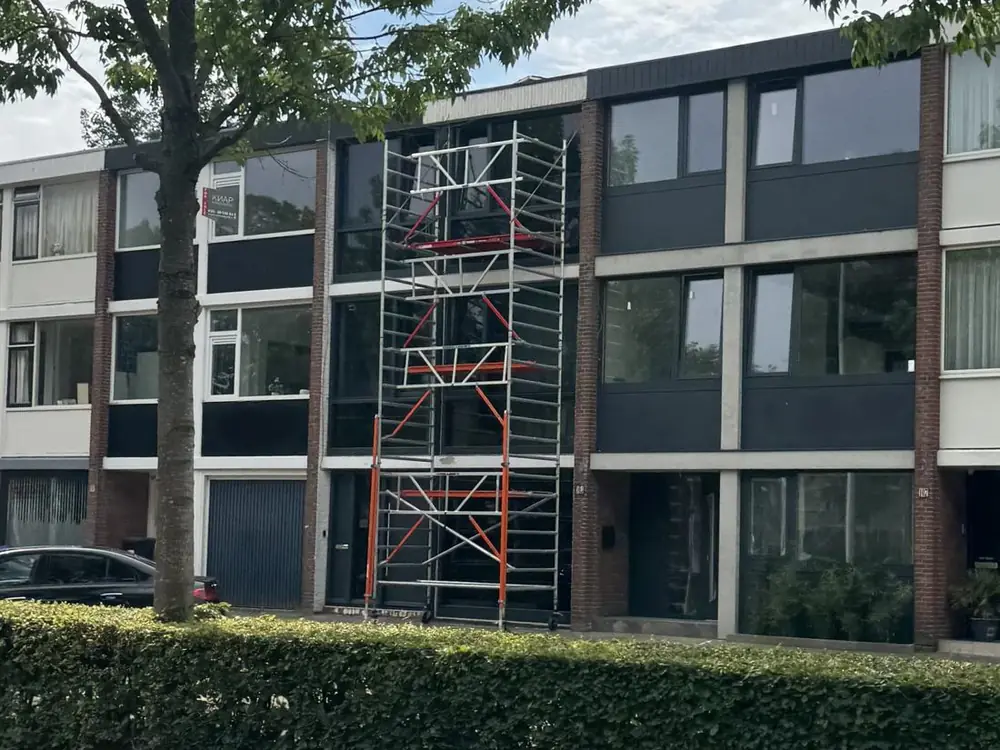
Narrow tower built up the full front of a modern block of flats, decks and guardrails fitted at each stage

The real danger here is the fall beneath you. Under the working floor there is no floor at all but the hall, a full storey below, and everything you drop ends up there. Make sure nobody walks on the flight below while you are busy above, and stow brushes and knives in a tray instead of leaving them loose on the edge. Paint on a tread makes the timber slick as well. The remaining guidance sits in this explanation of safe work at height.

In 5 steps

How hiring a mobile scaffold works

1
Choose working height

Pick the height that suits your job.

2
Book online

Sorted in 60 seconds, price shown instantly.

3
We deliver

At the agreed spot the next working day.

4
Assemble safely

Assembled by you, with a manual.

5
We collect

One call and we collect the scaffold.

Good to know

Practical tips for painting a stairwell

1

Finish the ceiling over the void completely before you start on any wall. Spatter from a rolled ceiling always lands on the wall and never the other way about, so that order saves you a whole coat.

2

Degrease the band at handrail height with a clean cloth and swap that cloth far more often than feels necessary. With a cloth that has gone dirty you only carry the grease across the rest of the wall.

3

Cut the line along the string with a narrow brush instead of masking tape. A timber string runs at an angle and has rounded arrises, and no taped line ever beds down tightly on that.

4

Stand a lamp down in the hall and let it shine up along the wall. In that raking light you see straight away which passes are not covering, something daylight from above will never show you.

5

Lift the landing doors off their hinges and lay them flat on two trestles in another room. Coating them upright above a void gets you nothing but runs and a good deal of awkwardness.

6

Ask for a collection date one day after the final coat when painting a stairwell. You want that morning for stripping sheeting off the flight and carrying the parts down dry, counted and complete.

Frequently asked questions

Frequently asked questions about painting a stairwell

Which scaffold do you hire for painting a stairwell?+

The Altrex RS44 room scaffold is the model to take from the fleet here: an indoor build reaching three to four metres, whose parts pass through ordinary internal doors. You want it above all for the ceiling over the void, the one point no pair of steps gets you to safely. After that the same set-up serves at a lower stage for the wall panels and for cutting along the string. In a domestic shaft you need nothing larger than this.

How does hiring a room scaffold for stairwell paintwork run?+

You reserve on the website, settle on a model and a build stage, state on which date the parts should turn up and on which date they leave again, and pay one fixed sum that already carries VAT. After that the set reaches you as loose scaffold components, you carry them upstairs and assemble the tower on the landing. At the end of your period everything goes back down, dismantled and stacked. The only decision left to you is which morning you start on the ceiling.

How many hire days does a complete stairwell repaint take?+

Three days of hire is the minimum and four is more realistic. Ceiling and walls each take two coats with drying time in between, and the strip at handrail height asks for half a day of degreasing and priming on its own. If the landing doors are in the job as well, add another day. Book tightly and you will be cutting along the string on collection morning, and that is the last part of painting a stairwell that wants hurrying.

How is the rental price put together for this indoor job?+

Two things set the figure: the model with its build stage, and a fixed charge for the journey out to your province and back again. You will find the whole rental price, VAT included, on the page setting out our rates. For painting a stairwell the structure works in your favour: once the opening day is behind you the daily figure falls away to a fraction of it, so building drying time into the period barely shows in the total at all.

Which working height do you hire for the ceiling over the void?+

Measure from the plane your set-up will rest on, so the landing and the treads immediately below it, and not from the hall downstairs. From that point up to the plasterboard you land at three to four metres of working height in a normal house, which the room scaffold covers exactly. If you fall between two stages take the upper one, since cutting with a bent arm is simply more accurate. The table of working heights lines the builds up.

Do you take delivery, or fetch the hired scaffold yourself?+

That choice sits entirely with you. Ask for delivery and the scaffold components stand at your door on a date you chose, and we return for them after your final coat has gone on. Fetching them yourself is possible by appointment at no charge, but bear in mind that the longest parts have to fit in your car or trailer. For a stairwell most people take delivery, because the arrival day is already needed for building and masking.

Must you build the hired tower above the void yourself?+

Yes, assembly falls within your part of the arrangement. We set the complete scaffold set down for you and come back for it afterwards, but putting it together, levelling it above the flight and taking it apart all stay with you, with the manual and the instruction video to follow. In a stairwell reckon on this taking longer than in a living room, because the parts go up first and then have to be levelled on uneven ground.

Can you hire for longer if the paintwork in the stairwell runs on?+

In almost every case that is fine. Let us know and we move the collection round to a later day, as long as the tower has not already been put on the calendar for somebody else. Shafts overrun regularly because the greasy strip at handrail height needs more preparation than expected. To cover that risk, plan an extra day in at the moment you book; handing back early is equally allowed and costs you nothing.

What has to be cleared off the landing during the hire?+

Reckon on the footprint of the room scaffold with walking room around it, plus somewhere for your kettle, your masking materials and the doors you are going to lay flat later. In practice that comes down to a completely empty landing, so cupboards and laundry baskets go first. Check whether the light fitting in the void can come out as well, because it hangs almost exactly at the height your hired working floor will end up at.

Does the tower stay on hire while the first coat dries?+

Yes, and that is how it is meant to work. The tower stays standing at the same stage while the wall or the ceiling goes off, so next morning you carry on with your second coat without levelling anything again. Do lift your kettle and your tools off the floor when you stop for the day. Since you fix the collection date yourself, a drying day slots into the period without anything needing rearranging.

What does paint on the parts mean for your deposit when hiring?+

Once the return journey is done your deposit is back within one working day, as soon as the hired scaffold parts have been counted and looked over. Spatter you wipe away the same day causes nothing at all; dried emulsion on deck sections and guardrails is another matter. Lay a piece of card where the kettle stands and wipe the edges of the platform at the end of each day. Five minutes keeps the whole thing straightforward.

Can the landing doors be done within the same hire period?+

Yes, and it is shrewd to schedule them inside it. The doors come off their hinges as soon as the walls are finished, and you coat them flat in another room while the shaft dries out. That way a drying day is fully used without the tower having to stay on hire beyond what the walls needed anyway. It also spares you a second build in the same cramped space a fortnight later, which nobody enjoys.

Hire a mobile scaffold for painting a stairwell today?

Calculate your rental price now or ask for free advice.

Rolsteiger van SteigerTaxi geleverd op locatie
Book it online

Your scaffold sorted in 2 minutes.

Choose your scaffold and working height, see the price instantly and book online.