
See your price
Application

Plastering a shed wall? Choose the right scaffold.

Plastering a shed wall is outdoor work, and outdoors there is no heating, no closed door and no way of steering the climate. Wind, sunshine and how thirstily the brickwork drinks decide how fast you keep moving, which is why you want a face finished in one session from the top down. The MiTower is the model for that: light, slim, and assembled to 4 or 6 metres of reach depending on your wall. Further down: how many days you hire, where it stands beside the building and what frost does to the plan.

  • Order before 3 pm, delivered tomorrow
  • Professional Altrex scaffolds
  • Up to 14.2 metres working height
  • Easy to assemble yourself
4,2 tot 14,2 mWorking heights available
12Provinces served
7Days a week
200 kg/m²Load class 3
In short
  • For plastering a shed wall we recommend the 1-person scaffold.
  • For plastering a shed wall you hire the MiTower, put together to a working height of somewhere between 4 and 6 metres.
  • Outdoors you cannot steer the drying: wind, sun and overnight frost decide which days the hired tower will actually earn its keep.
  • A face wants finishing in one session from the top down, so choose your moving point before any mortar goes into the tub.
  • First 24 hours from €100 incl. VAT and delivery; every day after that 95% off.
Key facts for this job
FeatureValue
Recommended scaffold1-person scaffold (Altrex Mi Tower)
Working height for this job4 to 6 metres
Available working heights4.2 to 14.2 metres
StandardEN 1004, load class 3 (200 kg per m²)
DeliveryOrdered before 3 pm, delivered next working day
Each extra day95% off, from €5 a day
Why a mobile scaffold for plastering a shed wall?

Safe, stable and professional work at height

Render outdoors has no pause button. From the first band onwards the clock is running, because the background pulls water out of your mortar and the wind takes care of the rest. Break off halfway and you will see that interruption later as a seam across the face. So your set-up has to be standing before you start mixing, and you need to know in advance where it moves to. A ladder is no help at all here: one hand carries the hawk, the other holds the trowel, and the tub needs somewhere flat to sit. Hiring a tower for plastering a shed wall is therefore about keeping going, not about reaching high.

  • Outdoors nothing lets you steer the drying rate
  • The background pulls water straight from your mortar
  • One wall face finished in a single session
  • One night of frost ruins a fresh render coat
Read more about working safely →

Which MiTower to hire for plastering a shed wall

Plastering a shed wall points you at the MiTower, Altrex's one person model with a base 75 cm across, a type carrying on to 6.2 metres of working height. Beside an outbuilding that measurement is a gift: it passes a side gate and a paved path to the back, and you position it alone while the mortar is still dry in its bag. You build it nowhere near the top of that range. Which stages you can order is listed on the page about hiring a slim one-person tower.

There is room on the deck for your tub, your hawk and your trowel, which is precisely what finishing one bay demands. Any more material than that is a nuisance, because a full tub is heavy and you are hoisting it up yourself. Keep the platform clear of spilled mortar as well: what you leave on it goes hard, and you will be standing on the lumps for the rest of the week. Whatever is not in your hands right now waits below at the mixing spot.
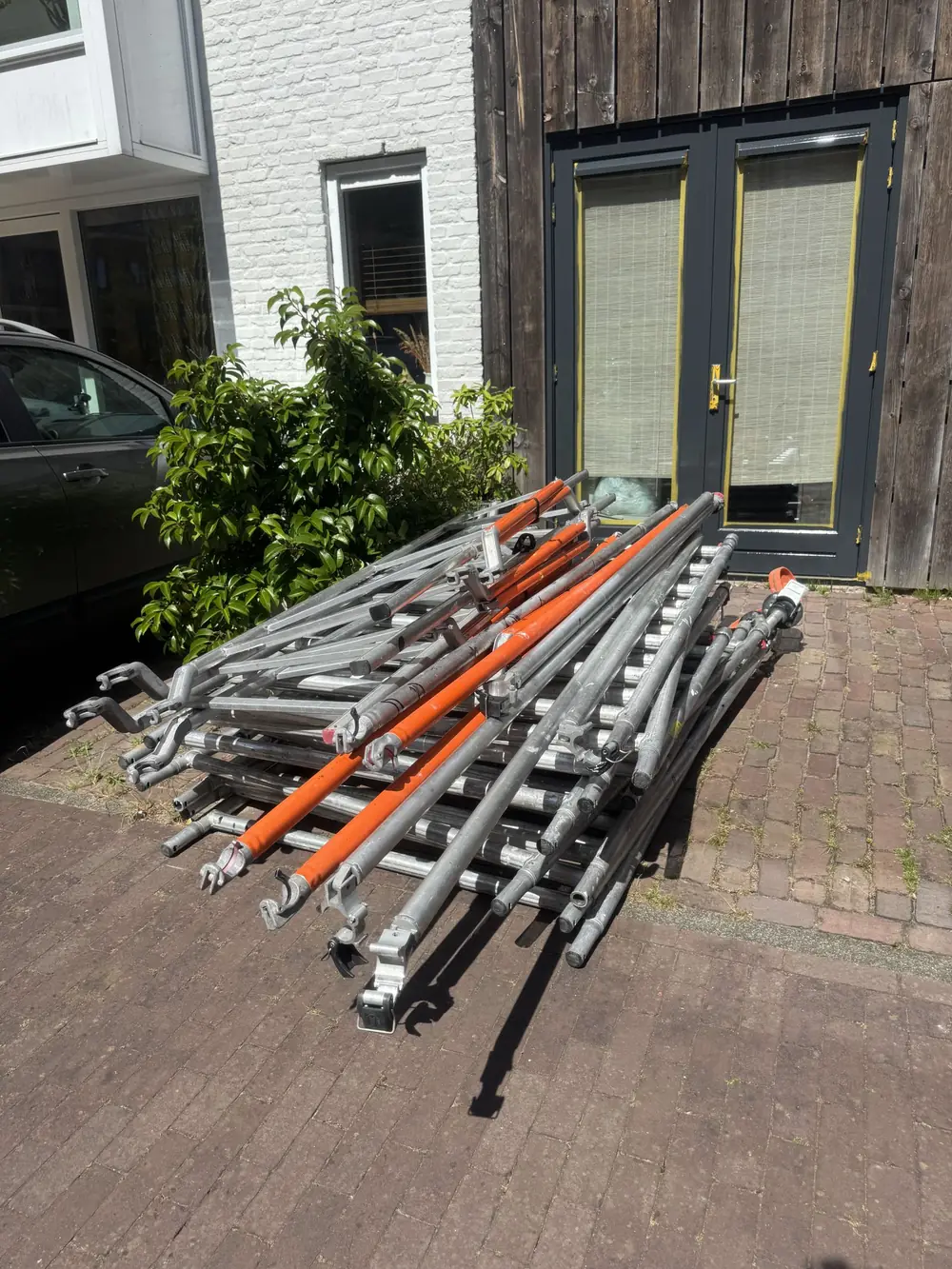
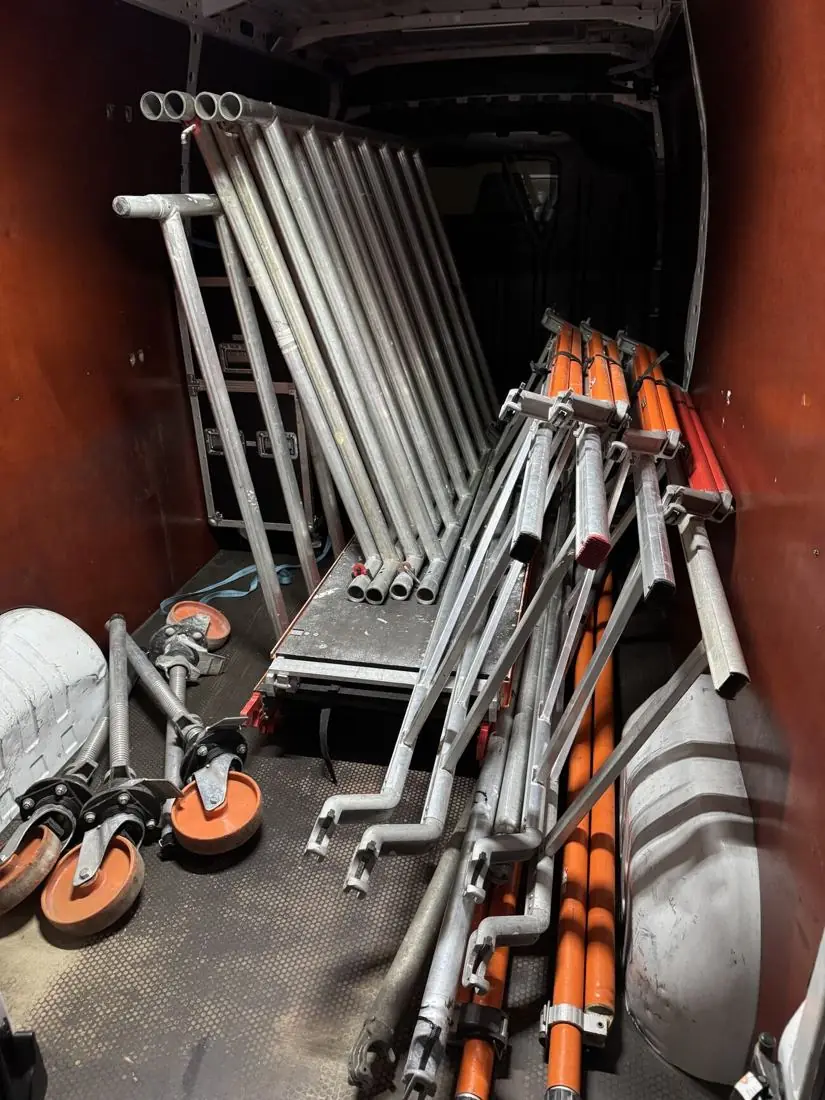
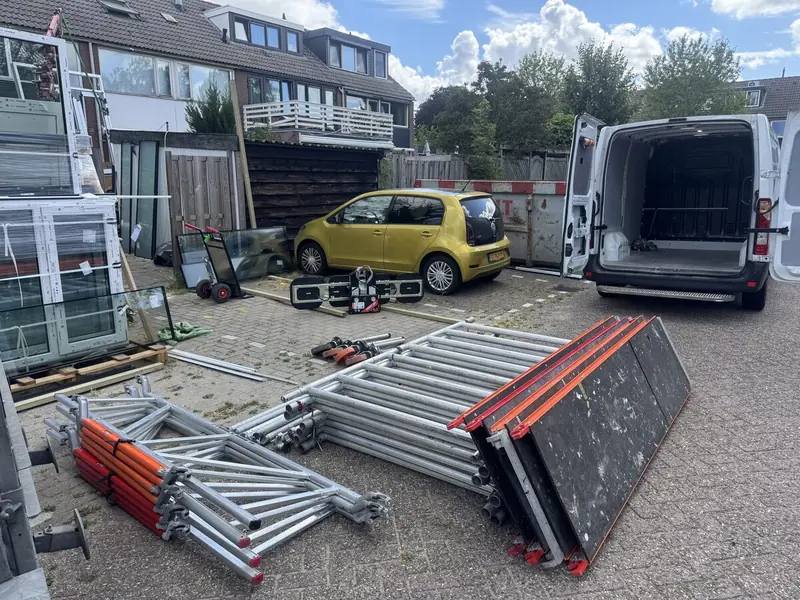
A single person's hire set lying on a drive as frames, tubes and braces, 75 cm across once built.

The room scaffold you would reach for indoors drops out here. That model was designed around floors and interior doorways, and it has no answer to garden soil, a path that falls away, or wind along a free-standing face. Outdoors you want adjustable legs and castors resting on a slab or a board. Should an interior wall follow later in the week, the low room scaffold for indoor use shows which type belongs inside the house.
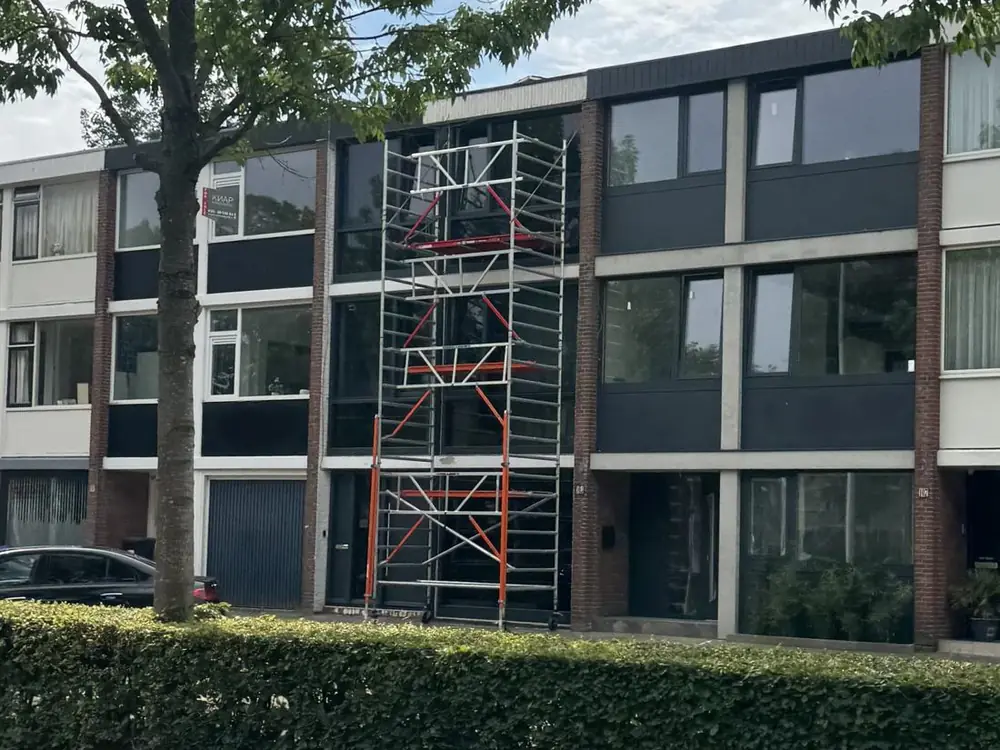
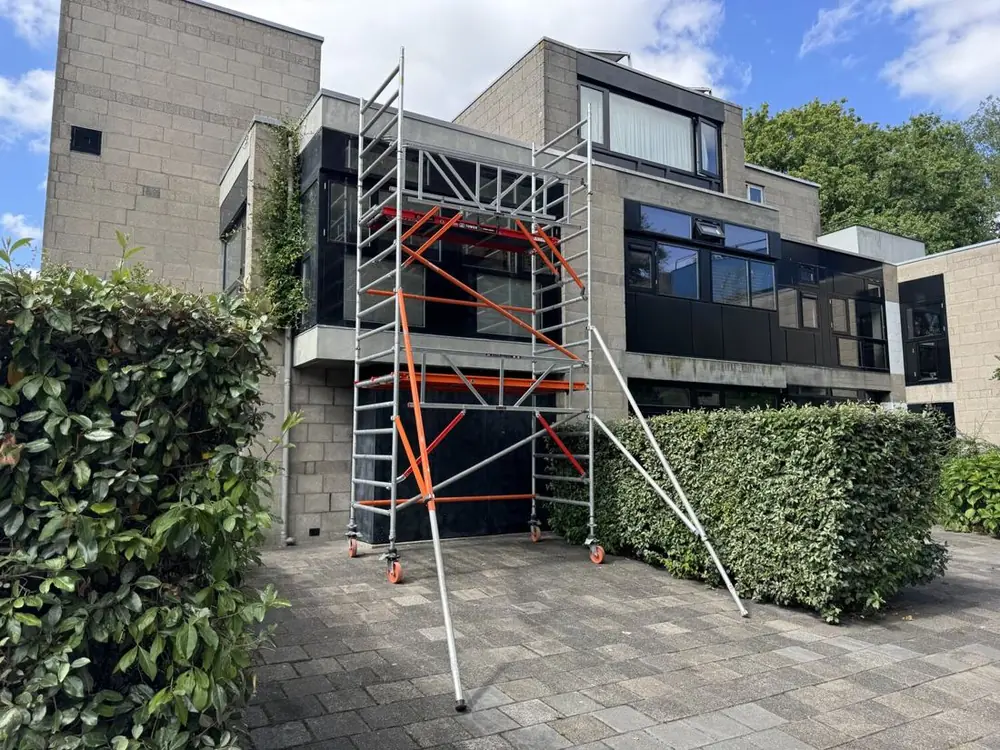
Hiring working height to suit the top of the shed wall

You read the height of this job off the topmost edge that still receives a coat. On a flat-capped outbuilding that is the top course of brickwork; under a pitched roof it is the point where the wall vanishes beneath the eaves. Run your tape to it from the spot where the castors will land, because garden level and terrace level drift apart faster than anyone expects. Out of that comes a deck height, and the reach you book is that deck with roughly two metres of arm added.

For most walls of this kind the answer lands between 4 and 6 metres of working height. Where the face stops under three metres, the lowest stage will do and keeps the hawk close to your body. Where the wall runs on up to the gutter of a tall outbuilding or a garage, take the upper stage this model offers. Which build belongs with which reach is set out at a six metre build stage, together with the matching deck height.

Mobile tower assembled in front of a house wall, built to the reach that a full-height masonry face calls for

Choosing tight is dearer with mortar than it is with paint, because a band cannot be finished off later. Stand too low for the top fifty centimetres and you have to reposition with a half-loaded hawk in your hand while the edge of the previous band goes off. That shows up afterwards as a shadow line which jumps out in raking light across the face. Take the stage that still leaves you above the top edge with a straight arm when plastering a shed wall.

Where the tower stands beside the shed wall you are plastering

An outbuilding rarely has a tidy drive running alongside it. More often there is a paved path some fifty centimetres wide, a planted border next to that, and then the lawn beyond it. Look at where the four castors come down and where your mixing spot goes, because both want space and you do not want to step across planting carrying a full bucket. Put the tub and the mixer on the side you begin from, so you never have to walk round the set-up with a loaded hawk in one hand.

The ground weighs more heavily here than on dry trades. Under a tower where render is going on, water arrives: gauging water, rinsing water and whatever slides off the hawk. On garden soil that turns to mud inside an hour and the castors sink into it. So put slabs or thick boards down, under the adjustable legs as well, and tip your bucket out well away from the base. Staying stable on such ground is covered in the pointers for a base that will not sit level.

Adjustable legs splayed from a tower base onto hard paving, the firm footing needed once water starts running down

Look too at whatever is parked against the masonry. Beside an outbuilding that is usually a rack of pots, a stack of firewood, a compost bin, or the butt the downpipe feeds. All of it has to move before the van arrives, and along the full length of the face rather than only where you intend to start. When you shift position halfway through a bay you want nothing at all in the way with a hawk in your hand.

How many hire days for plastering a shed wall

The rendering itself goes quickly; it is everything round it that fills your hire days. Count on one day of preparation: degreasing, knocking off loose material, filling cracks and damping the background down. Then comes the render day itself. On a two-coat build another day sits in between while the first coat pulls in and firms up enough to take the next. For a face of four by three metres, plastering a shed wall therefore works out at three hire days, and the assembly morning is not yet in that figure.

Outdoors the weather gets a vote. Below about five degrees it stops, and a frost overnight on fresh mortar makes the work worthless however fine the following day turns out. Blazing sun or a stiff wind is no better, since the face then pulls in faster than you can rule it off. The consequence is that your period must not sit tightly around the render day itself. A week that yields only two usable days is entirely ordinary on this kind of job, and nobody should treat that as bad luck.

Scaffold components bundled and strapped on a pallet before loading, the counted set behind a booking of several hire days

Shifting things about is fortunately cheap. Only the opening 24 hours carry the whole amount; whatever you attach behind that runs at 95 per cent off. Pinning down five days instead of three therefore barely alters the rental price, while it buys you two chances to dodge a frost or a shower. Booking wide is the rule here rather than the exception. How that works out per type is shown at the tower rates including VAT.

Which mobile scaffold suits plastering a shed wall?

Kamersteiger RS44
  • Working height up to 4 metres
  • Compact and narrow
  • Great for indoor and small jobs
View and calculate →
Smalle rolsteiger RS51
  • Working height up to 14.2 metres
  • Narrow (75 cm)
  • Ideal for narrow passages
View and calculate →
Brede rolsteiger RS52
  • Working height up to 14.2 metres
  • Wide platform (135 cm)
  • Extra stability and workspace
View and calculate →
Most chosen
1-persoons steiger MiTower
  • Working height up to 6.2 metres
  • Very compact
  • Quick and easy to assemble
View and calculate →

Plastering a shed wall top down from the scaffold deck

A deck 245 cm long is your bay width on this job. A four metre face therefore takes two positions, and that single moment of moving gets chosen before you tear a bag open. Pick a point where the wall is already interrupted anyway: a window opening, a door frame, or the corner of the building itself. The seam between two sessions then falls on a line that was in the elevation to begin with, and nobody will pick it out afterwards from the garden.

Inside one position, work downwards. Begin at the top edge, rule off, and drop with the hawk to the next stretch, so material that falls lands on wall you have not touched instead of a face you have just brought flat. The bottom fifty centimetres you do standing on the ground, off the tower altogether. When plastering a shed wall, reckon on half a tub to a whole tub of mortar per bay, depending on how deep the joints have been raked out.

Tower put up along a side elevation, the working platform from which one band of a wall is ruled off

How hard the background sucks sets your pace. Old dry brickwork takes the water straight out and swallows your working time, so damp it first and lay on in smaller panels. Concrete, or a face that was rendered once before, hardly draws at all and stays wet longer. Test it with a wet sponge before you fix the render day, because the answer governs how many bays you manage in a day and therefore how long you keep the tower on hire.

Hiring the scaffold: delivery and build before the mortar is mixed

The scaffold reaches you in pieces: uprights, a deck, guardrails, braces and the four adjustable legs, every item counted before the van pulls away. Settle in advance where that pile may sit, since the strip beside the masonry will be taken by tub and mixer. A drive or a terrace suits that pile far better than grass does, where the pieces sink in and come up wet. Get the order away on a weekday ahead of 15:00 and your delivery falls on the next working day, leaving the evening before for clearing up.

Which day the van pulls up, and which day it takes everything back, is your choice. With render outdoors you look at the nights first: with frost in the forecast, move the whole block rather than the render day alone. Standing the thing up is your task, with a manual and an instruction video within reach, and it swallows an hour that people forget to plan. Follow the order given in a written out assembly plan.

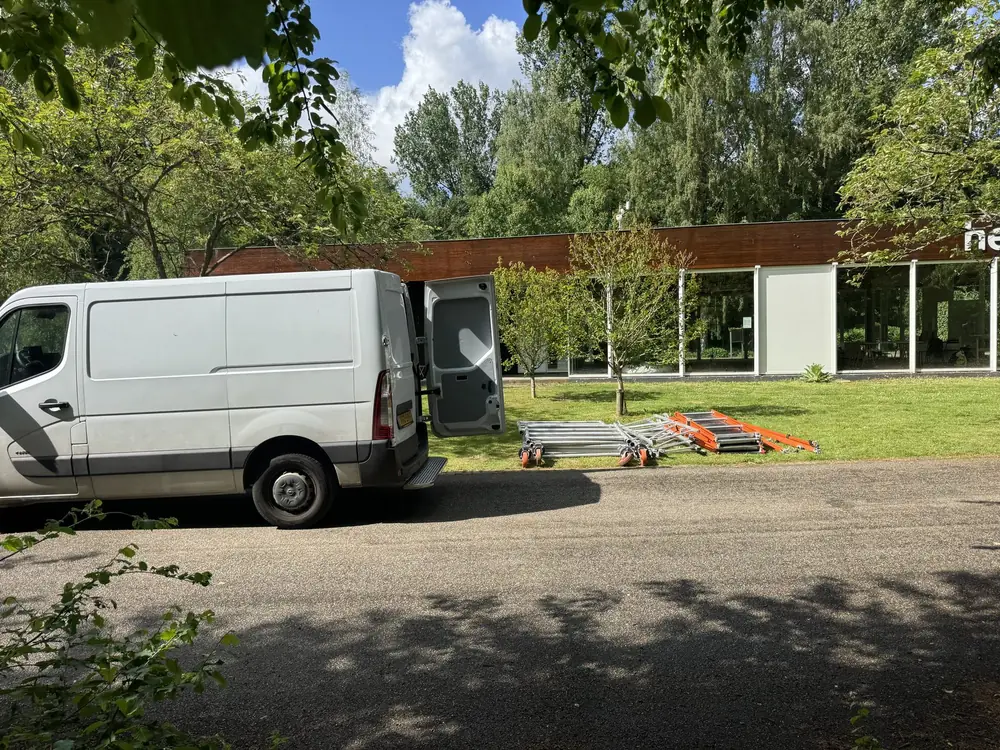
Delivery van at the kerb with scaffold sections aboard, the drop-off you time for the day before mixing starts

With the final coat on, take everything apart and set the pieces together in one spot; we come along afterwards to load them. Rinse the deck and the uprights down first, since mortar that has cured on aluminium will not come off later. If you can drive it yourself, the whole set may be picked up by arrangement, at no charge, from Zeeburgerpad 89 in Amsterdam. What bringing it to your province costs is listed at the rates for delivery and collection.

Frost, wind and safe footing on a hired mobile scaffold

This type sits in load class 3 under EN 1004, which allows two hundred kilos of carrying capacity on every square metre of deck. With render that matters more than it does with paint, because a full tub is heavy and there are often two of them up at once. Distribute it over the run of the platform; stacking everything into one corner is exactly what you do not want, even if that happens to be the corner you are working from. What the class covers is explained at the note on this standard.

Beyond that the usual agreements apply. Wheels braked before you step on, nothing and nobody aboard while it is being moved, and down you go once it starts to blow. You will reach that wind threshold sooner here than elsewhere, because a free-standing outbuilding usually sits on the open side of a garden and takes the weather full on. After every reposition, walk the four legs round and set them out firmly again before the tub goes up.

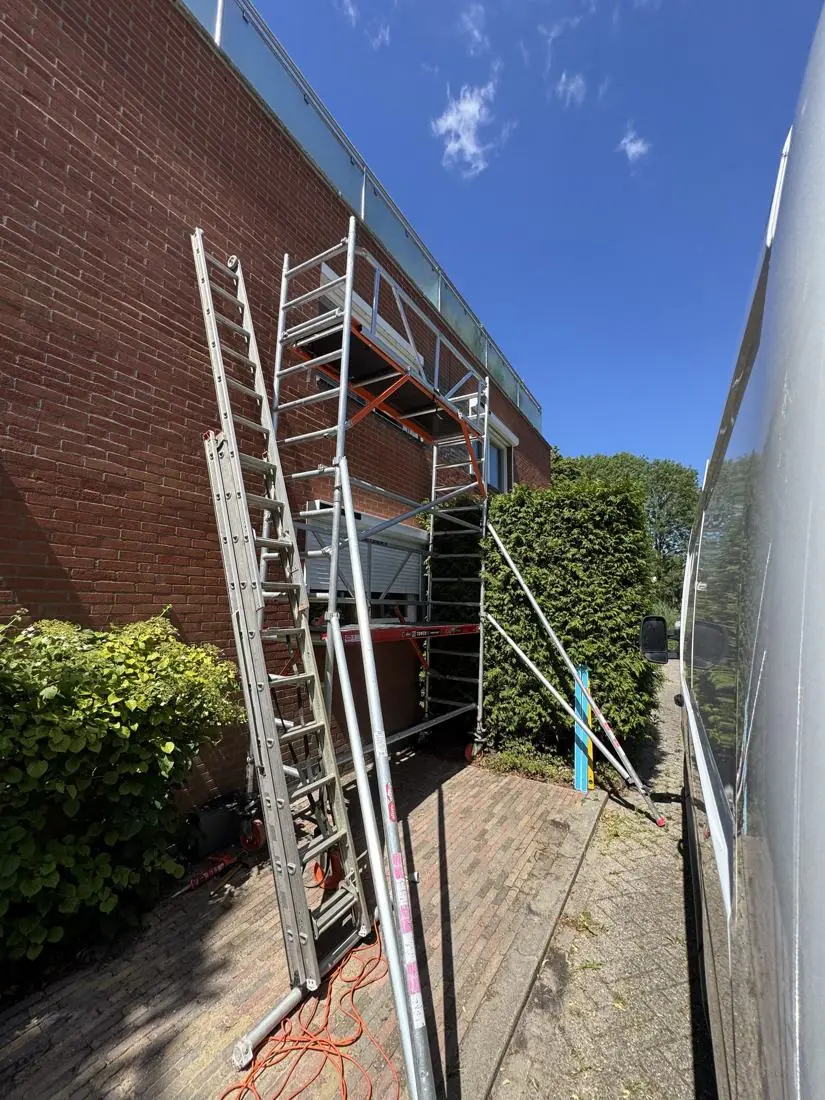
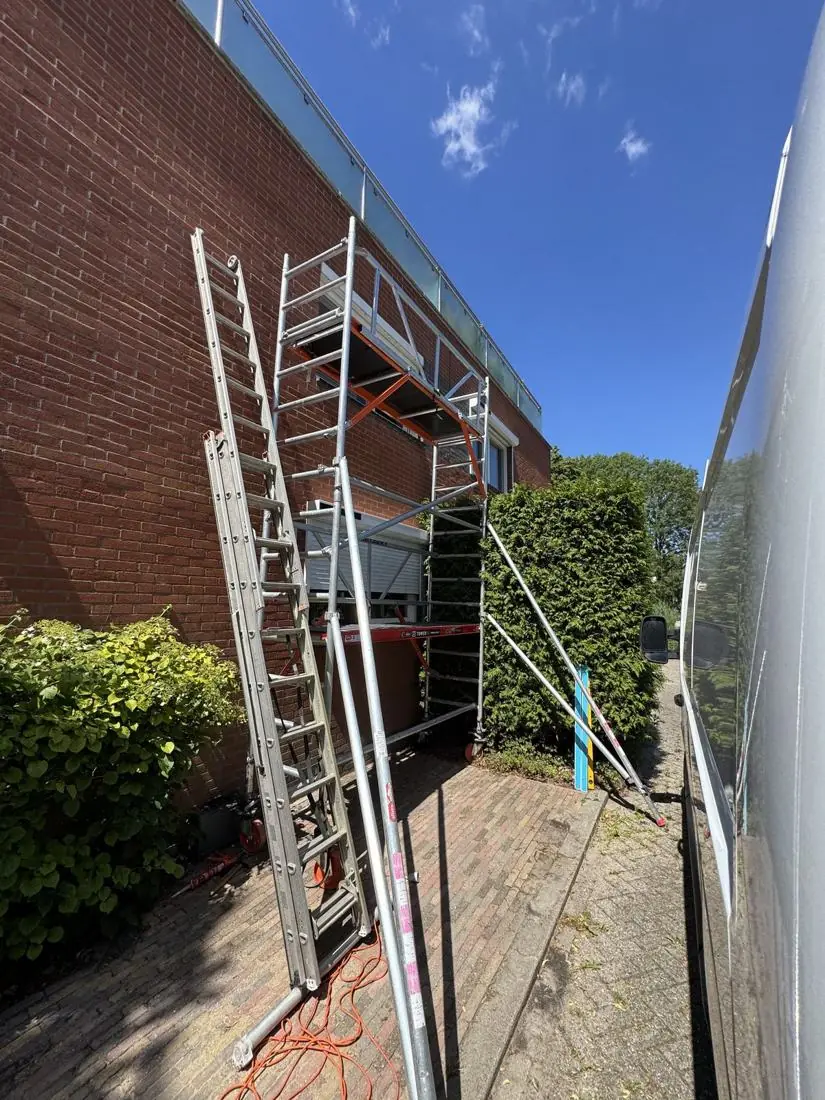
Erected tower in a narrow passage against brickwork, a sliding ladder leaning on the wall and not fixed in it.

The hazard that belongs to this job is wet and slick. Mortar on a deck turns treacherous the moment water joins it, so sweep between bays and rinse off at the end of the day. Wear boots with a decent tread on them, and place the tub where you are not obliged to step over it at all. Keep the ground beneath the tower clear of people, because a dropped trowel or a tipped bucket arrives hard down there. More on that at safe work at height.

In 5 steps

How hiring a mobile scaffold works

1
Choose working height

Pick the height that suits your job.

2
Book online

Sorted in 60 seconds, price shown instantly.

3
We deliver

At the agreed spot the next working day.

4
Assemble safely

Assembled by you, with a manual.

5
We collect

One call and we collect the scaffold.

Good to know

Practical tips for plastering a shed wall

1

Damp the masonry the evening before and once more just before you begin. Dry brickwork pulls the water out of your mortar and robs you of the minutes you need to rule the band off.

2

Set the mixing spot on the side you start from. You then never walk round the tower carrying a full bucket, which saves a minute and a wet trouser leg on every batch.

3

When plastering a shed wall, choose your moving point at a window or a corner beforehand. A seam that coincides with an interruption already in the wall goes unnoticed; one in the middle of a plain face never does.

4

Rinse the deck as soon as you stop, even when you are carrying on the next morning. Mortar that cures on a hired platform will not come off, and you stand on it all week.

5

Look three nights ahead at the temperature rather than at the day itself. Frost on a fresh coat makes the work worthless, and you only find out once the face starts letting go.

6

Have a sheet ready in case rain threatens. The tower may stay standing, but a shower that washes out your fresh face costs you the whole band again plus another hire day.

Frequently asked questions

Frequently asked questions about plastering a shed wall

Which scaffold should I hire for plastering a shed wall?+

The MiTower fits this best: a light single-person type you place beside the building alone and move on alone. Built to a working height between 4 and 6 metres, it covers virtually any wall of that sort, including one running on under the roof edge. Where two of you render, or two tubs travel upstairs, it is worth looking at the wider option and you then hire a mobile scaffold on the broader 135 cm base instead.

What do I arrange when I hire a tower for this work?+

You settle the type and the build stage online, choose a day for the set to arrive and a day for it to leave, and the price with VAT included is settled at that moment. From there the tower is your business: erecting, rendering, dismantling and stacking. The one thing outdoor work really forces you to plan is the weather, which is why you pick dates with a couple of spare days built in on either side of the render day.

How many days do you hire for plastering a shed wall?+

Three to four hire days is realistic for an ordinary face. You need a day to degrease, knock off loose material and damp down, then the render day itself, and with two coats another day sitting between them. Count the hour in which the tower itself goes up and four hire days arrives very quickly. With frost running through your week, reserve one further day of slack on the hire straight away rather than trying to add it later.

What is the outlay on hire, and what does a spare day add to it?+

That depends on the type of tower, the build stage and which province the van has to reach. You will find it including VAT at the rates per build, so nothing is a surprise at checkout. With outdoor render the way the rental price is built up is what counts: day one weighs heavily, everything behind it hardly at all. A spare day against frost or a shower therefore costs you next to nothing while it rescues the whole face.

Which working height do I hire for a wall of just over three metres?+

Measure from the point where your castors come down up to the highest edge that still gets a coat. At just over three metres the lowest stage of this model already reaches, but where the wall carries on under the gutter you hire the tower a stage above that. Stay under four metres of working height and you give up reach you will want back at the top edge. If in doubt, hire the roomier stage and lose nothing by it.

Is the hired scaffold delivered at the shed, or do I fetch it?+

Delivery is available, and the van comes as far as your drive or the kerb. Getting the pieces across the garden is down to you, which is manageable with this hired model because the uprights are light. Do walk the route through first and look out for a narrow gate or a raised threshold on the way. Rather not wait in? By appointment you may collect it yourself, provided your transport handles the length of the uprights.

Do I build it myself after hiring, or does it arrive assembled?+

Putting it together falls on your side of the hire. The pieces come loose with a manual and an instruction video alongside, and at outbuilding height a tower like this is standing inside half an hour. Plan that half hour on the day before you render, because you do not want to be building with a mixed tub in your hand. System scaffolding, facade scaffolding and cherry pickers fall outside the hire range, so this is the arrangement the job gets.

Can I hire for longer when frost pushes my render day back?+

Yes. Frost is precisely why people extend on this job, and all it takes is moving your collection date, as long as the tower has not already gone to someone else. With mortar outdoors that is anything but unusual: two cold nights in a row and the whole plan slides a week, without anything going wrong at all. So set a generous return date and simply hand back sooner when it turns out well.

How much clear space beside the wall does the hire need?+

Count on the footprint plus how far the legs splay out on either side, and then a further strip for your mixing spot and your tubs. In practice you want a good metre and a half free along the entire face, not merely at the first panel you tackle. Move the firewood, the pots and the water butt well before the hired scaffold arrives, because clearing the ground with mixed mortar already standing in the tub simply will not happen.

Is there any point renting on when rain is forecast?+

Not for the rendering, but yes for the period. The tower is allowed to stand out in the wet, and that is usually wiser than having it collected and brought back a second time. Give the wet hours to hacking off loose material, damping down or degreasing the background, and keep any fresh face covered over. Wet mortar and a heavy shower do not mix, so push the real work along until it clears.

How quickly does the deposit come back when the hire ends?+

A deposit is paid at the point of reserving the tower. Once the collected set has been counted, the sum returns to your account within a single working day of that check. On this job watch the mortar residue above all: cured render has no business on a deck or on the uprights, so rinse everything down before you start dismantling. Missing pieces hold up the settlement of your hire as well, so count aloud while you stack.

Can I take the side wall in the same hire period?+

You can, and it is the handiest order to work in. While the tower is already there you roll it round the corner to the side elevation and finish that within the same period. Bear in mind that every face has a suction rate of its own: a north wall stays wet far longer than the side that catches sun all afternoon. Do not plan those two the same way, and allow the shaded one extra drying time.

Hire a mobile scaffold for plastering a shed wall today?

Calculate your rental price now or ask for free advice.

Rolsteiger van SteigerTaxi geleverd op locatie
Book it online

Your scaffold sorted in 2 minutes.

Choose your scaffold and working height, see the price instantly and book online.