
See your price
Application

Impregnating brick slips? Choose the right scaffold.

Impregnating brick slips looks like ordinary facade work, yet the skin you are treating is barely two centimetres thick. Water finds the joint first, the sawn edges beside windows drink faster than the field around them, and behind the slips there is usually insulation that must never hold damp. So you work slowly, close in, and without leaning on anything. For an elevation of two storeys you hire the RS51: 75 cm wide, built to span 6 to 8 metres. What follows is how to arrange that side of it.

  • Order before 3 pm, delivered tomorrow
  • Professional Altrex scaffolds
  • Up to 14.2 metres working height
  • Easy to assemble yourself
4,2 tot 14,2 mWorking heights available
12Provinces served
7Days a week
200 kg/m²Load class 3
In short
  • For impregnating brick slips we recommend the Narrow mobile scaffold.
  • With brick slips the weak point sits in the joint and along the sawn edges, never on the face of the slip.
  • The RS51 you book measures 75 cm across the base, gets you 6 to 8 metres up, and stands well clear of the slips.
  • Allow two dry days on hire for impregnating brick slips: one for washing the wall down and drying it, one for application.
  • First 24 hours from €150 incl. VAT and delivery; every day after that 95% off.
Key facts for this job
FeatureValue
Recommended scaffoldNarrow mobile scaffold (Altrex RS TOWER 51)
Working height for this job6 to 8 metres
Available working heights4.2 to 14.2 metres
StandardEN 1004, load class 3 (200 kg per m²)
DeliveryOrdered before 3 pm, delivered next working day
Each extra day95% off, from €7.50 a day
Why a mobile scaffold for impregnating brick slips?

Safe, stable and professional work at height

A slip elevation is a thin hide over a background that must not get wet. Solid brickwork draws damp deep into the stone and later dries back out to both faces; here you have a few millimetres of margin and insulation sitting behind it all. So you choose a vapour open product and lay it on evenly, with no pooling in the joint and no dry edges left between passes. That asks you to stand still, hold a fixed distance and shuffle sideways without ever brushing against the slips, which no ladder rung will let you do for a full morning. Hiring a scaffold for impregnating brick slips is therefore as much about keeping your distance as it is about reaching the height above you.

  • The joint stays the weakest point on this wall
  • Sawn edges around the reveals will soak up noticeably faster
  • Vapour open products matter because of the insulation sitting behind
  • Nothing at all should be leaning against that thin skin
Read more about working safely →

Which mobile scaffold to hire for impregnating brick slips

For a slip clad elevation over two storeys you take the RS51, the narrow Altrex model with a 75 cm base. Narrow helps here because you are steering along the wall while deliberately holding back from it: the less you have to squeeze, the smaller the chance that a frame or a guardrail taps the slips. A chipped corner on a skin like that shows, and it is awkward to make invisible again. The range of mobile scaffolds available to hire lists the build widths side by side.

Not much kit travels up with you. A low pressure sprayer or a block brush, a bucket of fluid, a cloth for splashes on the frames and tape for masking glass covers it. The 245 cm platform sets how wide a strip you can keep wet in one go. It gets no wider than that, because anything you try to catch at full stretch lands unevenly on the wall and shows up later as a patch that drank more fluid than the strip beside it did.
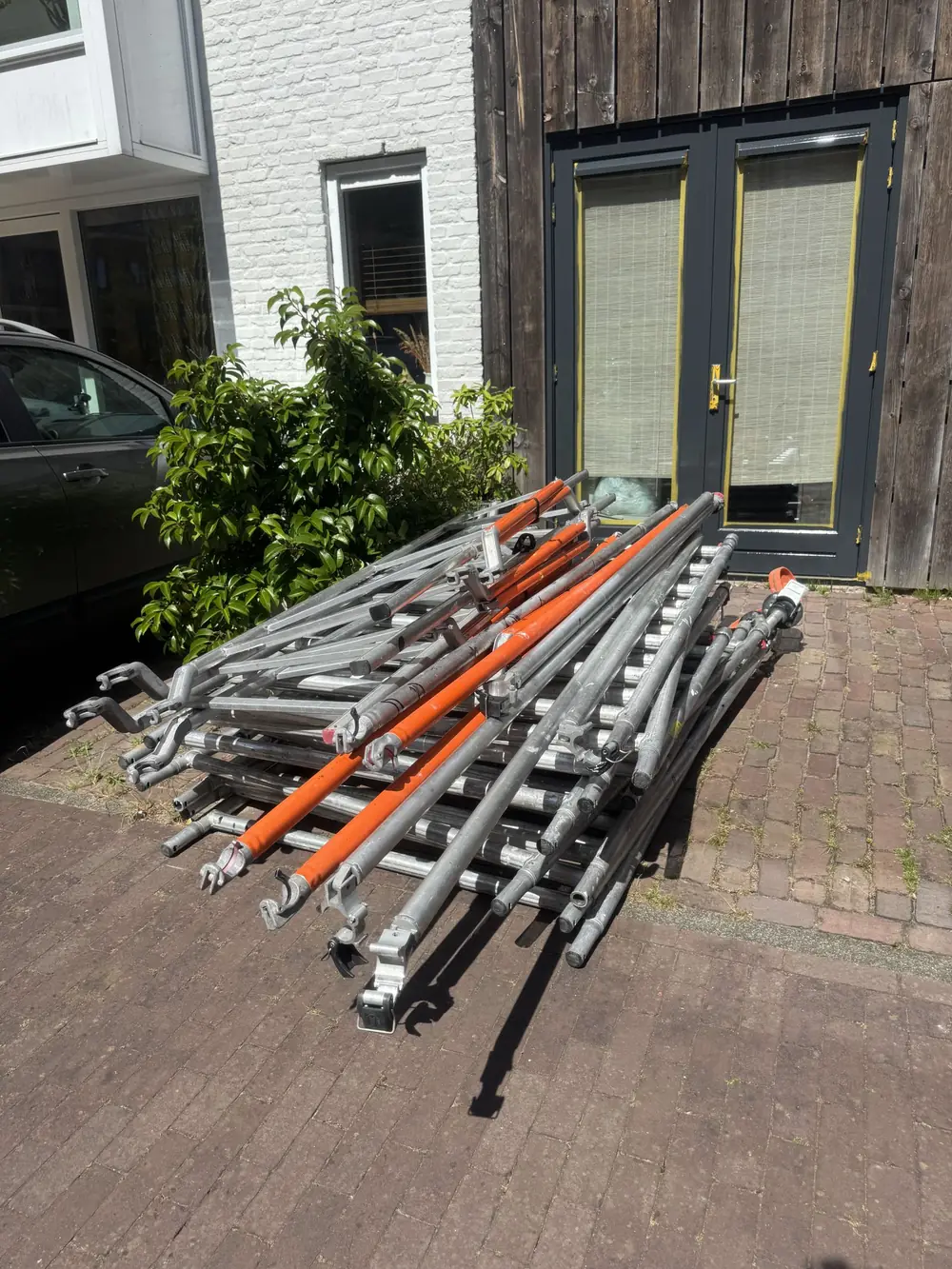
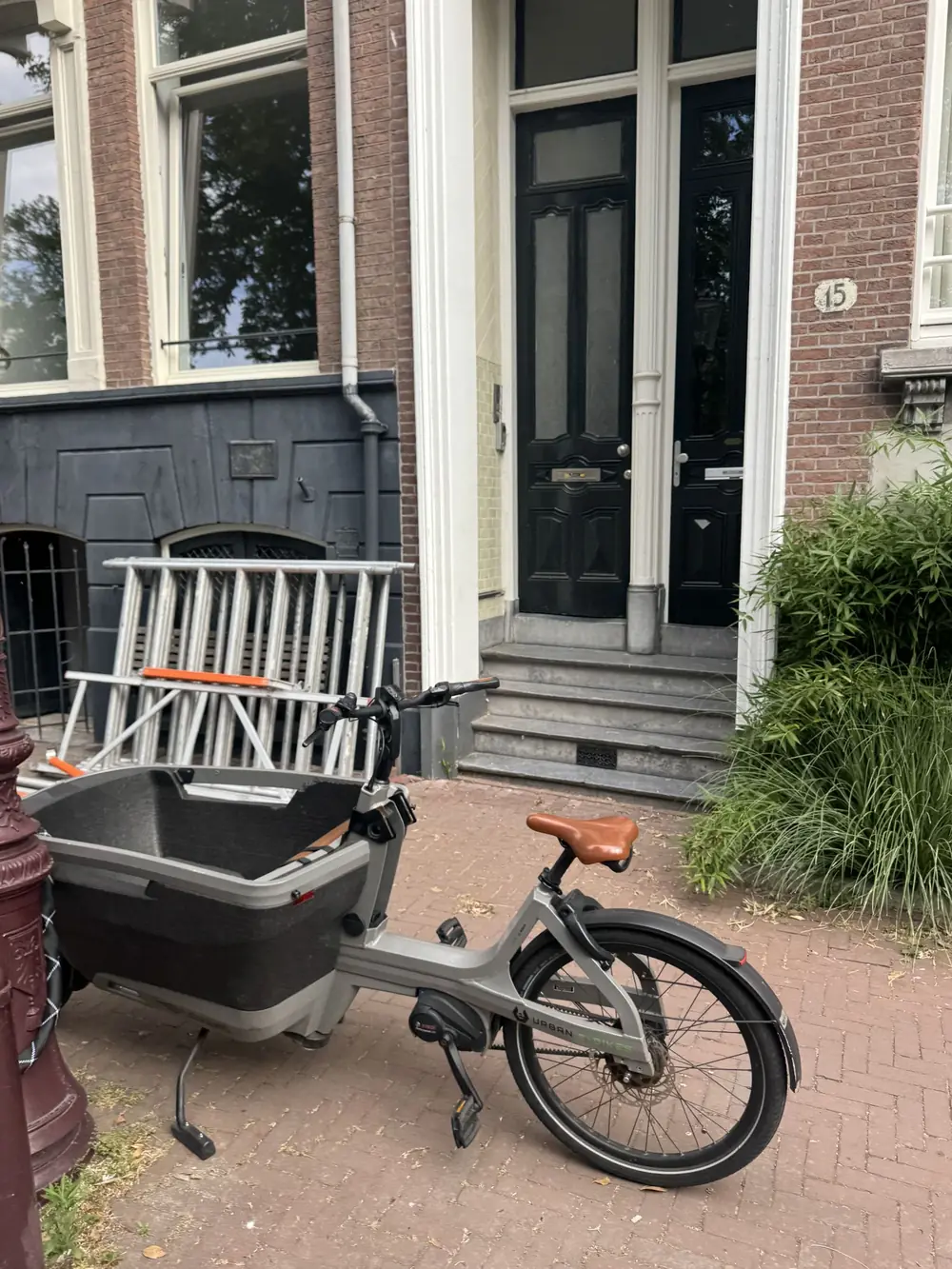
Frames, tubes and orange braces stacked on a drive, the narrow 75 cm hire set that keeps clear of a wall.

Stepping up to the 135 cm RS52 makes sense once two of you share a deck, or when a few joints get pointed up while you are there. Reckon on more weight to roll along the wall in that case. A MiTower carries one person to 6.2 metres and suits a low extension or a slip clad garage, though a full house elevation runs past what that model was ever drawn for. See what a one person tower will cover before you settle on it.
Working height to hire when brick slips reach the roofline

If the whole elevation gets treated, your highest point is the top course of slips under the roof trim or the gutter, and your tape runs to exactly that line. Two storeys then call for a span of 6 to 8 metres. Do the sum yourself: platform height plus the roughly two metres you still cover standing on the deck adds up to working height, and that is the figure entered at booking. The overview of reaches per build sets them out clearly for you.

Go generous rather than tight on this job. Spraying with an arm stretched above your head gives an uneven film, and on a thin skin any difference in saturation comes back later as cloudy patching that only shows once the wall has dried. You want the top course roughly at eye level or just below, so the sprayer can follow every joint without guesswork. It also cuts down how often you have to shift a deck up mid job, which almost never happens when the build you hire has a little room left in it.

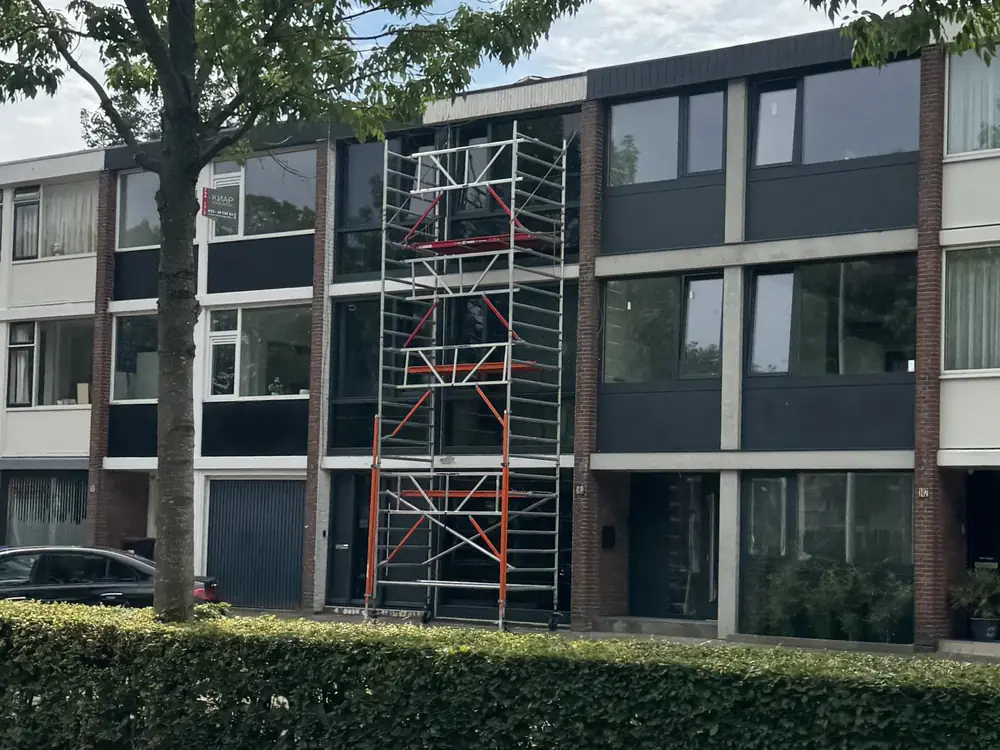
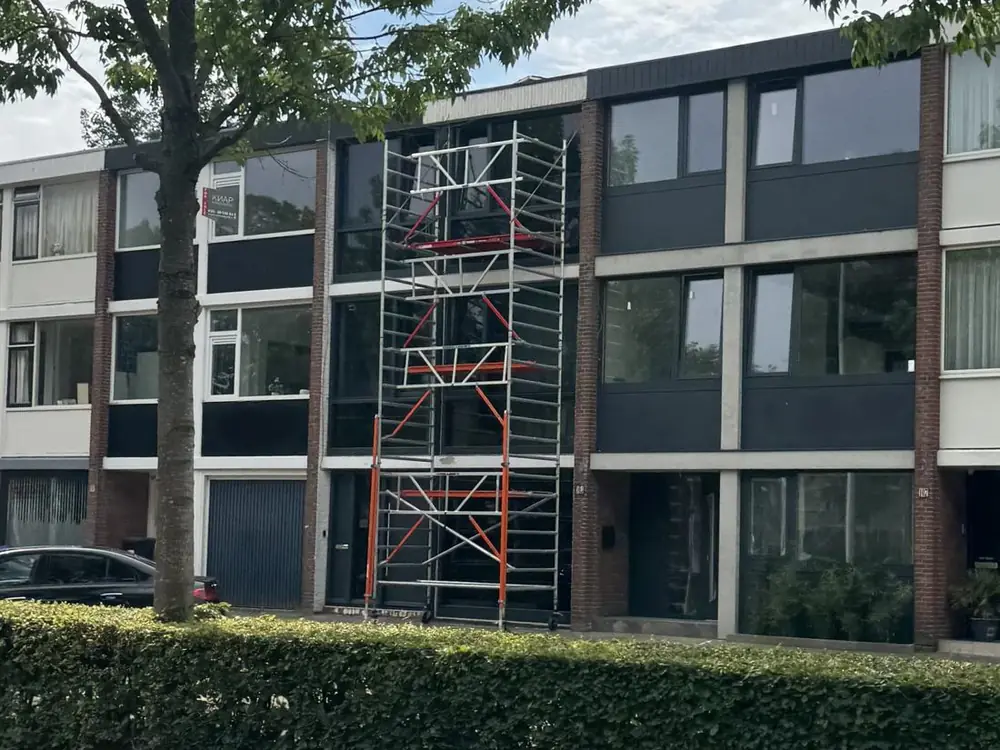
Scaffold tower erected across a house front, showing the build height ordered when slips run up to the trim

Your measurement starts at wheel level, not at the front step. A sunken terrace, or ground sloping off towards the boundary fence, means the build starts lower than you guessed from the pavement, and that difference has to come out of the reach you order. Think about the reveals too: they sit deeper in the face, and reaching them tidily with the sprayer wants a bit more slack above you. For an elevation carried past the first floor windows of a house, take the extra lift.

Hiring a tower that never leans against the thin skin

The single most important thing on a slip elevation: the tower stands completely free. You tie it into nothing, you rest no frame against the slips and you lay no plank from a guardrail across to a window frame. A slip is bonded onto board or onto insulation and was never meant to carry load. Keep a hand width of air between you and the face on purpose, and walk that gap again after every move. Anyone hiring a tower for this counts that gap into the free space needed.

Under the castors you want firm, level ground, and room all round for the four stabilisers to swing out. Alongside a slip clad wall there is often a gravel strip, a planting bed or a sunken lightwell, and on ground like that you put spreader plates down wherever the surface gives. Check that footing once more once the build is up to height. For gardens that drop away towards a fence, the method for uneven ground transfers straight to this job.

Four stabilisers extended from a tower base, marking out the clear footprint you keep beside a house wall

Give some thought to what stands below. Fluid running off the wall lands on the plinth, on the paving and, with a little breeze behind it, on a neighbour's car as well. Sheet over planting and glass, and agree where the bucket lives so that you never scrape a full one along the slips on your way past. Do not wedge the tower hard into a corner either, because you will need to reach in two directions with the sprayer from that last stand.

How many days to hire a scaffold for impregnating brick slips

Two days is a realistic window on a house of two storeys with a plain front. On day one you clean the elevation down and let it dry; day two the fluid goes on. That drying cannot be skipped: a slip still holding moisture takes the product up unevenly, and you see it afterwards as staining around the joints. A wall that has just been washed also needs longer than the surface suggests, because the joint releases water far more slowly than the fired face of the slip does.

Weather sets the diary for impregnating brick slips. Rain during or shortly after application flushes the product out of the joint before it has drawn in, and strong sun on the wall makes it flash off far too fast. Early mornings and dry, overcast days give the best result. Since nobody can order that sort of weather to arrive on cue, an extra day on the booking beats starting at the wrong moment and ending up with a part treated elevation on your hands.

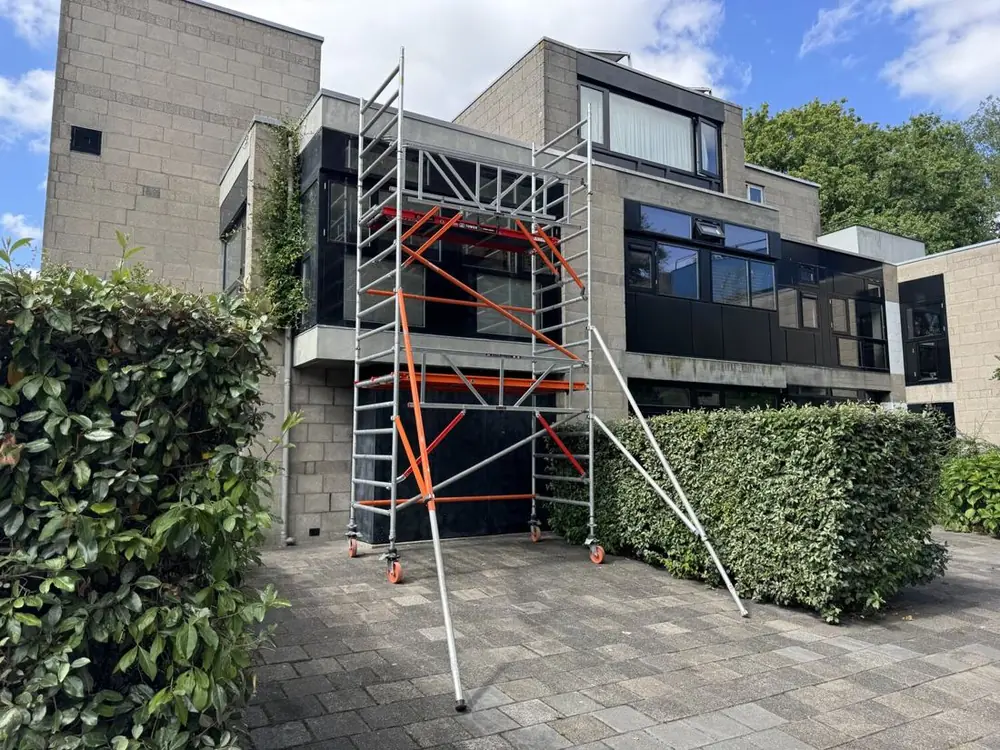
Mobile scaffold standing at a modern elevation, the position it holds for the whole of a booking

Money wise that spare day barely registers. The full charge runs over the opening twenty four hours, while every further day of the booking lands with 95 per cent taken off, so booking wide costs you almost nothing. What it buys is calm: you wait for a dry morning without having to move your end date or ring anyone. How the rental price is put together per model is shown on the page with our hire rates.

Which mobile scaffold suits impregnating brick slips?

Kamersteiger RS44
  • Working height up to 4 metres
  • Compact and narrow
  • Great for indoor and small jobs
View and calculate →
Most chosen
Smalle rolsteiger RS51
  • Working height up to 14.2 metres
  • Narrow (75 cm)
  • Ideal for narrow passages
View and calculate →
Brede rolsteiger RS52
  • Working height up to 14.2 metres
  • Wide platform (135 cm)
  • Extra stability and workspace
View and calculate →
1-persoons steiger MiTower
  • Working height up to 6.2 metres
  • Very compact
  • Quick and easy to assemble
View and calculate →

Impregnating brick slips one 245 cm platform bay at a time

From each stand you treat a strip as wide as the deck: 245 cm. Finish that strip from top to bottom before you start anything else, and keep the edge wet where the next stand will join on. A dry edge in the middle of a panel leaves a visible line, and on a slip elevation that stands out more because the joints run in such a tight grid across the face. Land your joins on a corner, beside a downpipe or against a window frame instead.

Give the joint more attention than the slip. The slip itself has a fired skin that takes up only so much, while the joint is porous and lets water through fastest. The same goes for the sawn edges: at the reveals beside windows and doors, and at external corners, the slip has been cut through, so the open body of the clay lies there drinking. Those places want a second pass, laid wet on wet and therefore taken without a break in between the two.

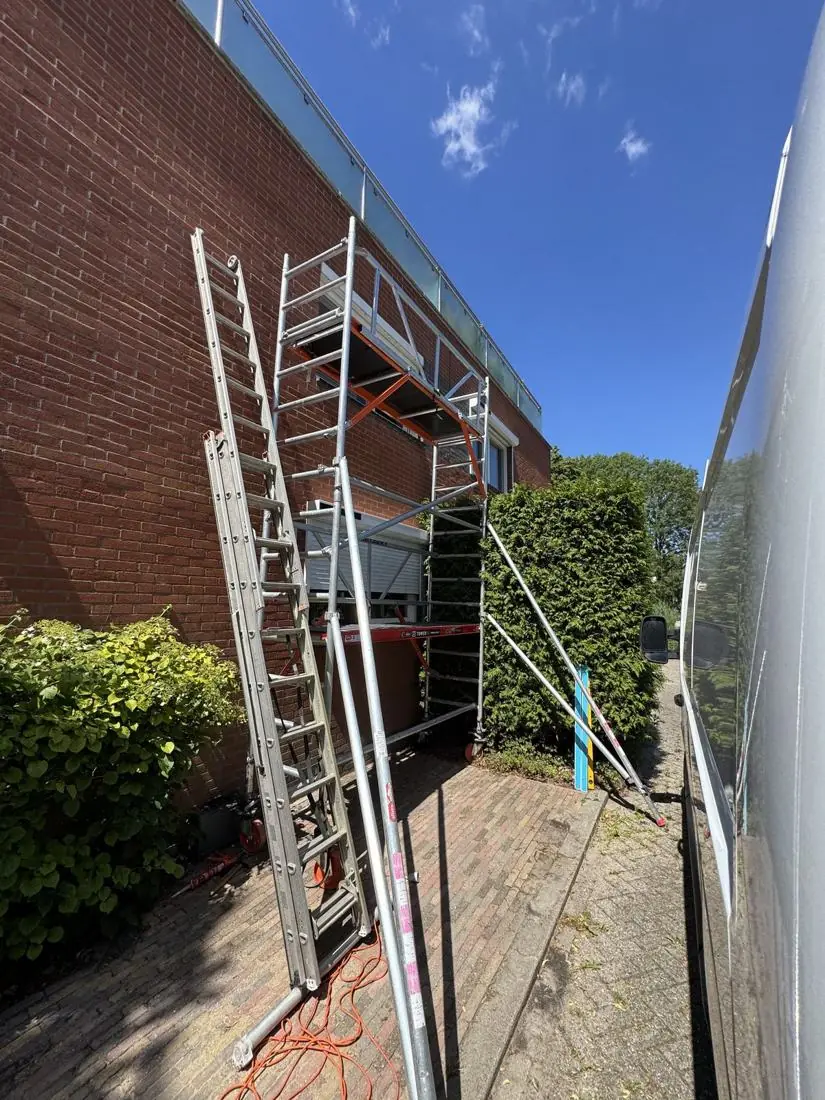
Frames propped against brickwork by a doorway, the hire set you build before treating a strip as wide as the boards.

Work at low pressure and hold the nozzle close to the face. You are saturating, not misting, because a fine fog never reaches the top of the joint and drifts off into the garden as well. Only leave a stand once the strip is genuinely complete, since coming back to half a panel no longer works. How impregnating brick slips differs from solid work is set out under treating solid brickwork with a water repellent.

Delivery of the hired scaffold set on a dry day

What turns up is a scaffold in loose pieces, counted out before it left us. Pick a spot for that stack where nothing can topple against the wall, so not tight up to the slip clad plinth. A drive, or the corner of a lawn, beats the narrow path running past the house. Place the order on a weekday, leaving yourself on the right side of 15:00, and everything is waiting on your ground by the start of the next working day.

Arrival and collection dates are both yours to set. Have the set land before your washing day, since putting it up belongs to you: two people have it standing in a couple of hours, and the printed manual plus the film take you through the order of assembly. Getting that out of the way early means the tower is ready the moment conditions allow, rather than a dry morning going on frames and braces while the sun climbs.

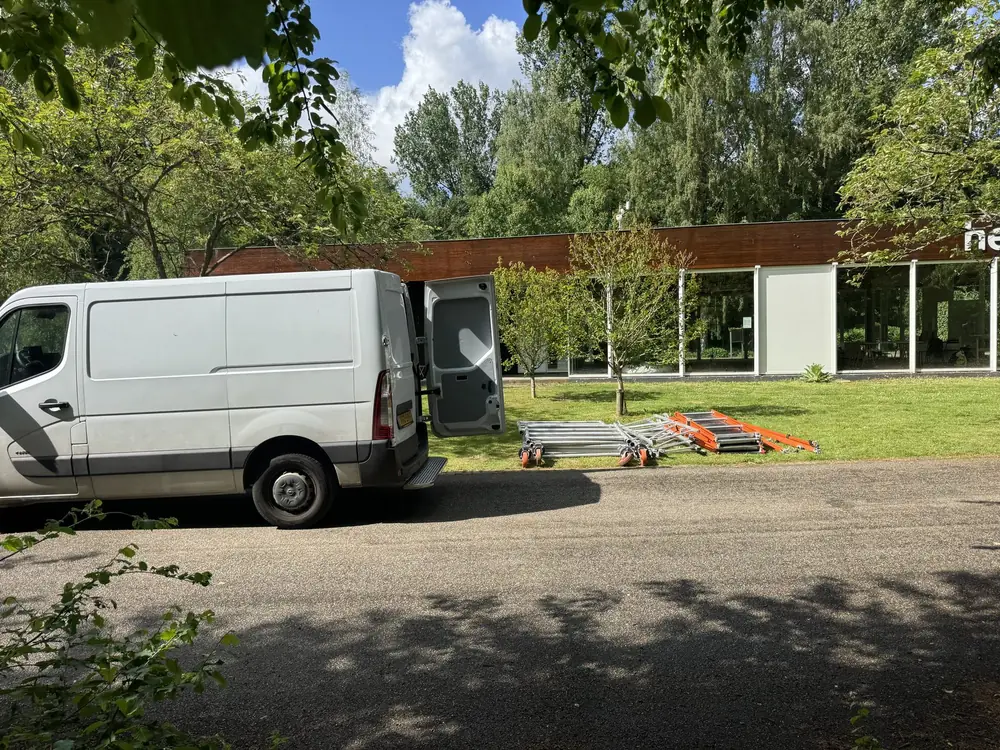
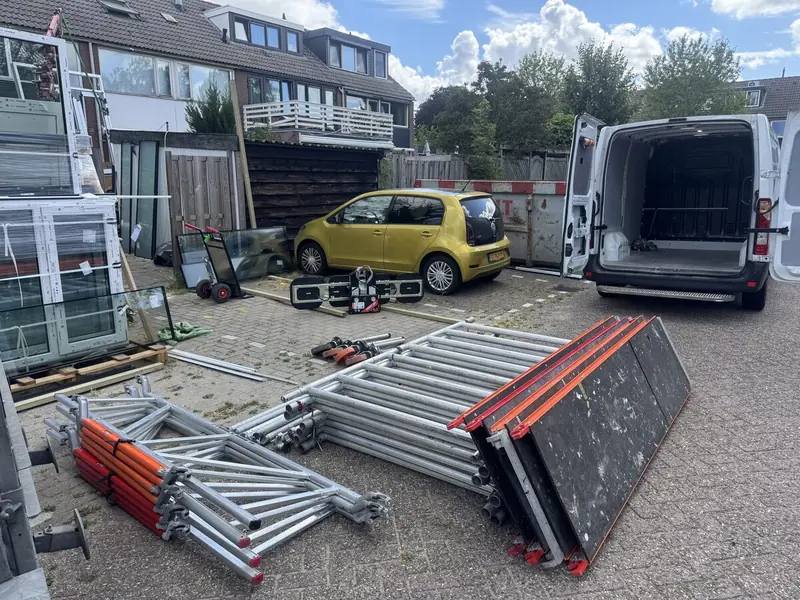
Delivery van with scaffold parts parked in front of a house, the loose counted set you hire and build

Collection we arrange; taking it apart and stacking it is yours. Hold off until the fluid has drawn right in and you have walked the elevation in dry light, because a missed patch can only be put right properly from the deck. Make sure the van can reach the stack when you set it out for us. Booking an appointment and loading up yourself at Zeeburgerpad 89, 1019 AD Amsterdam costs nothing at all; for the other route the fixed charges per province apply.

Safe working on the hired tower with impregnating fluid

Under EN 1004 these platforms fall in load class 3, which allows two hundred kilos across a single square metre. A bucket, a sprayer and yourself sit a long way inside that figure, so capacity is never the worry on a job like this one. Wet hands and slick soles are the real risk instead. Lock the castors before your weight goes on the first rung, and leave them locked until both boots are back down on the paving.

Move the tower empty, with no bucket and nobody aboard, and swing all four stabilisers back out after every reposition of the build. In wind you stop spraying altogether: the fluid drifts as a mist over the boundary and the coverage on the wall turns patchy where the breeze catches it. While rolling, watch that nothing scrapes along the slips, because a frame catching the face will take a corner off a slip and that will not be repaired invisibly.

Ladder set inside a guardrailed scaffold tower, the internal route you climb with one hand free

Impregnating fluid is thin and travels further than paint. Wear gloves and eye protection, keep it away from your face when spraying upwards, and wipe spills off the deck straight away or it turns treacherous underfoot. Let nobody walk under the tower while the sprayer is running, and set something out as a marker if need be. What else applies up a scaffold, even on a job lasting a single day, is gathered at the rules for working at height.

In 5 steps

How hiring a mobile scaffold works

1
Choose working height

Pick the height that suits your job.

2
Book online

Sorted in 60 seconds, price shown instantly.

3
We deliver

At the agreed spot the next working day.

4
Assemble safely

Assembled by you, with a manual.

5
We collect

One call and we collect the scaffold.

Good to know

Practical tips for impregnating brick slips

1

Put a test patch on an out of the way corner and let it dry right through. Brick slips sometimes darken a shade, and you want to discover that on half a square metre rather than a whole front.

2

Treat the reveals beside windows and doors as separate strips in their own right. The slip is cut through there and the open body lies bare, so those edges take up far more fluid than the field right beside them.

3

Pick a vapour open product and check the tin to see whether it suits a bonded skin with insulation behind it. A film forming coat seals the moisture in, and once that happens you will never get it out again.

4

Work whichever elevation lies in shade during the morning and move your stands round the house along with the sun. On a warm face the fluid evaporates off again before it has drawn into the joint at all.

5

Mask glass, cills and aluminium trims on the same day the set arrives and the tower goes up. A splash on a window dries to a matt bloom that no cloth will shift once it has hardened onto the pane.

6

Walk the wall again just after sunrise with the tower already standing in its position. Raking light shows you at once which bands have stayed dry and where impregnating brick slips still owes you a proper second pass.

Frequently asked questions

Frequently asked questions about impregnating brick slips

Which mobile scaffold should you hire for impregnating brick slips?+

On an elevation of two storeys the handiest thing to hire is the narrow RS51 at 75 cm. It slides past a border or a path without being forced, which matters because you want to touch the slips nowhere at all. Up top you only need a sprayer, a bucket and a cloth, so extra width buys you very little on this particular job. If two of you share the same wall, hire the RS52 instead and take the roomier deck.

How does hiring work for a treatment like this one?+

Online you pick the model together with the build height, choose an arrival day and a collection day, and settle up in advance with VAT included. The scaffold set is dropped off with you, after which you erect it and work the wall strip by strip. Once the fluid has drawn in you break it down again and the van takes it away. Build a spare day for dry weather into your rental period, because nobody can schedule a cloudy morning to order.

How many rental days does impregnating brick slips take?+

Count on two days for an average house: one for cleaning and drying, one for application. If the wall is already clean and bone dry it can be done inside a single day, though that is the exception rather than the rule around here. Four elevations or an extension add a day, mostly through repositioning the scaffold along the wall. Hire too tightly and you stall halfway across a panel, which always leaves a line you can see.

What drives the rental price, and what does a spare weather day add?+

The figure follows from the model you hire and the build you choose, with a fixed sum per province for bringing it and taking it back, all VAT inclusive. Since the opening day is the one that counts and the days behind it hardly move the total, pencilling in a reserve day beats risking a bad start on a half wet elevation. On weather led work that is simply the sensible way to hire, and it saves a second booking.

What working height do you hire for a slip elevation of two storeys?+

Reckon on 6 to 8 metres of working height, measured to the top course of slips beneath the roof trim. Start the tape where the castors will sit, so not at your own doorstep and not at a raised terrace. Within that band take the roomier build when you hire, because spraying at full stretch saturates the joint unevenly. Which build gets you there is set out on the page about getting to eight metres of reach.

Does the hired scaffold come to me, or do I collect it myself?+

You make that choice while reserving, and both routes end with the same counted set of parts. With delivery the scaffold arrives at your door on your own date and disappears again afterwards, for a fixed sum per province. Prefer to fetch it, and the hired set can be loaded by appointment at the yard, provided your trailer takes the long pieces. On weather led work most people have it brought, so erection never waits on a borrowed trailer.

Do I put the hired scaffold together myself for this work?+

Yes, that part is down to you. We bring everything complete and counted and take it back later, but erecting, rolling and dismantling stays your work across the hire days. Two people spend a couple of hours on it, following an instruction film that runs through the order of assembly so that nothing at all is left to guesswork. Facade scaffolds and cherry pickers are not on offer here, so a tower is the fitting answer on two storeys.

Can I hire for longer if the wall is not dry in time?+

You can, as long as that scaffold set is not already booked out to the next customer waiting for it. Say so the moment you see the wall still holds too much moisture, and the collection day simply moves along with you. On slips this is a real scenario, because a skin that has just been washed needs more drying time than most people expect. A day extra on hire always beats starting on a wall still full of water.

How much space do I need beside a wall clad in brick slips?+

Beyond the 75 cm of the tower itself come the four stabilisers swinging out, and you are deliberately holding off the skin as well. So reckon on a good metre of clear, level strip running along the wall. Planters, a water butt and garden furniture all want shifting before the scaffold you hire turns up. Bear in mind too that tying into the skin is out of the question, so that clear space is the only thing keeping you stable.

Can I add rental days if it starts raining during application?+

Stop applying and let the wall dry off first. Rain on fresh fluid washes it out of the joint before it has drawn in, and on slips the joint is exactly what you set out to protect in the first place. The scaffold meanwhile stays standing where it is, brakes on, so you pick the thread back up on the first dry morning that turns up. Since you set the collection day, such a break costs you at most that one day.

When does the deposit come back once a hire like this ends?+

Once the load is back with us and every item has been checked off against the packing list, the deposit is credited inside one working day. On this job watch for spilled product above all: wipe the decks and the rungs off before you strike the hired scaffold, because dried marks on a frame never come off later. Hand the rest back complete, down to the small clips that end up in a border while you roll the tower along.

How does hiring differ from a job on solid brickwork?+

Solid brickwork drinks deep and dries back out to both faces, so you can work more freely there and worry less about pooling. Impregnating brick slips means a thin skin with insulation behind it more often than not: the joint is the weak spot, the sawn edges take up extra and the product has to stay vapour open, or you seal moisture in. When you hire a mobile scaffold for that, it mainly means standing clear.

Hire a mobile scaffold for impregnating brick slips today?

Calculate your rental price now or ask for free advice.

Rolsteiger van SteigerTaxi geleverd op locatie
Book it online

Your scaffold sorted in 2 minutes.

Choose your scaffold and working height, see the price instantly and book online.