
See your price
Application

Impregnating brickwork? Choose the right scaffold.

Impregnating brickwork means soaking a wall rather than covering it. The product sinks into the brick and the joint, and that only happens if you can stay the same length of time on every spot. A ladder will not give you that, because you have to keep going wet into wet over the full height of a bay. Over two storeys you hire a narrow RS51 tower of 75 cm, put together for a working height between 6 and 8 metres, and you keep it on site for the whole run.

  • Order before 3 pm, delivered tomorrow
  • Professional Altrex scaffolds
  • Up to 14.2 metres working height
  • Easy to assemble yourself
4,2 tot 14,2 mWorking heights available
12Provinces served
7Days a week
200 kg/m²Load class 3
In short
  • For impregnating brickwork we recommend the Narrow mobile scaffold.
  • For impregnating brickwork you hire a slim RS51 of 75 cm, put together to reach between 6 and 8 metres.
  • Work each bay from the bottom upwards to the roof edge, or every pause you take will mark the brick later.
  • Do a test patch first, because how thirstily your wall drinks decides the consumption and with it the hire days.
  • First 24 hours from €150 incl. VAT and delivery; every day after that 95% off.
Key facts for this job
FeatureValue
Recommended scaffoldNarrow mobile scaffold (Altrex RS TOWER 51)
Working height for this job6 to 8 metres
Available working heights4.2 to 14.2 metres
StandardEN 1004, load class 3 (200 kg per m²)
DeliveryOrdered before 3 pm, delivered next working day
Each extra day95% off, from €7.50 a day
Why a mobile scaffold for impregnating brickwork?

Safe, stable and professional work at height

A brick wall drinks unevenly. A hard facing brick takes up very little, a weathered wirecut soaks itself full, and the mortar joint behaves differently again from the brick beside it. So the work is not a matter of spreading evenly but of watching where the product draws away and staying there longer. That watching is done close up and with both hands free, which in practice means from a fixed deck held at the right level against the wall. When you hire a mobile scaffold for impregnating brickwork you are therefore choosing on reach and on steadiness: every bay has to be finished from bottom to top without a move halfway, because each interruption leaves its trace in the stone.

  • Test how thirstily brick and joint drink
  • Judge the test patch before doing the elevation
  • The wall must stay vapour open afterwards
  • Work each bay through from bottom to top
Read more about working safely →

Which mobile scaffold to hire for impregnating brickwork

For impregnating brickwork on a dwelling the Altrex RS TOWER 51 works most comfortably: a rolling tower measuring 75 cm across. That slim profile counts double here, because you have to get past a boundary, between two houses or along a garden path to reach the rear elevation. In the hire fleet the model runs to 14.2 metres, entirely depending on how many frames you stack on it; over two storeys you simply order the version that lands between 6 and 8 metres.

What travels up with you is limited. Usually that is a low pressure sprayer with a tank of a few litres, or a bucket and a broad brush if you are working by hand. Deck space is mainly needed to stand the tank somewhere it cannot topple over and to keep the hose from wrapping round your feet. A narrow build is more than adequate for that. The remaining types are listed among the the rolling towers in the hire range.
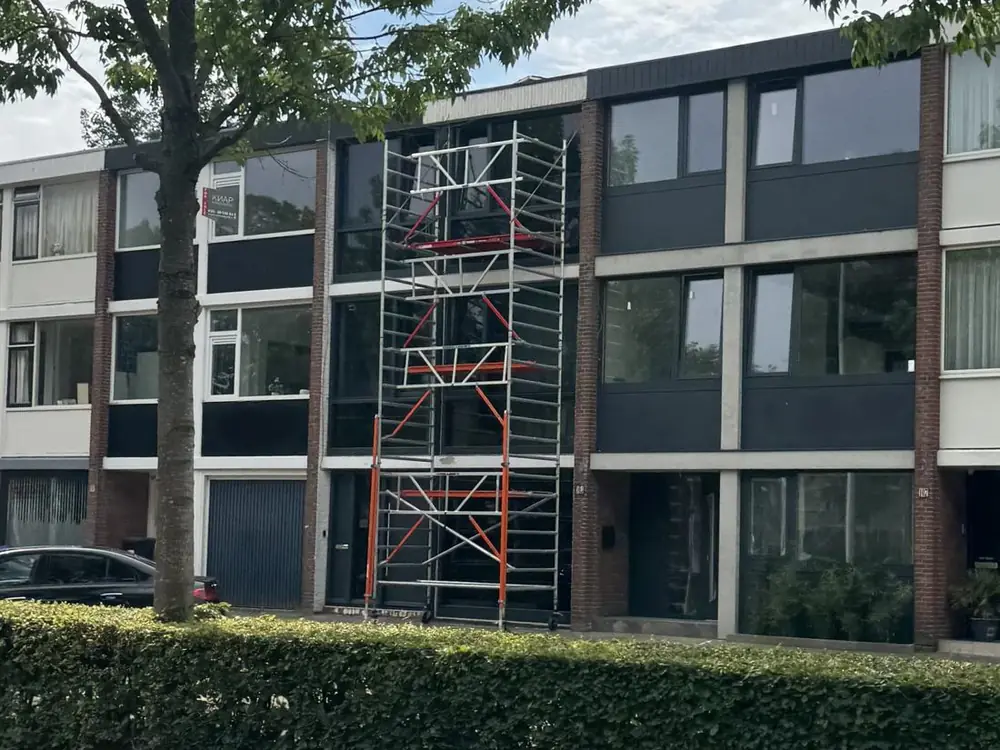
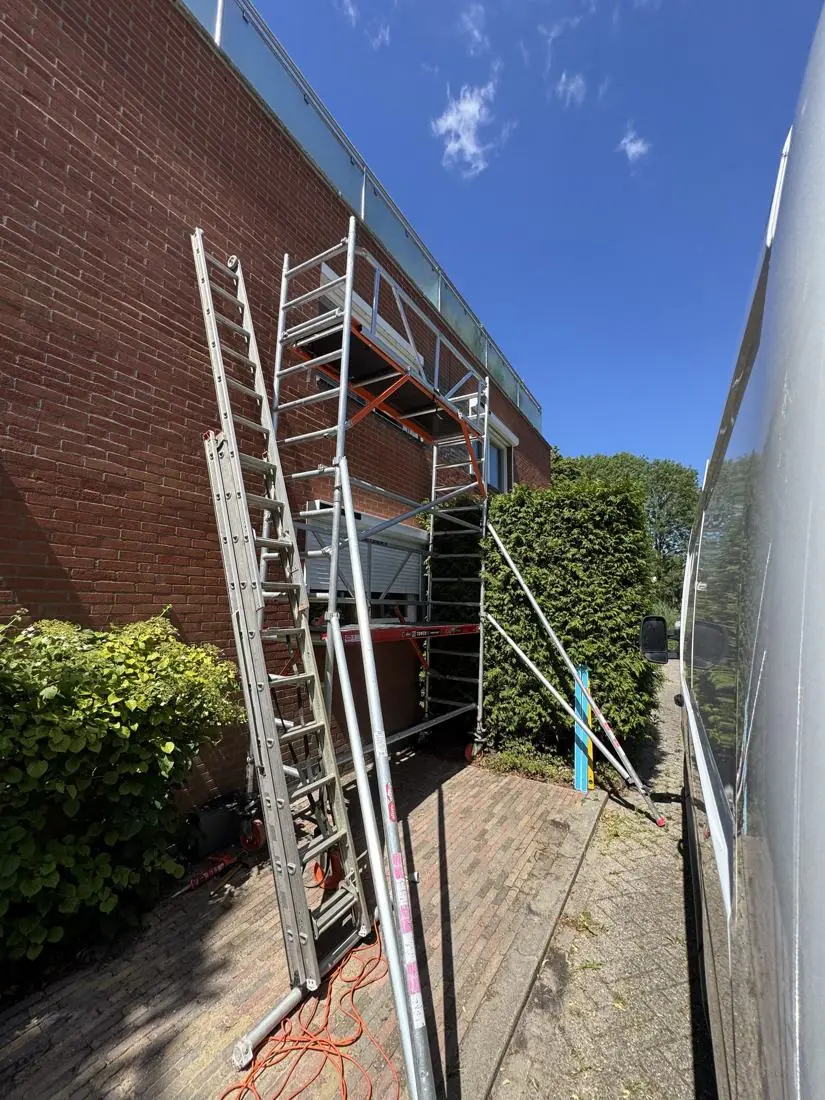
Slim mobile scaffold standing along a brick wall, the setup from which one bay at a time gets treated

Working with a bigger tank, or with a second person following behind on the joints, brings the RS52 at 135 cm into view. It gives you deck to set a jerrycan down outside the walking line, which saves tripping while you refill. The drawback is that it will not pass many a back alley, and you discover that on delivery day itself, with the parts already at the door. Which scaffold suits which facade job is weighed up in the piece on choosing for facade work.
Choosing the working height to hire for a brick elevation

The surface being treated runs on to wherever the masonry stops, and that is usually under the roof trim or below the gutter. Measure up to that line, and start from the ground or the path on which the wheels of the tower will shortly rest. Do not skip the last fifty centimetres in your sum: a band of untreated brickwork high on the wall stands out after the first shower as a dark rim that will not go away again.

The height you order is made of two parts. First the deck you stand on, then roughly 2 metres of reach on top of it, and together they give the working height that appears in your reservation. Go for 6 to 8 metres and you are standing at 4 to 6 metres, able to take in a band of nearly two metres above your head without stretching. How many frames that involves can be checked where eight metres of reach is explained.

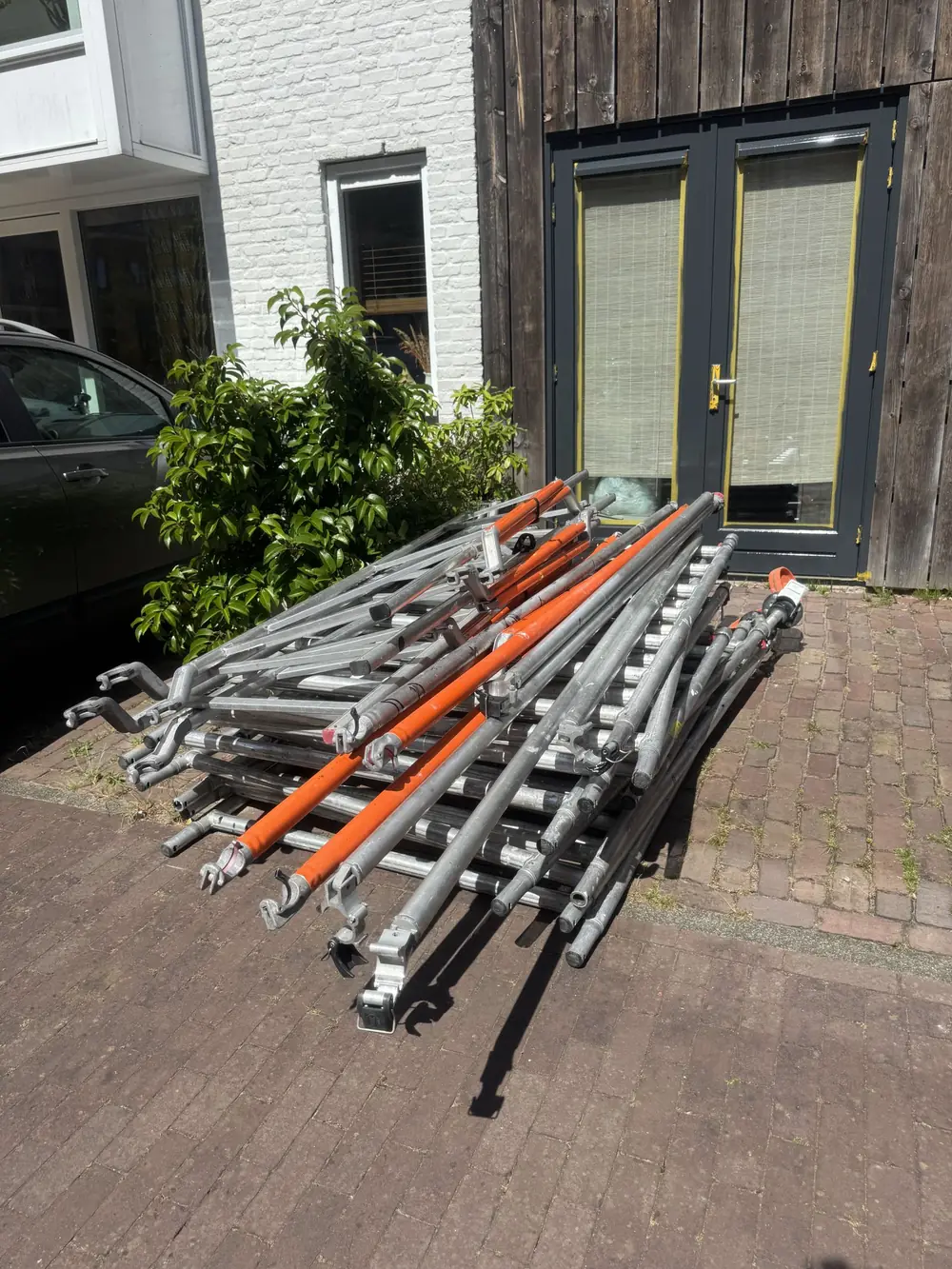
Mobile scaffold running up a side elevation to just below the roof edge, the reach this treatment asks for

Cutting it fine punishes you straight away on this work. Fall a little short at the top and that last band has to be done from a second setup, by which time the coat below it has long since drawn away. On the boundary between those two moments a visible difference in sheen and colour appears. So take one frame more rather than one too few when you settle the build height. Where the masonry carries on above the second floor of a house, that margin matters more still.

Where the tower stands while impregnating brickwork

The setup goes hard against the wall you are treating, and with masonry that is often the side where the garden begins. Reckon on a flat strip wider on every side than the tower itself, because the stabilisers point outwards at an angle. Borders, a gravel path, a settled slab or a tree root all make that strip unusable; a wheel that sinks a centimetre leaves you with a build no longer standing square to the brickwork.

Look at what is waiting underneath you as well. Fluid running down the wall ends up on the border, on the terrace and on the plinth, and not every planted edge enjoys that. Cover the lower strip with film or lay sheeting there, and move plants growing hard against the brick aside for as long as the hire lasts. A path that falls away is brought level with boards under the wheels of the tower, an operation described in the approach on uneven ground.

Outward set stabilisers under a mobile scaffold, marking the flat strip that must stay clear beside the masonry

Finally, think about where your materials live. The jerrycans, the tank and the filling kit sit best right beside the foot, on a piece of sheeting, so that refilling does not mean stepping around the stabilisers with a full can. Do not put them against the wall, because that is exactly where the next position goes and you would then move your entire workplace at every bay. A couple of metres clear of the line the tower runs along is enough to avoid all of that.

How many rental days to hire for impregnating brickwork

Putting the product on goes quickly; the preparation does not. A wall has to be clean and dry before anything draws in, and loose joints are repaired first, or the fluid simply runs away through them. Add to that the test patch you make a day earlier in order to judge the absorbency of the wall. For a house with a front and a rear elevation that brings you to two or three hire days in total, of which only one is really spent putting product on the wall.

The waiting is mostly weather. Masonry that got wet yesterday takes up nothing today, and after treatment you want a spell without driving rain so the product can draw away in peace. Frost and full sun on the wall are both unhelpful, which makes a grey, dry day your best moment. So do not book your hire days tight against one another, but with room to slip a day when the forecast turns or the wind swings round.

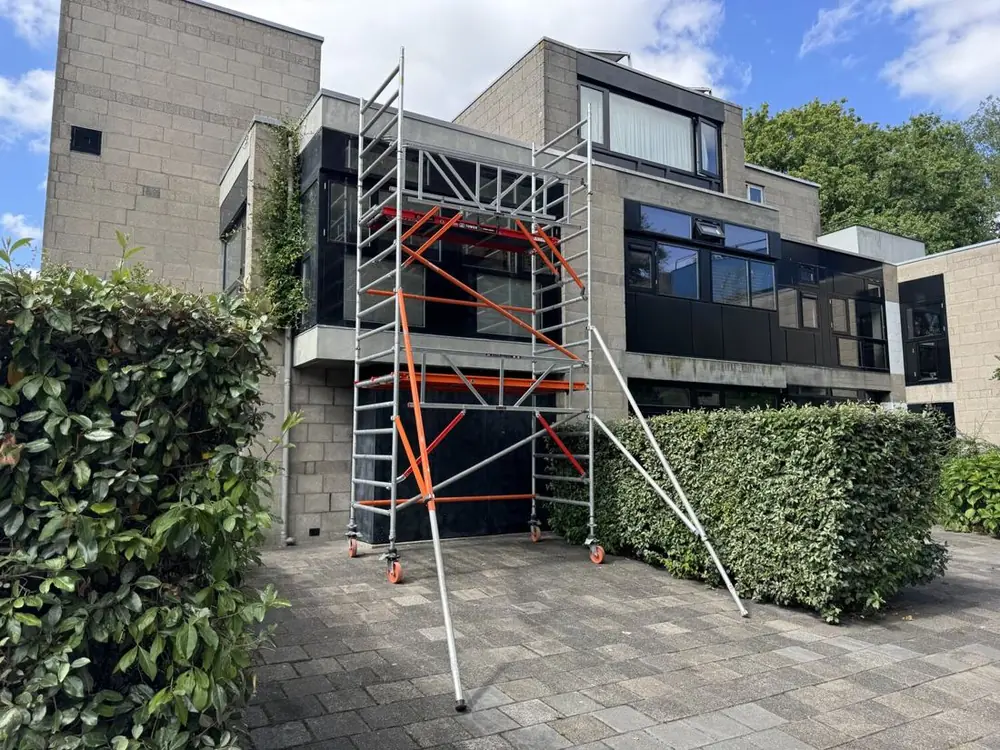
Mobile scaffold beside a dwelling, the build you leave standing for the hire days this treatment takes

Booking generously weighs light in the cost. There is one day at the normal amount, covering the first twenty four hours, and a 95 per cent reduction runs on every further day of the booking, so waiting for dry weather barely counts in the total. What does count heavily is a half treated wall on the morning the build gets collected, because that seam never comes out. Choosing a realistic period is described in the explanation of hire days.

Which mobile scaffold suits impregnating brickwork?

Kamersteiger RS44
  • Working height up to 4 metres
  • Compact and narrow
  • Great for indoor and small jobs
View and calculate →
Most chosen
Smalle rolsteiger RS51
  • Working height up to 14.2 metres
  • Narrow (75 cm)
  • Ideal for narrow passages
View and calculate →
Brede rolsteiger RS52
  • Working height up to 14.2 metres
  • Wide platform (135 cm)
  • Extra stability and workspace
View and calculate →
1-persoons steiger MiTower
  • Working height up to 6.2 metres
  • Very compact
  • Quick and easy to assemble
View and calculate →

Impregnating brickwork from the 245 cm working platform

Your deck measures 245 cm, and that measurement sets the width of the bay you treat per position. Work such a bay from below upwards and keep the edges wet, so the next part joins on before the previous one has drawn away. Run it from the top down instead and surplus fluid trickles over dry brick, leaving streaks that stay visible once everything dries. Across an elevation eight metres wide that works out at three or four bays in a row.

How thirsty the wall is decides how often you refill. On weathered masonry or on old joints far more disappears into the wall than you estimated beforehand, and then you are down at the jerrycan more often than up at the brick. So top up before you climb, and where you can, take a full spare can up with you and stand it on the deck out of the way. That saves two descents per bay, and those add up across a whole elevation.

Erected mobile scaffold at a front elevation, its 245 cm deck setting the width of one bay

What people underestimate is the join between two positions. Put your vertical seam somewhere sensible, at a corner, a downpipe or a window reveal, and not in the middle of a closed stretch of masonry. Move the tower straight away afterwards and start the next bay, rather than breaking for tea or tidying your tools first. The transition then stays wet, and later nobody can see where one position ended and the next began. On a closed stretch of masonry that is the difference between invisible and irritating.

Hiring a mobile scaffold with delivery for impregnation work

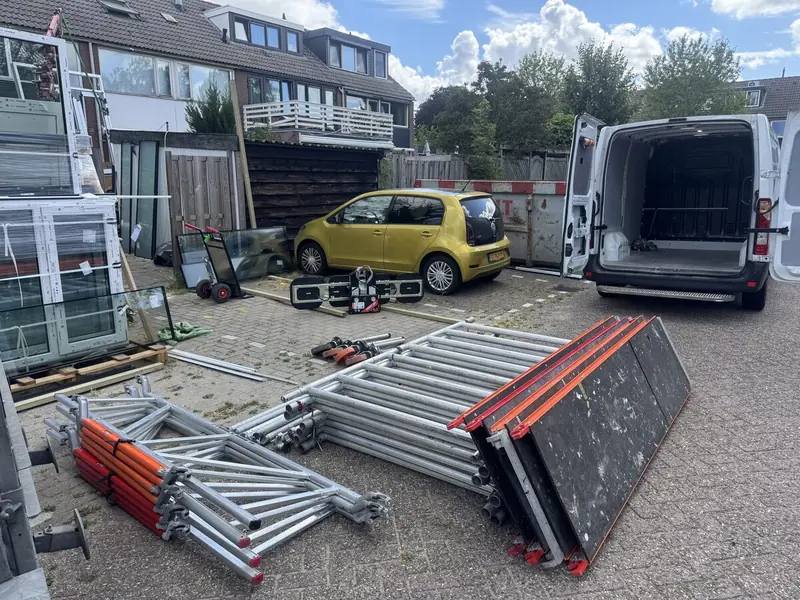
What gets delivered is a fully counted set of loose parts: uprights, decks, braces and stabilisers. Agree where they may be put down, and do not choose the strip beside the wall, because that is where you want a clear run. A drive, a piece of lawn or a quiet corner of the garden suits better, certainly if you want the parts in the order you need them. A reservation that comes in ahead of the 15:00 deadline on a weekday puts the parts at the given address the following working day.

Both ends of the period are yours to fix: the morning the parts appear and the morning they leave again. On this treatment a spare day at the front is handy, so that you can build, set your test patch and start the next morning the moment the wall feels dry. The building is yours to do: the manual and the instruction film run through the sequence step by step, and with two people that costs half a day which you count as working time.

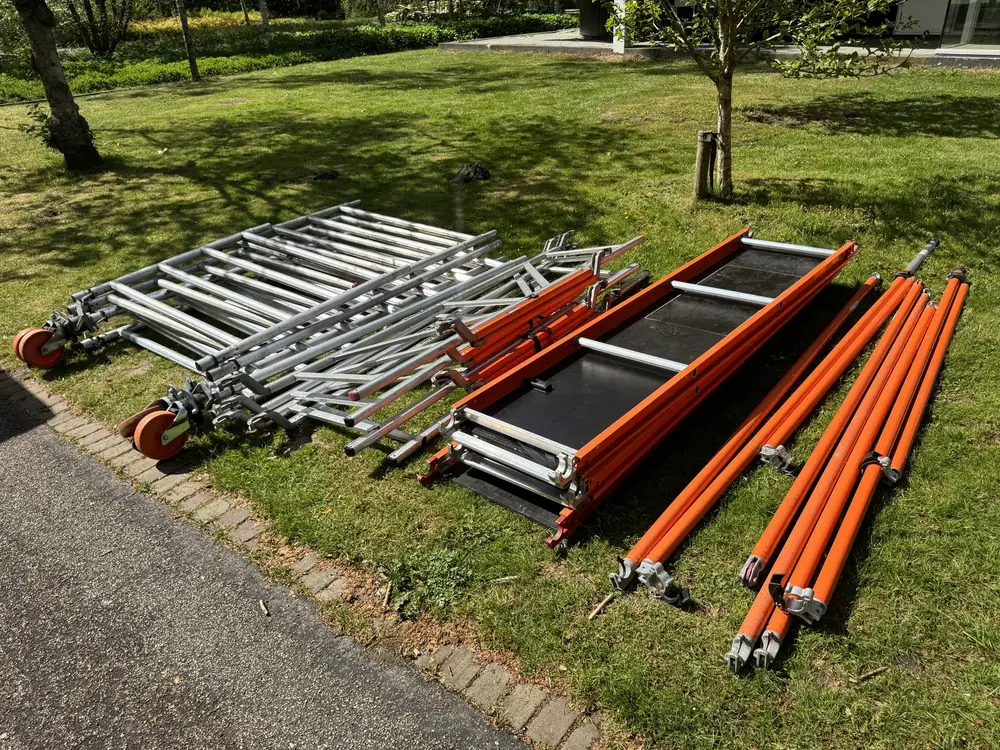
Parts of a mobile scaffold laid out on the lawn beside a house, ready to be built up along the masonry

Once the last bay is finished you take the build apart again and lay the parts together, after which we come to collect them. Do that only when the product has drawn into the wall, since packing wet tubes works against you. Count the parts off while you dismantle and nothing will be short later, which keeps the handover on collection day brief. What bringing and fetching costs per province can be read at the fixed amounts for delivery.

Safety on the scaffold you hire for treating brickwork

These towers sit in load class 3 of EN 1004, and that class draws the line at 200 kg per square metre of deck. Impregnating with one person and a tank stays well under that, but as soon as a second man and a full jerrycan join in it starts to mount. What goes wrong more often is the distribution of it: a heavy can belongs near the centre of the boards, not tucked into a corner against the guard rail.

The ground rules do not change. Brake the wheels before you climb on, never roll the build along a stretch with tools or a person still aboard, and set the four stabilisers down firmly after every move. When it blows hard you stop: with a fluid that atomises, the mist travels with the wind and lands on windows, cars and the neighbours' hedge instead of in the stone. Still mornings are simply the best hours to be up on the tower for this work.

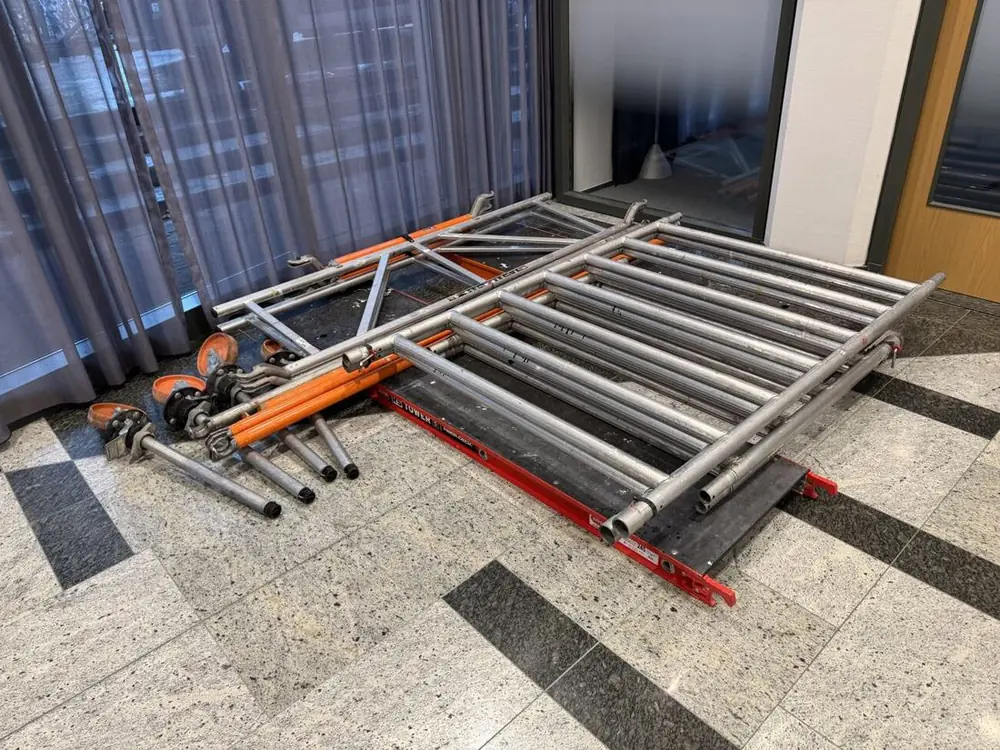
Complete inspected set of scaffold parts, the material from which you assemble the build to the standard

Two things belong specifically to this job. The deck turns slippery the moment product lands on it, so mop spills immediately and work in footwear that keeps its grip. And the zone below you is seldom empty: plants stand there, your cans lie there, and now and then somebody walks past. Rope that strip off, keep it covered and put nothing on the edge of the deck that can roll away. Further arrangements sit at the rules on working at height.

In 5 steps

How hiring a mobile scaffold works

1
Choose working height

Pick the height that suits your job.

2
Book online

Sorted in 60 seconds, price shown instantly.

3
We deliver

At the agreed spot the next working day.

4
Assemble safely

Assembled by you, with a manual.

5
We collect

One call and we collect the scaffold.

Good to know

Practical tips for impregnating brickwork

1

Put your test patch somewhere inconspicuous, behind the downpipe or low by the plinth, before the tower is even delivered. You then see what the brick takes up and whether the colour shifts.

2

Fill the tank at ground level and never on the deck of the tower. Splashes while decanting give you a slippery patch exactly where you have to stand for the rest of that bay.

3

Treat the joint with as much attention as the brick. Water that gets into a wall usually travels through the mortar, so a bay done only across the brick faces leaves the weakest line untreated.

4

Read the forecast three days ahead before you fix your hire days. Wall that has taken rain absorbs nothing, and then you wait for it to dry with the tower standing and the period running.

5

Sheet the ground under the build and cover the planting along the wall. Whatever runs down the brickwork lands in the border otherwise, and you notice that only weeks later in the plants.

6

Keep the wall vapour open: pick a product that draws in rather than one that closes the surface off. Judge that on the test panel from the deck before you commit the rest of your hire days.

Frequently asked questions

Frequently asked questions about impregnating brickwork

Which mobile scaffold do you hire for impregnating brickwork?+

Take the RS51 at 75 cm across, which still gets you along a boundary or down a narrow back alley to the wall. Up top you only have to find room for a low pressure sprayer or a bucket, so a lot of deck is not the point. Working with a second person, or with a bigger tank, the RS52 at 135 cm gives more freedom. Walk the route to the rear elevation before you book, since the tightest gap on the way decides which tower you hire.

How does hiring a scaffold for impregnating brickwork run?+

You put the model and the height together online, fix the arrival day and the departure day and pay one set amount with VAT included. The parts are dropped at your place, you assemble the tower, make your test patch and then treat the wall bay by bay. At the end you gather everything dismantled and we take it away. All you arrange before the hire starts is a dry spell in the forecast and a clear strip beside the wall for the build.

How many days must you hire to treat a brick elevation?+

For a house with two elevations, two to three days is a realistic hire period. Applying takes only a few hours per wall; the cleaning, the repair of loose joints, the test patch and the wait for dry masonry fill the rest of it. With a corner plot or an extension carrying another face, add a day without hesitation. Since a tower is hired by the period anyway, taking that day now works out better than coming back with a second booking later in the season.

What does the hire come to, and why does day two weigh so little?+

The tariff comes out of the tower you pick and the height it is built to, with bringing and fetching as a separate item per province. The rental price for each model is shown with VAT on the page of hire tariffs. Most of what you pay covers the transport and the handling, and all of that lands on the first day; a longer period simply spreads the same amount over more days. For weather dependent work that falls out well, since you can take the margin you need.

Which working height do you hire for a wall treated to the roof edge?+

Two storeys brings you to 6 to 8 metres, so the deck of the scaffold ends up at 4 to 6 metres. Measure to the point where the masonry stops, so up under the roof trim or the gutter, counted from the ground the wheels stand on. Where the garden lies lower than the pavement, hold that difference in your figure and round upwards. Which range goes with which build, and what you have to hire for it, is on the the list of working heights.

Can I make the test patch before the hire period starts?+

If it can be done low down, yes, and it is worth doing. A patch just above the plinth is set from a ladder or off the ground, and after that you know how greedily the masonry drinks. That figure decides how much you buy in and how many days you need the tower. Where the panel has to sit higher, on a weathered gable say, move it to the first day of hire and leave that day open, since impregnating brickwork starts with a judgement you cannot rush.

Do you deliver the hired scaffold or do I fetch it myself?+

Either is possible when you hire a mobile scaffold here. With delivery the set comes to the address on the day you picked and goes back afterwards, for an amount laid down per province. Prefer to drive, and picking the set up costs nothing at all: Zeeburgerpad 89 in Amsterdam, at an agreed time, with a vehicle that takes a full load of parts. Impregnating brickwork usually means a car already loaded with cans and sheeting on your starting day, so most people take the delivery.

Do I put the hired tower up myself, or do you?+

Assembly belongs to you, not to us. Our van brings the counted parts and takes them back at the end, while putting the tower up, moving it and stripping it down again are yours, guided by the step plan and the instruction film. Two people manage it in half a day, so count that into your planning. Cherry pickers are not on our list, and neither is facade or system scaffolding, so at this height you hire the rolling type and build it yourself.

Can I hire for longer if the wall turns out still to be damp?+

Yes. Say the word and the collection day moves, provided no other customer is queued for this tower straight after you. On this treatment that happens regularly, because a wall that has had a night of rain takes up nothing the next day and you only find that out in the morning. So take a margin when you hire, or accept that a working day may fall away. Handing back early is always allowed, which makes a generous booking no waste at all.

How much room is needed around the foot of the hired tower?+

Take the width of the build, add how far the stabilisers reach out to the side, and keep a further strip clear for the jerrycans and the sheeting. In practice you want several metres of flat, firm ground running along the wall. Where a border, a water butt or a shed stands hard against the masonry, clear it before the scaffold arrives. Tidying while the work is on eats straight into your hire days, and you feel that most by the time the final bay comes round.

What is agreed about the deposit on this hire?+

There is a deposit on the booking. When the tower comes home and every part is accounted for, that money reaches your account inside 1 working day. While the hire runs, watch for baked on residue: product drying onto the tubes has no business being there, so wipe spills away at once with a wet cloth. That is a minute of work and it saves argument on collection day. More on that settlement is in the note on the security sum.

Does brickwork stay vapour open, and what do you check on the first hire day?+

That is precisely the point to watch when you pick a product. An impregnating fluid belongs in the brick and in the joint without shutting the pores, so moisture from inside can keep evaporating outwards. A sealing layer does the opposite and pushes that damp back into the wall. Judge it on your test panel, and use the first day you hire the tower to study that panel close up, the joints between the bricks included, before you commit to a full elevation.

Hire a mobile scaffold for impregnating brickwork today?

Calculate your rental price now or ask for free advice.

Rolsteiger van SteigerTaxi geleverd op locatie
Book it online

Your scaffold sorted in 2 minutes.

Choose your scaffold and working height, see the price instantly and book online.