
See your price
Application

Pointing joints? Choose the right scaffold.

Pointing joints turns on the filling: pressing mortar into the seam, packing it home and striking it at the right moment. You advance bay by bay, and a bay is sized by the batch you mixed, not by the length of your arm. On a brick elevation of two storeys that points to the slim RS51, put up for a reach that stops somewhere between six and eight metres. What follows explains why that model suits the filling, how many hire days are realistic, and what the ground at the foot has to offer.

  • Order before 3 pm, delivered tomorrow
  • Professional Altrex scaffolds
  • Up to 14.2 metres working height
  • Easy to assemble yourself
4,2 tot 14,2 mWorking heights available
12Provinces served
7Days a week
200 kg/m²Load class 3
In short
  • For pointing joints we recommend the Narrow mobile scaffold.
  • Anyone pointing joints on an elevation of two storeys hires the narrow RS51, put up for a reach that stops around eight metres.
  • A mixed batch defines your bay, so each position on the tower holds you far longer than most other work on a wall.
  • Count on three to five days of hire, aftercare included, plus the days on which frost or rain simply stops you.
  • First 24 hours from €150 incl. VAT and delivery; every day after that 95% off.
Key facts for this job
FeatureValue
Recommended scaffoldNarrow mobile scaffold (Altrex RS TOWER 51)
Working height for this job6 to 8 metres
Available working heights4.2 to 14.2 metres
StandardEN 1004, load class 3 (200 kg per m²)
DeliveryOrdered before 3 pm, delivered next working day
Each extra day95% off, from €7.50 a day
Why a mobile scaffold for pointing joints?

Safe, stable and professional work at height

With filling, the mortar dictates your pace. You mix a portion, charge a bay, let it firm and strike it, and only then do you move along. So hiring a mobile scaffold for pointing joints is not about building as high as you can, but about standing steady and close to the brickwork with your tub and your irons within arm's reach. You push hard against the wall, you hold one posture for long stretches, and you have to judge the seam from a hand's breadth away. Nobody keeps that up half a day on a ladder, where your whole body hangs off one point and your tools off the other hand.

  • Deep seams get charged in two passes
  • Strike as soon as the mortar feels thumb dry
  • The top seam under the eaves sets your reach
  • Tub, water and irons all within arm's length
Read more about working safely →

Hiring a narrow mobile scaffold for pointing joints on brickwork

For recharging the seams of a brick elevation the RS51 is the obvious choice from the fleet: a tower that builds only 75 cm wide. That dimension pays you back twice over. It travels along a garden path, through a side gate and down the strip beside the house where the boundary fence crowds in, and it shifts one bay along without your having to move the mixing station with it. The rest of the fleet is set out under the mobile scaffolds available to hire.

Up on the deck you barely miss the extra width on this sort of work. Your chest is close to the brickwork, you drive the mortar in with short strokes, and everything you reach for lies within half a metre: the iron, a small brush, a bucket of clean water and the portion you mixed a few minutes ago. What you do notice is how long the boards under your feet run, because that length settles how many seams fall inside one position.
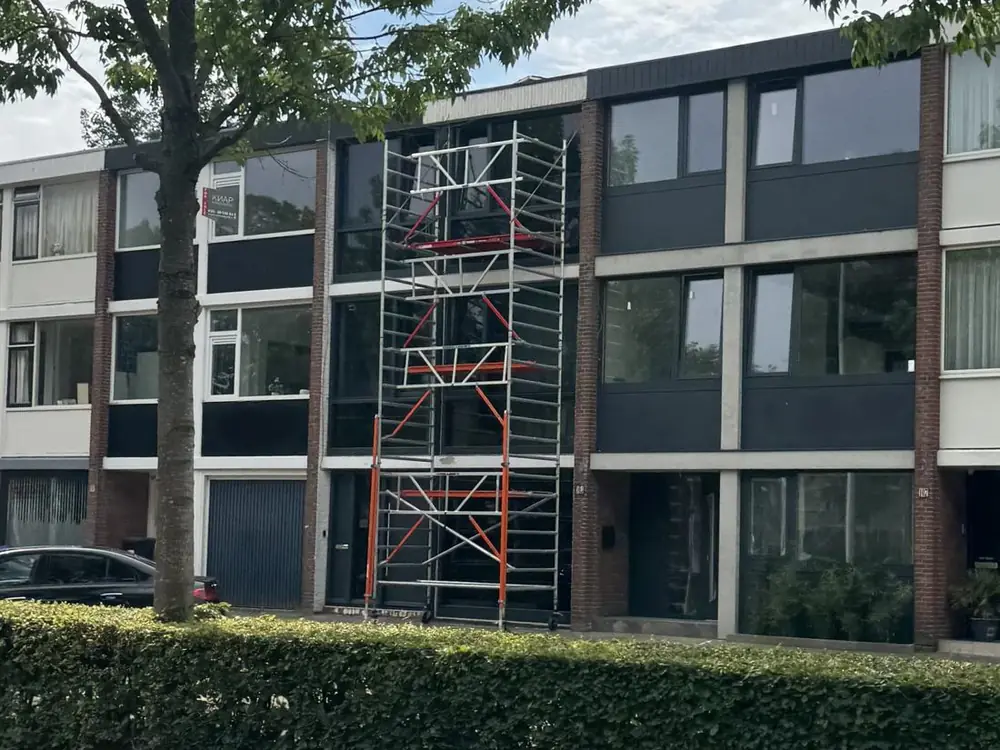
Mobile scaffold built up the front of a three storey building past the upper windows, standing on a narrow footprint

The 135 cm model only starts to make sense when two of you are up there together, or when the whole tub travels up instead of small portions. That choice has a price: more components to carry round the back, and a build that will not pass everywhere. If you are cutting out first and pointing joints later, the balance tips differently. The two widths are compared under a side by side look at both tower widths.
What working height to hire up to the topmost seam

Measure to the highest seam still waiting to be charged. On most terraced houses that is the soldier course or the last course of brick under the eaves, and it calls for a hired reach of six to eight metres. Working height is not the boards on their own: it is those boards plus roughly 2 metres that you still bridge with your arms raised. Stand at four metres and you reach six. That total is the figure you give when you book, and not the height of your gutter.

The starting point for the measurement is the ground the castors come to rest on. If the drive falls away towards the carriageway, if there is a sunken light well along the plinth, or if your terrace drops a step down into the garden, your baseline slips half a metre without your noticing. Where only the bottom two metres are being recharged, above a plinth that has drawn damp, you can hire considerably lower. The build behind an eight metre working height is worked out on that page.

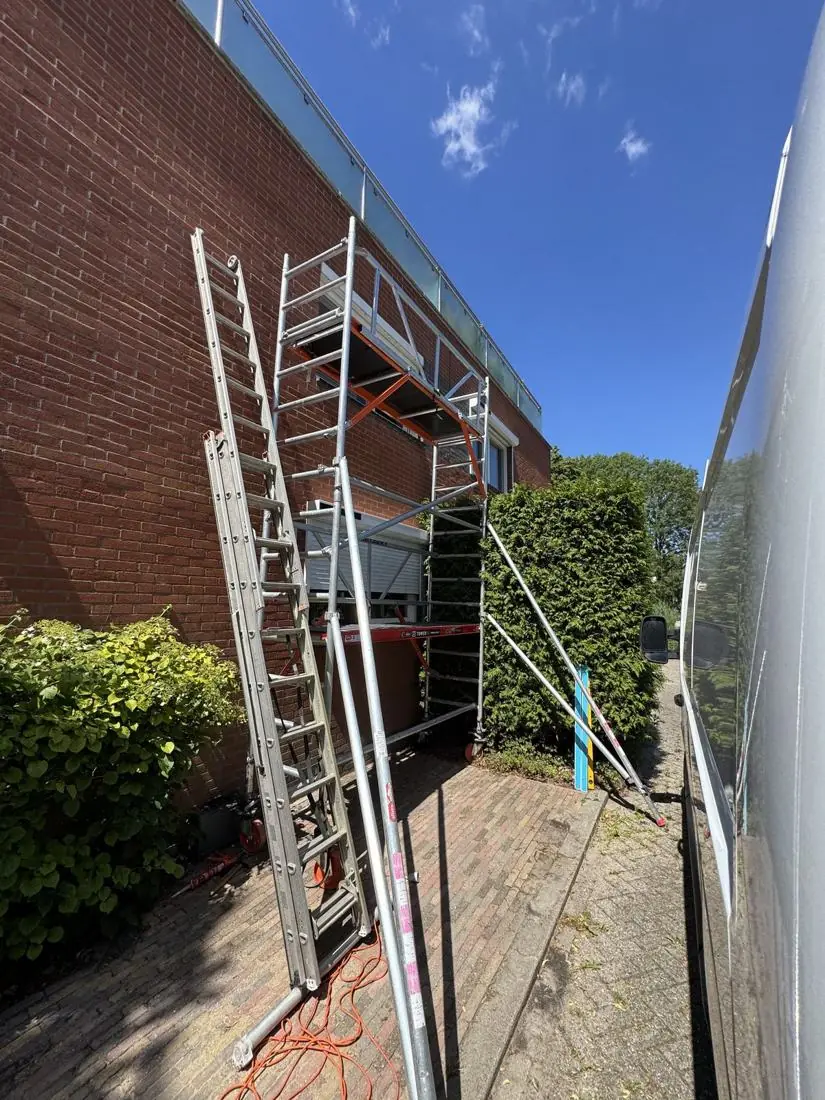
Aluminium ladder propped beside an erected tower in the gap between a brick wall and the neighbouring building

Standing too low shows up immediately when you are pointing joints. Above shoulder height you can no longer pack the mortar fully home, voids stay behind the face of the seam, and the striking runs crooked because you are looking up at it from underneath. That top course comes back to haunt you later as a band in an odd colour with a different profile. Half a metre of reserve is cheap insurance when you hire a mobile scaffold, while a second build to reach that last course costs half a working day.

Hiring a tower and setting it beside your mixing station

At the foot of the build, pointing joints puts more on the ground than the tower alone. Your mixing tub turns there, the bags of mortar mix lie dry under a sheet, and the hose from the outside tap hangs within reach so that your irons can be rinsed between bays. Reckon therefore on a band of level ground that is roomier on every side than the tower itself, with the four stabilisers reaching outwards and a walking route beside them that stays clear for your buckets.

The ground has to carry the castors without sinking, even after a day of working with water. Slabs, block paving and a firmed drive are all fine; a planted border or a newly sown lawn is not. Look at what sits beneath your position as well: a cellar hatch, a light dome over the crawl space or a freshly repaired plinth is not something to use as a bearing point. Uneven ground is dealt with in the advice on a sloping or soft surface.

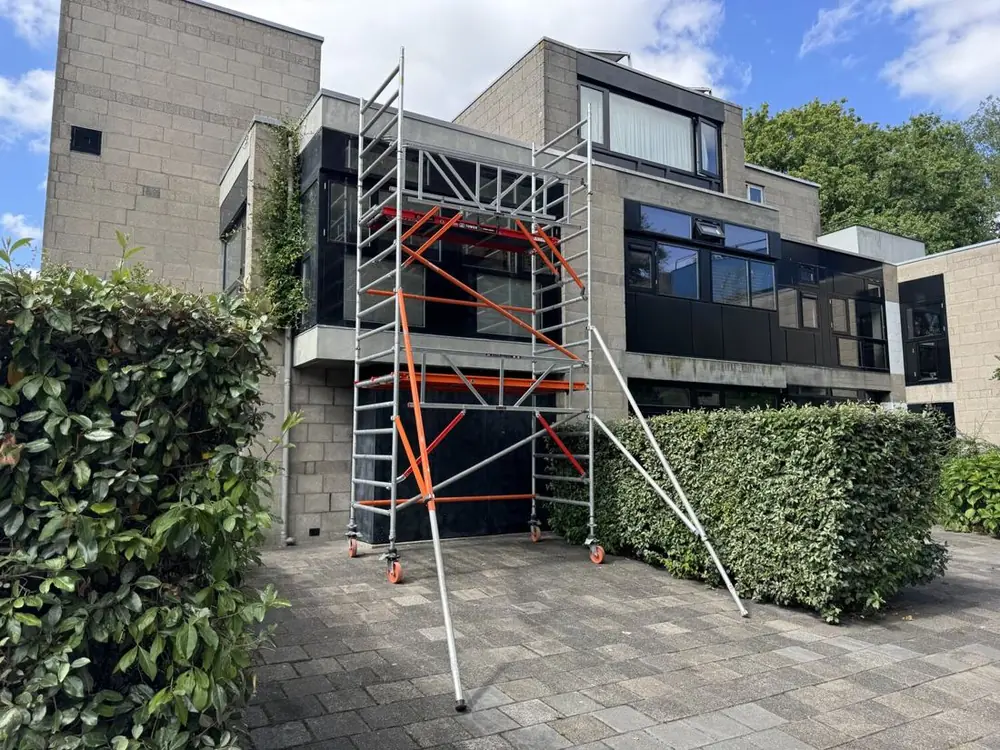
Erected tower standing on paving before a grey block house, its long stabiliser tubes reaching down on either side

Finally, work out where the mess is going to land. Filling drops mortar, and mortar bonds to paving and car paint harder than you would wish. Spread a tarpaulin below the strip you are charging, and move vehicles well clear before the first tub travels up. Where the hired build takes in part of the pavement, leave enough footway for a pushchair to pass, and ring the council to hear which permissions apply on your particular street.

How many hire days does pointing joints call for

Filling does not translate neatly into square metres per day, because you spend as long mixing and striking as you do charging. For the front elevation of a two storey terrace most people hire for three to five days, spread over four to six positions. Take in the flank wall as well, or find that cutting out has to come first, and it climbs. Add to that the round in which you go back over the bays you charged on the opening day.

Scattered through that period are hours when nothing can be done. A bay has to firm before it can be struck, and in warm weather you want to damp the fresh seam down a few times afterwards so that it does not dry too fast. If it freezes, or rain drives against the wall, you do not point at all and the whole thing slips a day. Those silent hours fall right in the middle of your hire period, so count them when you book.

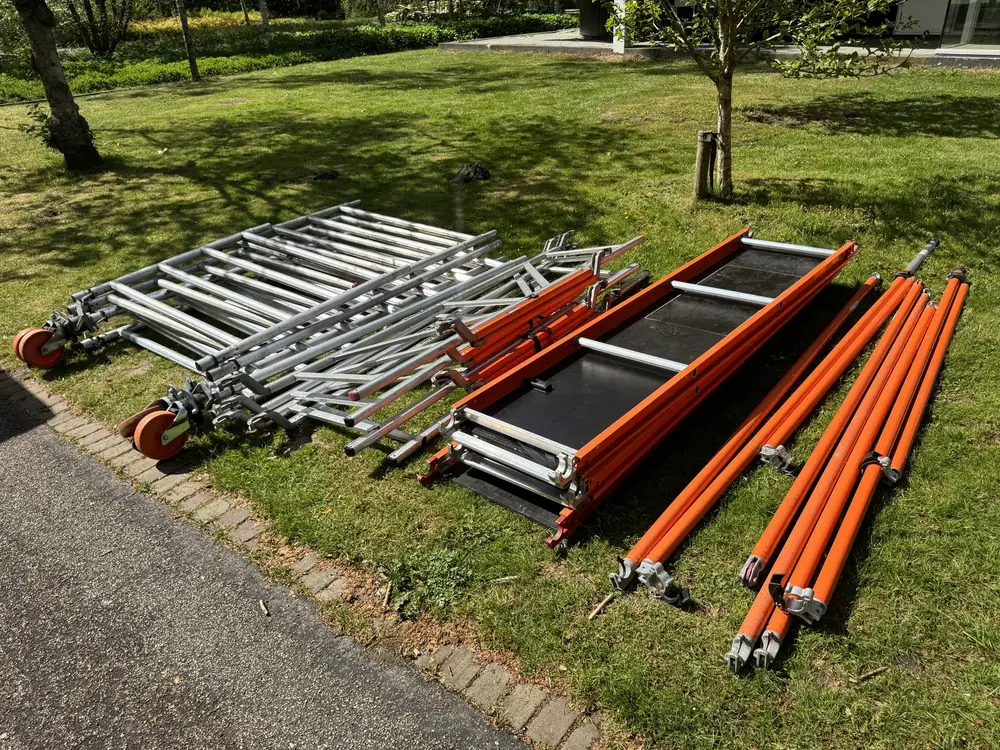
Aluminium frames with red castors, orange braces and dark deck boards laid out across a lawn beside a path

That is exactly why the sums work out kindly on a job like this. The full rate applies to the opening twenty four hours only; every following day is charged with 95 per cent taken off. Two days of slack for the aftercare therefore weigh almost nothing, while booking tight leaves you at the collection van with half charged bays. So a generous reservation is the cheap choice here, and a tight count is the expensive one. To sharpen the estimate, read the guidance on how long to book a tower.

Which mobile scaffold suits pointing joints?

Kamersteiger RS44
  • Working height up to 4 metres
  • Compact and narrow
  • Great for indoor and small jobs
View and calculate →
Most chosen
Smalle rolsteiger RS51
  • Working height up to 14.2 metres
  • Narrow (75 cm)
  • Ideal for narrow passages
View and calculate →
Brede rolsteiger RS52
  • Working height up to 14.2 metres
  • Wide platform (135 cm)
  • Extra stability and workspace
View and calculate →
1-persoons steiger MiTower
  • Working height up to 6.2 metres
  • Very compact
  • Quick and easy to assemble
View and calculate →

Charging a bay per batch from a 245 cm platform

Boards of 245 cm sound generous, and they are, because when you are pointing joints your bay is bounded by the batch and not by the tower. An ordinary tub charges roughly one and a half to two square metres before the mortar begins to go off. So you work the full height of the wall that falls inside your position, from the topmost seam down to the plinth, and only when nothing there is still open do you roll one board length further along.

Keep every batch identical to the last. The same water, the same mixing time and the same sand out of the same bag, because a wetter tub dries lighter and you will see that on the wall as a block that does not match its neighbours. Where the seams have been cut out deep, charge them in two passes: press firmly to halfway first, then lay the finishing coat over it. Stuffing a deep seam in one go leaves voids behind the face for damp to find.

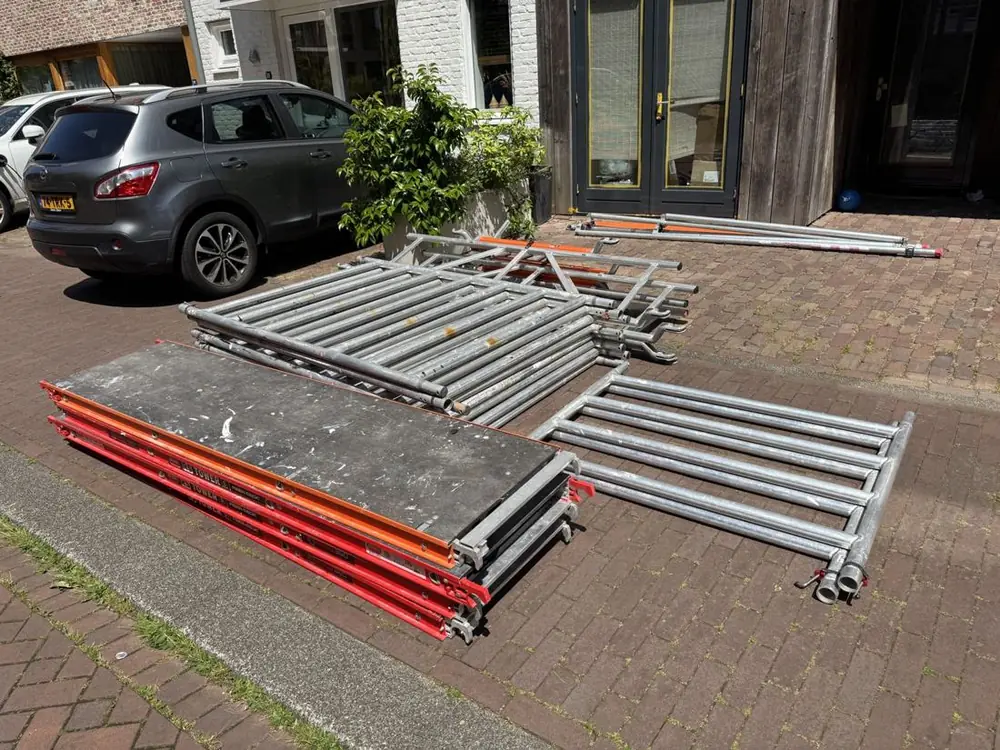
Guardrail tubes, stacked frames and red edged boards set out on brick paving, a parked grey car just behind them

Strike with the iron that matches the width of the seam, at the moment the mortar feels thumb dry and no longer clings to your finger. Too early and you drag the seam open; too late and you scrape it to pieces. That moment comes round again in every position, so you keep walking the boards past the bays already charged. This is where people misjudge the job: you move the tower less often, but you stand still far longer.

Scaffold hire with delivery on a date you pick yourself

What arrives at your address is a set of loose components, every one of them counted. Order on a weekday before 15:00 and those components are on the pavement the next working day; which date that turns out to be is yours to decide, as is the day we come back for them. For pointing joints the best delivery day is the one before your first bay, so that you build in the dry and start mixing the following morning.

Agree in advance where the components are to be set down. They go on the pavement or the drive, and that is precisely the place where you will shortly want your mixing tub, so keep two strips free instead of one. Putting the parts together is your own job and takes about an hour with two people. If you would rather not have a delivery day in the diary at all, the set can be collected by arrangement, free of charge, from Zeeburgerpad 89 in Amsterdam.

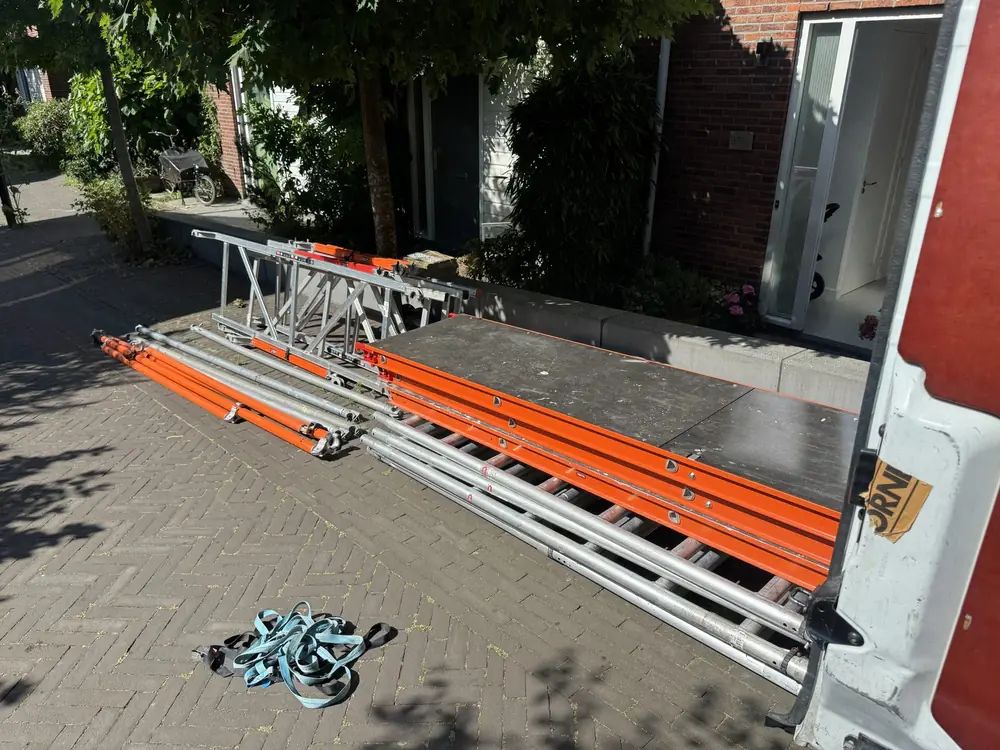
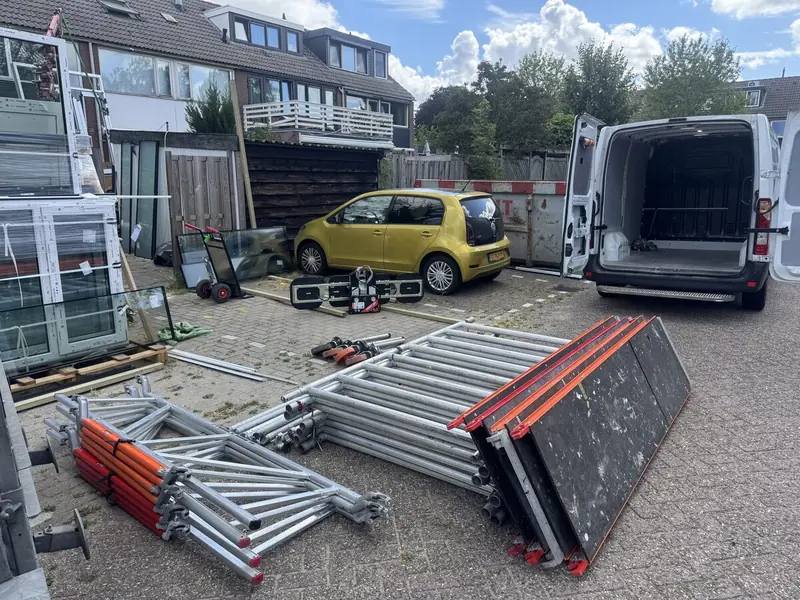
Braces, frames and a wide deck board set out on herringbone brick beside a van with its rear standing open

Let the forecast have a say in your dates. Night frost really does spoil this work, because fresh mortar that freezes has to be done again. So put your delivery day behind a cold spell and your collection day one day after your last bay, leaving room to dismantle and rinse at leisure. What the transport comes to in your own province is listed under the charges for delivery and collection, so there is nothing left to work out afterwards.

Safe filling six to eight metres up on a hired tower

There is more weight on your boards on this job than you might guess. A tub of mortar, a bucket of water, half a bag of mix and your own body together climb faster than expected towards a ceiling of 200 kg for each square metre, the figure that EN 1004 attaches to load class 3. So spread that kit out along the length of the boards instead of parking tub, bag and buckets together in one corner, and bring the heavy material down before you move the tower on.

The castors go on the brake before you take the first rung, and they stay locked as long as anyone is working aloft. Never roll the build a step sideways with somebody aboard or your tub still up top, however short the shove to the following bay. If the wind gets up, stop: with a bucket in your hand and your face towards the wall you register a gust a second too late, and that second is the whole problem.

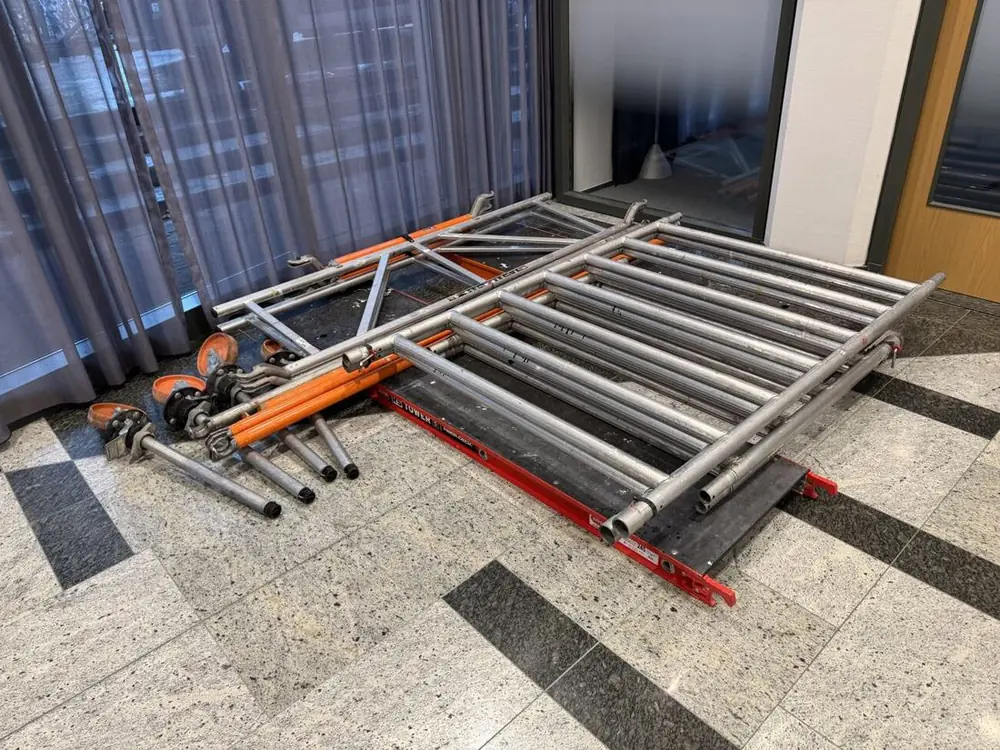
Frames, orange diagonals, castor units and one red edged board arranged for counting on a polished tiled floor

The hazards peculiar to filling are wet and slippery ones. Mortar droppings and rinsing water make the boards greasy, so sweep between bays and never let a puddle stand under your feet. An iron laid down on the edge for a moment is guaranteed to go over eventually, so put tools against the trap door rather than by the guard rail. If a path runs beneath you, close it off while you are up there working.

In 5 steps

How hiring a mobile scaffold works

1
Choose working height

Pick the height that suits your job.

2
Book online

Sorted in 60 seconds, price shown instantly.

3
We deliver

At the agreed spot the next working day.

4
Assemble safely

Assembled by you, with a manual.

5
We collect

One call and we collect the scaffold.

Good to know

Practical tips for pointing joints

1

Make your first batch deliberately small and count how many seams it charges before it starts to bind. That number is the measure by which you divide up the rest of your hire days.

2

Write the mix ratio on the rim of the tub with a marker. After the fourth portion of a long day you trust your memory less than you think, and colour variation never comes out again.

3

Take a second iron in a different width up with you. Seams in old brickwork do not run to one size, and climbing down for the right iron costs more time than charging the whole strip.

4

Hang a bucket of clean water on the inside of the guard rail so you can rinse your irons as you go. Caked mortar on a tool draws streaks through a seam you have just struck neatly.

5

Sheet the ground under your position before the first tub goes up. Fallen mortar can be shovelled off a tarpaulin, but it grips porous paving for good once it has gone hard.

6

On the morning of collection day, walk the bays you did first with a small mirror. Small holes in the joints can still be made good from the hired tower then; afterwards there is nothing left to climb.

Frequently asked questions

Frequently asked questions about pointing joints

Which mobile scaffold do you hire for pointing joints on a brick elevation?+

For two storeys most people hire the slim RS51. You stand close to the brickwork on this work and mainly need your tub, a bucket of water and two irons within reach, which fits comfortably on a narrow deck. The gain lies in access: past a side gate or between two dwellings the slim tower goes through and a wide one does not. If two of you will be working aloft together, take the broader model from the fleet instead and accept the extra carrying.

How does hiring a tower for pointing joints run from booking to collection?+

It starts online: you pick a model and a reach, say which day the set has to be waiting and put a collection day straight after it. The amount is fixed beforehand, VAT included. On delivery day you build, after which the tower is yours for as long as your hire period runs, and on the last day you leave everything dismantled and complete. The only thing you have to time precisely is your first mix, because everything after it follows the mortar.

How many hire days are enough for pointing joints on a front elevation?+

Three to five hire days is the usual answer for a two storey frontage. The charging itself moves along, but mixing, waiting until a bay is thumb dry, striking and damping down fill the rest of your day. If you are taking in the flank wall as well, or more has to be cut out than expected, add two days at once. Book tight and you will be rushing on the final morning with a strip still half open.

What sets the rental price here, and why is the second hire day so cheap?+

Two things decide the rental price: which model you hire and the height you build to. Transport out and back is settled as one amount fixed per province. Figures appear with VAT included on the published rate list well before you commit to anything. What matters most for pointing joints is the shape of the bill. Nearly all the weight lands on the opening day, and what follows hardly moves the total, so a single long booking beats two short ones taken back to back.

What working height should I hire if the top seams sit under the eaves?+

Find the highest brick you still intend to charge and measure to it from the ground the castors will stand on, since that top seam is what your reach has to cover. On an ordinary two storey house that puts you on a build coming out somewhere between six and eight metres. If only the lower courses are poor you may hire lower, but a second build costs more than a few extra rungs at the working height you settle on.

Should I hire delivery as well or collect the set myself?+

Either works. Having the tower brought is usually easiest for this job, since the counted set is then lying on your pavement on delivery day and you carry nothing yourself; the figure per province is listed with the transport charges. If you have a van and the time, you may also collect it by arrangement. Bear in mind that a set with several deck boards asks for a fair amount of load space.

Is the building included, or do I put the hired scaffold up myself?+

Building is always your own job with us. An assembly manual is in the box, and the order from the bottom upwards is demonstrated in a video. Our fleet runs to mobile scaffolds, the room scaffold and the MiTower, all brought to you as loose components. Nothing leaves the yard ready assembled, we put up no facade scaffolds, and no cherry picker is on offer. That suits pointing perfectly well, since you roll the tower to each new position by hand anyway.

Can I extend the hire if the filling takes more batches than expected?+

Yes. As soon as you can tell you will not finish, you pass on a new collection day, your hire period simply carries on and the tower stays exactly where it stands. It will not prove expensive, because after the opening twenty four hours each further day weighs very lightly. Just do not leave it until the van is at the door, or you will be dismantling in a hurry with open seams still waiting.

How wide a strip beside the mixing spot does this hire need?+

Add the four legs that splay outwards to the width of the tower itself. Beyond that you want a band left over for your tub, the bags of mix and two or three buckets, plus a route you can walk with full hands without kicking a stabiliser. That comes to a few metres of level ground along the wall. Put the mixing spot beside the tower and not between the positions, or every move begins with lifting a full tub.

Can I add days to the hire if night frost is forecast during the work?+

Fresh mortar that freezes has to be done over, so in frost you do not point at all. If you see it coming before the tower has arrived, shift your delivery day. If it is already standing, leave it up and push your work back a day; extending costs little because only the first day counts heavily. Cover a freshly charged panel and start again next morning once the wall is above freezing.

What happens to the deposit when my hire period for pointing ends?+

You lodge a deposit at the reservation stage, and it lands back on your account inside 1 working day once the scaffold components have come home. With this work there is really only one thing to watch: set the parts out clean and complete. Hardened mortar on the couplers, the rungs and the deck boards is something nobody can remove afterwards. Rinse them down with the garden hose at the end of your last hire day, count the parts against the packing list, and the settlement is a formality.

Can the hired tower stay put between charging a bay and striking it?+

Leaving it standing is precisely the plan. You charge a bay, let it firm and strike it from that one position, so the tower stays where it is until that strip is completely done and nothing has to be revisited. Only then do you roll it along. Anyone who moves the hired scaffold on early has to make those bays good later with an extension or from the ground, and that shows in the profile once the wall dries out.

Hire a mobile scaffold for pointing joints today?

Calculate your rental price now or ask for free advice.

Rolsteiger van SteigerTaxi geleverd op locatie
Book it online

Your scaffold sorted in 2 minutes.

Choose your scaffold and working height, see the price instantly and book online.