
See your price
Application

Installing a charging point? Choose the right scaffold.

A charging point hangs low: on the wall at about a metre, or on its own post beside the drive. For that box itself you do not need to hire a scaffold. The work that does ask for height is the cable: the run from the meter cupboard, the penetration through the wall and the trunking that follows the eaves along the elevation. For that you hire a one-person MiTower with 4 to 6 metres of reach. Below you read when that scaffold is really needed and how many hire days it costs.

  • Order before 3 pm, delivered tomorrow
  • Professional Altrex scaffolds
  • Up to 14.2 metres working height
  • Easy to assemble yourself
4,2 tot 14,2 mWorking heights available
12Provinces served
7Days a week
200 kg/m²Load class 3
In short
  • For installing a charging point we recommend the 1-person scaffold.
  • For installing a charging point you usually hire a one-person MiTower, narrow and light, with a reach of 4 to 6 metres.
  • The scaffold is there for the cable run and the wall penetration, not for the box that hangs at about a metre.
  • One hire day often does it, unless the run crosses two elevations or the meter cupboard sits up in the loft.
  • First 24 hours from €100 incl. VAT and delivery; every day after that 95% off.
Key facts for this job
FeatureValue
Recommended scaffold1-person scaffold (Altrex Mi Tower)
Working height for this job4 to 6 metres
Available working heights4.2 to 14.2 metres
StandardEN 1004, load class 3 (200 kg per m²)
DeliveryOrdered before 3 pm, delivered next working day
Each extra day95% off, from €5 a day
Why a mobile scaffold for installing a charging point?

Safe, stable and professional work at height

Whether you need height here depends on where the cable runs. Does the supply come from the meter cupboard in the hall and do you drill low through the wall, then a step stool keeps you on the right side. Is the meter cupboard on the first floor, must the trunking pass under the eaves to the back elevation, or does the charging point hang under a carport, then you work at three to five metres with a drill, trunking and a cable reel. On a ladder that will not go, because you need both hands and shuffle along a bit at a time. Hiring a scaffold for installing a charging point is a choice you make on the run.

  • The cable run decides whether you need height
  • Drilling and fitting trunking with two hands
  • Reach of 4 to 6 metres to the eaves
  • One fitter up top, so a light tower
Read more about working safely →

Hiring a MiTower for installing a charging point along the drive

The MiTower is the scaffold you are after on this work: 75 cm wide, meant for one person and light enough to build and move on your own. That fits the job, because a fitter here usually works without help, and the strip between a parked car and the wall is tightly measured for anything wider. What is available in this segment and which build heights go with it you see on the page about hiring a MiTower.

The 245 cm deck is exactly what you want on a run that goes horizontally. Trunking rarely hangs off one point: you fit a bracket, shuffle a piece along, place the next bracket and only then lay the cable into what hangs there. With that length you do a good two metres of trunking per pitch, tools beside you included. A case with bits, plugs and screws fits next to that without trouble, provided you set it against the guardrail.
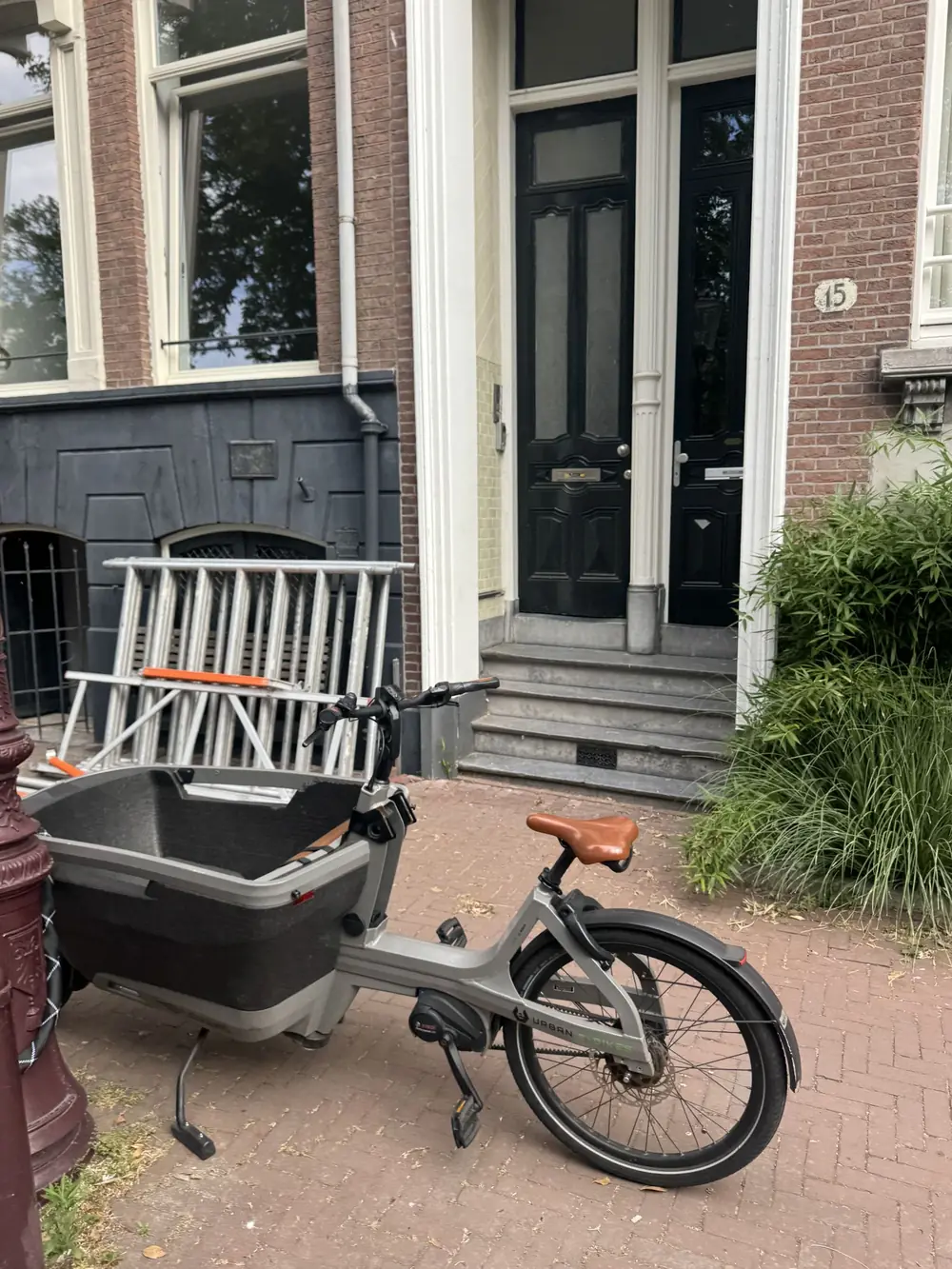
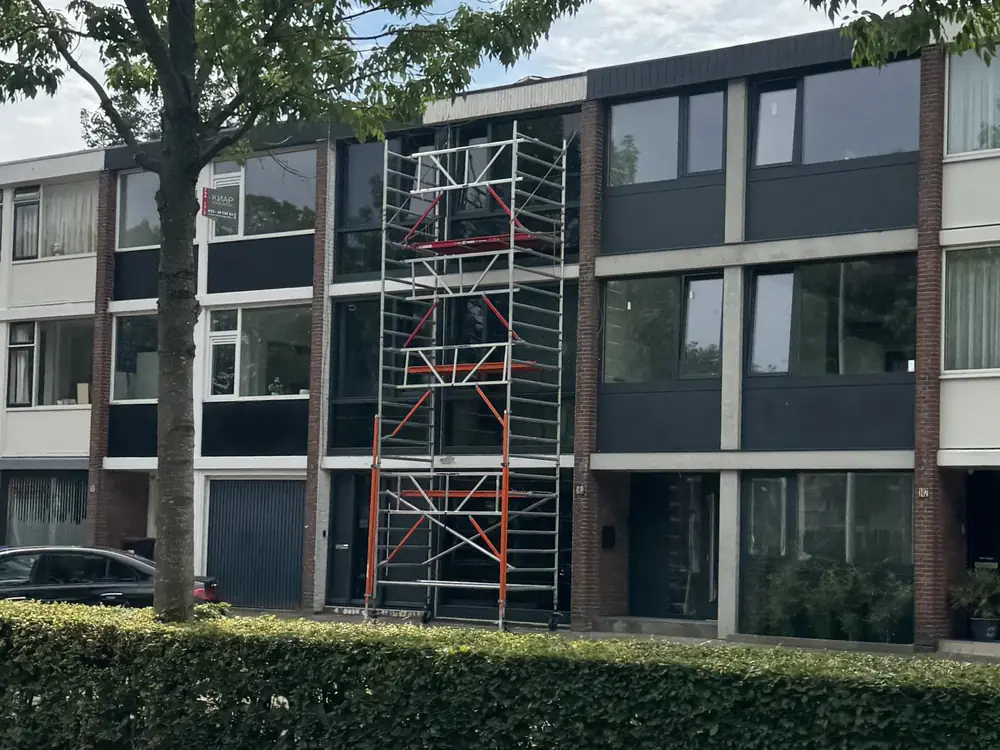
Guard rail frames by the kerb in front of a house, the 75 cm MiTower kit one person builds without help

Does the run have to go higher than six metres, say along a three storey elevation to a meter cupboard in the loft, then the MiTower will not get you there. This model is built for 4.2 to 6.2 metres of working height and stops above that. Then you hire a mobile scaffold of the RS51 type instead, which as a narrow tower carries on to 14.2 metres. For an ordinary house with the meter cupboard downstairs or one floor up, the MiTower is ample.
Which working height to hire for the cable run

Measure not to the charging point itself but to the highest point of your cable run. That is usually the penetration through the wall at the meter cupboard, or the spot where the trunking turns the corner under the eaves and you have to steer with a bracket. On a terraced house that sits somewhere between two and four metres, and then you need a build with 4 to 6 metres of reach. Those figures work out because the platform height carries about 2 metres of reach on top.

The lowest build of this scaffold starts at 4.2 metres and covers the bulk of these jobs already. If you do hire higher, that is nearly always because the meter cupboard is upstairs or because the trunking has to run the full width of the elevation. Look in that case at what belongs to six metres of working height. Is your run entirely on the ground floor, then there is hardly anything to hire and a step stool will do.

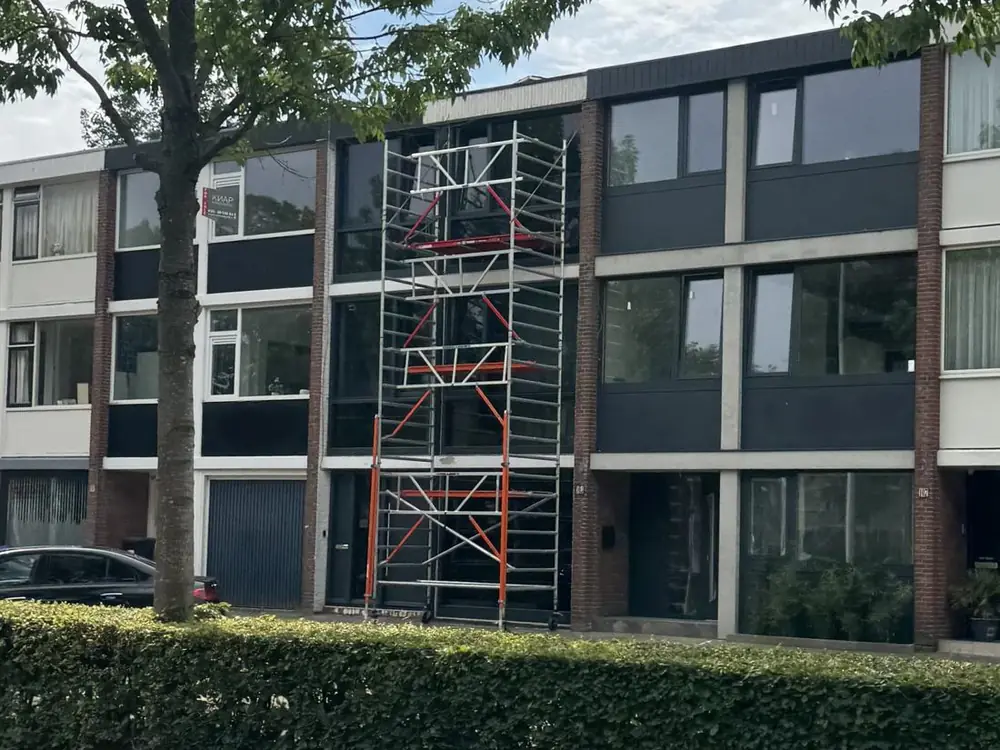
Tower built against a front elevation up to just under the eaves, where the trunking runs along the house

Your measuring point lies at the paving under the castors. A drive that falls from the garage down to the pavement easily costs you half a metre, and you notice that exactly on the last stretch of trunking. Choose too tight and you drill the penetration with your arms above your head, while what you want is to face the hole squarely and keep the drill level. A hole running back in at an angle fills with water in the first heavy shower, and that only shows up much later.

Setting the MiTower up on the drive beside the charging point

The place this scaffold ends up is nearly always the drive, the path beside the garage or the strip along the front elevation. That gives you a hard surface, which works well, but it also means a car has to go and the garage door may not open that day. Park the car elsewhere for the day and agree with the household that the drive stays blocked until the installation is done, even though there seems to be room enough.

Watch the splay of the stabilisers, because they reach out at an angle and on a drive they love to hit a bollard, the neighbours' charging point or the gate into the garden. Look at what is in the ground too: with a charging point on its own plinth a trench is open or has just been filled, and on freshly made up ground you do not want a tower standing for days. How you solve that is set out at a base that is out of level.

Unfolded stabilisers on paving, taking extra room on a drive next to the charging point

Work out beforehand how many pitches you are going to make. If the run goes from the meter cupboard to the side elevation and from there to the drive, you shift the scaffold two or three times over its full length. Keep that route free of bikes, wheelie bins and garden furniture, because a tower you have to lift to get past something is exactly what you do not want. Anything standing on that route you move the evening before.

How many hire days a charging point installation asks for

Most charging points are in within a day. You hang the box, drill the penetration, run the trunking, pull the cable through and terminate at the meter cupboard. The part at height takes only a couple of hours, but those hours are spread across the whole day: first setting out the run, halfway through finishing off the trunking, and at the end sealing the penetration. So you hire the scaffold for a full day and not for a half.

Does the run cross two elevations, does a consumer unit have to be added, or is the meter cupboard upstairs, then reckon on two days. The inspection and the actual connection by your installer can also fall on a different day from the fitting on the wall. Drying times as in decorating you do not have here, but dependencies you certainly do: a network operator who has to call, or a cable delivered only the next morning, decides whether the tower stands another day.

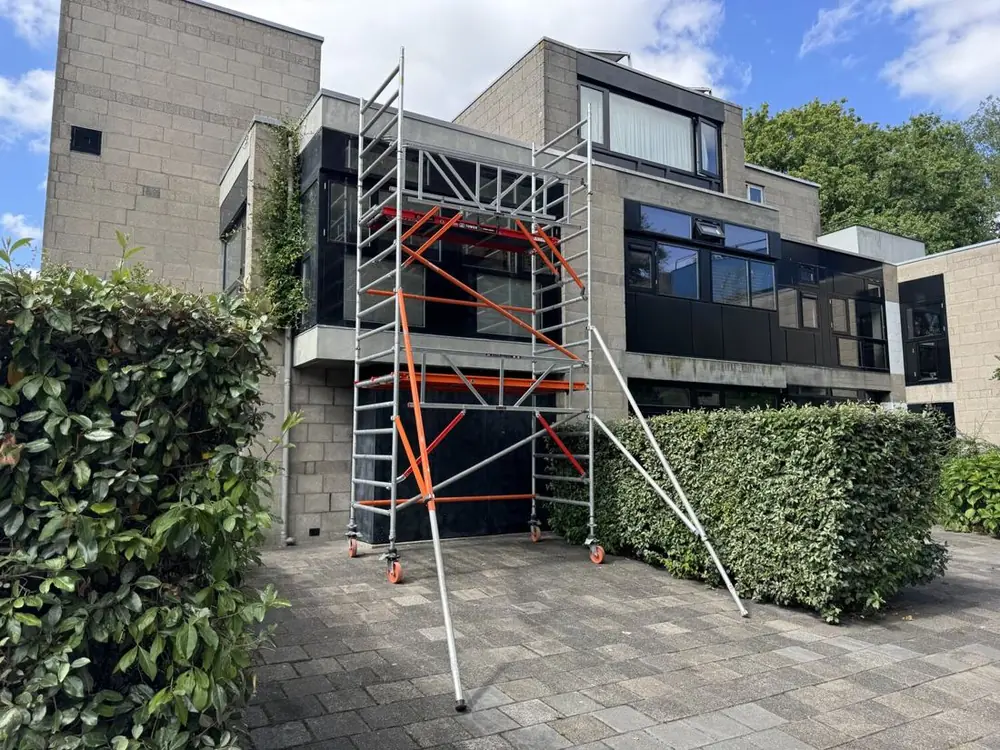
Built tower with platform along a modern elevation, the pitch you leave standing for a whole working day

That extra day is a small matter in the cost. Your first 24 hours go at the full rate; each further day of the booking is cut by 95 per cent. That difference is big enough to plan around. Building a day of slack in is therefore a good deal cheaper than having delivery and collection come out a second time because you handed the scaffold back just too early. What the various models cost stands with VAT included at the rental prices per period.

Which mobile scaffold suits installing a charging point?

Kamersteiger RS44
  • Working height up to 4 metres
  • Compact and narrow
  • Great for indoor and small jobs
View and calculate →
Smalle rolsteiger RS51
  • Working height up to 14.2 metres
  • Narrow (75 cm)
  • Ideal for narrow passages
View and calculate →
Brede rolsteiger RS52
  • Working height up to 14.2 metres
  • Wide platform (135 cm)
  • Extra stability and workspace
View and calculate →
Most chosen
1-persoons steiger MiTower
  • Working height up to 6.2 metres
  • Very compact
  • Quick and easy to assemble
View and calculate →

Installing a charging point from the platform and along the elevation

The box itself you simply hang from the ground, because a charging point goes at about a metre so the plug stays comfortable to handle. Everything above that you do from the deck of the tower: the wall brackets for the trunking, the bend round the corner, the penetration at the meter cupboard and the seal around it. Work from the highest point downwards, then you do not have to go up again later for a bracket you forgot.

Make sure you take up in one go what you need above. A cordless drill with a masonry bit, plugs, screws, the trunking cut to length, a sealant gun and a tape measure, plus the cable reel that you hang on the guardrail instead of laying on the deck. Set that reel so the cable can pay out freely down the outside of the scaffold, or you will pull it tight between the uprights and jam it just as you want to lower it.

Tower standing at a side elevation, the position for fitting brackets and trunking across the brickwork

Per pitch you cover a good two metres of wall, so a run of eight metres asks three or four positions of the tower. Coming to a corner, move it once more rather than trying to work round the brickwork with a stretched arm. Combine the work with an outside light above the drive and you take on both jobs from the same pitches, so you only need to hire the scaffold once for the pair.

Hiring a MiTower delivered on the day before installation

You get the scaffold delivered as a counted set of parts and put it together yourself. On this job that is easy to plan: make sure the set is there a day earlier, so the installation day does not start with building work. Lay the parts on the drive and not in front of the garage door, because your material still has to pass there. Book it on a working day, with the clock still short of 15:00, and the set turns up the following working day.

Delivery and collection dates you enter yourself at the booking. Working with an installer? Then match those dates to his diary and not to yours: he comes on a fixed morning and will not wait for a tower to go up. The building is your job and on this model it goes fine alone, with the manual and the video beside you. Half an hour to an hour is enough at this modest height, certainly if you laid the parts out in order.

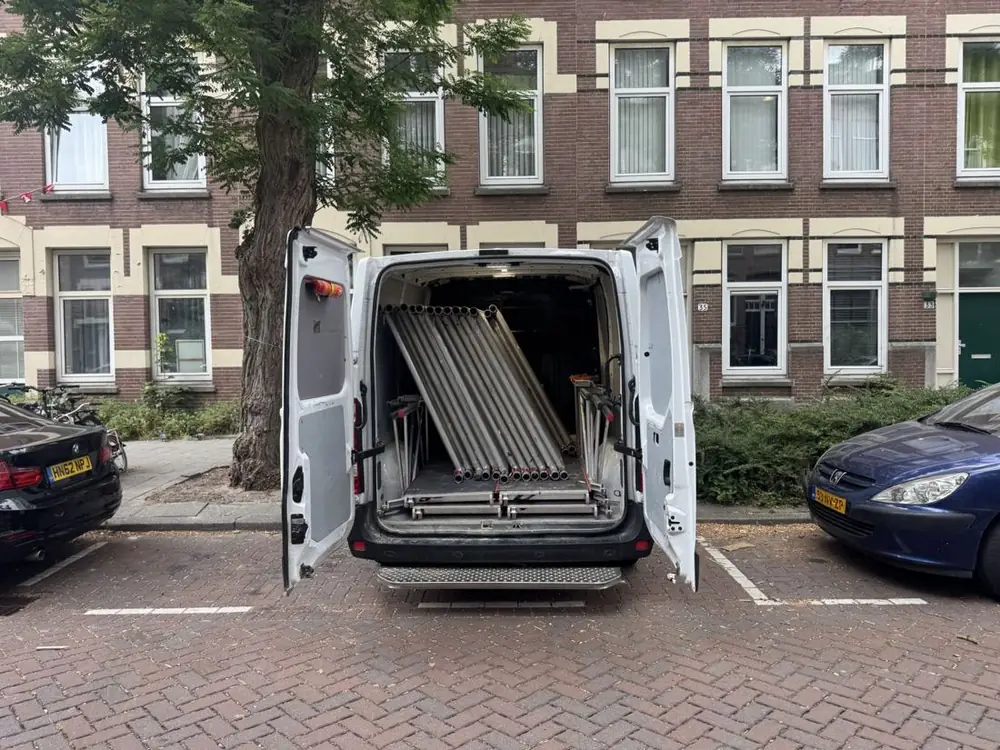
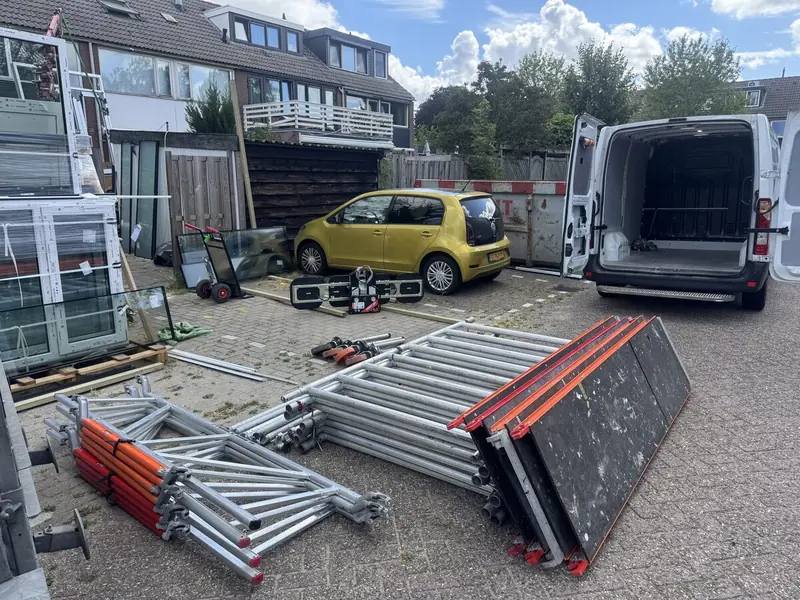
Van at a house unloading counted scaffold parts, dropped off the day before the charging point goes on

Once the work is done we come for the set again, after you have taken the tower apart and laid it out complete. Pick a spot for that where the van can get to, so not behind a locked gate to which only you have the key. Run through whether every part is lying there again before you pull the door shut behind you. What the run out and the pick-up cost depends on your province, and you read that at the costs of delivery.

Working safely on a hired MiTower when fitting a charging point

A platform carries 200 kg per square metre, which belongs to load class 3 from EN 1004. On this work you will not get near that, certainly not on a tower meant for one person. Do genuinely stay up there alone: a second person coming to look or to pass something up does not belong on this model. Hand things up from the ground or hoist them with a line rather than letting somebody climb behind you with a reel.

The standing agreements apply to a light scaffold as well. Brake the castors as soon as you start climbing, never move it while tools are lying on it, and wait for a strong wind to drop before working. On a drive something extra comes in: never leave the tower unattended along the public road without the castors locked, because a light pitch like this rolls a little way towards the pavement in a good gust.

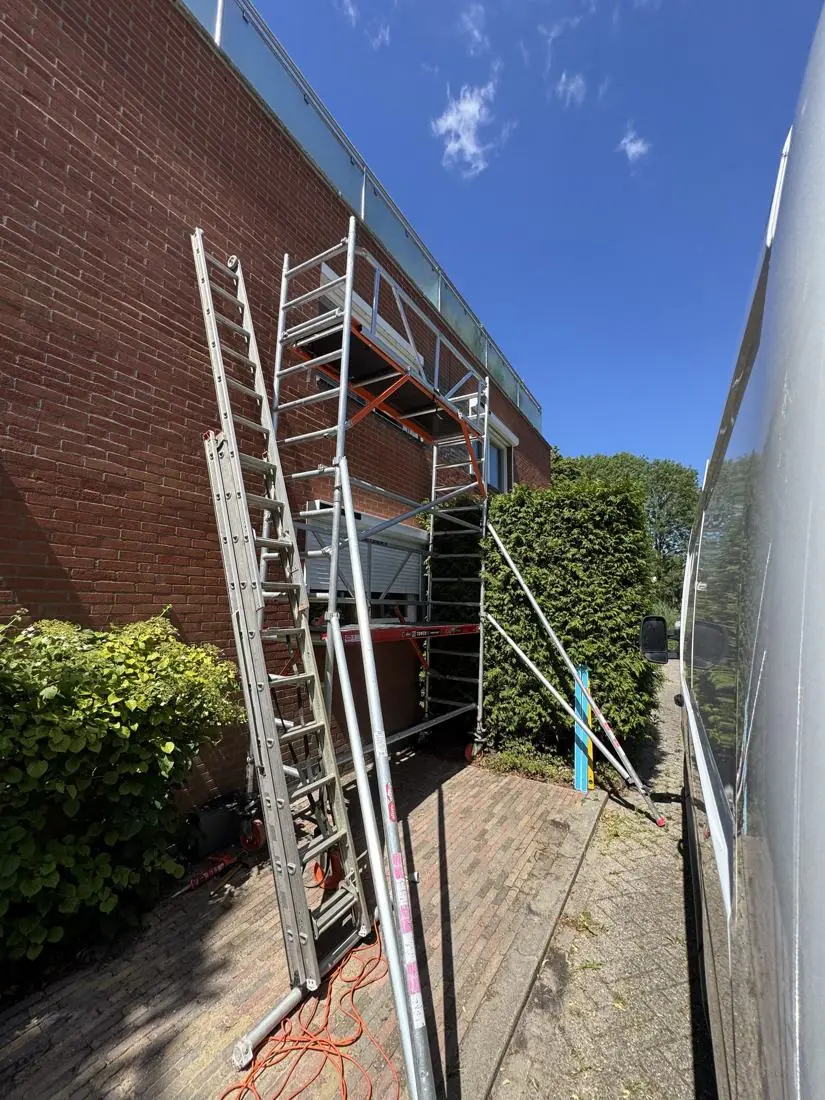
Mobile scaffold pitched against a side wall with a loose ladder alongside, the one person build you hire for this work

The risks that belong to this job are electrical and falling. Switch the circuit concerned off and check that with a voltage tester before you drill anywhere near existing wiring, because a bit shooting through a cable gives you a double problem at height. Keep the zone under you completely clear as well: a drill or a coil of cable sliding off the deck lands with a bang on the paving of the drive. The rest you find at the rules for work at height.

In 5 steps

How hiring a mobile scaffold works

1
Choose working height

Pick the height that suits your job.

2
Book online

Sorted in 60 seconds, price shown instantly.

3
We deliver

At the agreed spot the next working day.

4
Assemble safely

Assembled by you, with a manual.

5
We collect

One call and we collect the scaffold.

Good to know

Practical tips for installing a charging point

1

Set the run out on the wall in pencil before you build the scaffold. Then you know at once how many pitches you need and whether four metres of reach covers the highest point.

2

Hang the cable reel on the outside of the guardrail. Lying on the deck the cable runs between the uprights and jams exactly when you want to lower it to the box below.

3

Drill the wall penetration with a slight fall to the outside. From a platform you stand square in front of the hole and hold the machine steady, which one handed on a ladder never quite works.

4

Ask your installer beforehand where the cable comes in. That decides the height you hire, because a meter cupboard under the stairs asks for something quite different from a consumer unit on the first floor.

5

Book the scaffold from a day before the agreed installation date. Then everything stands ready when the fitter pulls up and no hour is lost to building while he waits with his hands in his pockets.

6

Move your car somewhere else the evening before. A drive already clear on arrival saves shuffling with a built tower, and moving it with tools aboard is not allowed anyway.

Frequently asked questions

Frequently asked questions about installing a charging point

Which scaffold to hire for installing a charging point?+

For most installations the MiTower is enough: a tower 75 cm narrow, meant for one person, with a reach starting at 4.2 metres. You put it on the drive on your own and move it along the run without help. Does the trunking go higher than six metres, because the meter cupboard hangs in the loft, then you hire an RS51 instead, which carries on further than this model. For an ordinary terraced house the light tower does the job.

Do I really need to hire a scaffold to install a charging point?+

Not always, and we say so honestly. If the charging point hangs beside the front door and the cable runs low from the meter cupboard in the hall, a step stool gets you far enough. Hiring a scaffold only becomes sensible once the run climbs the elevation, follows the eaves or has to reach an upper floor. So look first at where the cable will actually go and decide about hiring after that.

How many hire days does a charging point normally take?+

Usually one hire day is enough. The work at height covers only a few hours, but those hours lie spread across the day, so you want the tower at your disposal from morning to evening and not to hand it back halfway. Does the run cross two elevations or is a consumer unit being added, then reckon on two days. Waiting on a network operator or on material? Then take a day of slack when you book.

What does it cost to hire a scaffold when you fit a charging point?+

The rental price is made of the model rate and the build height, with a fixed delivery amount for your province on top. On a one day job you mainly pay for that first day in practice; what you stick behind it hardly counts. That makes taking a day of slack attractive. All amounts stand online including VAT, so you know before booking what hiring a scaffold is going to cost you.

Which working height must I hire for the trunking along the elevation?+

Measure to the highest point of the run, usually the penetration or the bend under the eaves, and so not to the charging point itself. On a terraced house that puts you on a scaffold with 4 to 6 metres of reach, which is the lowest build there is. Stand square in front of your hole and the drill stays level, so the hole does not run in at an angle. Look at the overview of working heights for what belongs with it.

Is this tower brought to the house, or do you hire and collect?+

Both routes are open when you hire this tower. Choose delivery and it stands on the drive on the day you named, and afterwards it is taken away again at a rate that is fixed per province and known in advance. Collecting it yourself costs nothing, by appointment at Zeeburgerpad 89 in Amsterdam. A MiTower is compact and fits in many people's van, but count on driving two trips yourself on the day.

The installation overruns: can I hire the tower a day longer?+

Just let us know and the collection date moves back, provided that same tower has not been promised to a next customer. You arrange that beforehand rather than on the collection day itself. With charging points the overrun usually lies with third parties: the network operator turns up later, a consumer unit proves too small or the right cable is still in a warehouse. An extra hire day is cheap certainty here.

How much room do you have to keep free on the drive?+

Take the 75 cm of width, add the splay of the stabilisers to it and keep the whole route along the elevation clear as well. In practice you end up with a strip two to three metres wide. On a drive that comes down to: the car out, the bikes aside and the wheelie bin out to the street. Arrange that before the scaffold is delivered, because shuffling in between costs you needless time.

Can you carry on working in the rain on your hire days?+

Drilling and mounting brackets still goes in a shower, but on a wet wall sealant grips badly and a wall penetration you would rather close up dry. In a strong wind you stop working at height in any case. The tower meanwhile stays standing, so you pick the thread up again the next morning where you left off. Because you choose the collection day yourself, a day of delay costs you little extra hire.

Is a deposit due when you hire a MiTower for this?+

When you book the scaffold you pay a deposit, which is refunded within 1 working day after the returned set is checked over. On this work watch mainly for drilling dust and sealant residue on the deck and the guardrails, and for scratches from tools laid loose on the platform. A cloth and a piece of card on the deck solve that. Make sure every part goes back too, because a missing brace holds up the deposit.

Can the charging point be up already before I hire the scaffold?+

That works fine and is often the smart way round. The box you simply fit from the ground at about a metre, so that part need not wait for a tower. What is left is the run: the trunking, the penetration and the connection at the meter cupboard. Plan the scaffold exactly for that day, and it does not stand on your drive for days while you wait on a fitter or on material.

Hire a mobile scaffold for installing a charging point today?

Calculate your rental price now or ask for free advice.

Rolsteiger van SteigerTaxi geleverd op locatie
Book it online

Your scaffold sorted in 2 minutes.

Choose your scaffold and working height, see the price instantly and book online.