
See your price
Application

Painting bargeboards? Choose the right scaffold.

Bargeboards are the sloping lengths that follow the roof surface down the gable end, running from the ridge to the gutter. Painting bargeboards is patient work: abrading, a primer, a topcoat, and a wait between each one while the last coat hardens. Every round takes you along that same sloping line, well above the garden. So the tower to hire is the RS52, wide across the frame at 135 cm, in a build landing between eight and twelve metres. What follows covers standing positions, hire days and the order of the work.

  • Order before 3 pm, delivered tomorrow
  • Professional Altrex scaffolds
  • Up to 14.2 metres working height
  • Easy to assemble yourself
4,2 tot 14,2 mWorking heights available
12Provinces served
7Days a week
200 kg/m²Load class 3
In short
  • For painting bargeboards we recommend the Wide mobile scaffold.
  • Painting bargeboards calls for a wide tower: a 135 cm base, built to land somewhere between eight and twelve metres.
  • The timber runs on a slope, so each following position sits lower and wants its deck hung a notch further down.
  • Three or four days on hire is realistic, since abrading, priming and glossing will not follow each other inside one shift.
  • First 24 hours from €175 incl. VAT and delivery; every day after that 95% off.
Key facts for this job
FeatureValue
Recommended scaffoldWide mobile scaffold (Altrex RS TOWER 52)
Working height for this job8 to 12 metres
Available working heights4.2 to 14.2 metres
StandardEN 1004, load class 3 (200 kg per m²)
DeliveryOrdered before 3 pm, delivered next working day
Each extra day95% off, from €8.75 a day
Why a mobile scaffold for painting bargeboards?

Safe, stable and professional work at height

On this job the scaffold stands there far longer than the amount of brushwork suggests, and the reason is waiting. Between abrading, priming and glossing there is always a stretch when nothing can be done to the timber while the position beneath it still has to stay put. If a length is being renewed in the same week, that is a different job, with old timber coming off and fresh lengths going up. Here nothing is taken away at all. You carry paper, a kettle and a brush up, and you do that three or four times along a line that drops steadily as you travel.

  • Following a slope from the ridge to the gutter
  • Two or three coats with drying time between
  • The deck drops with every following position
  • No stripping out, only paper and paint upward
Read more about working safely →

Which mobile scaffold to hire for painting bargeboards

Bargeboards hang above you. Your head stays tipped back against timber that runs away on a slope and carries the eaves overhang underneath. The tower for that is the RS52, the wide Altrex model, 135 cm between the uprights. On a deck that size you can take half a pace back to judge whether the line is holding straight, rather than ending up pressed to the guardrail, and that scrap of distance separates a flat gloss from a wavering one. Widths are compared on the page listing the tower sizes you can book.

The slimmer RS51 at 75 cm does turn up on this work, but you give away deck exactly where you wanted space for a sander, a trailing lead and a kettle standing open. A MiTower is out the moment the apex passes 6.2 metres, which on a gable end it nearly always has, and a room scaffold belongs indoors rather than alongside a roof. That leaves the wide tower, built high enough to clear the point where the two lengths meet each other.
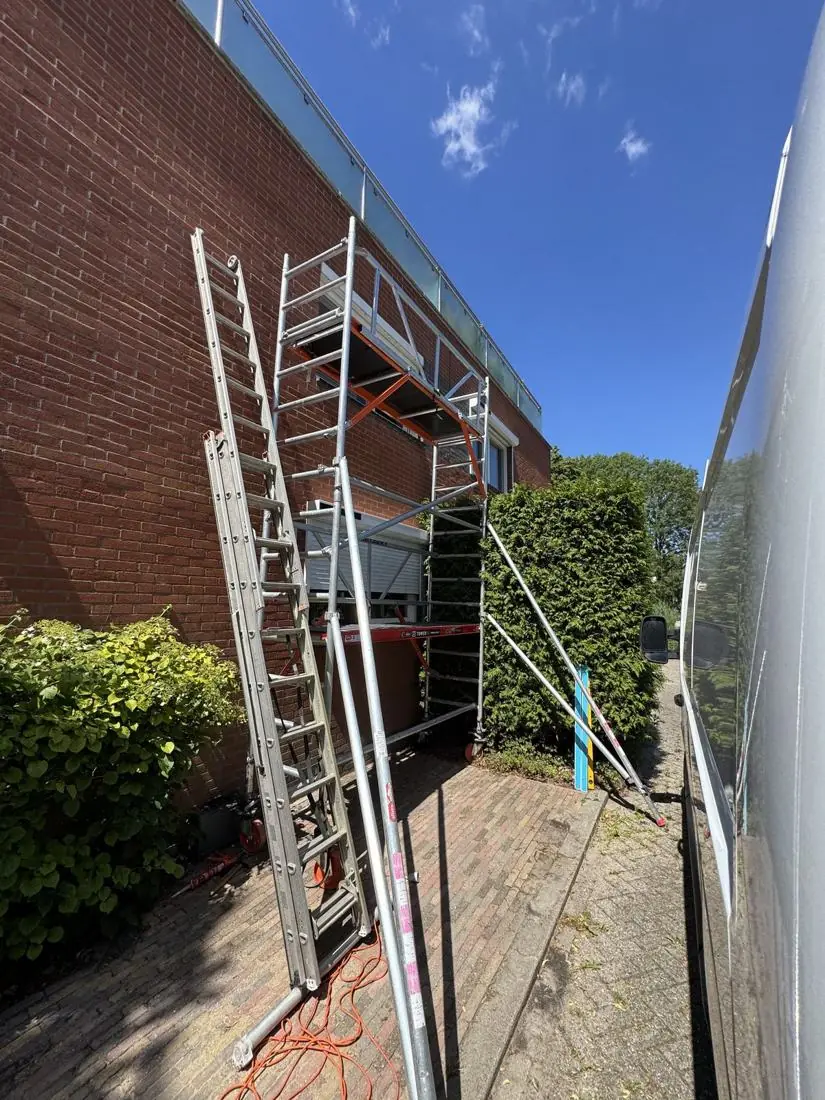
Built tower squeezed into a slim passage beside a brick wall, with an extension ladder standing against the brickwork

Reckon on the number of times you go up and down as well. Each coat sends you aloft with very little in your hands, yet it sends you back to the same spot three or four times over the week. A generous build with a roomy hatch and a proper climb makes those trips bearable, especially when a bucket of water and a rag come along to keep the timber free of dust between coats. Weigh the trips in when you pick a tower, not just the reach.
Hiring enough working height for bargeboards at the ridge

This job tops out at the apex rather than at the gutter, since that is where the two lengths run into each other. Stand your tape at the level the castors will settle on and carry the line right up to that tip. The figure you enter when booking is a working height, and it is made of the platform height with about 2 metres of reach added on top, so that arms raised will meet the last stretch of timber without any stretching from the toes.

On a terraced house with an ordinary pitch the apex sits at eight to ten metres. On a property of three storeys, or one with a steep roof, it runs on towards twelve. That is why painting bargeboards falls in the eight to twelve metre band. Caught between two builds? Compare the platform settings behind a ten metre working height and hold them against the figure your own tape gave along the gable, well before the order goes in.

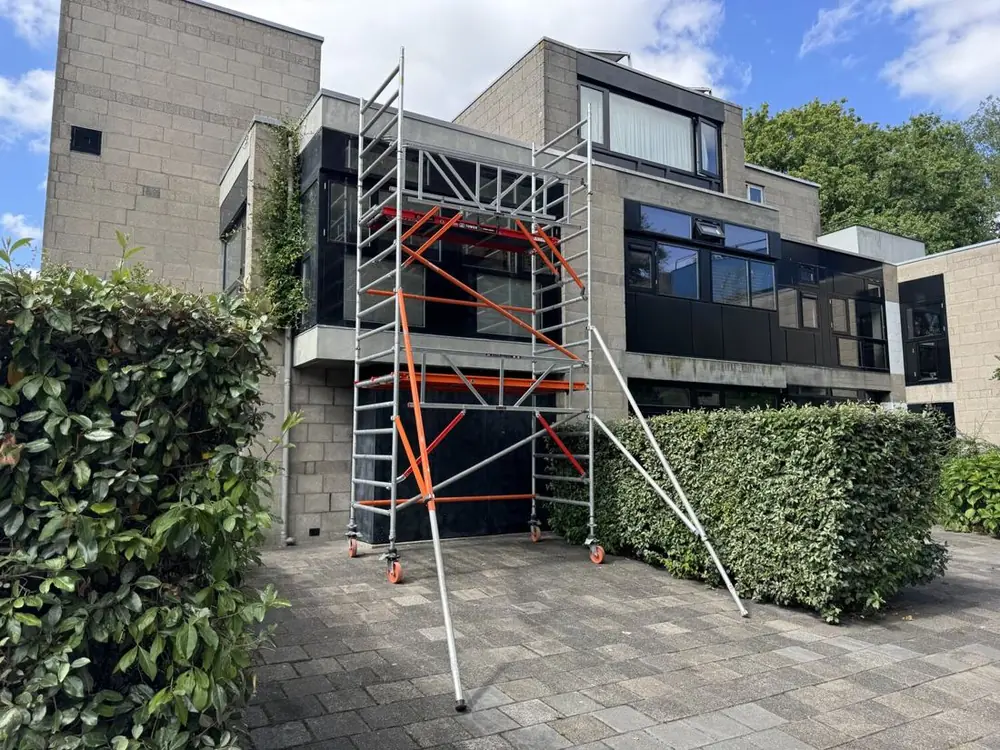
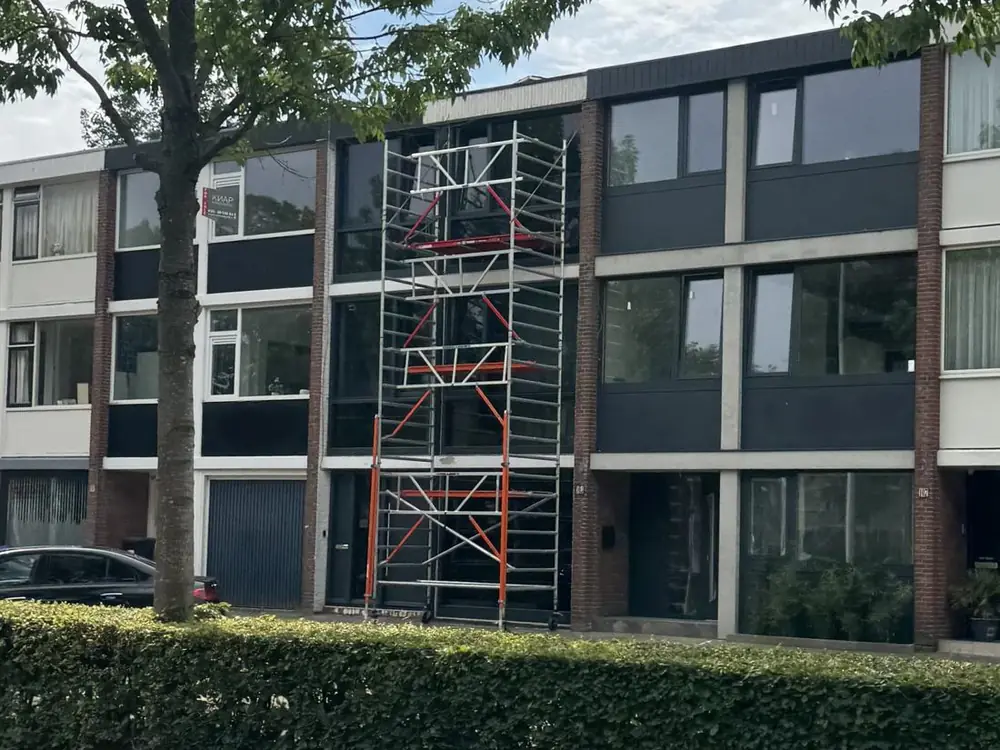
Tower assembled tight to a three storey block of flats, upper decking sitting level with the highest run of windows

Hiring short bites harder here than it does on flat wall work. The timber runs uphill, so a build that falls a little shy leaves the top metre and a half untouched, and an unpainted patch sits precisely at the apex where the whole street can see it. Reaching that from a ladder leaned against fresh gloss is no answer. Measure on the tall side, since a build one platform taller costs very little next to a second visit from the van. There is a method at working the height out beforehand.

Hiring a tower to stand beneath a sloping verge board

A gable end is rarely the side of the house with the best ground. Usually there is a narrow band of gravel, a planted border or the path through to the back, and that is exactly where the base of the tower has to land with four stabilisers reaching out at an angle. Walk that band before you hire a mobile scaffold and take away whatever is loose: a water butt, a few spare slabs, the children's bikes. Making room takes half an hour, shuffling things about mid job takes half a day.

Mind the gap to the wall as well. The eaves overhang stands proud above you, so the tower cannot sit tight against the brickwork without the top rail fouling the gutter. Leave a hand's width and check it before you build, because a position you have to wrestle into place at the top will never come level again. On a path that falls away, take up the difference on the spindles under the castors, a move described in setting a tower on ground that is not flat.

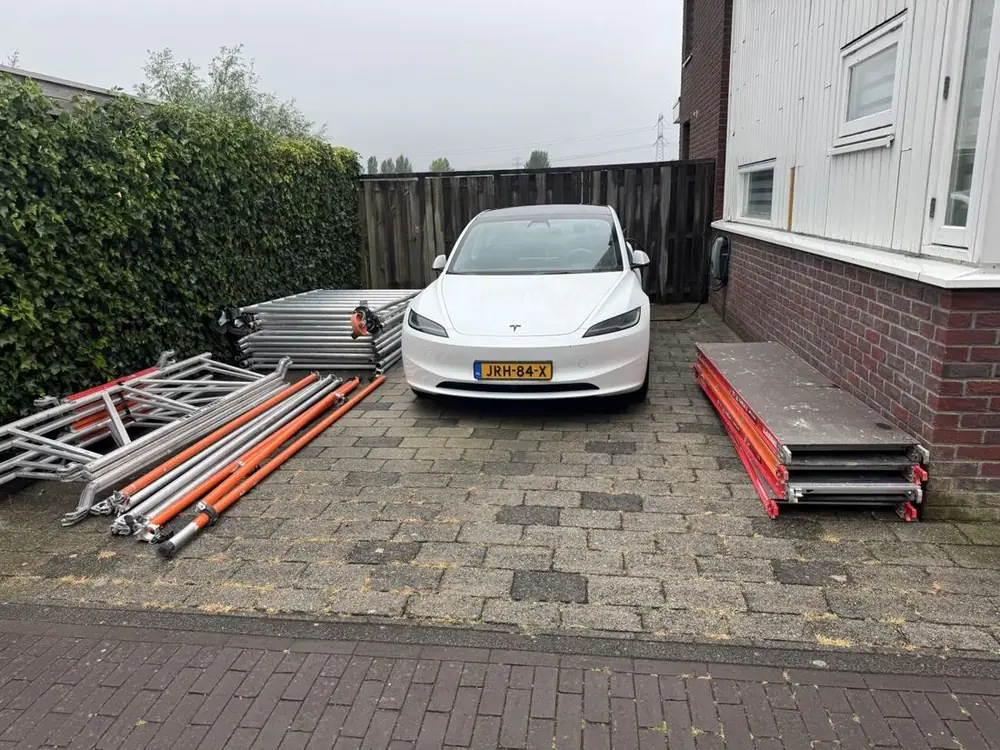
Frames, braces and platform decks set down either side of a parked car on a block paved drive beside a house

Spare a thought for the neighbours too, since a gable end often abuts their drive or their garden. You are there for days on end, you raise dust with the paper and you drop the odd spot of paint, so sheet whatever lies below and say what you have in mind. If part of the base lands on council ground beside the pavement, ask the council what is permitted there. That question belongs well before the delivery day, not on the morning the first tubes are already at your gate.

How many hire days painting bargeboards in coats takes

Two lengths on an ordinary roof come to perhaps fifteen metres of timber. Abrading and dusting off fills the first day, the primer goes on in a morning and so does the gloss. Even so you hire three to four days, because between those steps sit waits that cannot be squeezed: each coat has to harden before the next may cover it, and the tin in your hand is the thing that states how long. Those hours count inside your hire period all the same.

The way the rate is built helps with that. Your first twenty four hours are charged whole, and each further day of rental joins them with ninety five per cent taken off, so a day spent waiting for primer to go hard, doing nothing at all, costs next to nothing. What your own build comes to is worked out on the page setting out the rates. Book the longer period rather than the tighter one, because a half painted board will not wait for a fresh reservation.

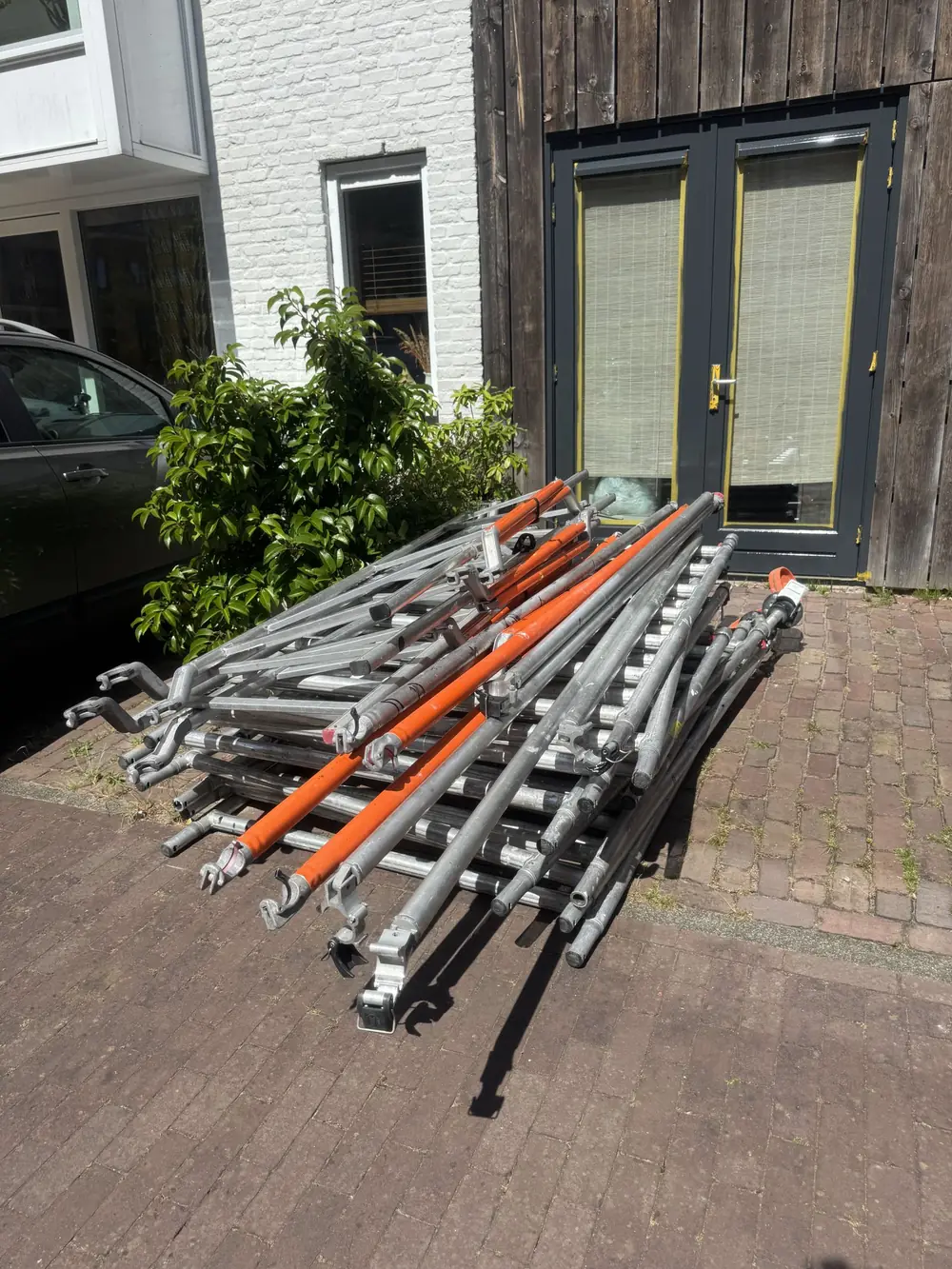
Bundle of scaffold tubes, frames and orange diagonal braces resting on brick paving outside a dwelling, ready for the days ahead

Weather has its say as well. Paint on outside timber wants dry conditions and not too much cold, and a board sitting in full afternoon sun skins over sooner than you would like. So read the outlook for the whole week instead of the day you mean to start. If it turns against you, push the collection date back; you decide yourself how long the tower stays standing. A margin of one day is no luxury on work that is broken into coats.

Which mobile scaffold suits painting bargeboards?

Kamersteiger RS44
  • Working height up to 4 metres
  • Compact and narrow
  • Great for indoor and small jobs
View and calculate →
Smalle rolsteiger RS51
  • Working height up to 14.2 metres
  • Narrow (75 cm)
  • Ideal for narrow passages
View and calculate →
Most chosen
Brede rolsteiger RS52
  • Working height up to 14.2 metres
  • Wide platform (135 cm)
  • Extra stability and workspace
View and calculate →
1-persoons steiger MiTower
  • Working height up to 6.2 metres
  • Very compact
  • Quick and easy to assemble
View and calculate →

Painting bargeboards from a 245 cm platform on the slope

A deck of 245 cm sets how the job is broken up, because that length is as far as one position will carry you. Unlike a flat wall, a position here does not cover a rectangle but a slanting piece of timber: at one end of the deck the board is level with the guardrail, at the other it sits a good way above your head. So each position finishes a sloping strip rather than a band at one fixed level, and that changes the order in which the tower travels.

Begin at the apex and work down towards the gutter. Doing it that way, every next position only ever asks you to come down: you lift the top platform out and hang it a notch lower, instead of building back up again halfway along. Move with a bare deck, so the kettle and the sander go to the ground before the castors are unlocked. Two people shift this tower quicker than one, and beside a gable end that is usually pleasanter anyway.

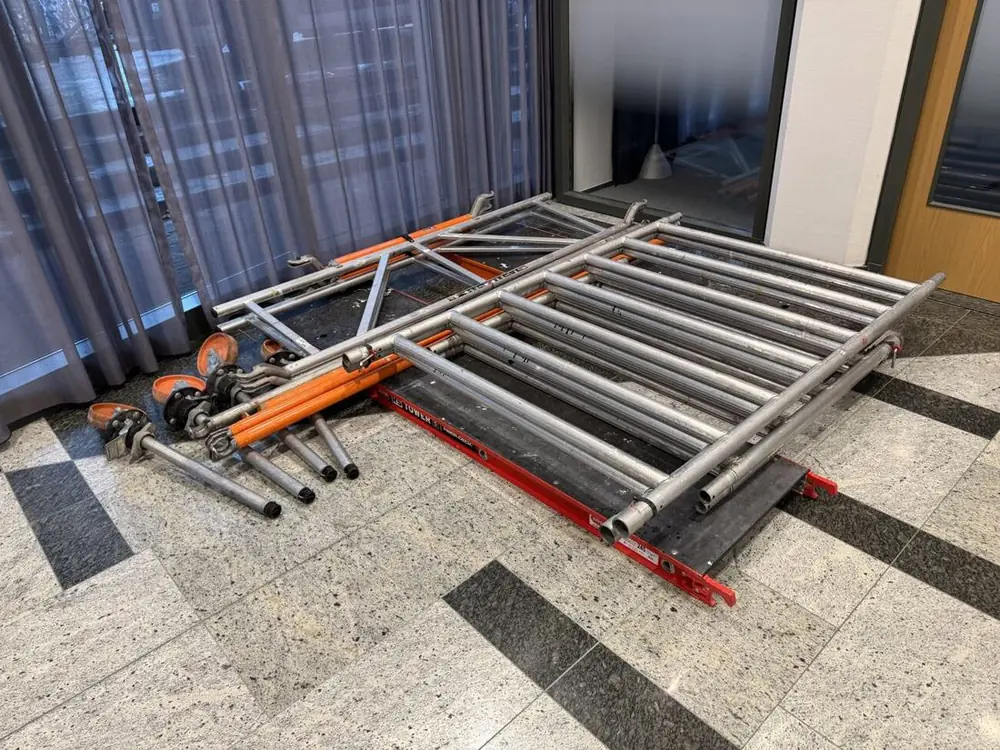
Frames, orange braces, castor wheels and one platform deck spread across a tiled indoor floor, counted before they go out

What catches people out is the number of stops. A bargeboard is one continuous line and every place you break off with wet paint shows up afterwards as a faint edge. So finish the full depth of the timber within a position, carrying it to a joint or a bracket, and let the overlap fall just past that point. Before you climb, line up what has to come with you: kettle, brush, rag, tape and a scrap of paper for the patch you can still spot up top.

Delivery and assembly when you hire a scaffold for bargeboards

The tower turns up in loose pieces, as a set that arrives counted and complete. Orders that are settled by 15:00 on a weekday go out on the round of the next working day. Choose in advance where those pieces are allowed to land, because the band beside the gable is narrow and you need it clear to build in. Better the drive or a slab of pavement than the planted border, and nobody enjoys lifting tubes out of wet grass.

Putting it together is left to you. Instructions travel with the parts, and there is footage online taking you through the order of assembly from the base up; at this height two pairs of hands are busy with it for a good hour and a half. Slot the build into the day before your first go with the paper, so the following morning starts with work rather than with assembly. Pick a delivery date at the front of a dry spell as well, since tightening couplings in the rain is slow going.

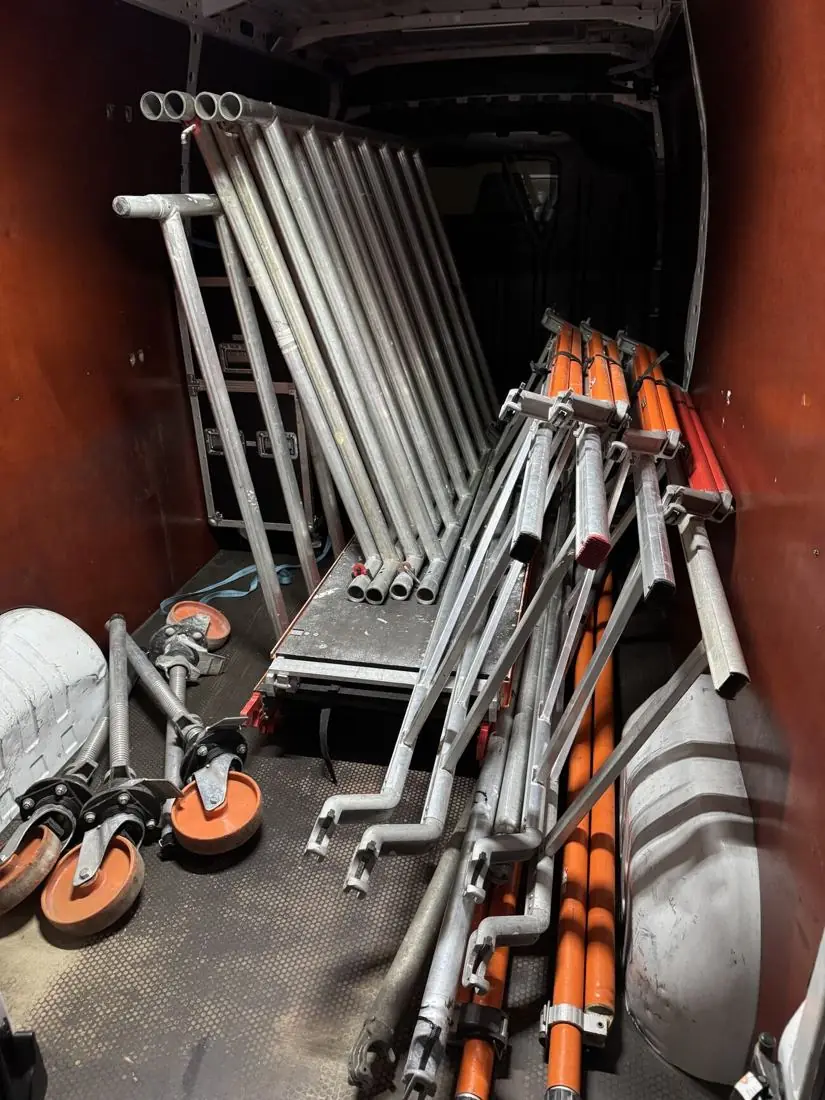
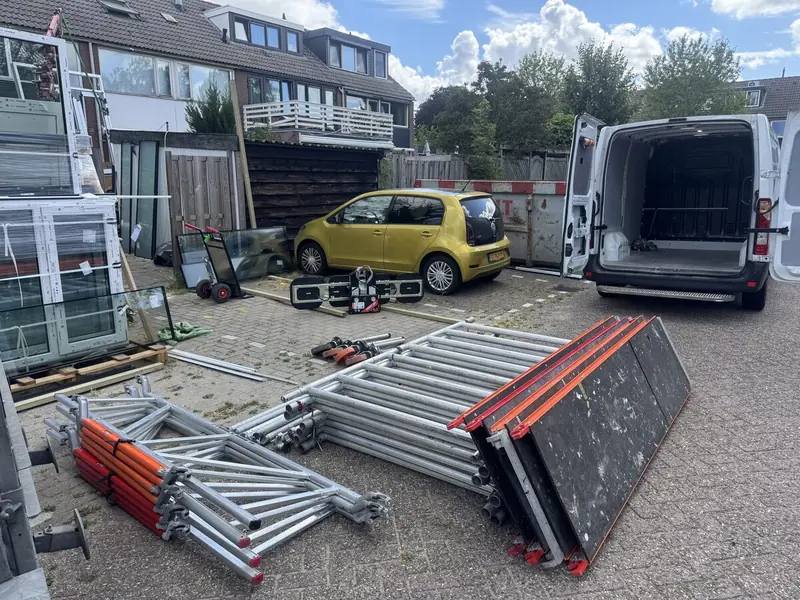
Scaffold frames stood on edge inside a van with braces, decking and orange castor wheels stowed around them

Once the final coat is on you take the tower apart and set the pieces together in one lot; on the collection date you named, we come by and load them. Hold off until the gloss has properly hardened, or a tube taps against fresh work and you have a repair on your hands. The fixed figures per province for the run out and the run back are listed under what delivery comes to in your province, so the total is known while you plan.

Safe work on the tower under an overhanging verge

Every square metre of decking may carry 200 kg, precisely what load class 3 permits under EN 1004. Painting bargeboards keeps you a long way inside that, since one person, a kettle and a sander together weigh very little. The figure only becomes interesting once somebody joins you up there and a bucket of water is standing about as well. What the class covers in practice is unpacked in this explanation of the tower standard and where its limits sit.

None of the usual rules change for this work: lock the castors before you climb, roll the tower only when it is empty of people and kit, and put the brush down as soon as the wind gets up. You reach that point sooner beside a gable than elsewhere, because there is seldom anything on that side of a house to break a gust. Glance along all four stabilisers whenever the tower has shifted, even for half a metre of travel beneath the timber.

Built mobile scaffold on paving with all four stabilisers angled out and locked down against the ground

The risk peculiar to this job is overhead. You are looking up while spreading paint, so spots land on your face and dust from the paper finds your eyes; goggles and a cap earn their place more than you would expect. Never balance the kettle loose on the guardrail, hang it from a hook or wedge it against an upright, and keep the ground beneath the tower free. There is more on the page covering the rules for working at height.

In 5 steps

How hiring a mobile scaffold works

1
Choose working height

Pick the height that suits your job.

2
Book online

Sorted in 60 seconds, price shown instantly.

3
We deliver

At the agreed spot the next working day.

4
Assemble safely

Assembled by you, with a manual.

5
We collect

One call and we collect the scaffold.

Good to know

Practical tips for painting bargeboards

1

Measure the apex and the gutter both before you reserve. The gap between those two figures tells you how many platforms have to be rehung along the way and whether the build you fancy allows it.

2

Put a strip of tape on the timber wherever a position ends. Coming back after a drying day, you see at once where the previous coat stopped and lay the overlap in exactly the same place.

3

Sand and dust off on the day the tower goes up. That way the next morning opens on clean timber and you avoid climbing with a machine in one hand and a kettle in the other.

4

Hook the kettle under the guardrail instead of standing it by your boots. It stays out of your walking line and both hands stay free for the timber that is sitting above your head.

5

Spread an old sheet over the border or the paving beneath the position. Dust and gloss spots never come out of either, and beside a gable the neighbours look straight down on that ground.

6

Set the collection day a full day after your final coat. That keeps a morning in hand to walk the line and check the top metre by the apex really covers before a single frame is dismantled.

Frequently asked questions

Frequently asked questions about painting bargeboards

Which mobile scaffold should I hire for painting bargeboards?+

The RS52 at 135 cm wide is the sensible answer. The timber sits above you on a slope, and a wide deck lets you step back to judge whether the line stays true. A sander, a lead and an open kettle all end up on the same platform as well. Take a narrower tower and you surrender exactly the elbow room this work asks for. Measure the band beside the gable first, though, since it decides whether the wide base actually fits.

How does hiring a tower for bargeboards work from first click to collection?+

You put the reservation together online: the model, the build, the day the set pulls up and the date it leaves again, at a fixed figure with VAT included. The scaffold parts arrive at your address, you raise the tower beside the gable and lay on as many coats as the timber asks for. At the close you hand everything back dismantled and counted, stacked where the driver can load it. Beyond that there is very little left to arrange while the hire runs on.

How many hire days should I book for painting bargeboards?+

Count on three to four days of hire for two lengths on an ordinary roof. Abrading fills a day, primer and gloss take a morning each, and in between sits drying time during which the tower simply stands with nobody on it. A steep roof or a house of three storeys soon adds a day. Hire tightly and the last coat goes on in a rush; one spare day in the booking costs little and removes the hurry.

What does hiring a scaffold for this cost, and how does the discount work?+

The rental price follows from the build you settle on and from the journey out to your address; the whole figure appears with VAT before you confirm. More telling is how the rate behaves on painted work: your opening day carries the weight and everything hung behind it almost disappears. Since so much of painting bargeboards is spent waiting for coats to harden, one generous booking works out cheaper than two short ones placed back to back.

What working height do I hire for bargeboards that reach the apex?+

Measure from the spot where the castors will rest up to the point where the two lengths touch at the top. A terraced house usually puts that around nine metres, three storeys or a steep pitch nearer twelve. So the build you hire lands between eight and twelve metres. Each build carries its own platform heights, and they are set side by side on the page comparing working heights. If in doubt, take the taller build rather than the one that only just reaches.

Does the hire include delivery, or may I collect the tower myself?+

You may have it brought out or come and get it. With delivery the set is at your house on the morning you picked, for a figure per province that is known in advance. Fetching it yourself is fine too: by arrangement the scaffold comes to you at no charge from Zeeburgerpad 89 in Amsterdam, provided the tubes and platforms of a tall build will go in your van. Allow for load length, because the platforms alone are over two metres.

Who raises the tower when I hire one for bargeboard painting?+

Rigging the tower is your side of the job. Steigertaxi brings the parts and you assemble them; we do not come and build, and no tower is ever delivered ready made. Raising a build at this height deserves its own slot in the programme, because the abrading only starts once the frames and platforms are standing. Our fleet holds no facade scaffolding, nothing of the system kind and no cherry pickers, so this stays mobile tower work.

What if the paintwork overruns and I want the tower on hire for longer?+

Pass on the new end date and we shift the collection day, so long as the tower is not already down for somebody else. Painting bargeboards runs over more often than planned: a coat that has not gone hard cannot be covered, and a wet afternoon stops everything. To cover that, add a day at the point of booking; handing back sooner is equally fine. Tell us any time before the collection day, provided you remember.

How much clear space beside the gable does the hired tower need?+

Take the width of the base and add what the four stabilisers claim on either side, then keep a further stretch free for laying parts down during assembly. Beside a gable that band is often tight, so measure it before you commit to a rental. If a shed, a hedge or a downpipe stands in the way, shift or cut it back beforehand; a build of this height simply will not be squeezed between obstacles on the day.

Does the hire keep running when it is too damp to gloss?+

The tower does not have to go anywhere; only the glossing is postponed. Paint that cannot dry off bonds badly, and timber that has taken on damp needs to dry right through before anything covers it. Spend a day like that on the sheltered stretch under the overhang, where it stays dry longer, or on masking off the gutter. Since you set the end date, the delay costs you one further day of rental in practice.

When does the deposit come back after a scaffold hire?+

A deposit goes down with the reservation, and as soon as the tower is back and the parts are counted the money is on its way within 1 working day. Two things trip people up on painted work: a component left lying in the garden, and paint that has dried onto a platform or a tube. Put a cloth under the kettle and wipe splashes off as they happen, and there is no scrubbing on the last day.

Is painting bargeboards the same hire job as replacing one?+

No, they are two different jobs. Painting bargeboards leaves the timber where it is and only adds coats: paper, primer, gloss, with waiting between. On renewing a bargeboard on the gable the old length comes off, you inspect what is behind it and screw fresh timber back, with waste going down past the tower and an open roof edge wanting to be shut the same day. That asks more hire days, more hands and somewhere for the waste to go.

Hire a mobile scaffold for painting bargeboards today?

Calculate your rental price now or ask for free advice.

Rolsteiger van SteigerTaxi geleverd op locatie
Book it online

Your scaffold sorted in 2 minutes.

Choose your scaffold and working height, see the price instantly and book online.