
See your price
Application

Hanging a wall light? Choose the right scaffold.

Hanging a wall light is work at one point in the elevation, and that point usually sits a storey higher than a ladder will safely take you. You drill into brickwork, you make a feed through to the inside, and you want the fitting to end up neatly above the frame below it. For that you hire an RS51: narrow in build, 75 cm across, put up to a reach of six to eight metres. Below you read how you choose that one setup and how short the hire period can stay.

  • Order before 3 pm, delivered tomorrow
  • Professional Altrex scaffolds
  • Up to 14.2 metres working height
  • Easy to assemble yourself
4,2 tot 14,2 mWorking heights available
12Provinces served
7Days a week
200 kg/m²Load class 3
In short
  • For hanging a wall light we recommend the Narrow mobile scaffold.
  • For hanging a wall light on the elevation an RS51 is enough: 75 cm narrow, taken up to six or eight metres.
  • Set the tower right first time, because you work at a single point and shifting it during the fitting gains you nothing.
  • Line the fitting up on the centre line of the window frame below it, or the offset shows from the pavement.
  • First 24 hours from €150 incl. VAT and delivery; every day after that 95% off.
Key facts for this job
FeatureValue
Recommended scaffoldNarrow mobile scaffold (Altrex RS TOWER 51)
Working height for this job6 to 8 metres
Available working heights4.2 to 14.2 metres
StandardEN 1004, load class 3 (200 kg per m²)
DeliveryOrdered before 3 pm, delivered next working day
Each extra day95% off, from €7.50 a day
Why a mobile scaffold for hanging a wall light?

Safe, stable and professional work at height

With one fitting the time does not go into the mounting but into everything around it that has to be right. Up there you need two hands for a drill with a long masonry bit, you pull a cable through a hole that has to come out on the same spot inside, and the fitting hangs on one screw while you hunt for the second. A light at height is also something everybody sees: a centimetre out of true against the frame below shows straight away from the street. Hiring a mobile scaffold for hanging a wall light gives you a flat deck with your tools beside you, plus the calm to look at the job twice before the first hole goes in.

  • One fixing point, so one setup that fits
  • Feed through that meets up inside and out
  • Centre line of the frame below as guide
  • Two hands free for drill and fitting
Read more about working safely →

Hiring an RS51 for hanging a wall light

For a single fitting on the wall you take an RS51, the version measuring 75 cm across. Narrow is no concession here but a gain: a light seldom sits in the middle of a clear surface, but beside a bay, above an extension or at the side of the house where the path is only a metre wide. Measure that gap before booking, since the frames travel through it in your arms too. With that width you pass between a fence and the brickwork without moving the planting.

On the platform you need very little space when hanging a wall light. A drill, a box of plugs, a spirit level, the cable and the fitting itself lie side by side with ease on a deck of this width, and there is room left to kneel while you make the connection. Choose the wider version only if two of you go up, one watching while the other sets the cores. Which models we hire out, and how high they go, is set out in the overview of mobile scaffolds for hire.
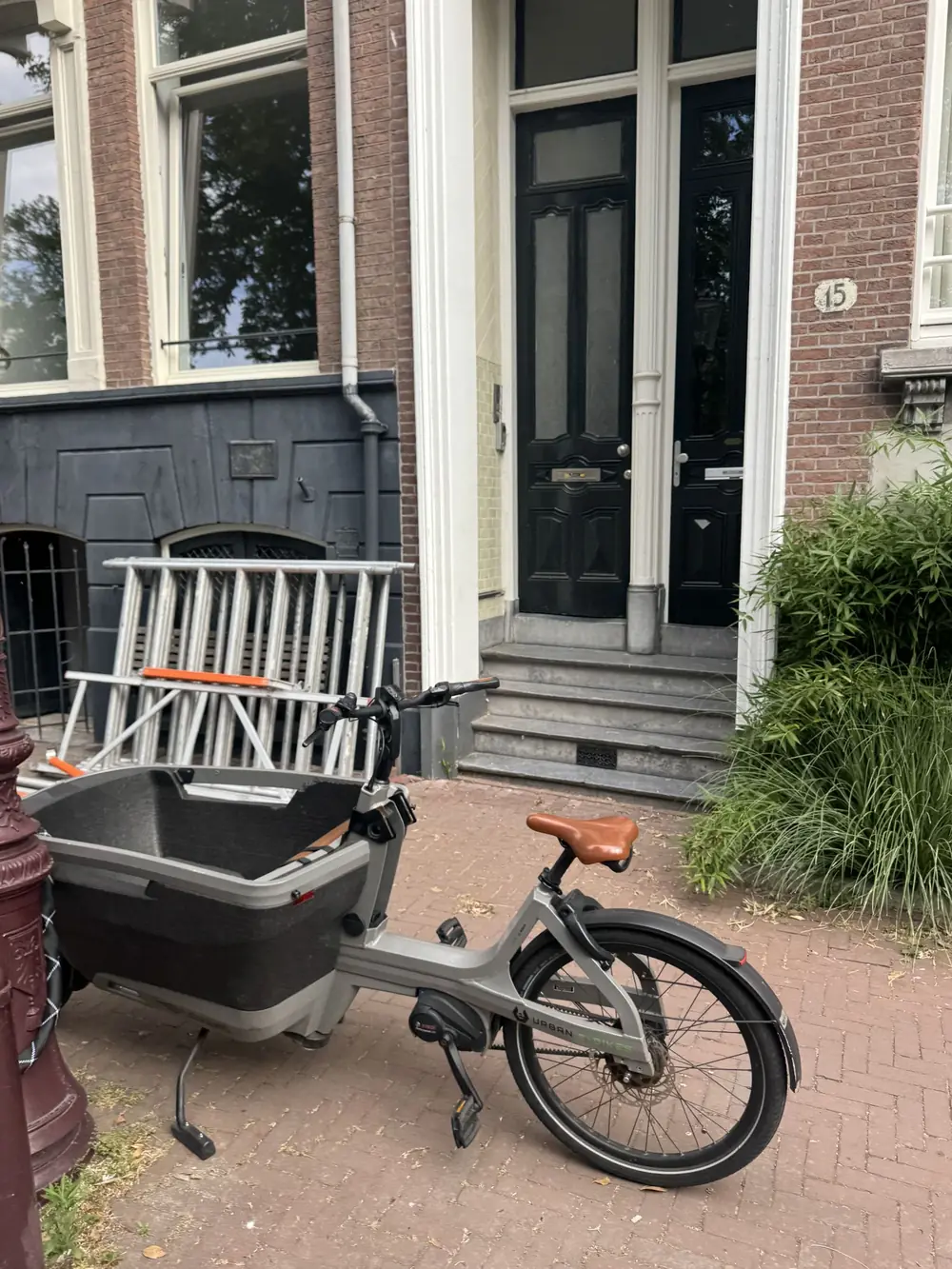
Scaffold frames stacked against a railing beside the entrance steps of a brick townhouse, a cargo bike in front

If the fixing point sits lower than six metres and you are doing the job alone, the MiTower comes into consideration too: a one person tower that reaches a good six metres of working height. If the light hangs higher, or if material and a second pair of hands go up with you, the narrow mobile scaffold stays the better choice. If in doubt, the comparison at these two types side by side helps, because the two differ in weight, in build time and in what you can set down beside you.
Which working height to hire for a light above a window

Measure not to the eaves but to the point where the light is going to hang, and on this job that easily saves two metres. A wall light above a window on the first floor usually sits around five metres above ground level, sometimes a little higher if it tucks under an overhang. Add the good two metres you still reach upward from a platform and you understand why 6 to 8 metres of reach is the answer when hanging a wall light. Hire on that figure, not on the height of the house.

More important than the maximum is the height your deck finally ends up at. You want the hole roughly at chest height, because a hole drilled above your head nearly always runs off upwards and the dust falls into your face. Half a metre either way decides whether you drill straight or drill blind. So set the platform so that you work against the wall with slightly bent arms, and not as high as it will go. For one fitting an eight metre build suits the job better than the tallest stack the frames allow.

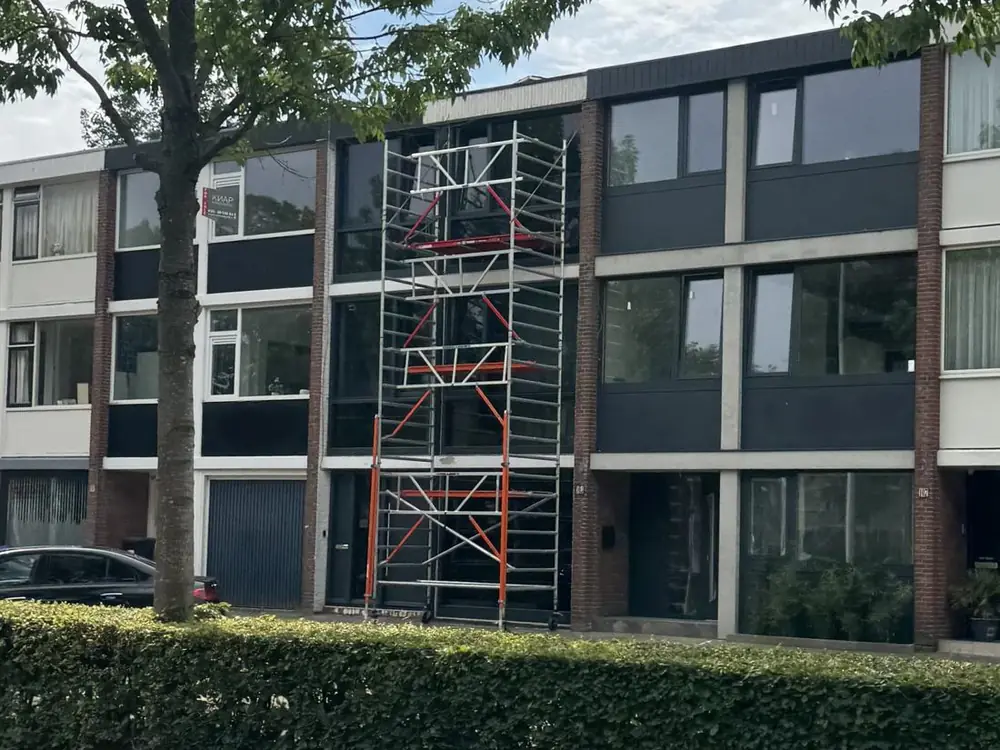
Mobile scaffold built up along the front of a terrace to above the first floor windows, decks stacked in stages

Look as well at the spot where the castors are going to stand. If there is a sunken terrace under the light, if the tower stands in a border lying lower than the path, or if the drive runs downhill to the kerb, your build begins at a different level from your threshold. Anyone starting half a storey lower than they thought is exactly one platform short and ends the day stretching after all. What a storey normally measures is set out under the heights of a first floor.

Hiring a narrow tower and setting it once, correctly

Hanging a wall light knows one setup, and it has to be right first time. Stand the tower so that the fixing point is not straight in front of your face but a little to one side of the middle of the deck; then you can work with your shoulder along the wall and have room to swing the machine. Too far to the left or right and you drill with a stretched arm, which you see back later in a hole that does not sit square in the brickwork.

The ground decides whether that works. A light often sits above a border, a gravel strip or a drive that drains towards the street, and in such places castors sink away or the setup stands out of true. Lay levelling plates or firm slabs under the castors and hold a spirit level against the uprights before you go up; a tower standing a degree out of plumb puts the hole in at an angle you notice afterwards. How to take up a sloping spot is explained at ground that is not flat.

Base of a tower on paving with castors and stabiliser legs folded out, the footing that has to stand plumb

Think about the inside as well. The feed through you drill from outside comes out in a room where a cupboard may stand against the wall or a joist may sit just in the way. Walk that through before the mobile scaffold is standing there, because a hole that has to move fifteen centimetres means the whole setup moves with it, and a built tower does not shift in a minute. Mark a cross on the wall outside with a pencil and hold a batten along the wall inside at the same height.

How many days to hire for a single fitting

The mounting itself costs you an hour or two. Building, levelling the setup, drilling, pulling the cable through, connecting, testing and taking it down again fills the rest of the day. For hanging a wall light you therefore book one hire day in practice, and that day starts when the components are unloaded and ends when the set lies back on the heap. It sounds short and it is: putting the tower up and striking it take longer here than the fitting work does.

Two days are sensible as soon as a cable still has to be run. If there is no circuit reaching that spot yet, a way has to be found for it, a channel or a conduit has to go in inside, and perhaps an electrician works at a moment that does not suit you. A switch you still want to move, or a second fitting on the other side of the elevation, also turns this into a day of extra work. Book that second day at once.

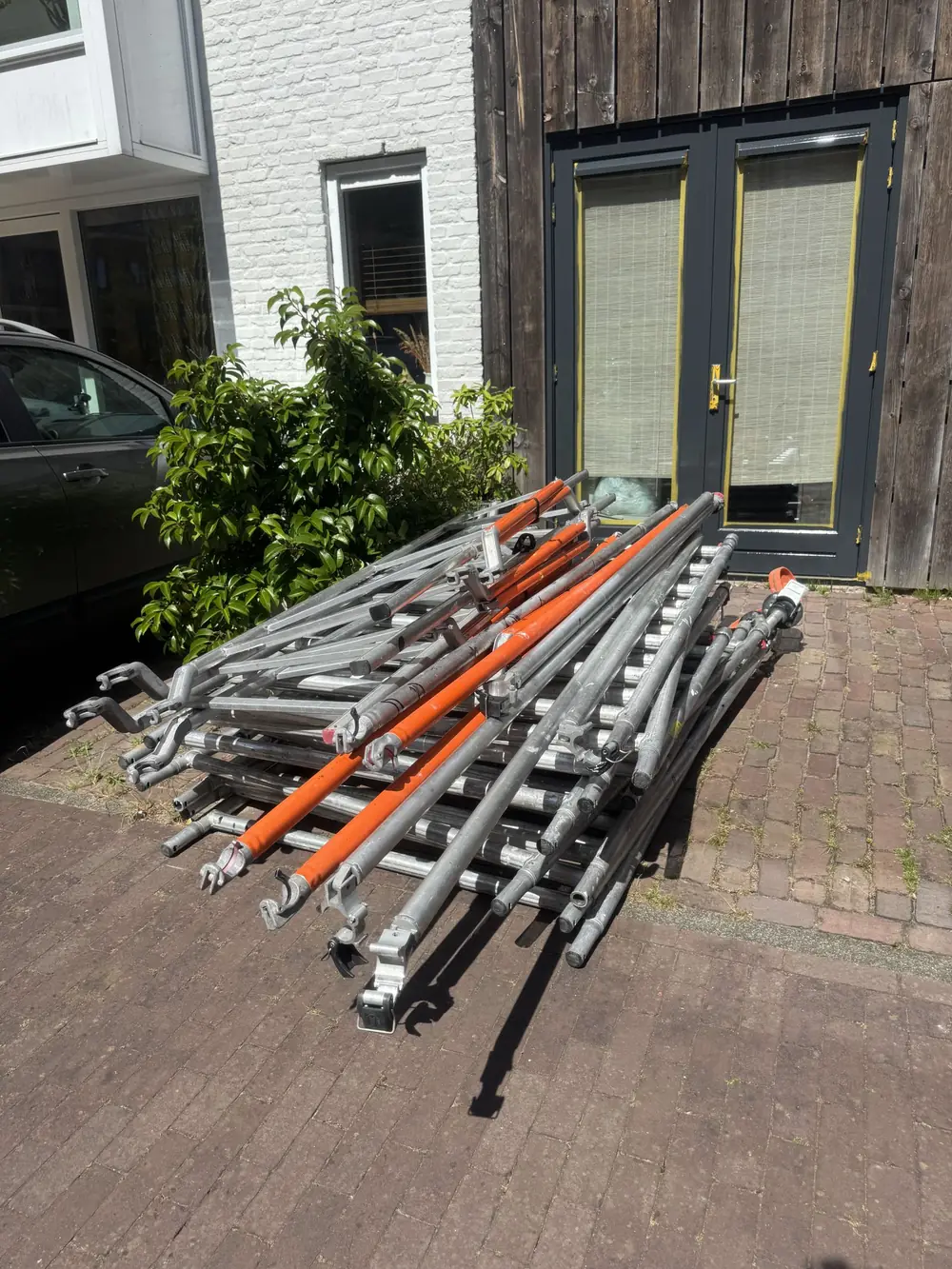
A counted stack of tubes, frames and ladder sections lying on brick paving in front of a house wall

Booking generously costs little with such a short hire period. You pay the full price over the first twenty four hours, and the day you hang on behind it comes in at ninety five per cent off, so the mobile scaffold can stand until the next morning. That is pleasant if the light is still not burning at five o'clock and you would rather look again tomorrow by daylight than tonight with a torch. Weighing that up is easier with the choice between a day and a week in front of you.

Which mobile scaffold suits hanging a wall light?

Kamersteiger RS44
  • Working height up to 4 metres
  • Compact and narrow
  • Great for indoor and small jobs
View and calculate →
Most chosen
Smalle rolsteiger RS51
  • Working height up to 14.2 metres
  • Narrow (75 cm)
  • Ideal for narrow passages
View and calculate →
Brede rolsteiger RS52
  • Working height up to 14.2 metres
  • Wide platform (135 cm)
  • Extra stability and workspace
View and calculate →
1-persoons steiger MiTower
  • Working height up to 6.2 metres
  • Very compact
  • Quick and easy to assemble
View and calculate →

Aligning the wall light from a 245 cm deck

From a platform of 245 cm you stand close on your work, and that is exactly why you cannot see whether the fitting hangs right. What looks centred above the window from up there turns out from the pavement to sit a few centimetres off the centre line of the frame. So do not measure by eye but with a tape from both reveals of the frame below, put your cross on the average and let somebody across the road confirm it before the drill goes on.

If a fitting already hangs on the other side of the elevation, that height counts for more than your own measurements. Two lights differing by ten centimetres jump out at once, even though each sits neatly above its own window. In that case run a line or use a long spirit level across the surface, and take the height of the existing fitting as your starting point. For that check the hired tower simply stays where it is.

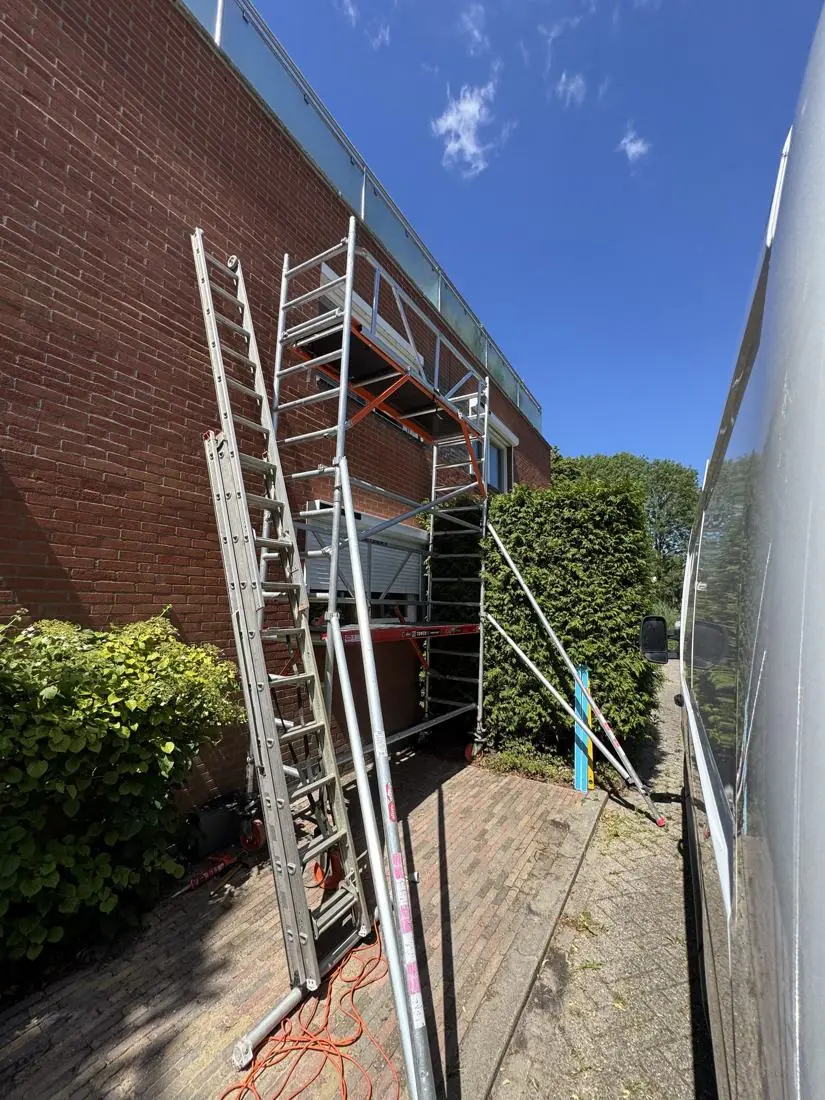
Tower erected in a narrow passage alongside a brick wall, with a long extension ladder propped against the same brickwork

Drill the hole for the feed through slightly upward, reckoned from the outside, so that rainwater creeping along the cable runs back out instead of into your wall. Hang the fitting loosely on the top plug first, check with a small level that it does not tilt, and only then do it up tight. Test the connection before you seal anything, because sealant you have to cut open again costs more time than all the drilling together. Every one of those steps in hanging a wall light happens standing on the deck.

Scaffold hire and delivery for a one day fitting job

On a one day job like hanging a wall light the logistics weigh heavily. The set is delivered as a complete, counted stack of components and that has to lie somewhere you can build it straight away: on the drive, on the path beside the house or in the front garden, and not behind a gate that is locked while you are at work. Agree who is at home and make sure the route from the van to the wall is clear of bins and bicycles.

Two dates go into the booking, one for the drop off and one for the pick up, and you name them both. Order the tower for hanging a wall light before 15:00 on a working day, and its parts stand at the door the working day after, which suits a fitting that has only just come in. Have the mobile scaffold dropped early in the morning if you can: building takes about an hour with two people, so the afternoon is left for drilling, feeding the cable through, connecting and testing the light.

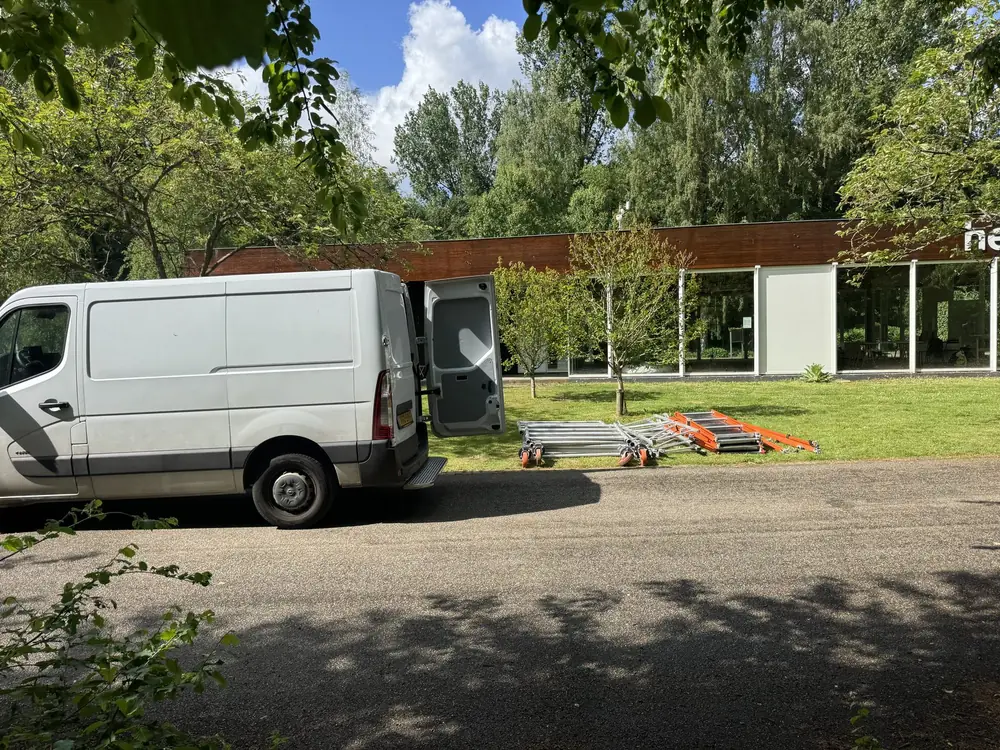
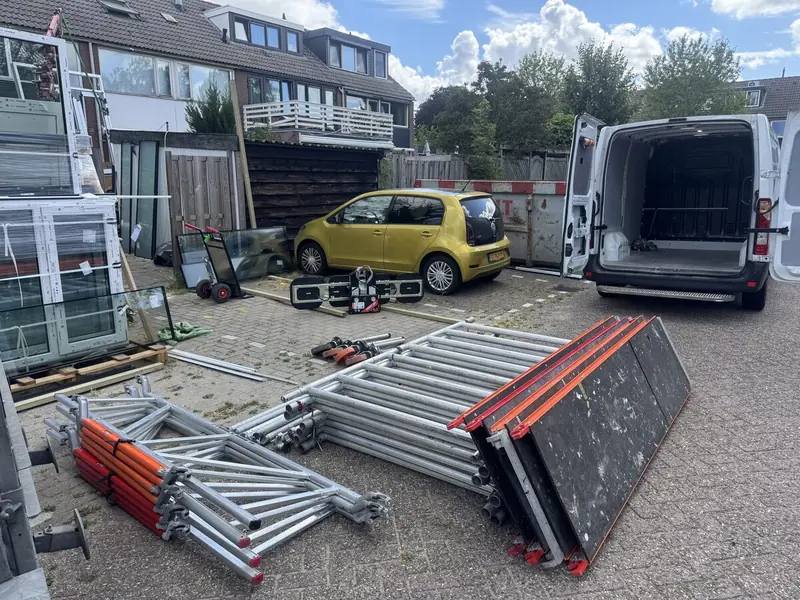
Van parked on a drive with its load space open, scaffold frames and braces already set out on the grass

Once the light is burning the mobile scaffold comes back our way. You take it down and lay the parts complete on the spot where they were brought, preferably that same evening, because a dismantled set lying out in the rain over a weekend is none the better for it. Run the count while you are striking it and that is off your mind. What the run to your address costs is set per province and listed under the delivery charges for your area.

Working safely with power and a drill on a tower

The first thing you do happens indoors: the circuit off, and a voltage tester to check that there really is no power on it any more. Only after that do you go up. Haul the drill up on a cord or have it passed to you rather than taking the ladder with a machine in your fist, and hang your cable reel over the guardrail so the flex does not run tight along an upright. A machine catching on its own lead pulls you off balance.

These towers answer to EN 1004, and in load class 3 that means 200 kg resting on a square metre of platform. For one fitting with a few tools that is wildly more than you need, but the rules around it hold in full: castors braked before you step on, stabilisers out and checked, and no movement at all while anybody or anything is on the deck. In hard wind you put the job off, because a fitting held out at arm's length leaves you nothing to hold on with.

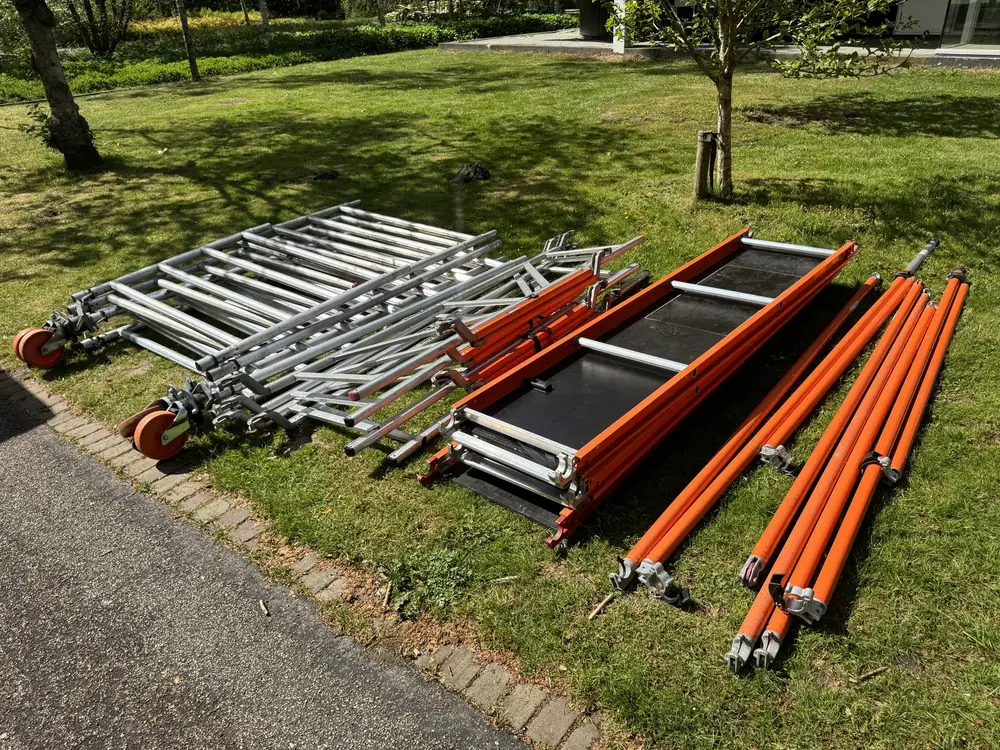
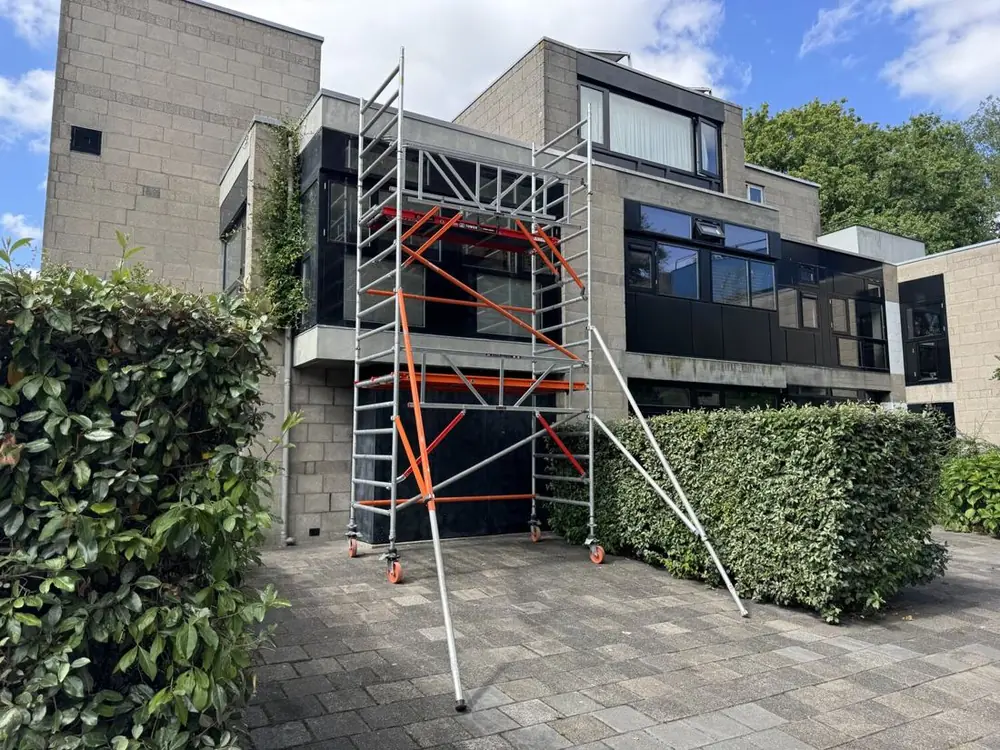
Frames on red castors, orange stabiliser tubes and a deck board spread across a lawn, a set waiting to be built

Finally, watch what can fall. Plugs, screws and the cap off a gland roll off a deck in no time, and under a wall light there is often exactly the path somebody walks along or the place where the bicycles stand. Use a tub or a bucket hung on the guardrail, and sweep the drilling dust away before the deck turns slippery with it. Put a bin at the foot of the hired tower if the pavement runs past. The further arrangements are at working safely above ground level.

In 5 steps

How hiring a mobile scaffold works

1
Choose working height

Pick the height that suits your job.

2
Book online

Sorted in 60 seconds, price shown instantly.

3
We deliver

At the agreed spot the next working day.

4
Assemble safely

Assembled by you, with a manual.

5
We collect

One call and we collect the scaffold.

Good to know

Practical tips for hanging a wall light

1

Mark the fixing point out while you are still on the ground. From across the street you see at a glance whether the light will line up with the frame and with the fitting on the other side.

2

Drill a thin pilot hole through the wall first and look inside to see where it comes out. If the spot is wrong you have a six millimetre hole to fill instead of a fourteen millimetre feed through.

3

Leave plenty of cable spare inside and coil the rest of it up. Half a metre short up top means climbing down, switching the circuit off again and redoing the whole run of indoor work.

4

Take a second plug and a longer screw up with you. Brickwork crumbles readily around a fresh hole, and then you do not want to descend for something waiting at the bottom of your toolbox.

5

Let the light burn before you screw it finally to the wall and seal the edges. If it does not work you are left with fixed screws and fresh sealant on a job that starts again.

6

Set the collection day after the day the light burns. If a core turns out wrong in the evening, the tower still stands the next morning and hanging a wall light ends in ten quiet minutes.

Frequently asked questions

Frequently asked questions about hanging a wall light

Which mobile scaffold do you hire for a wall light on the elevation?+

For this job the narrow RS51 with its 75 cm is the obvious pick. You stand on it at one spot only, your tools lie on a deck that is amply wide for that, and with that width you reach the fixing point past a path or a border. Working up there with two people, you hire a wider tower instead. Under six metres and doing it alone, a one person model will serve, though that saves mainly on build time.

How does hiring a scaffold turn out on such a small job?+

You hire online, pick the model with the reach that fits, choose an arrival morning and a collection day, then pay up front at a fixed rate that already includes VAT. The components come to you, you build, you hang the fitting and you set the dismantled set out again at the roadside. On a job of a couple of hours it really is about choosing those two dates well, because they decide whether you can work without hurry.

How many rental days does hanging a wall light cost?+

One day of hire is nearly always enough. That covers the building, the lining up, the drilling, the connecting and the striking of the tower; the fitting itself hangs within two hours. If wiring still has to be run, or a second light joins it on the same elevation, reckon on two. Striking need not happen the same evening, so you can spread the job over an afternoon and the morning after within the same twenty four hours.

What do you pay when you hire a mobile scaffold for a one day job?+

Your rental price rests on two choices: which tower you take, and how many sections you stack on top of each other. Every rate stands with VAT on the list of rates per build, next to the fixed sum for bringing and fetching in your province. Count on the first twenty four hours costing the full amount and a second day adding only a fraction on top of that. Overrunning with a scaffold that is standing there anyway is therefore no expensive business.

Which working height do you hire for a light above an upstairs window?+

With the fixing point at about five metres you hire a tower with 6 to 8 metres of reach. Measuring starts at ground level beneath the castors and ends at the pencil cross on the brickwork, so not at the gutter. Bear in mind that your deck ends up lower than the fixing point, because you work most comfortably with the hole at chest height. The table of working heights sets the builds out in a row.

Is the tower delivered even when you hire it for one day?+

Certainly, and on a job of one day that is often the handiest route. We bring the set on the morning you choose and take it away again on the agreed day; the sum for that run follows your province and stands fixed before you book. Anyone who would rather collect the mobile scaffold can load it up, by appointment and at no charge, at Zeeburgerpad 89 in Amsterdam. Do weigh up whether two journeys are worth it for a short job.

Do you have to build the mobile scaffold yourself if you hire it for this?+

Yes, that belongs with the hire. We deliver and we collect; the building and the striking are your share of the job, and you work from the manual with the video to fall back on. Keep that time in your planning, because on a short fitting job it is the largest part of your working day. We never deliver anything standing, and a cherry picker is not in our range in any case, so this is the equipment the work gets done from.

Can you hire for longer if the wiring disappoints?+

That is possible; just let us know before the collection day comes. With a wall light the setback nearly always sits indoors: no cable in the right place, a consumer unit that is full, or a wall the feed through will not go through. We move the collection date back, as long as the mobile scaffold is not in somebody else's diary. Finished earlier instead, and we fetch it away sooner without any fuss.

How much clear ground do you need to hire a scaffold here?+

Reckon on the base of the tower plus the reach of the stabilisers to either side, which is a good deal wider than the deck itself. In a border it means a few plants moved aside for a while; on a narrow path it means nobody passing for a bit. Make sure the door under the setup still opens too, or the whole household walks round the house for the length of your hire day.

Can you keep hiring if it rains on the day of the fitting?+

Drilling and screwing go perfectly well in a passing shower, but a connection is better not made in pouring rain; moisture in a junction box is hard to get out again. The tower simply stays standing, so you can wait a couple of hours and then carry on. In hard wind you stop: holding a fitting at height does not combine with gusts. The extra hire day you need for that costs almost nothing.

How does the deposit run on a one day scaffold hire?+

Even with one day a deposit belongs with the hire. Once the collected set has been found complete, that amount is transferred back inside one working day. On fitting jobs the snags are small ones: a deck board left leaning in the shed, or brick dust and cement smears dried onto the tubes. Run the count while you strike it and wipe the deck boards, and it is settled before the van pulls up.

Can you replace the light on the other side in the same rental period?+

That is exactly the reason to book a day with room in it. As long as the scaffold stands on your ground you may move it to a second point, provided you clear it first and set the stabilisers out again. For two fittings on the same elevation that shifting takes half an hour, levelling included. If you also want work on the light beside the front door, plan it for the same day.

Hire a mobile scaffold for hanging a wall light today?

Calculate your rental price now or ask for free advice.

Rolsteiger van SteigerTaxi geleverd op locatie
Book it online

Your scaffold sorted in 2 minutes.

Choose your scaffold and working height, see the price instantly and book online.