
See your price
Application

Repairing a downpipe? Choose the right scaffold.

Repairing a downpipe is spot work. Somewhere along the run there is a split seam, a weeping socket or a bracket that has pulled out of the brickwork, and that single point is what you have to reach with both hands free and your tools within arm's length. The rest of the pipe stays exactly where it is. When the fault sits at first or second floor level, the narrow 75 cm RS51 built to somewhere between 6 and 8 metres working height is the sensible tower to hire.

  • Order before 3 pm, delivered tomorrow
  • Professional Altrex scaffolds
  • Up to 14.2 metres working height
  • Easy to assemble yourself
4,2 tot 14,2 mWorking heights available
12Provinces served
7Days a week
200 kg/m²Load class 3
In short
  • For repairing a downpipe we recommend the Narrow mobile scaffold.
  • For repairing a downpipe you take the narrow RS51 at 75 cm wide and build it to 6 to 8 metres.
  • This job keeps you in one spot: level with the split, the crack or the bracket that has worked loose.
  • One hire day usually covers it. If the whole run comes off, that is a different job with more days.
  • First 24 hours from €150 incl. VAT and delivery; every day after that 95% off.
Key facts for this job
FeatureValue
Recommended scaffoldNarrow mobile scaffold (Altrex RS TOWER 51)
Working height for this job6 to 8 metres
Available working heights4.2 to 14.2 metres
StandardEN 1004, load class 3 (200 kg per m²)
DeliveryOrdered before 3 pm, delivered next working day
Each extra day95% off, from €7.50 a day
Why a mobile scaffold for repairing a downpipe?

Safe, stable and professional work at height

The difference from renewing a complete rainwater run lies in reach. A repair does not ask you to work the whole line from gutter to paving, but it does ask you to stand dead still at the one height where things have gone wrong, with both hands free to prise a socket apart or refix a bracket. That point is rarely at a comfortable height and it is usually tucked into a corner as well. Deciding to hire a mobile scaffold for repairing a downpipe therefore comes down to three questions: where exactly is the damage, will the base clear whatever is stacked against the wall, and how many hire days do you want in order to check the mend afterwards.

  • One damage point, not the entire run
  • Standing still at the height of the leak
  • Both hands free for socket and bracket
  • Short hire period, often inside one working day
Read more about working safely →

Hiring a narrow tower for repairing a downpipe

For a mend to a rainwater pipe the Altrex RS51 is the obvious choice: a slim 75 cm model whose lifts run from 4.2 metres of working height as far up as 14.2 metres. You will only use part of that range here, because you set it up around the point where the pipe is letting water out. The narrow footprint is the argument here, since a downpipe runs down a corner, past a shed or along an alley between two houses. The range of mobile towers on hire shows the alternatives.

The 135 cm wide version gives you more deck, but spot work on a pipe does not need it and you will not get that width down half the routes to the back of a house. A room scaffold is out because it is built for indoor work and will not reach a gutter. What is left is exactly what suits: a 75 cm tower you can carry through in armfuls of parts and that still stands upright on a path a metre wide.
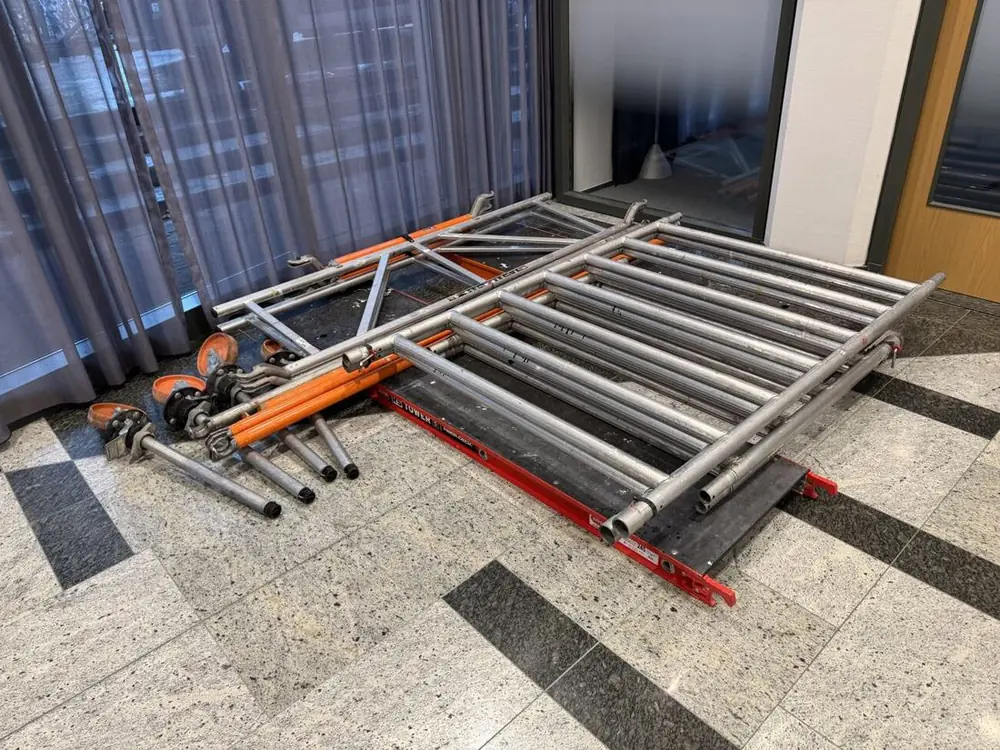
Counted set of scaffold parts checked and ready for hire, the narrow model booked for a downpipe repair

The 245 cm platform mostly serves as a bench when you are repairing a downpipe. A replacement bracket, a roll of tape, a cartridge of sealant, a cordless drill and an offcut of pipe all sit side by side on it, and you still have room to move about. That matters here, because with a leak you never know in advance which tool will turn out to be the one you need. Climbing down for every item costs more time than the mend itself.
Working height for repairing a downpipe on the first floor

On this job you measure to the damage and not to the gutter. If the split sits just under the upstairs floor, or the wet trail starts at a socket on the first floor, a build of 6 to 8 metres gives you plenty. That figure is your deck height with roughly two metres of standing reach added on top. What such a stand asks for in parts is set out under a build of eight metres working height, worth a look before you book.

The awkward part is that water tells lies. The wet streak on the brickwork often begins well below the hole the water is escaping from, because it clings to the pipe before it touches the wall. So when you give us your height, allow your margin upwards rather than downwards. Stand too low and you end up staring at the underside of a socket, only spotting the hairline crack above it once the tower has already gone back on the van.

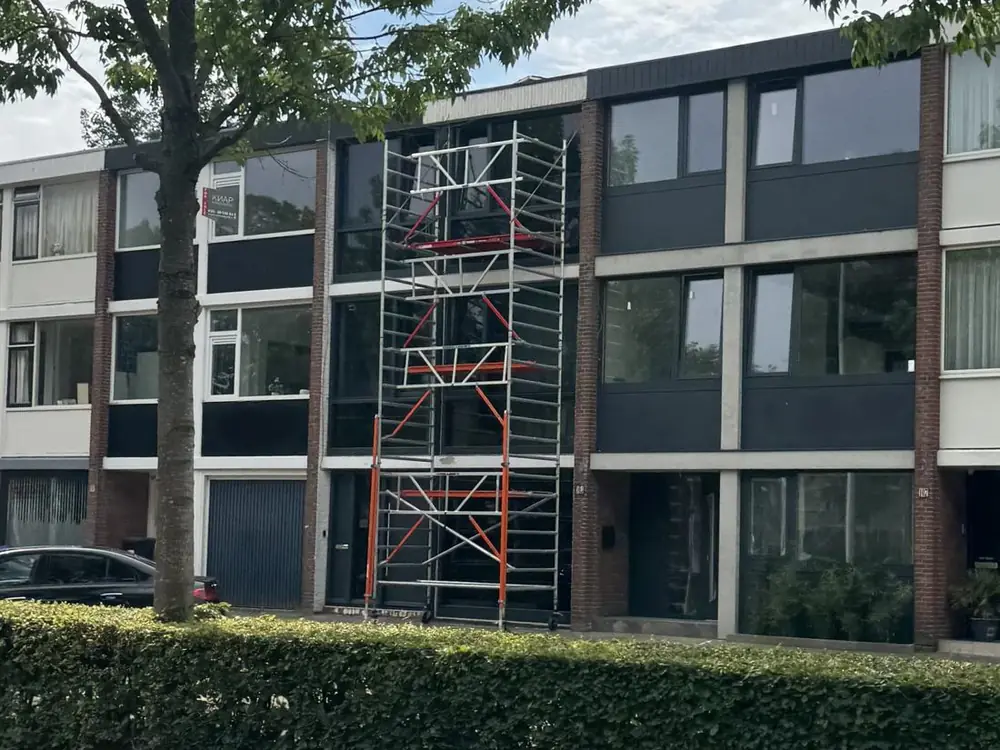
Narrow mobile scaffold built along the front of a house, reaching the level where a leaking pipe joint is normally found

Measure from the slab your castors will actually rest on, not from the level of your back doorstep. Paving around a rainwater outlet nearly always falls towards the gully, so your starting point sits lower than you think. If the damage turns out to be higher than you first judged, an extra lift is easy to add when you reserve, but you cannot order a platform halfway through a hire day. Take the roomier stand: it barely moves the rental price and it saves your temper.

Where the hired tower stands beside the damaged downpipe

When you are repairing a downpipe you want the deck alongside the damage rather than square in front of it, because a pipe hanging under your nose cannot be inspected all the way round. Set the tower half a step to one side of the line of the run, so you can get at the socket and still have room to undo a bracket. Down below, allow a level area noticeably bigger than the tower, since the stabilisers splay outwards and want firm ground under them.

Traditionally there is more clutter round a rainwater pipe than anywhere else on the property. A water butt plumbed in with a diverter, an outside tap on a hose reel, wheelie bins, a cycle rack and a border planted right up to the brickwork. Clear all of that before the van arrives, not on the morning you intend to start. If the fault is above a single storey extension or a flat shed roof, look for a sideways approach, because this tower may not stand on a roof.

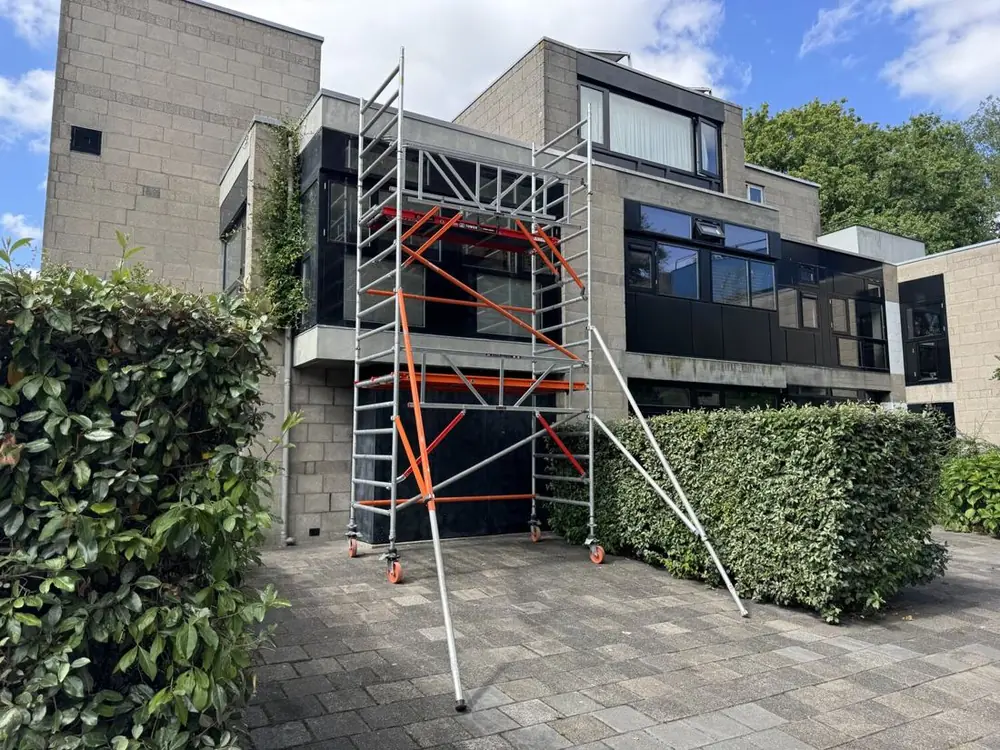
Stabilisers splayed out beneath a mobile scaffold on paving, the clear strip you need next to a gully

Watch the surface itself as well. Loose decorative setts and old slabs around a gully tip under a stabiliser foot and put the whole assembly out of plumb. A solid board under the foot usually settles it. How to take up a slope or an uneven bay is explained in the piece on uneven ground under a tower. Keep the gully cover clear too, so that when you test with water you can see where it goes and whether it drains away at all.

How many hire days for repairing a downpipe leak

A single leak is rewarding work as far as time goes. Two of you will have the tower up in a couple of hours, finding and sealing the damage takes half a day, and dismantling goes quicker than building. That lands you on one working day, which is what most people book for this. If the fault is in a solvent welded joint, or a bracket has to go back into the pointing, all of that still fits inside the same day as long as your materials are ready.

There is one waiting period built in that you cannot shorten. Sealant and adhesive have to grab before you put water near them, and you would rather check that the next morning than half an hour later. Proving it is watertight also takes rain, or a hose run into the gutter. That is why a second hire day makes such a difference on this job: you inspect with the tower still standing rather than craning your neck from the paving.

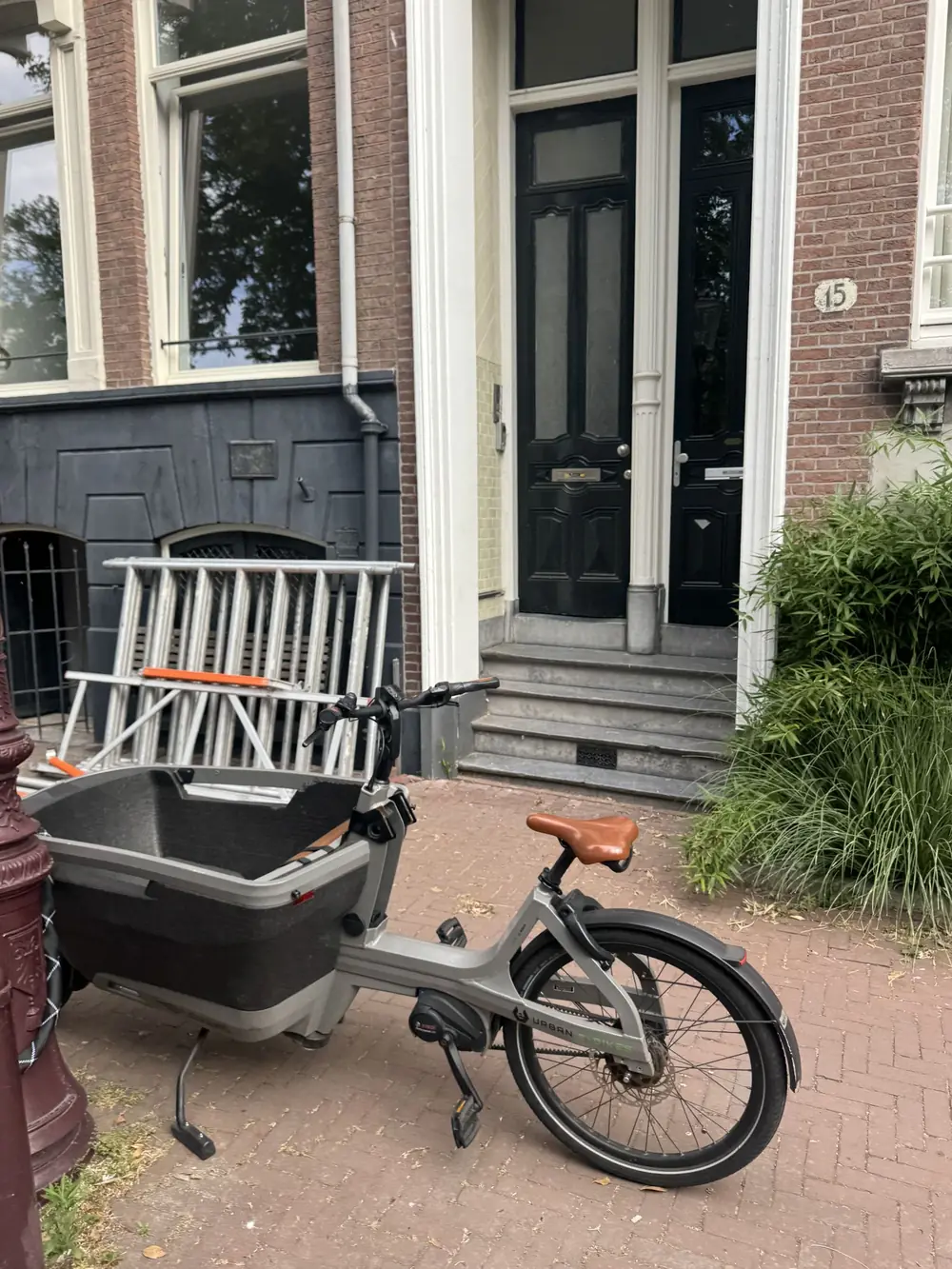
Aluminium frames left at the foot of a front door with a cargo bike alongside, the hire set for a single day.

That extra day hardly registers on the bill. You are charged in full for one day and one night, after which every further hire day drops by ninety five per cent. Book exactly one day, find the mend still weeping, and you are hiring again, arranging delivery again and building the whole tower again for ten minutes of work. Judging a longer job is easier with this guide to counting hire days in front of you.

Which mobile scaffold suits repairing a downpipe?

Kamersteiger RS44
  • Working height up to 4 metres
  • Compact and narrow
  • Great for indoor and small jobs
View and calculate →
Most chosen
Smalle rolsteiger RS51
  • Working height up to 14.2 metres
  • Narrow (75 cm)
  • Ideal for narrow passages
View and calculate →
Brede rolsteiger RS52
  • Working height up to 14.2 metres
  • Wide platform (135 cm)
  • Extra stability and workspace
View and calculate →
1-persoons steiger MiTower
  • Working height up to 6.2 metres
  • Very compact
  • Quick and easy to assemble
View and calculate →

Working from the platform beside the damaged rainwater pipe

The big difference from renewing a whole rainwater run is that you do not reposition. You build, climb up and finish the work from that one stand. Only if the damage runs over more than two metres, or you meet a second loose bracket on the way down, do you drop a platform. If the entire pipe has to come off, the character of the job changes and you are better off reading about renewing a complete rainwater downpipe.

Check your tools over before you step onto the ladder. An abrasive pad, degreaser, the new gaskets or collars, plugs in two sizes, the cordless drill and a small saw. Anything you forget costs a climb down and back, and that is a waste here because the mending itself is short. Put whatever can roll against the side of the deck where the guard rail is, because a length of pipe slides away faster than you would expect.

Working platform of a mobile scaffold along a side elevation, the stand you tackle a split pipe from

Cleaning first is the least glamorous part of repairing a downpipe and the part that decides it. A crack in zinc or plastic will not hold sealant over a film of green growth, and nine out of ten failures come apart on exactly that. While you are there, see whether the brackets above and below are still tight, because a pipe free to move splits again in the same place. Five minutes of checking from a hired scaffold saves you a second hire period later in the year.

Scaffold hire delivered on the morning of your repair

Everything arrives loose and pre counted: uprights, braces, platforms, guard rails and castors, checked off one by one before it leaves us. Decide in advance where that pile is to land and keep the strip directly under the pipe empty, because you will be walking tools back and forth there. A driveway or a patch of grass beside the path works better than the path itself. Place the booking on a working day and beat three o'clock, and the parts are with you the following working day.

You pin the arrival date and the departure date yourself. With a weeping rainwater pipe you would rather have that arrival on a dry morning, so the build goes up dry and you can start straight afterwards. Erecting it is your side of the arrangement, and with a colleague, the printed manual open and the assembly film playing on a phone you are on the deck within a couple of hours at this height. Collecting the set yourself costs nothing and is arranged by appointment at Zeeburgerpad 89, Amsterdam.

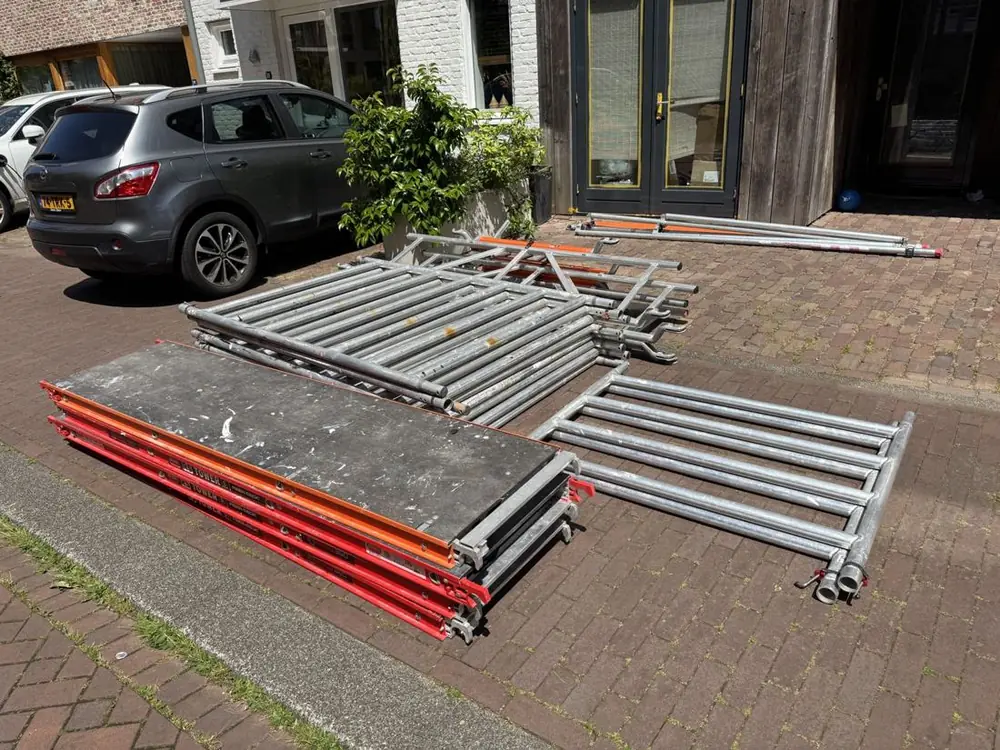
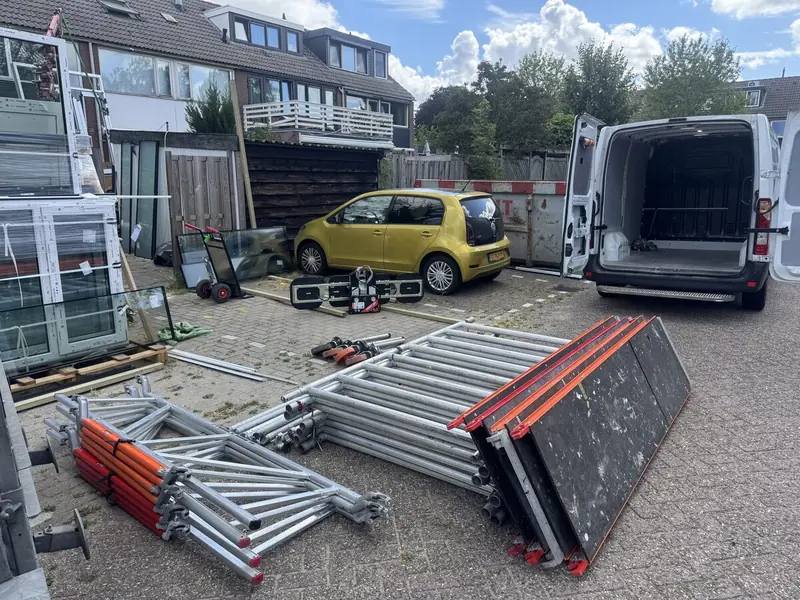
Scaffold parts unloaded in the street outside a house, the delivery you book for the morning of the repair

As soon as the work is done we come for the parts again. You take the tower apart, count everything as you go and lay the full set out at the agreed spot. Before you start dismantling, have one more look at whether the mend stays dry under a good slug of water; from the platform you see that at a glance and from the ground you do not. Fixed charges per province are listed under delivery rates by region.

Safe working on the hired tower during a downpipe repair

The deck you stand on belongs in load class 3 of EN 1004 and carries two hundred kilos per square metre. On a job like repairing a downpipe you will not come near that, because you go up with a bag of tools rather than a stack of materials. What does matter is the spread: put the cordless drill and the cartridge of sealant in the middle of the floor and not all against the rail you are leaning over as you work.

The ordinary agreements hold in full. Castor brakes go on before anyone sets foot on a rung, the deck is cleared of people and kit whenever the tower has to shift a metre sideways, and you stay off it in strong wind. That last one bites sooner here than you would expect, because you are often in a narrow passage between two houses where the wind pulls hard from one direction. The remaining rules sit at the rules for working at height.

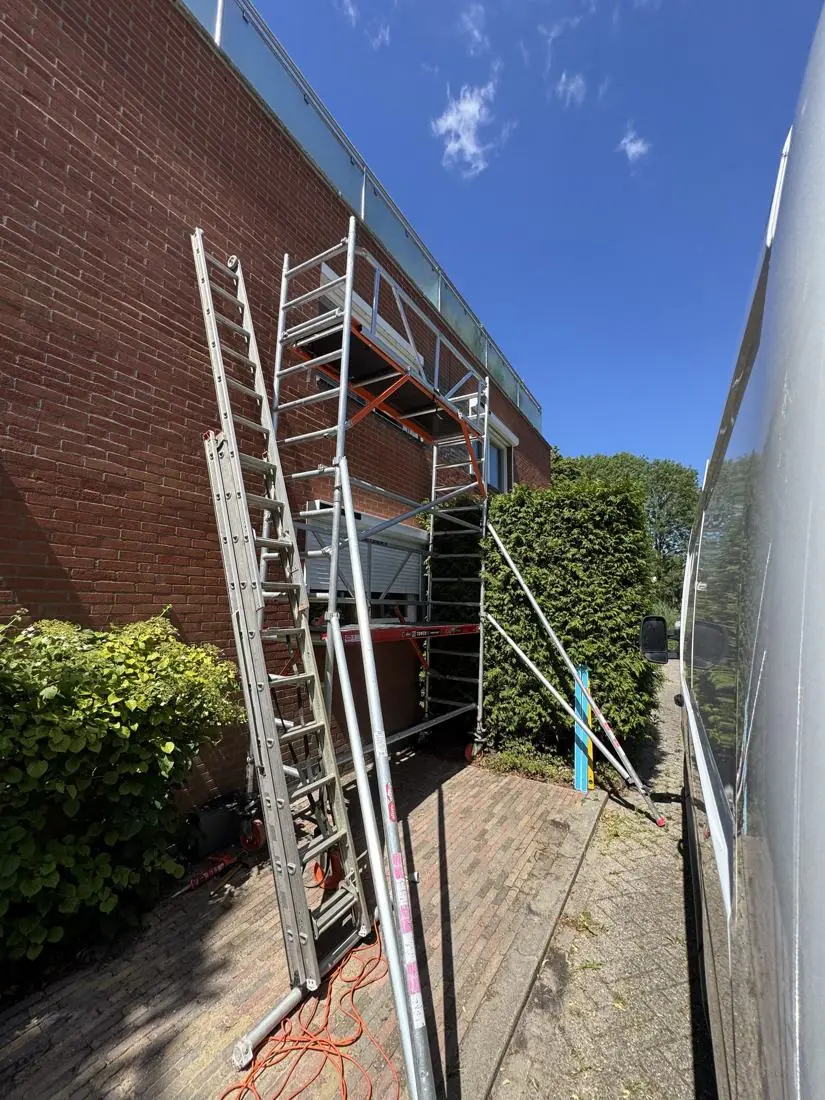
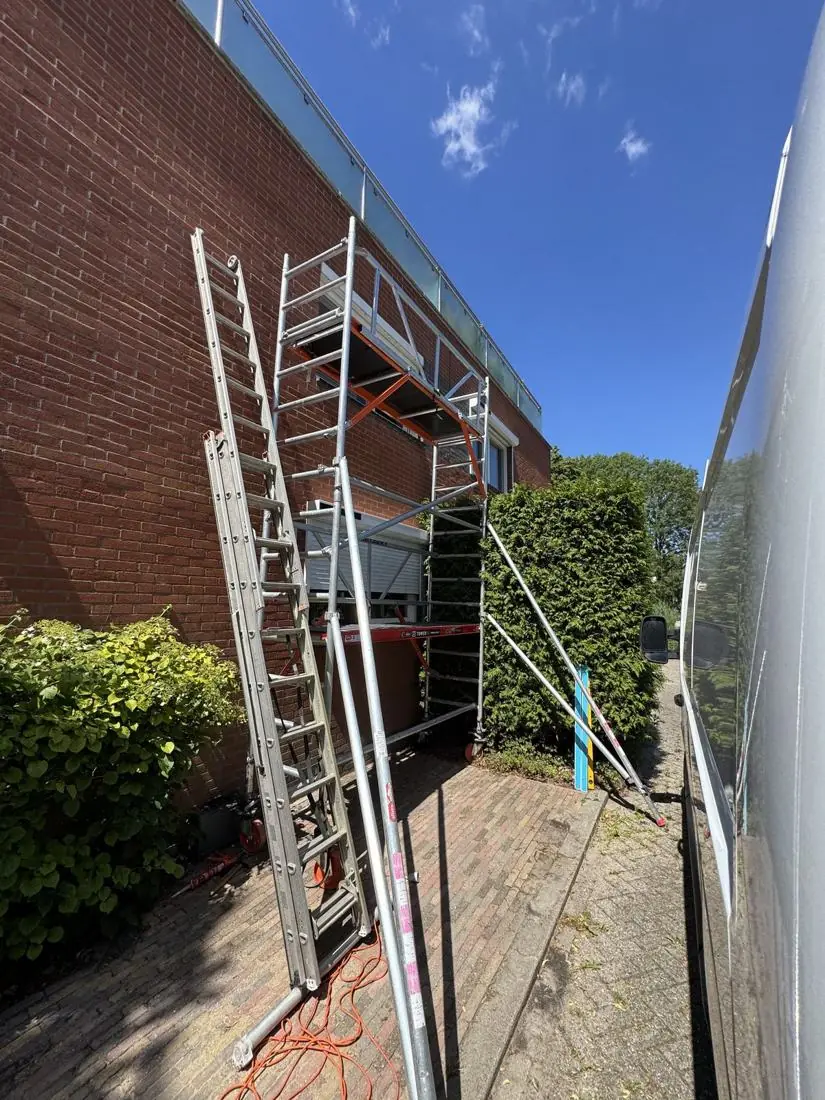
Built tower in a side passage with rails around the boards, a separate ladder leaning on the brick wall alongside.

The risks peculiar to this job are sharp metal and getting wet. Old zinc cuts when you open a split seam, so wear gloves. Water and green growth make the deck slippery the moment you flush a blocked pipe through, and you usually notice only as you turn round. Keep the zone beneath you clear, because a pulled off length of pipe or a falling bracket lands exactly on the slabs someone else walks over on the way past.

In 5 steps

How hiring a mobile scaffold works

1
Choose working height

Pick the height that suits your job.

2
Book online

Sorted in 60 seconds, price shown instantly.

3
We deliver

At the agreed spot the next working day.

4
Assemble safely

Assembled by you, with a manual.

5
We collect

One call and we collect the scaffold.

Good to know

Practical tips for repairing a downpipe

1

Flush the gutter and the pipe with a hose before you seal anything. You will see straight away whether the leak sits where the wet patch is, or half a metre higher at a socket.

2

Take a small mirror up with you, or use your phone camera, to look behind the pipe. The split sits on the wall side surprisingly often, exactly where the platform gives you no view.

3

Do not pull a loose bracket back into its old hole. Drill a fresh one a centimetre away in the brick rather than the joint, so the plug grips and the pipe does not split there again.

4

Lay an old towel over the guard rail you lean across. Zinc and coated steel pick up a mark otherwise, and while you are rubbing down a split you will want something to wipe your hands on.

5

Roll your pliers, chisel and drill bits into a tool wrap and hang it from the rail. On this kind of work you are forever turning on the spot, and loose kit gets kicked off the deck.

6

Ask for your collection date one day after you finish repairing a downpipe. After the first heavy shower you can then check the seam from the platform instead of guessing at it from the paving.

Frequently asked questions

Frequently asked questions about repairing a downpipe

Which mobile scaffold should you hire for repairing a downpipe?+

The 75 cm wide RS51 fits this best. A rainwater run nearly always sits in a corner, behind a shed or down an alley, and a wide tower will not get through. Up top you barely notice the narrower deck, since a mend keeps you on one spot instead of moving along a wall. Do give the height of the damage when you hire, not the height of the gutter, because that difference can easily be a metre. Ordering that lift up front saves you a rebuild halfway through.

How does hiring a scaffold for this repair work from start to finish?+

Online you pick the model and the height you need, and you state which morning the van pulls up and which day the set goes away again. The rate is fixed and VAT is in it. We unload the parts at your address, you stand the hired scaffold up, mend the pipe and afterwards lay everything out dismantled and counted. All we ask is that the ground under the outlet is clear when the van arrives. Everything else, from the timing to the stack of parts, is settled at booking.

Do you have to hire the tower for several days for one leak?+

For repairing a downpipe at a single damage point, one day is enough and two days are comfortable. The mend itself takes half a day, but the build at the start and the watertightness check at the end fill the rest. Anyone who also wants to refix loose brackets or look over a second pipe at the back hires the tower a day longer. Since you choose the collection day, that margin costs very little. Most people hire for two days and use the second only for checking.

Does the hire get dearer per day, or cheaper after day one?+

What you pay follows from the model on your booking and the lift you build to, with a fixed provincial figure on top that covers the outward run and the return run in one. The complete list, VAT included, sits on the page with our hire rates. On a short job nearly all the weight sits in that first period, and the tail end scarcely shows. Two short hires almost always work out dearer than one generous booking.

What working height do you hire if the leak is on the first floor?+

Then a build between 6 and 8 metres of working height suits, putting your deck somewhere between four and six metres. Measure to the top of the damaged section and add half a metre, because the source of a leak often sits higher than the wet streak. Our list of available working heights tells you which lift to tick before you hire the scaffold, so you are not guessing on the pavement with the parts already unloaded. Half a metre short is only obvious once the tower stands.

Can you hire a scaffold with delivery, or must you fetch it?+

Both arrangements are available for this. If you have it delivered, the driver sets the parts as close as he can to the way through to the back; carrying them round remains yours, and that works because every piece of this hired tower lifts with two hands. If you would rather drive, you can pick the set up yourself by appointment, provided your vehicle takes the lengths. Say where the parts should go when you make the reservation.

When you hire the scaffold, who actually builds the tower?+

Erecting and dismantling stay on your side. We bring every component and take it away again afterwards, but the building, moving a platform and the taking apart are yours. At a height like this two people need a couple of hours, and the manual and video supplied walk you through the order. We do not hire out ready built towers, facade scaffolds or cherry pickers; for spot work on a pipe this is more than enough. Reckon the build time into your hire period rather than treating it as free.

What if the mend drags on and I want to hire longer?+

Give us a ring in good time and the collection date moves, provided that set is not already promised to somebody else. On a rainwater pipe it happens regularly: you free a socket and find the section under it has rusted through, or a bracket will not bite in weathered pointing. Losing your tower at that moment is the last thing you want. Finish early instead and the hire can end a day sooner without any fuss.

How much clear space do you need where you plan to hire?+

Allow for the width of your hired tower plus whatever the four stabilisers stick out on either side, and leave the gully at the foot of the pipe completely free. In practice you are looking for a level stretch of two to three metres along the wall. Move a water butt, a wheelie bin or a border that runs up to the masonry beforehand, because shifting things later costs you half an hour. Reserve somewhere for the stack of parts too.

Can the hired tower stay up while it rains during the work?+

The tower can stay standing; you simply pick your moment. Sealant and adhesive bond poorly on a wet surface, so you close things up dry. A shower in between is actually welcome on this job, because from the deck of your hired tower you see straight away whether the mend has gone watertight. Use a wet morning to check brackets and lay out your materials, then take up the sealing once the wall has dried off. A day of drizzle rarely costs you more than one extra hire day.

What happens to your deposit once the hire period is over?+

It goes back within one working day of the hired scaffold returning and the set being found complete. On this kind of work, watch for sealant and adhesive residue above all: you wipe it off there and then in seconds, but once cured it will not come off a guard rail or a platform edge. Count the small items in as you dismantle, locking pins included. What gets looked at is set out in the piece on getting your deposit back.

Is it worth checking the gutter from the same hired stand?+

If you are up at that height anyway, yes. A leak halfway down a rainwater pipe often comes from a blocked outlet in the gutter, with water spilling over it at every shower. Put a hand in the outlet, pull the leaves out and see whether the top bracket is still fast. That costs ten extra minutes of your hire day and stops you having to hire a scaffold again in six months for the same corner.

Hire a mobile scaffold for repairing a downpipe today?

Calculate your rental price now or ask for free advice.

Rolsteiger van SteigerTaxi geleverd op locatie
Book it online

Your scaffold sorted in 2 minutes.

Choose your scaffold and working height, see the price instantly and book online.