
See your price
Application

Painting a shed? Choose the right scaffold.

Painting a shed is low work you nonetheless set up four separate times, since the building stands on its own and you walk round it wall by wall. The highest thing your brush reaches is usually the fascia board, and that board hangs lower than people assume. For this job you hire the MiTower, the lightest tower we let out, assembled to somewhere between 4.2 and 5.2 metres of reach. Below you can read how to measure that, what garden ground does to your set-up and how many hire days to book.

  • Order before 3 pm, delivered tomorrow
  • Professional Altrex scaffolds
  • Up to 14.2 metres working height
  • Easy to assemble yourself
4,2 tot 14,2 mWorking heights available
12Provinces served
7Days a week
200 kg/m²Load class 3
In short
  • For painting a shed we recommend the 1-person scaffold.
  • For a shed or summerhouse you hire the MiTower, a light single-person tower built to 4.2 or 5.2 metres of reach.
  • When painting a shed, measure to the fascia rather than the ridge, since that is the highest point your brush genuinely has to touch.
  • Around the building the tower ends up on four different surfaces: patio slabs, lawn, a strip of gravel and a planted border.
  • First 24 hours from €100 incl. VAT and delivery; every day after that 95% off.
Key facts for this job
FeatureValue
Recommended scaffold1-person scaffold (Altrex Mi Tower)
Working height for this job4.2 to 5.2 metres
Available working heights4.2 to 14.2 metres
StandardEN 1004, load class 3 (200 kg per m²)
DeliveryOrdered before 3 pm, delivered next working day
Each extra day95% off, from €5 a day
Why a mobile scaffold for painting a shed?

Safe, stable and professional work at height

A shed stands free of the house, and that alters the way you paint it. You are not moving along one elevation but circling four walls, and after each wall the ground under the castors has changed again. The top of the work is not far off either, because on most garden buildings the brush stops at the fascia, roughly two and a half to three metres up. That does not call for a heavy build. It calls for a tower one person can shift and stand on with both hands free for sanding and topcoat, so painting a shed is a hire question about weight, width and how easily the thing rolls sideways.

  • Four walls, so four separate set-ups
  • The fascia board sets your highest measuring point
  • One person can roll it along garden paths
  • A build to 5.2 metres of reach suffices
Read more about working safely →

Which MiTower to hire for painting a shed outdoors

Painting a shed calls for the MiTower, the single-person Altrex tower measuring 75 cm across its base, a model running up to 6.2 metres of working height. That slim footprint is the point here, not a compromise: you have to get it down a garden path, past a hedge and sometimes through the gap between building and fence. For this job you assemble it well below the top of its range. What else we keep in light towers is described on the page about the single-person MiTower we let out.

The deck of such a tower holds exactly what a shed asks of you and nothing more: one tin of stain, a brush, a sanding block and a cloth. You lift all of it up yourself, and you will be the one pushing the tower across the lawn to the next corner, so a short kit list is a feature rather than a limit. A second person does not belong up there beside you. Where two of you are working, split the job across the walls instead of the platform.
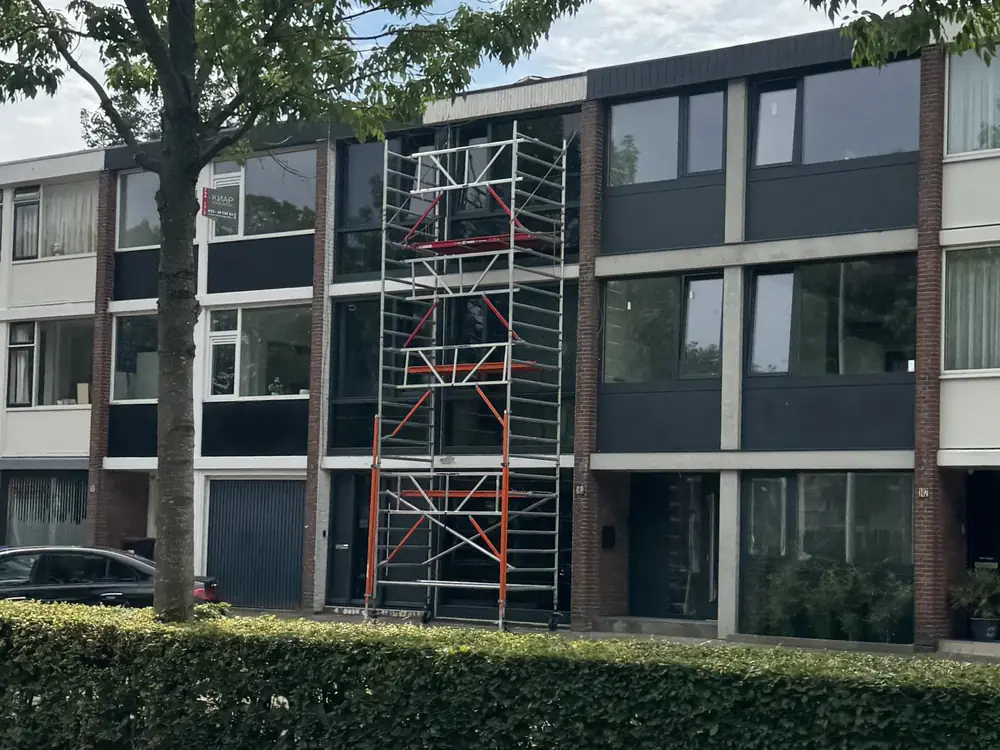
Light mobile tower stood up beside a modern house, the compact build hired when a small outbuilding wants repainting

A 135 cm wide mobile scaffold is more than this work needs. You often cannot get it past the flank of the building at all, and on garden soil the extra parts press deeper into the ground with every hour. Such a build only wins when boards are being replaced first and timber, screws and power tools travel up with you. Straight brushwork wants something lighter. The two sit side by side in a comparison of the wider rolling scaffold against the single-person model.
Hiring the working height that matches a shed fascia board

The highest point of a shed is almost never its ridge. You are covering walls, door, barge boards and fascia, and on most garden buildings that fascia lands two and a half to three metres above the soil. Run a tape up to it from the level where the castors will genuinely rest, not from the step outside your back door. Then turn the figure into a deck height, remembering that the reach you book is your platform plus about two metres for the span of your arms.

That lands a shed between 4.2 and 5.2 metres of working height, on a deck two to three metres up. You state the range when you reserve the tower, and it settles which stage of frame goes on the van. Where the building sits on a raised terrace, add the difference before committing; where it stands in a sunken corner, take it off. What each further stage of reach buys you is laid out per build on the page about reach heights per build stage.

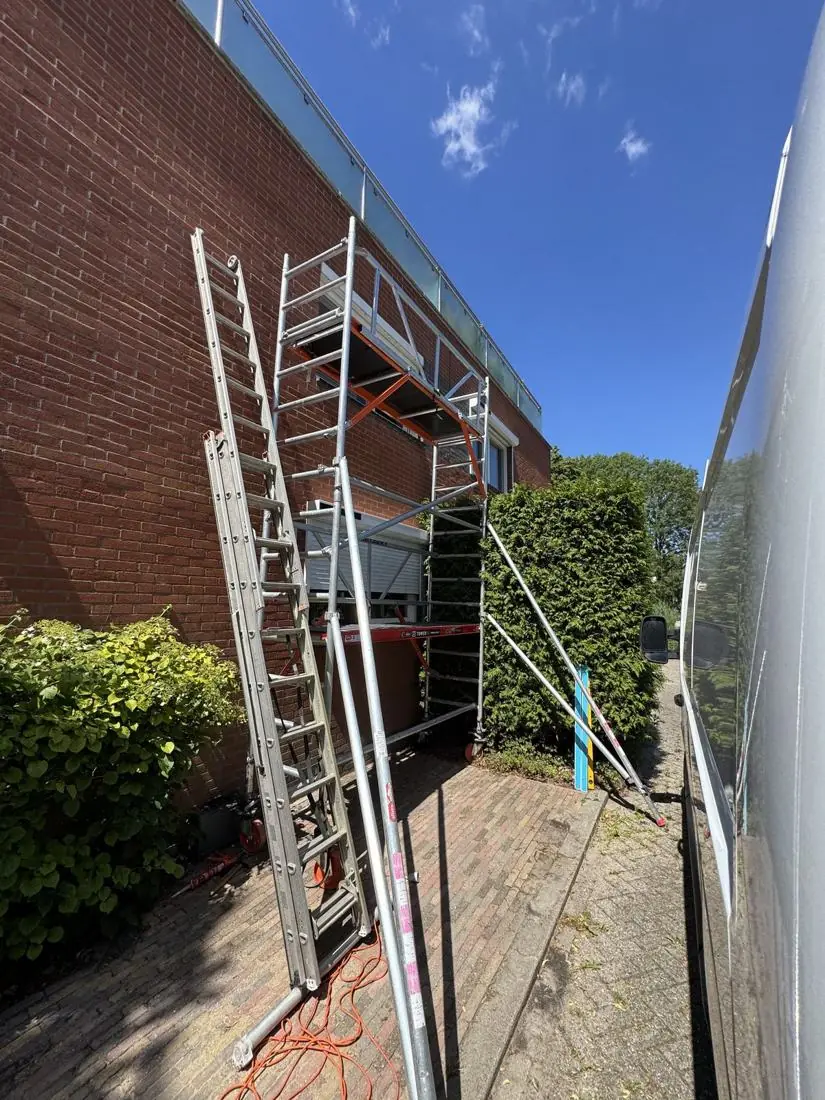
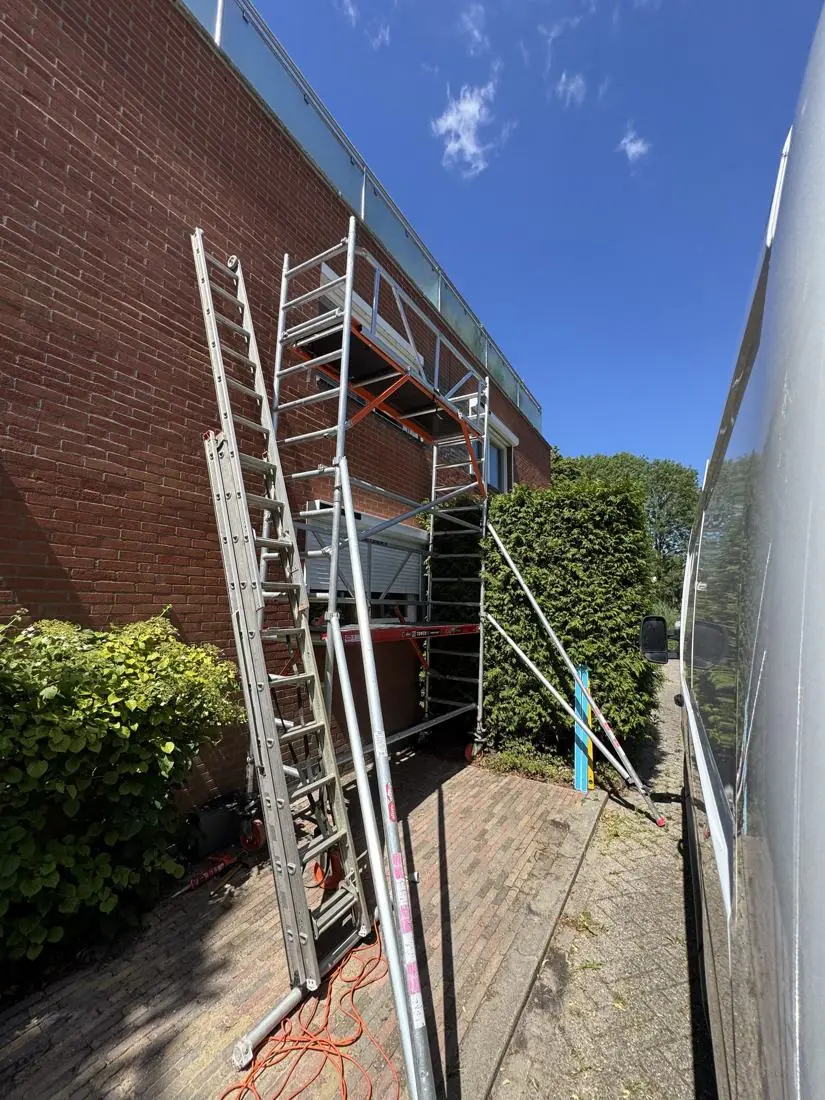
Tower assembled along a side wall to just above the roof edge, the sort of reach a fascia board asks for

Guessing low costs more than a few centimetres. With your eyes level with the fascia you cannot see over its top edge, and an unpainted stripe stays there that you never notice from the lawn. That last band also goes on with stretched arms, which is precisely when a topcoat flows out unevenly and shows brush ends. One stage higher adds almost nothing to the hire, and when painting a shed it spares you a second lap of four walls on a ladder.

Where the hired tower stands: slabs, lawn, gravel and border

Ground round a shed is rarely the same on all four sides. Patio slabs at the front, gravel down one flank, grass behind the building that stays soft for days after rain, and along the fourth wall a border of loose earth. Each time you take the tower round a corner the surface under the castors changes. Walk all four sides before booking and settle per side what has to go underneath: nothing on the slabs, boards on the grass, boards again in the border.

Gravel lets castors slide before the brakes have any grip, so slide a pair of paving slabs or one thick board under them first. A border is not something you flatten in a minute either: lift the planting out or choose a position falling just clear of it. Look for what you cannot see as well, such as an inspection cover, the buried cable feeding the shed light, or a water butt tucked against the wall. Move all that on delivery day, not once the tower stands.

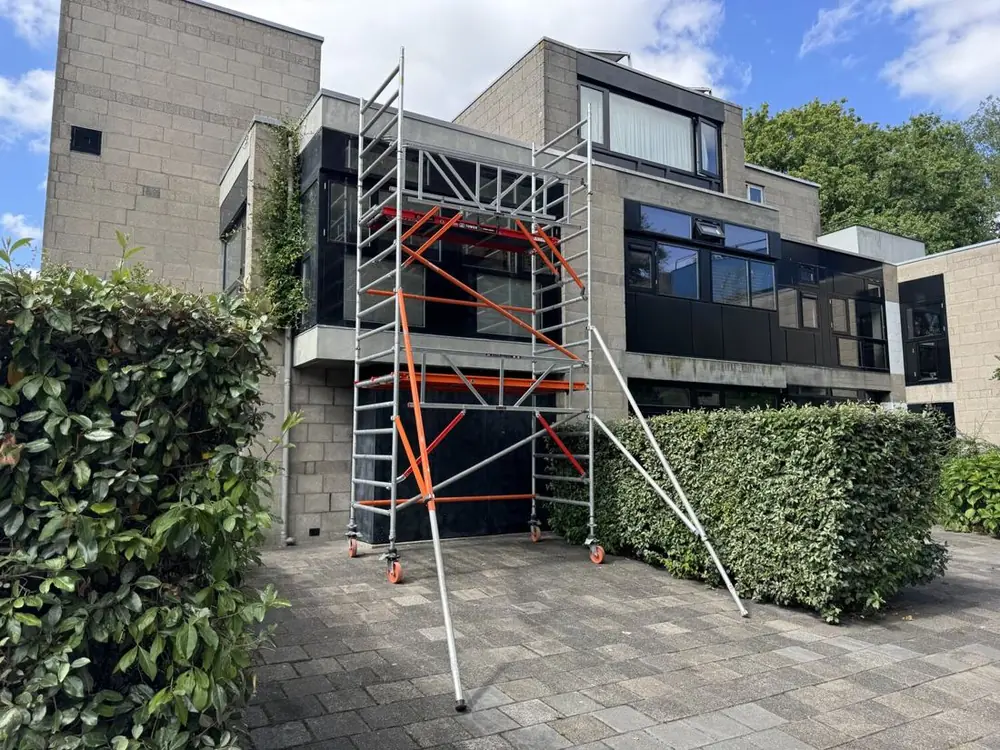
Stabilisers angled out from the base frame, showing the strip of clear ground kept free on every side

You want a walking strip right round the building too. Stabilisers splay outwards at an angle, and beside something free-standing the fence or hedge sits closer to that splay than expected. Measure the gap between wall and boundary on each of the four sides before reserving anything. Should one of them prove too narrow, work that wall from its end instead, or cut the hedge back a fortnight beforehand. There is more on levelling in the guidance on ground that is not flat.

Painting a shed: how many hire days should you book

A building of three by four metres is not an afternoon. Allow one day for sanding, cutting back bare patches and wiping off the dust, then one day per coat for the lap round four walls. Two coats on timber therefore means three hire days with the tower standing in your garden. Add half a day again where a door, a window frame or a small roof edge belongs to the job. Anyone booking tightly is still on the back wall when the van turns up.

The waiting sits between the coats and in the sky. Stain and topcoat both want to sink in and go off properly before anything else goes over them, and outdoors the air decides when that happens. A wall catching sun all afternoon is one you take early in the morning, because warm timber pulls stain in before you have brushed it out. Two wet days in the middle of the week push everything behind them along, so set your end date on the day you are certainly finished.

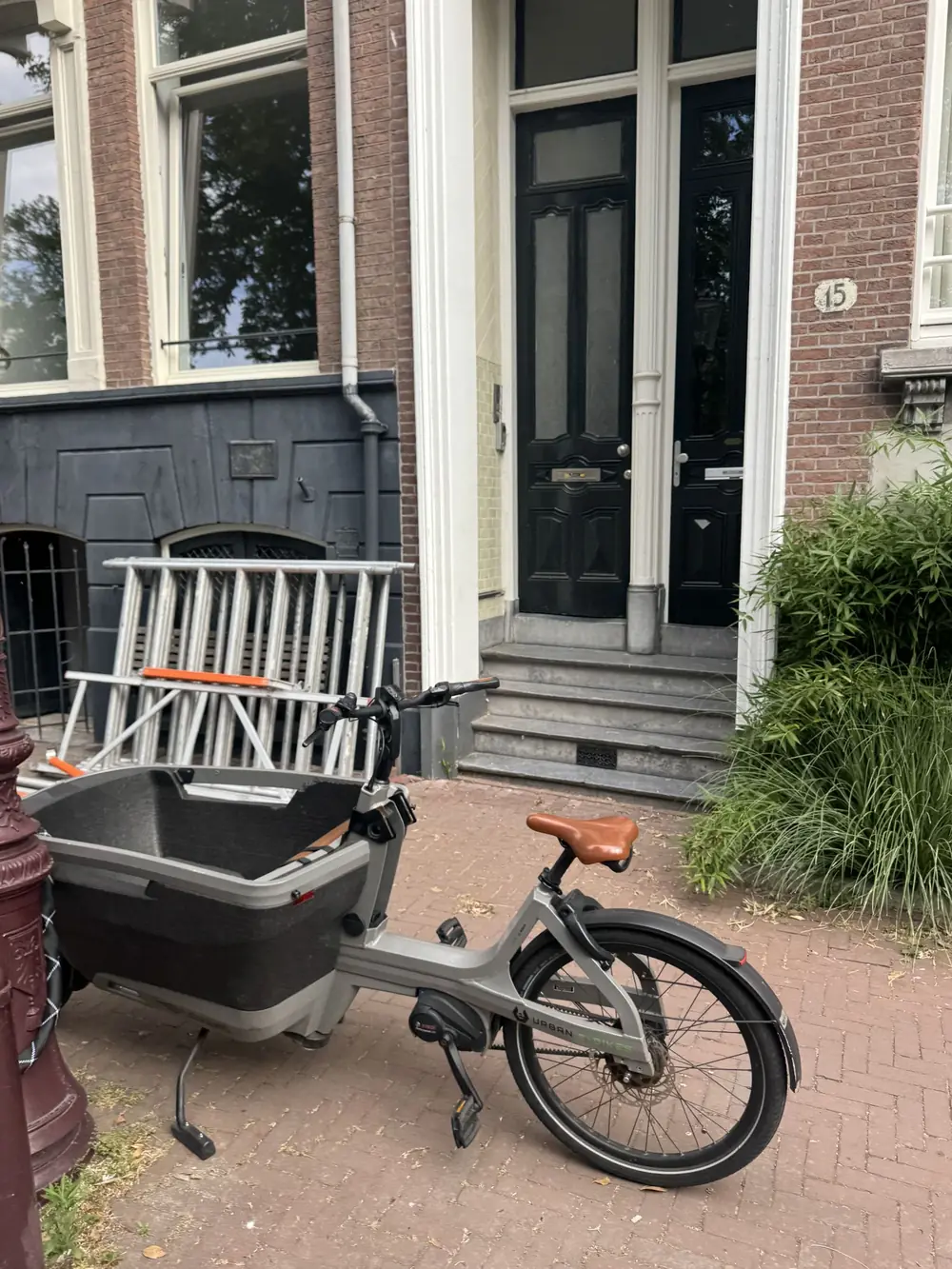
Guardrail frames waiting on the pavement beside a grey cargo bike, the hire set booked for a run of shed days.

Booking generously barely registers in what you pay. The full tariff covers just that opening 24 hours; every further day tacked on behind it is billed with 95 per cent knocked off. Pinning down four days rather than two therefore moves the rental price hardly at all, while it leaves you free to let a wet day pass without your schedule collapsing. On exterior timber that is no luxury. How the totals build up per model is set out under our fixed rates including VAT.

Which mobile scaffold suits painting a shed?

Kamersteiger RS44
  • Working height up to 4 metres
  • Compact and narrow
  • Great for indoor and small jobs
View and calculate →
Smalle rolsteiger RS51
  • Working height up to 14.2 metres
  • Narrow (75 cm)
  • Ideal for narrow passages
View and calculate →
Brede rolsteiger RS52
  • Working height up to 14.2 metres
  • Wide platform (135 cm)
  • Extra stability and workspace
View and calculate →
Most chosen
1-persoons steiger MiTower
  • Working height up to 6.2 metres
  • Very compact
  • Quick and easy to assemble
View and calculate →

Working the fascia and walls from the hired scaffold platform

A deck 245 cm long covers a little over two metres of wall from each position. A four-metre shed wall is therefore two pitches, and the whole building normally works out at eight to ten pitches. Take every pitch from the top down: fascia and barge board first, then the upper boards, then the band you could still have reached standing on the grass. That way you never drop a run of stain onto a stretch finished ten minutes earlier.

Collect what that wall needs at ground level and carry it up in one trip. On a single-person tower you do not want to climb down three times per pitch for a sheet of abrasive paper. A tin, a brush, a small sanding block, a cloth and a scraper between them cover the whole fascia run. Wedge that tin inside a bucket or hook it under the guardrail, since spilled stain on a patio becomes a whole job of its own once dry.

Tower with guardrails and an internal climbing ladder, the route up and down used through the working day

What almost everyone underestimates when painting a shed is the number of moves. Along a house you keep shuffling the same way, but here you go round, and at every corner the stabilisers come in, the tower turns and everything is set out afresh. Allow ten minutes a corner and four corners a lap. Plan a block of work per wall instead of walking coat by coat round the building. Carry straight on with a run of fence and railing painting and the set-up stays where it is.

Delivery, assembly and collection when you hire this tower

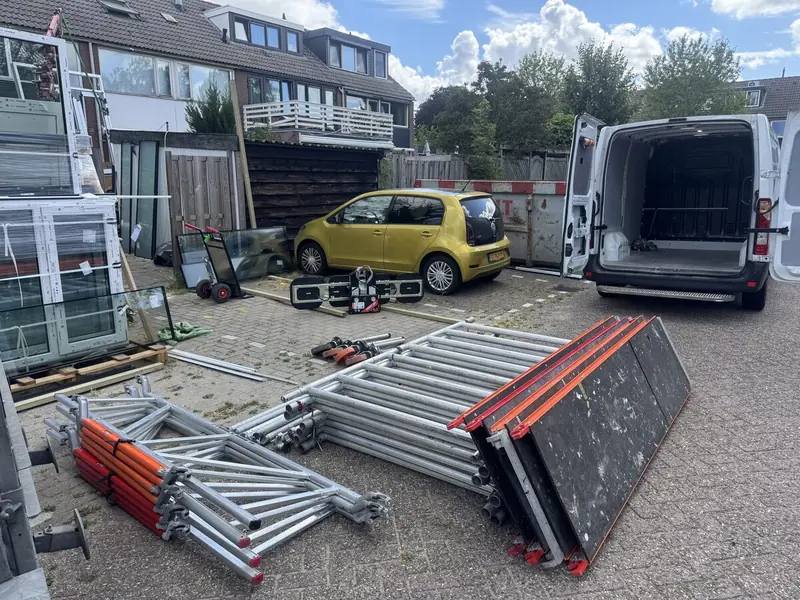
You receive no finished tower, only a pile: frame sections, a deck, guardrails, braces and four adjustable legs, tallied before they go in the van. Work out beforehand which corner that pile is allowed to occupy, since the strip beside the building is better kept empty. Patio or drive beats lawn, where parts settle into turf and come back up wet. Reserve before 15:00, and not at a weekend, and the van loads for the following working day, so the parts sit beside your gate before you have started.

You fix the day the van arrives and the day it takes everything away, and with outdoor timber the forecast gets a vote. Put the delivery at the front of a dry run, so the tower goes up calmly and you carry straight on into sanding. Bolting it together belongs to your day, not the driver's, so keep the first hour of it clear. The order of operations for painting a shed is written out in a step by step assembly sequence.

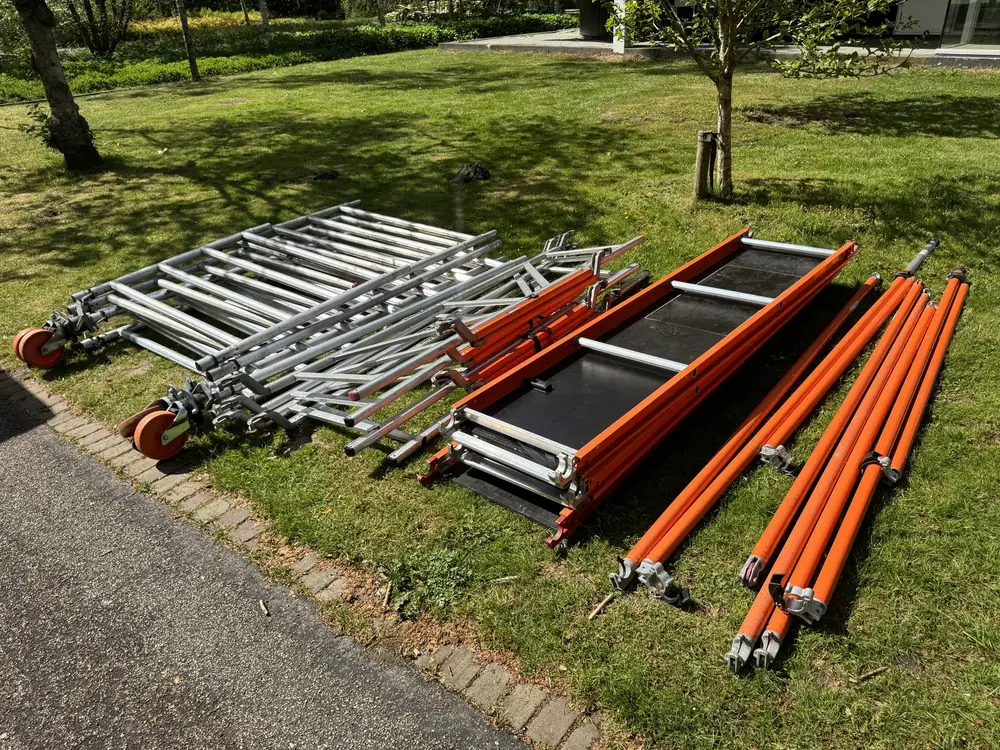
Loose scaffold parts laid out on grass, the counted set as it is dropped off at a garden address

With the last coat behind you, the tower comes apart and the parts go in one heap, and we drive past to load them again. Count out loud while dismantling, tube by tube, and no brace gets left behind in the long grass. Would you rather not wait in for a van? By arrangement you may load the parts yourself, free of charge, at Zeeburgerpad 89 in Amsterdam, provided your vehicle copes with the length. Bringing and fetching is priced in advance under the transport rates per province.

Safe solo work on a hired tower around your shed

What the frame carries is fixed by EN 1004, which puts this build in load class 3 and permits two hundred kilos for each square metre of decking. Repainting a shed stays comfortably underneath. You weigh what you weigh, and a tin of stain plus some abrasive gear goes on top. With this model the genuine limit is not the load but the head count, since the design assumes one. How that class is arrived at is explained in the background to this standard.

Four habits come with the job as standard. Brakes locked before you take the first rung. Nothing and nobody on the deck while it rolls, not even a half-used tin. Climb up on the inside, through the ladder in the frame, never round the outside. And you come down the moment the wind gets up, which in an open back garden happens sooner than between two terraces. Do not leave splayed legs sticking across a garden path when you go indoors either.

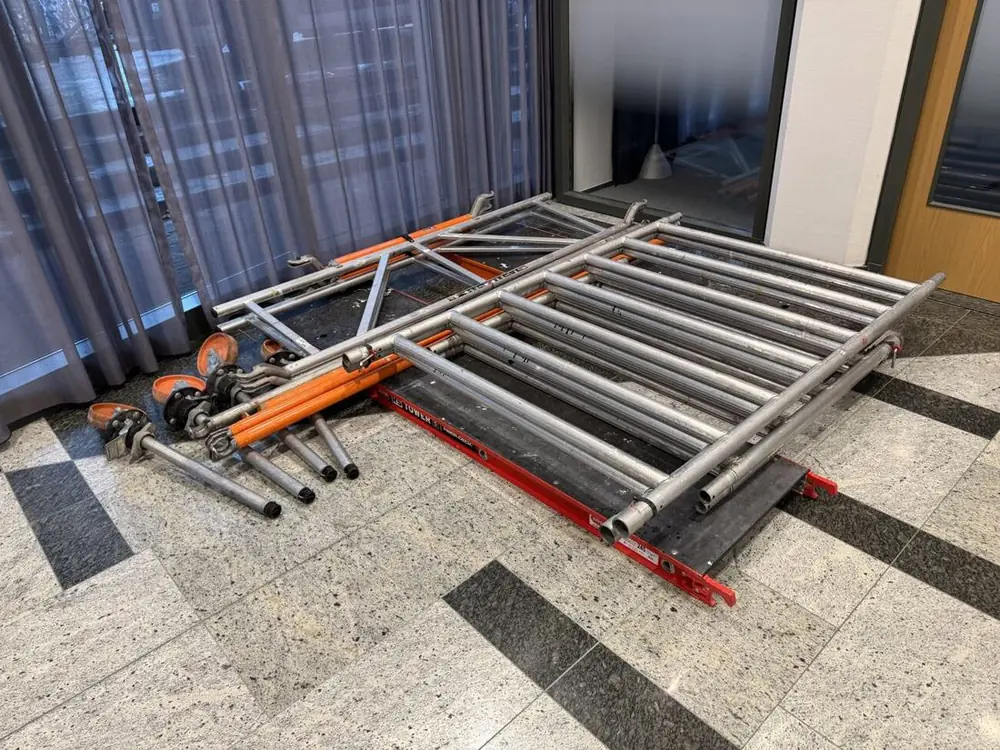
Complete set of scaffold components checked over and counted, laid out ready before it goes out on hire

On shed work the risks stay low but close at hand. A knocked-over tin makes the deck slippery, so wedge it and wipe spills straight away. Children and pets wander underneath you in a garden without a thought, so keep that zone clear while you are up. Watch for branches from a hedge or an overhanging tree pushing at the guardrail the moment the hired tower swings round a corner. There is more on that in the ground rules for work at height.

In 5 steps

How hiring a mobile scaffold works

1
Choose working height

Pick the height that suits your job.

2
Book online

Sorted in 60 seconds, price shown instantly.

3
We deliver

At the agreed spot the next working day.

4
Assemble safely

Assembled by you, with a manual.

5
We collect

One call and we collect the scaffold.

Good to know

Practical tips for painting a shed

1

Walk round the building once with a tape before reserving anything and note the surface at each wall. You then know straight away how many boards or slabs to have waiting on the drive when the parts arrive.

2

Stand your tin of stain inside a bucket hooked under the guardrail. A single-person deck is small, and one knocked-over tin can easily cost you half a working day of scrubbing paving slabs clean.

3

Do the fascia of the whole building in one lap, even though that means four moves of the tower. A join in such a long straight line shows up from every angle in the garden afterwards.

4

Pile the hired parts on the patio instead of in the grass. Wet frame sections slide in your hands while you are lifting them, and the dirt on them travels up to the deck with you afterwards.

5

Take the sunny flank early in the morning when painting a shed, before the wall warms through. Stain sinking into hot timber too quickly leaves streaks that no amount of sanding will lift out later.

6

Ask for collection one day after your final coat rather than on the same afternoon. That leaves a morning to take the tower apart dry and to fish stray braces back out of the border.

Frequently asked questions

Frequently asked questions about painting a shed

What should I hire for painting a shed in the garden?+

The MiTower is the obvious pick: a light single-person tower, narrow enough for a garden path and light enough to push round a corner unaided. You build it between 4.2 and 5.2 metres of working height, which brings you to the fascia of virtually any garden building. Where heavy material has to go up because boards need replacing first, it is wiser to hire a mobile scaffold with a broader base and put up with the extra bulk in a narrow garden.

Where does hiring a tower for my shed begin and end?+

Online you settle the model and the build stage, pick a date for the van out and a date for the van back, and the price including VAT is fixed there and then. On the agreed morning the set waits by your gate, counted and bundled. From there you work round the building at your own pace and leave the tower dismantled and complete on the final day. The only remaining decision is which wall you choose to start on.

How many days do people usually hire for a garden shed?+

Three days of tower hire suits an average building of three by four metres: one day preparing and sanding, then a lap of the four walls per coat. Where the timber is bare, grey or badly weathered, add another day on the hire for a primer coat. Working alone, count the repositioning in too, because eight to ten pitches together eat well over an hour of your day. Book the tower a day wider rather than a day tighter and you will not regret it.

What does the hire cost, and what does day two do to it?+

That varies with the model and the build stage, with a fixed transport figure for your province on top. You find it complete and including VAT under the rates per tower, so you know before booking. When painting a shed, the shape of the rental price matters most: the first day carries the weight and everything behind it hardly counts. Planning one continuous stretch of hire therefore beats two short blocks with two lots of transport arriving at the door.

Which build stage should I hire if the fascia sits at three metres?+

Hook your tape at the level the castors rest on, then read off the top edge of the fascia board. Landing around three metres, choose a build between 4.2 and 5.2 metres of working height. Where an overhang projects, or the roof slopes on over your head, measure to the furthest point your brush still has to touch. Torn between two stages on a hired tower, always take the higher one and give your arms some room to work in.

Does the van reach the back garden, or do I carry the hired parts?+

The van comes as far as the pavement or the drive. Getting parts from there to the building is your share, and with this model that is no hardship: loose frame sections you carry under one arm. Do check the route for a tight gate or a high threshold at the fence. Owning a van or trailer yourself, you may also collect the hired tower from us by appointment rather than waiting in all morning.

Does someone come to build it, or is that my job after hiring?+

The latter. Parts arrive loose, with a manual and a video showing the sequence. A light tower at shed height goes up single-handed in roughly half an hour, and you count that half hour into your first working day. A second pair of hands will take another quarter of an hour off that. Neither facade scaffolding nor system scaffolding appears on our list, and cherry pickers are absent too, which leaves this rolling build as the answer for a garden shed.

Can I extend the hire if the shed needs more preparation?+

Yes. Tell us and your collection day moves back, provided nobody else has that tower booked in behind you. On exterior timber a job overruns more often than people expect, usually because the walls wanted more filling or a wet day landed in the middle of everything. Anyone wanting to avoid the scramble sets a generous return date at the outset, since handing the parts back early is equally fine.

How much clear ground do I need around the shed before hiring?+

Add the splay of the legs on both sides to the footprint of the tower, and do it for all four sides rather than the one you start on. In practice a good metre clear everywhere between wall and boundary is what you want. Check it before you hire, because a back strip that is too narrow only announces itself once everything stands. Shift water butts, planters and bikes well aside a day before delivery, not on the morning itself.

Is it worth renting on if rain is forecast mid-job?+

Usually, yes. The tower may stay standing in the wet; it is only your brushwork that stops. Because an added day barely registers, carrying on almost always beats having the set collected and renting again later with transport on top. Use a wet day to sand under a lean-to, to take the shed door furniture off, or to clear the border. Just dry the deck before climbing back on.

When is my deposit returned once the hire period ends?+

A deposit is settled at the moment you reserve the tower. As soon as the parts that come back have been tallied, the money follows within one working day of that check. On brushwork hire, watch two things: hand in everything, including the board that ended up under a castor in the grass, and leave no dried stain on the tubes. A cloth over the deck each evening saves you bother later.

Can I do the summerhouse further down in the same hire period?+

Yes, and that is the cheapest way to run it. While the tower already stands in your garden you push it on to the summerhouse and finish that inside the same period. Just check the route between the two: a tight gate, a step or a border edge means dismantling and starting over. Where a continuous path runs through, you roll it across in one go and never book twice.

Hire a mobile scaffold for painting a shed today?

Calculate your rental price now or ask for free advice.

Rolsteiger van SteigerTaxi geleverd op locatie
Book it online

Your scaffold sorted in 2 minutes.

Choose your scaffold and working height, see the price instantly and book online.