
Knowledge base · reading time 9 min
Mobile scaffold on a balcony or roof terrace
A balcony or roof terrace is a workplace with edges. Space is limited, the floor is not simply solid ground, and on one or more sides there is a rail you do not want to lean over. Working at height there is perfectly possible, but the setup allows less room for improvisation than a garden does. It comes down to three things: getting the parts up, spreading the weight and making sure you never work over the edge.
- A scaffold on a balcony or roof terrace? How to get the parts up, spread the weight and work safely within a confined space with an open edge.
- That depends on the structure and on who is responsible for the building.
- The RS44 room scaffold, because it is made to pass through a standard internal door from about 70 centimetres.
- Put base plates, boards or panels under every castor so the load is spread over a larger area.
Why a balcony calls for different choices than a garden
In a garden you put a scaffold wherever you like and roll it aside when it is in the way. On a balcony that changes: the floor area is fixed, the way in is a door, and the gap between the rail and the wall is often less than two metres. That makes the width of the model more important than its height, and it means measuring in advance rather than shuffling things around on the spot.
On top of that, a balcony or roof terrace is itself a structure. A garden path rests on the ground; a balcony floor hangs off the building. So you do not simply place a load on it without thinking, certainly not in an older property. The weight of a compact scaffold with one person on it is manageable, but it does land on a small number of points.
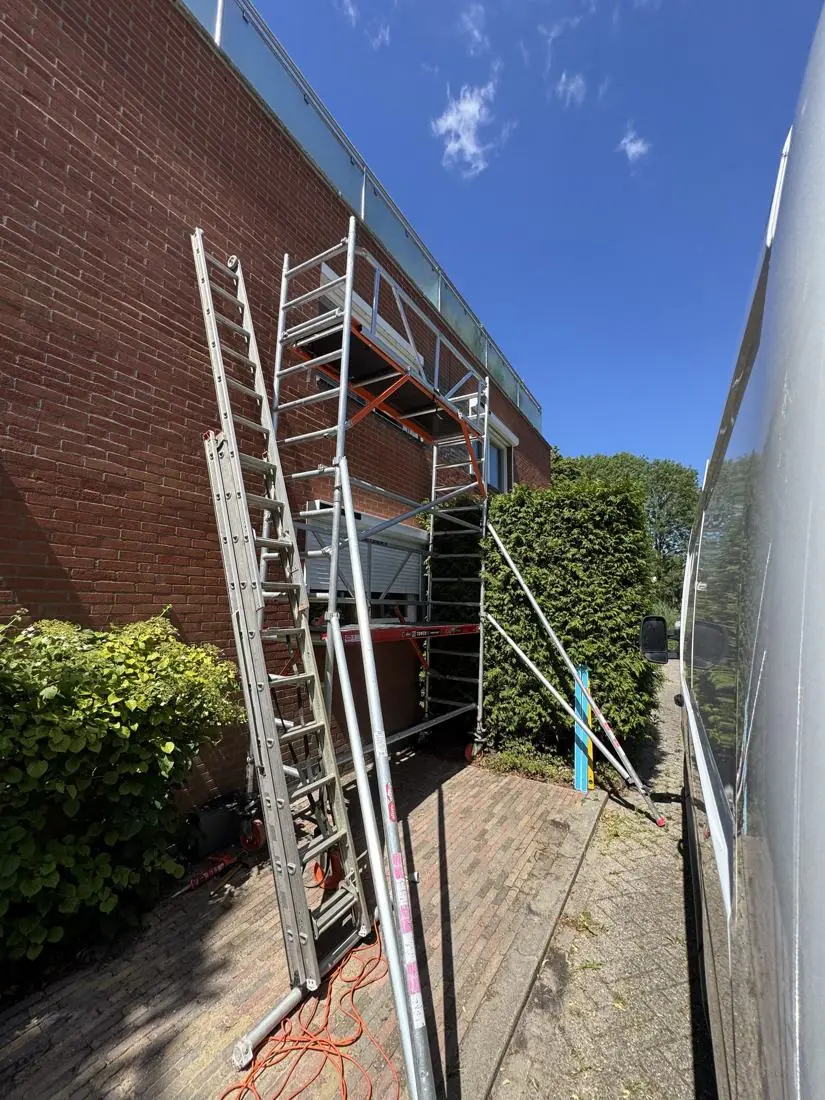
For the work itself little changes. A room scaffold or narrow mobile scaffold gives you a flat platform with guardrails, exactly as it would at ground level. The difference is in the preparation: measuring, planning the route, protecting the floor and agreeing who stands on it and when. For the general rules, working safely at height is useful background. Working through that list beforehand puts you on the platform within the hour.
Key facts
| Feature | Value |
|---|---|
| Core answer | Only on a floor with proven load capacity, using load-spreading pads |
| Load class | Class 3: 200 kg per m² |
| Castors | Swivel castors with brakes, locked while in use |
| Standard | EN 1004 |
| Room scaffold (RS44) | Fits through a standard doorway |
First the route: how do the parts get up there
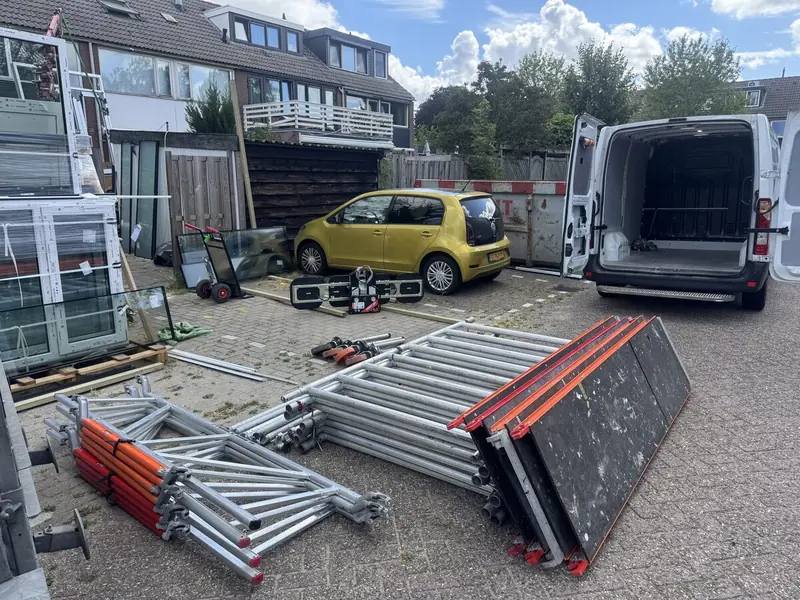
A scaffold arrives as separate parts and all of them have to go up. The route runs through a stairwell, a lift or a gallery, and the narrowest point along the way decides what fits. Measure that point before you order: a door, a turn in the stairs, a lift door or a threshold. Parts that will not come round the corner cannot be assembled on your balcony either.
The RS44 room scaffold is the model that fits most often here, because it is made to pass through a standard internal door from about 70 centimetres. The narrow RS51 is 75 centimetres wide and gets through wider openings. What fits through a door per model is covered at does a mobile scaffold fit through the door. Measure the height of the doorway too, since frames go through upright rather than flat.
Carry the parts up separately rather than all at once. Aluminium is light enough to take one frame at a time, even up a staircase. Lay them out on the balcony in the order you will need them, so you are not climbing over a stack of braces halfway through the build. On a small balcony that order is the difference between half an hour and an afternoon.
The weight lands on a small number of points
A scaffold stands on castors, which means the whole weight of the structure plus the person on it goes into the floor through four points. On a concrete slab in a garden you never notice that; on a balcony floor or a roof terrace it is worth thinking about. Spread the load with base plates or boards under the castors so the weight is carried over a larger area.
Place the scaffold near the wall or above a bearing point rather than right at the outer edge. If you do not know how the floor is built up, that is not a reason to guess: ask the owner, the owners association or the contractor who knows the building. The same applies on a roof terrace over an extension, where a roof structure carries the load instead of a floor structure.
Our scaffolds are in load class 3, which works out at 200 kilos per square metre of platform. That says something about what the scaffold can take, not about what the balcony can take. Keep the number of people and the amount of material limited and do not store stock on the balcony that could just as easily stay downstairs. More on the class is at loading and weight on a mobile scaffold.
Protecting the floor from castors and tools
Balcony floors are more vulnerable than they look. Tiles on pedestals tilt, a timber deck picks up pressure marks and bituminous roofing is easily damaged under a narrow castor, especially on a warm day when the material is softer. So always put something between the castors and the floor, even if you are only up there for an hour. A castor that drops through a tile damages the layer underneath as well as the tile itself.
Think about what falls from above as well. Paint spatter, sanding dust and a dropped screw do not land in the grass on a balcony but on a tiled floor or in a gutter. Sheet the area where you work and keep the drain clear, because a blocked balcony drain creates more work after the first rain shower than the job itself did.
On a roof terrace with tiles on pedestals there is one more point: those tiles sit loose and can tilt the moment a castor reaches an edge. Lay a panel across that rests on at least two pedestals, so the load never lands on the corner of a single tile. On a timber deck the same principle applies, except that there you also watch the direction of the boards relative to the joists underneath.
- Put base plates, boards or thick panels under every castor
- Check that loose tiles or tile pedestals do not tilt
- Give a timber deck or bituminous roofing extra covering
- Keep the balcony drain clear of dust, paint and debris
- Lock the castors as soon as the scaffold is in position
Which models fit on a balcony or roof terrace
The choice is decided by the opening and the floor area, not by the height you would like. The room scaffold is the narrowest option and fits most balconies, the RS51 at 75 centimetres suits roomier roof terraces, and the MiTower is a one person scaffold up to 6 metres working height that you set up alone. The wide RS52 at 135 centimetres nearly always drops out.
Look at the build height you can accommodate as well. On a balcony with another balcony above it the clear height is sometimes under three metres, and then a tall setup makes no sense. On an open roof terrace that does not apply and you can go higher. The differences between the models are set side by side at mobile scaffold or room scaffold.
| Model | Width | Height range | Deposit on delivery |
|---|---|---|---|
| RS44 room scaffold | Through an internal door from about 70 cm | Limited, intended for indoor work | 150 euro |
| RS51 narrow mobile scaffold | 75 centimetres | Within 4.2 to 14.2 metres | 500 euro |
| RS52 wide mobile scaffold | 135 centimetres | Within 4.2 to 14.2 metres | 500 euro |
| MiTower | Compact, for narrow openings | Up to 6 metres | 500 euro |
Working out height in a confined space
The sum stays the same: working height is platform height plus two metres, because that is the reach of an adult standing on the platform. On a balcony that sum works in both directions. You measure not only how high you need to get, but also how much clear height there is above you before you run into the balcony or canopy overhead.
So measure the clear height from floor to ceiling or to the balcony above first. Subtract your own height plus some clearance and you know which platform height still fits. If that does not bring you to the point you need to reach, a scaffold is not the answer and the work has to be done from outside. The explanation of the term is on the working height page.
Never work out over the balcony rail
This is where a balcony genuinely differs from a garden. On the outer side there is a rail with a drop behind it, and that rail is not made to lean over with a tool in your hand. Position the scaffold so your work sits straight in front of you rather than at an angle over the balustrade. If that is not possible, move the scaffold instead of reaching.
Use the scaffold guardrails as intended and never remove one to get at something more easily. The same goes for the toe boards: they stop tools that would otherwise roll off the platform and land on the street. More about those parts and what they do is at fall protection on a mobile scaffold. Before you climb, check that every guardrail is locked and that the hatch closes properly.
Do not put anything on the balustrade itself either. A tin of paint, a drill or an offcut resting on the rail is exactly the object that goes over the edge the moment your elbow brushes past it. If you are working on the railing itself, for instance painting a balcony railing, do it from the floor or from a low setup rather than leaning across it.
Wind matters more at height
On a roof terrace several storeys up there is more wind than in a garden between fences. You notice it in loose parts blowing away, in sheeting you should not stretch out and in the work itself. In sustained strong wind it is better to postpone the job than to carry on with material in your hands. A gust that would go unnoticed in a garden can push a loose panel off a terrace.
Never hang scaffold sheeting, tarpaulin or plastic on a scaffold on a balcony. Material like that catches wind like a sail and turns a stable setup into something with real force on it. If you want to protect the surroundings from spatter, use covering on the floor and the wall rather than on the structure. What stabilising and anchoring involve is at stabilising and anchoring.
Clear away loose material at the end of the day as well. A bucket, a piece of covering film, abrasive paper or an empty tin blows over the edge of a roof terrace easily, even when the day felt still. Put tools inside or under a lid and leave nothing on the platform, because that is exactly what you find on the street the next morning.
Permission, neighbours and shared space
In an apartment the balcony is often yours, but the facade, the stairwell and the roof are not. Work on the outside or on the balustrade regularly falls under the owners association, so it is sensible to ask in advance what is allowed. The same goes for using the lift for material and for whether parts may be left standing in the stairwell.
It also helps to tell the neighbours when you plan to start. Work at height brings noise, dust and sometimes an hour in which the passage is blocked. What else is involved when working on an apartment is covered at which scaffold for an apartment, including the situations where working from outside is the better route. A note in the entrance hall listing the days you will be working prevents most irritation.
When a scaffold does not fit on the balcony
Sometimes the answer is that it will not work. A balcony one and a half metres deep with garden furniture on it and a 60 centimetre door is not a place for a scaffold, however compact the model. The question then becomes whether the work can be done from outside, from a mobile scaffold standing at ground level that reaches up to the balcony.
For short work at limited height indoors a lower alternative can be enough, for example when you only need to reach the balcony ceiling. What a trestle can and cannot do is set out at scaffold or trestle. Whatever you do, never stand on a chair, a garden table or the balustrade, because that is precisely the situation where things go wrong.
Working from ground level does need different preparation. You need space on the pavement or in the garden below, and you bridge the full height up to the balcony instead of only the last stretch. Work that height out with the usual sum and then look through the mobile scaffolds to see which setup matches. Bear in mind that a scaffold on the pavement sometimes needs a notification or permission from the council.
Delivery, collection and the deposit
Order before 15:00 and the scaffold is at the agreed spot the next working day, anywhere in the Netherlands. At an apartment it is unloaded at street level, so agree where the parts may be put down and make sure you can take them up straight away. Delivery and collection sit in a fixed amount per province, shown on the delivery costs page.
Collecting it yourself is free by appointment at Zeeburgerpad 89 in Amsterdam. On delivery the deposit is 150 euro for the room scaffold and 500 euro for the RS51, the RS52 and the MiTower. On collection it is 150 euro for the room scaffold, 1000 euro for the RS51 and RS52 and 750 euro for the MiTower. The amount is back within one working day after return.
We do not assemble for the customer and never deliver a ready built scaffold. You get the separate parts with a manual and an instruction video, and you build it on your balcony yourself. Costs per model are at the cost of hiring a room scaffold and in the configurator on the pricing page; the deposit conditions are at the scaffold deposit page.
- Measure the narrowest door, turn and threshold on the route up
- Agree where the driver may leave the parts at street level
- Carry the parts up separately, in the order of assembly
- Lay the parts out on the balcony before you start building
- Dismantle in reverse order and stack at the collection point
Frequently asked questions
Am I allowed to put a scaffold on my balcony?
That depends on the structure and on who is responsible for the building. In an apartment, ask the owner or the owners association, certainly if you work on the facade or the balustrade. Always spread the weight with base plates and keep the scaffold away from the outer edge.
Which model fits through a balcony door most often?
The RS44 room scaffold, because it is made to pass through a standard internal door from about 70 centimetres. The narrow RS51 at 75 centimetres gets through wider openings. Measure the narrowest point on your route before ordering, including turns in the stairwell.
How do I avoid damaging the balcony floor?
Put base plates, boards or panels under every castor so the load is spread over a larger area. On bituminous roofing or a timber deck that matters even more. Lock the castors afterwards and sheet the floor against spatter and dust.
Can I work on the wall above me from the balcony?
Only if you can stand square to it without reaching over the balustrade. If you cannot get there without leaning, the work belongs outside, from a mobile scaffold standing at ground level. Reaching over a balcony rail is never a solution.
How much clear height do I need on a balcony?
Measure from the floor to the ceiling or the balcony above and allow for your own height plus some clearance. Working height is platform height plus two metres, so the platform must never sit so high that you end up wedged under the structure overhead.
Can I hang sheeting on a scaffold on a roof terrace?
No, sheeting and tarpaulins catch wind and put real force on the structure. At height that risk is greater than in a garden. Use covering on the floor and the wall if you want protection from spatter, and leave the scaffold itself clear.
What deposit applies to a room scaffold?
150 euro, both on delivery and on collection. For the RS51 and RS52 it is 500 euro on delivery and 1000 euro on collection, and for the MiTower 500 euro on delivery and 750 euro on collection. The amount is back on your account within one working day after return.