
Knowledge base · reading time 10 min
Mobile scaffold or construction hoist: which to choose?
Mobile scaffold or construction hoist sounds like a choice between two kinds of equipment, but they are two different things. A hoist moves things upwards, a mobile scaffold is the place where you stand and work. Once that question is clear, the choice makes itself for most jobs on a house.
- Mobile scaffold or construction hoist for your job? The difference in purpose, what a 245 cm platform can carry, and when a hoist genuinely helps.
- No, a hoist is meant to move material, not to work from.
- For most domestic jobs yes.
- For the work itself you need a safe workplace along the roof edge, and that is what a scaffold provides.
Two pieces of equipment with different jobs
A construction hoist is transport. It takes roof tiles, insulation boards, bags of mortar or tools from ground level to a higher point, and then goes back down for the next load. You do not stand on it and you do not work from it. Once the material is up, somebody still has to be standing somewhere safe to take it and use it.
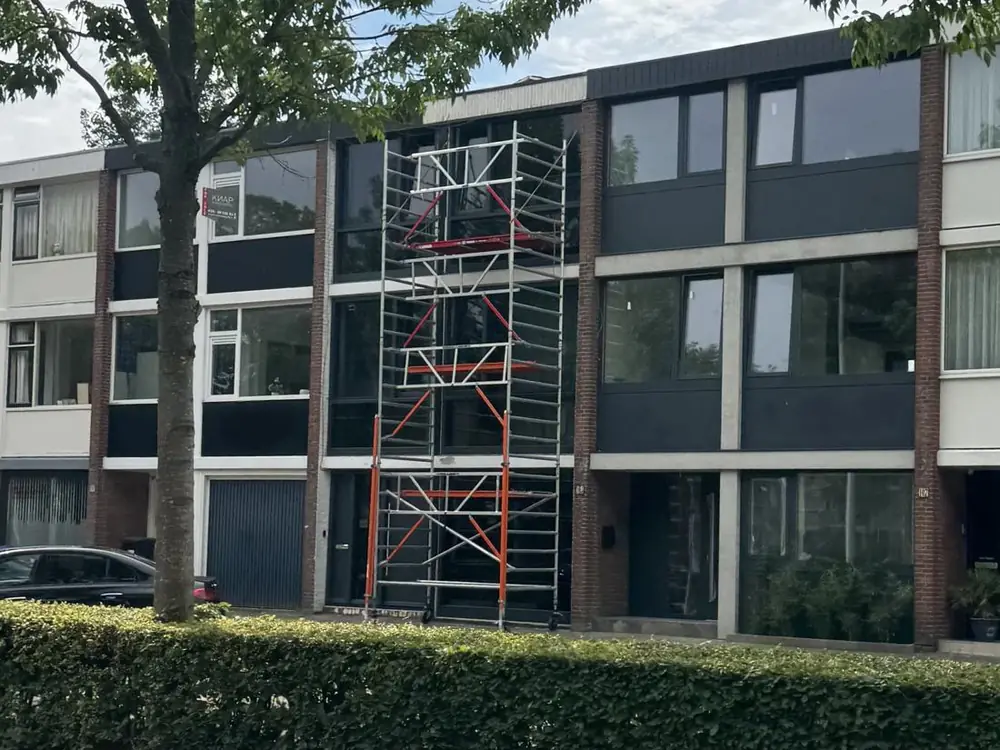
A mobile scaffold is exactly that safe place. It is a working platform with guardrails and toe boards that you can stand on for hours, with your materials within reach and both hands free. You can roll it along the facade and lock it again at each position, so you finish a whole surface without having to come down for the next section or the next tin of paint.
The two are therefore not mutually exclusive. On construction sites you regularly see them together: a hoist bringing material to the fourth floor and a scaffold or facade scaffold for the people doing the work. On domestic jobs that combination rarely applies, because the amount of material that has to go up usually stays limited. A few packs of tiles or a roll of membrane go up perfectly well with two people.
Key facts
| Feature | Value |
|---|---|
| Core answer | People work from a scaffold; a construction hoist is for material |
| Load class | Class 3: 200 kg per m² |
| Available working heights | 4.2 to 14.2 metres |
| Standard | EN 1004 |
| Delivery | Ordered before 3 pm, delivered next working day |
The question that settles the choice
Ask yourself one question: where are you standing while the work happens? If you are the one painting, pointing, fitting or cleaning at height, you need a workplace and a hoist is no alternative. If you are only sending material up to a roof where somebody else takes it, then transport is the problem and a hoist may be worth having.
On domestic jobs it is almost always the first of those. Replacing a gutter, painting a dormer, checking solar panels or sanding window frames are all jobs where you are at height and the material is secondary. A tub of sealant, a drill and two lengths of timber can be got up in any number of ways, but a safe place to stand is not so easily improvised.
If you are weighing a scaffold against a machine, look at the guide on a mobile scaffold or a cherry picker as well. That is the comparison that comes up more often, because a cherry picker, like a scaffold, gives you a workplace at height and is therefore a genuine alternative. A hoist falls outside that comparison, since it never provides the place where you do the work.
Getting material up without a hoist
The platform of a mobile scaffold is 245 cm long, and the equipment is built to EN 1004 in load class 3, which is 200 kg per square metre as a distributed load. More fits on it than people expect: yourself, your tools, a couple of buckets and a stack of battens. For an average job on a house you therefore have nothing to hoist at all.
What you do have to do is load sensibly. Take material up in batches rather than all at once, keep one hand free while climbing, and spread the weight across the platform instead of putting everything in one corner. Heavy bags are best placed above an upright rather than in the middle of a board, and you take them off before you move the scaffold.
For larger quantities a simple rope with a bucket, or a small pulley, works perfectly well, as long as you stay within the limits and hang nothing on parts that were not made for it. Let somebody pull from the ground and keep the load clear of the braces. What the scaffold can take is covered in the guide on loading and weight on a mobile scaffold.
When a hoist does add something
Some jobs are mostly transport. Replacing a complete roof means hundreds of tiles going up and the old material coming down again. The same goes for large quantities of insulation board, roofing membrane or mortar. Once you can no longer count the trips by hand, a hoist or another lifting aid becomes the logical step. At that point it is no longer about convenience but about how long the whole job takes.
Even then the hoist does not replace your workplace. You still need a scaffold, a facade scaffold or edge protection to work from. The comparison between a mobile and a fixed arrangement is set out in the guide on a mobile scaffold or a facade scaffold, because that is the choice that genuinely arises on a job of that size.
What the choice does to your schedule
A mobile scaffold arrives in parts and you build it yourself. That costs time on the day of delivery, but after that you have a workplace that stays up for as long as you hire it. There is nothing to connect, nothing to operate and nobody you depend on in order to start. You decide yourself when you go up in the morning.
Adding a hoist means a second piece of equipment to be delivered, positioned and collected, with its own space on the pavement and its own schedule. On a job of a few days at a house that rarely balances against the convenience. On a roof renovation running into weeks it can be the time saving that makes the whole job workable.
So look at the whole period rather than only at the day you start, including the days you spend waiting on drying time or on better weather. Those days count in your hire too. How to judge that period is covered in the guide on how many days you need a scaffold, and what delivery and collection come to for your province is set out under delivery costs.
The differences side by side
The table sets the main points against each other. Pay particular attention to the first two rows, because that is where the difference that decides the choice sits: what the equipment is meant for and where you stand while working. The rest follows from those two, from the way you set the equipment up to the jobs it is meant for.
Compare your own job against this list and you usually see quickly which column you belong in. Work where you spend hours at height belongs on the left; work that is mainly about shifting loads belongs on the right. If your job falls into both columns, you need a scaffold and, alongside it, some way of getting the material up there.
| Point | Mobile scaffold | Construction hoist |
|---|---|---|
| Purpose | Workplace at height | Moving material upwards |
| Where you stand | On the platform, behind guardrails | On the ground or another workplace |
| Hands free while working | Yes, both hands | Not applicable |
| Moving along the facade | Rolls on castors | Usually set up in one position |
| Setting up | You build it yourself from the manual | Positioning and connecting |
| Typical job | Painting, pointing, fitting, cleaning | Large quantities of material to a roof |
Height and space around the house
Working height is platform height plus two metres, because that is how far an adult reaches from the platform. The range covers working heights from 4.2 to 14.2 metres, from a low garage to the roof edge of a tall building. Measure from the ground to your highest work point, subtract two metres and pick your build at that platform height; the working height page walks through the steps.
Beside height there is width. The RS51 is 75 cm wide and fits along a garden path or through a gate, the RS52 is 135 cm and gives you a roomier working area. Both have a platform length of 245 cm. For indoors there is the room scaffold, which fits a standard internal door from about 70 cm, and for short solo jobs the MiTower up to 6 metres working height.
When you measure up, count the stabilisers as well. They project out on every side and need a flat, load bearing spot to stand on, so an alley exactly as wide as the scaffold itself is too narrow in practice to work in safely. All the dimensions of the models are collected together in the guide on scaffold dimensions and sizes.
Where the risks sit in both cases
With transport at height, things usually go wrong with falling objects. A tile, a panel or a bucket coming down from ten metres is lethal for anyone walking underneath. So with heavy transport you cordon off the zone below and stay out of it yourself, not even for a quick trip to fetch a tool that happens to be lying there.
With a mobile scaffold the risk shifts to the build and to the wind. Stabilisers left retracted, castors not braked and working in wind force 6 or higher are the classics. Also avoid taking a load off a hoist with both hands while you are standing on the platform yourself, because that pulls on the structure at exactly the wrong height.
- Cordon off the zone under a suspended load and keep it clear.
- Do not work on a mobile scaffold in wind force 6 or higher.
- Fit stabilisers before you build high, not afterwards.
- All castors braked before anyone climbs.
- Clear the platform when you stop working.
- Never move the scaffold with a person or materials on it.
Combining a scaffold with a rope or pulley
If you choose a mobile scaffold and something heavy has to go up now and then, a rope with a bucket or a small pulley is usually enough. Keep the person pulling on the ground and let the one on the platform handle only the last stretch, with the load close to the body and the guardrail between them and the drop.
Keep the distributed load of 200 kg per square metre in mind while you do it, including your own weight and your tools. Never pull at an angle on the structure and never fix a pulley to a guardrail or a toe board; those are made to stop you falling, not to carry a load. Falls and protection are covered in the guide on fall protection on a mobile scaffold.
What you hire from Steigertaxi and how it arrives
The range consists of mobile scaffolds, the room scaffold and the MiTower, all Altrex equipment built to EN 1004 in load class 3. So what you hire is a workplace, not a transport machine. Order before 15:00 and delivery follows the next working day anywhere in the Netherlands, and collecting it yourself is free by appointment at Zeeburgerpad 89 in Amsterdam. Delivery and collection are covered by a fixed amount per province.
Steigertaxi does not assemble the scaffold for you and does not deliver it ready built. You receive the parts, along with the manual and an instruction video showing the sequence step by step, and you then build the scaffold yourself following the step-by-step guide. What your job costs is worked out in advance in the configurator on the pricing page, delivery and deposit included.
If you are not sure whether a mobile scaffold is enough for what you have in mind, for instance when replacing roof tiles or fitting a completely new gutter, put the job to us over WhatsApp. You will hear straight away which build height you need, which model fits your access route and whether the scaffold on its own will do.
- Mobile scaffolds, room scaffold and MiTower, Altrex to EN 1004.
- Ordered before 15:00 means delivery the next working day.
- Free self collection by appointment in Amsterdam.
- Manual and instruction video with every delivery.
- Deposit refunded within one working day after return.
Frequently asked questions
Can I stand on a construction hoist to work?
No, a hoist is meant to move material, not to work from. You always need a workplace as well, such as a mobile scaffold or a facade scaffold. The choice is therefore not either or, but a question of what your job actually needs.
Will I get enough material onto the scaffold without a hoist?
For most domestic jobs yes. The platform is 245 cm long and the equipment is built to load class 3, meaning 200 kg per square metre distributed. Take material up in batches and spread the weight across the platform rather than in one corner.
What is better for solar panels on a roof?
For the work itself you need a safe workplace along the roof edge, and that is what a scaffold provides. Which build suits it is set out in the guide on which scaffold for solar panels.
How high can I get with a mobile scaffold?
The range covers working heights from 4.2 to 14.2 metres. Working height is platform height plus two metres, so measure to your highest work point and subtract two metres to find the platform height you need.
Does Steigertaxi assemble the scaffold for me?
No, you build it yourself. The delivery includes the manual and an instruction video that shows the sequence step by step. If you get stuck, we will think it through with you over WhatsApp.
Do I need a hoist for a complete roof renovation?
With large quantities of tiles or boards, a lifting aid saves a great many trips, but it does not replace your workplace. Work from the roof edge still needs a scaffold, and at that scale the choice between a mobile and a facade scaffold matters more.
May I climb the scaffold with a load in my hands?
Always keep one hand free while climbing and take material up in small batches. Heavier items are better passed up from the ground or pulled up on a rope while you stand safely behind the guardrail.